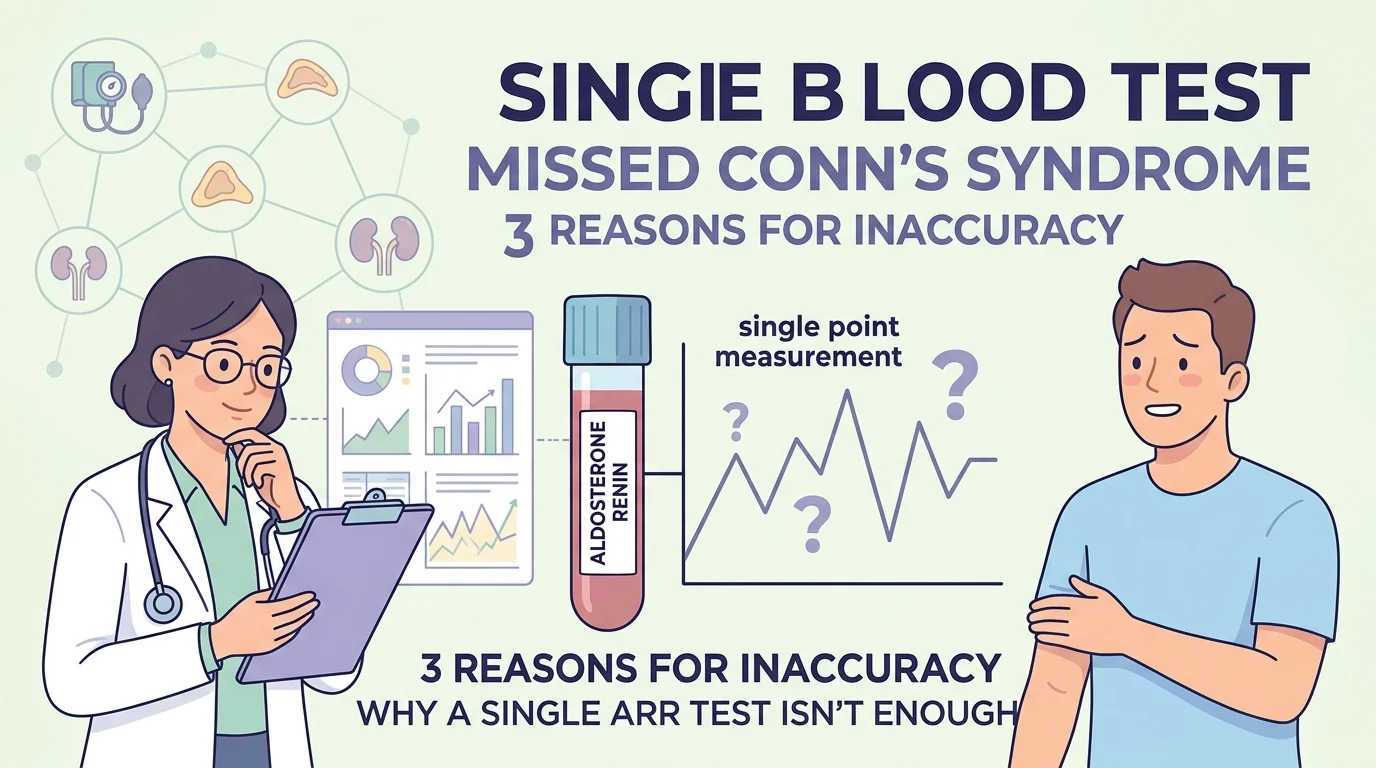
On 14 and 15 September 2026, research from the University of Bristol and the University of Manchester, with teams in Bergen, Stockholm and Athens, drew wide coverage. Published in Science Translational Medicine, the study followed 60 patients wearing a device that sampled hormones every 20 minutes for a full day and night. It found that aldosterone, the hormone that governs salt and water balance, is not steadily high in people with primary aldosteronism. It comes in bursts, including whilst they sleep. Between bursts, levels can fall below the thresholds used to make the diagnosis. That matters for anyone who has ever had a single aldosterone and renin blood draw come back looking reassuring.
What the September 2026 study actually showed
Primary aldosteronism, also called Conn's syndrome, happens when one or both adrenal glands produce too much aldosterone on their own. It raises blood pressure, and unlike most high blood pressure it can often be treated at the source, sometimes cured by removing a single affected gland.
The Bristol team used a wearable sampler worn at the waist, roughly the size of a mobile phone, that collects hormones from fluid just under the skin. Because patients stayed at home and slept normally, researchers could see the overnight hours that a clinic blood draw never reaches. They found repeated night-time surges of aldosterone that disappeared after the affected adrenal gland was removed. The surges were strongest when only one gland was involved.
Why continuous sampling changes the picture
A standard workup measures aldosterone and renin once, usually mid-morning, and divides one by the other. If aldosterone happens to be in a trough at that moment, the ratio looks normal. The study reported that this happened even in some of the most severe cases. The authors are not saying the current test is useless. They are saying a single time point is a snapshot of something that moves.
Three reasons your aldosterone renin ratio can look normal anyway
1. The hormone moves during the day and at night
Aldosterone follows a daily rhythm and, in primary aldosteronism, adds irregular bursts on top of it. Posture matters too: levels differ depending on whether you were lying down or standing before the sample. That is why laboratories ask you to rest or stand for a set period before the draw.
2. Common medications shift the result
Several blood pressure drugs act directly on the renin-angiotensin-aldosterone system and change the numbers being measured. A September 2026 debate article in The Journal of Clinical Endocrinology and Metabolism laid out both sides of a long-running question: whether these drugs must be stopped for several weeks before testing to avoid false results, or whether stopping them carries its own risks and costs. There is no settled answer yet, which is precisely why the interpretation belongs with a clinician who knows your prescriptions.
3. Potassium is not always low
Low potassium is the classic clue, and it is a genuinely useful one. A Brazilian cohort published in the Journal of the Endocrine Society in August 2026 found low potassium in 75 per cent of patients with confirmed primary aldosteronism, and higher still when a single gland was responsible. But the same literature includes cases where potassium and the ratio were both normal and the diagnosis was still real. Normal potassium lowers the suspicion. It does not close the file.
How to read an aldosterone and renin result
Aldosterone is almost never interpreted alone. It is read against renin, the kidney hormone that would normally rise when blood pressure drops. The combination is what carries the meaning, and only a clinician can confirm it with follow-up testing.
| Aldosterone | Renin | What the pattern can point towards |
|---|---|---|
| High | Low | Possible primary aldosteronism; confirmatory testing is required before any conclusion |
| High | High | Secondary aldosteronism: narrowed kidney artery, heart failure, cirrhosis, diuretics |
| Low | High | Adrenal insufficiency, investigated with separate tests |
| Normal | Normal | No clear pattern; a single sample can still land in a trough, so symptoms and context still count |
Our library explains the complete electrolyte panel, the routine test where a low potassium value usually turns up first. We also cover urine electrolyte results, which sometimes accompany the workup.
When this question is worth raising with your doctor
National guidance now leans towards considering primary aldosteronism far more often than in the past. Situations that commonly prompt testing include high blood pressure that appears young, blood pressure that stays high on three or more medications, high blood pressure alongside a low potassium value, and high blood pressure found together with an incidentally discovered adrenal nodule.
If any of these describe you, the useful move is not to reorder the test yourself. It is to bring your existing results to the consultation and ask whether the timing, your medication list, and your potassium history were taken into account. We published a companion piece on the blood tests that decide blood pressure treatment, and a broader overview in our high blood pressure guide.
Latest scientific advances
Beyond the Bristol work, three recent findings help place it in context, and all three point the same way: this condition is found less often than it exists.
A 2025 review in Frontiers in Endocrinology estimated that primary aldosteronism affects somewhere between roughly 4 and 20 percent of people with high blood pressure, and argued that the aldosterone-to-renin ratio is simply not requested often enough. In plain terms: the test exists, it is cheap, and it is skipped.
The Brazilian cohort mentioned above found something equally telling about delay. The median age when high blood pressure first appeared was 32. The median age at which primary aldosteronism was finally diagnosed was 53. Two decades of avoidable exposure to excess aldosterone. What this changes for a reader is straightforward: if your blood pressure started early, that history is worth mentioning explicitly.
A 2026 cross-sectional study in Sleep Medicine screened consecutive patients with high blood pressure for every identifiable cause at once. Obstructive sleep apnoea was by far the most common contributor. Primary aldosteronism was confirmed in 8.4 percent, more often in leaner patients and in those whose blood pressure resisted treatment. The practical lesson is that these conditions frequently coexist, so finding one does not mean the search should stop.
What has not changed yet
The wearable used in the Bristol study is a research tool. It is not available at your local laboratory, and the study itself was a proof of concept in 60 people. Current guidelines still rest on the aldosterone-to-renin ratio followed by confirmatory tests. What the work adds is a reason to treat one normal result with appropriate caution rather than as a closed door.
Glossary
- Aldosterone: a hormone made by the adrenal glands that tells the kidneys to hold on to sodium and release potassium, raising blood pressure.
- Renin: a kidney enzyme released when blood pressure or blood volume falls, starting the cascade that produces aldosterone.
- Aldosterone-to-renin ratio (ARR): the screening calculation that divides the aldosterone level by the renin level.
- Primary aldosteronism (Conn's syndrome): excess aldosterone produced by the adrenal glands themselves, independent of the kidney signal.
- Secondary hypertension: high blood pressure caused by an identifiable underlying condition rather than by the usual mix of age, weight and lifestyle.
- Hypokalemia: a potassium level in the blood below the reference range.
Frequently asked questions
Does a normal aldosterone renin ratio rule out primary aldosteronism?
Not on its own. The September 2026 study showed aldosterone levels can dip below diagnostic thresholds between bursts, including in severe cases. A normal ratio makes the condition less likely, but persistent clinical clues justify a second look with your doctor.
What time of day should the blood sample be taken?
Testing is usually carried out in the morning after you have been upright for a set period, because both posture and time of day affect the result. Follow the instructions your laboratory gives you rather than improvising.
Do I need to stop my blood pressure medication before the test?
Sometimes, but never on your own initiative. Some drugs alter aldosterone and renin measurements, and specialists continue to debate how strictly they must be withdrawn. Only the prescribing clinician can decide.
Is low potassium always present in primary aldosteronism?
No. It is common, found in roughly three out of four patients in one recent cohort, but a normal potassium value does not exclude the diagnosis.
Can primary aldosteronism be cured?
When a single adrenal gland is responsible, surgical removal can normalise aldosterone and substantially improve or resolve the high blood pressure. When both glands are involved, targeted medication is used instead.
Sources
- Aldosterone Test – MedlinePlus, National Library of Medicine (NIH)
- About High Blood Pressure – Centers for Disease Control and Prevention
- Scientists find a hidden cause of high blood pressure that routine tests can miss – University of Bristol, September 14, 2026
- Grytaas MA, Upton T, Marinelli I, et al. Tissue corticosteroid rhythms are dysregulated predominantly during sleep in primary aldosteronism. Science Translational Medicine, 2026. DOI (via PubMed)
- Carling T, Faucz FR. Primary aldosteronism: adrenalectomy could save more lives. Frontiers in Endocrinology, 2025. DOI (via PubMed)
- Montozo JL, Elias PCL, Alexandre AE, et al. Delayed diagnosis, greater disease burden: primary aldosteronism in a Brazilian cohort. Journal of the Endocrine Society, 2026. DOI (via PubMed)
- Teo AED, Pamporaki C, Lenders JWM, Brown MJ. Must RAAS-modifying drugs be withdrawn for the diagnosis of primary aldosteronism? The Journal of Clinical Endocrinology and Metabolism, 2026. DOI (via PubMed)
- Mangrole A, Goyal A, Shah B, et al. Comprehensive evaluation of secondary causes of hypertension: integrated screening for obstructive sleep apnoea and primary aldosteronism. Sleep Medicine, 2026. DOI (via PubMed)
- Thomas G. New guidance on primary aldosteronism: rethinking screening in hypertension. Cleveland Clinic Journal of Medicine, 2026. DOI (via PubMed)
Other articles
- Our library explains the complete electrolyte panel
- We detail urine electrolyte results
- We reviewed the blood tests that decide blood pressure treatment
- Read our high blood pressure guide
Understand your lab results with AI DiagMe
An aldosterone value, a renin value and a potassium value only mean something together, and in the context of your own history. AI DiagMe reads your laboratory report, explains each marker in plain language and shows you which combinations deserve a conversation with your doctor. Understand your lab results with AI DiagMe.