


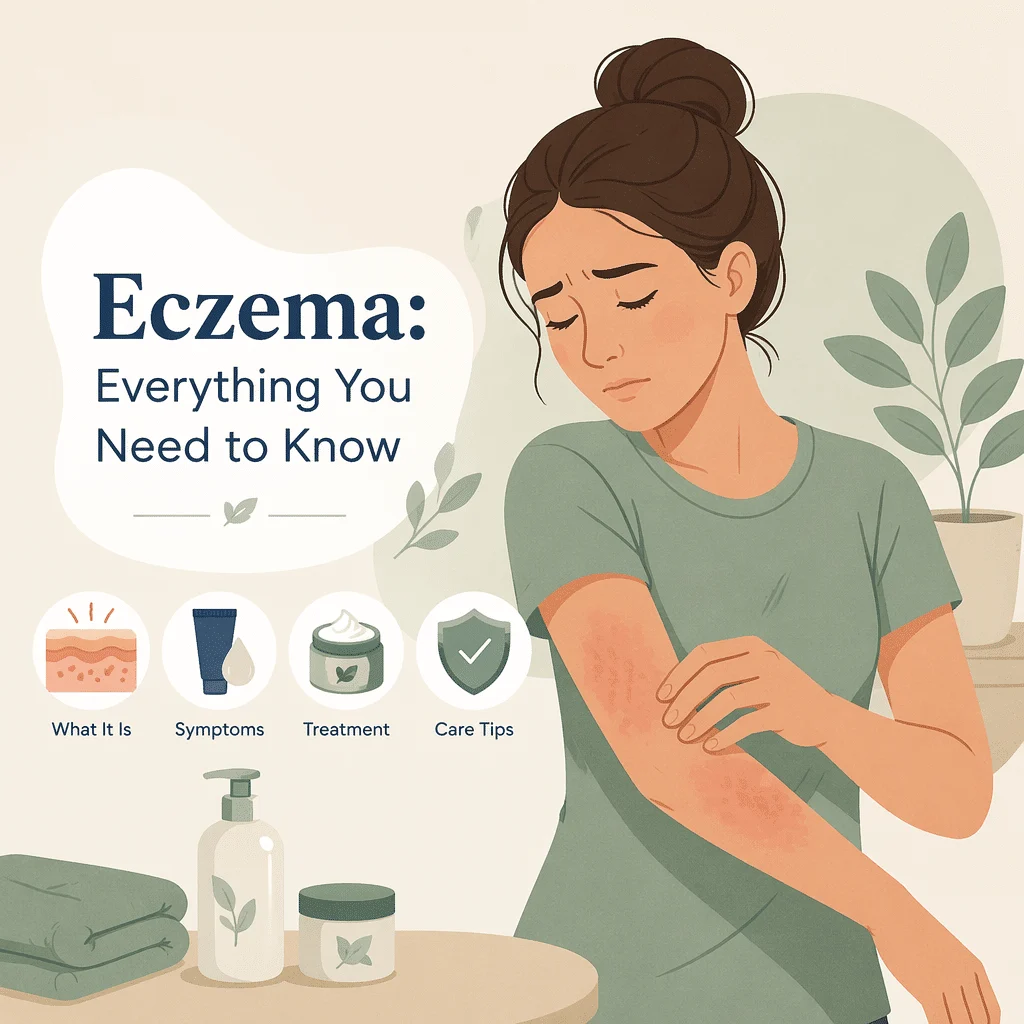
Eczema is one of the most common skin conditions in the world, affecting roughly one in ten people at some point in life and often starting in early childhood. The word covers several forms of itchy, inflamed skin, but the most frequent by far is atopic dermatitis — a long-term, relapsing condition tied to a fragile skin barrier and an overactive allergic immune response. The reassuring part is that eczema is well understood and, in most cases, manageable with the right daily routine and treatment.
In this article you’ll learn what eczema is and how its main types differ, what it looks like at different ages, the triggers that set off flares, how doctors diagnose it, and which treatments work — from everyday moisturisers to the newer biologics and targeted pills for severe disease. You’ll also see exactly where blood tests such as IgE and eosinophils fit in, and where they do not.
What is eczema?
Eczema, also called dermatitis, is an inflammatory reaction in the outer layers of the skin. In healthy skin, a protective barrier locks in moisture and keeps irritants, microbes, and allergens out. In eczema, that barrier is leaky and inflamed, so the skin loses water easily, dries out, and reacts to things that would not normally bother it. The result is dryness, redness or discolouration, and the intense itch that defines the condition.
Two features drive most cases. The first is a weakened skin barrier, often linked to changes in a protein called filaggrin that helps hold surface skin cells together. The second is type 2 inflammation — an allergic pattern of immune activity in which signalling proteins such as interleukin-4 and interleukin-13 push the skin towards itching, swelling, and sensitivity. Together they create a cycle: a broken barrier lets triggers in, the immune system overreacts, scratching damages the barrier further, and the flare continues.
The main types of eczema
Atopic dermatitis is the most common form and the focus of this article. Other types include contact dermatitis, a reaction where skin meets an irritant or allergen; seborrhoeic dermatitis, linked to oil glands and a common skin yeast; dyshidrotic eczema, with small deep blisters on the hands and feet; and nummular eczema, which forms coin-shaped patches. Because these can look alike, a professional assessment matters. If a rash has you unsure, you can compare presentations in our guide to skin rashes and their causes.
Symptoms: what eczema looks like
The hallmark of eczema is pruritus — the medical term for intense itching — which often feels worse at night and can badly disrupt sleep. The appearance changes with age and skin tone. On lighter skin, eczema usually looks pink or red; on brown and Black skin it may appear grey, purple, or a darker brown, and redness can be harder to see, which sometimes delays diagnosis. After a flare settles, the skin can stay darker or lighter for weeks to months.
| Age group | Common locations | Typical appearance |
|---|---|---|
| Infants (under 2) | Cheeks, forehead, and scalp, later the outer arms and legs | Red or discoloured, oozing patches that may crust over |
| Children | Creases of the elbows and knees, wrists, ankles, and neck | Dry, thickened, scaly skin from repeated scratching |
| Teens and adults | Hands, eyelids, neck, and the elbow and knee creases | Dry, leathery patches (lichenification) with lasting dark or light marks |
What causes eczema, and common triggers
Eczema is multifactorial, meaning several things combine rather than a single cause. Genetics load the dice: eczema, asthma, and hay fever often run in the same families, a tendency doctors call the atopic background. Many people also carry filaggrin changes that weaken the skin barrier. On top of this genetic base, everyday triggers set off individual flares — which is why identifying and reducing your own triggers is such a practical part of managing the condition.
Common triggers include:
- Allergens such as dust mites, pollen, pet dander, and mould
- Irritants such as harsh soaps, detergents, fragrances, and wool
- Dry or cold air and sudden shifts in temperature or humidity
- Heat and sweat
- Stress and strong emotions
- Skin infections
In some infants, certain food allergies (such as cow’s milk or egg) can worsen eczema, though this is far less common in adults and should be assessed by a doctor before cutting foods out. The atopic link also explains why eczema rarely travels alone: children with eczema more often go on to develop asthma and hay fever, a progression known as the atopic march. To see how the same allergic tendency affects the lungs, you can read our overview of asthma and the airways.
How eczema is diagnosed
There is no single blood test that diagnoses eczema. Doctors diagnose it clinically — by examining the skin and asking about symptoms, timing, family history, and triggers. A typical picture is itchy, recurring patches in characteristic locations in someone with a personal or family history of allergy. Because several conditions can mimic it, a clinician may need to separate eczema from psoriasis, fungal infections, or contact reactions. To tell apart the two conditions people confuse most, you can review our comparison of psoriasis symptoms and triggers.
When contact dermatitis is suspected, patch testing can help. Small amounts of common allergens are taped to the back, and the skin is checked after 48 to 72 hours to see which, if any, provoke a reaction. Patch testing identifies contact allergens; it does not diagnose atopic dermatitis itself.
Where blood tests fit in: IgE, eosinophils, and the atopic background
Although eczema is diagnosed on the skin, blood tests can shed light on the allergic background behind it. Two results come up most often, and understanding them helps you make sense of an allergy work-up without expecting them to confirm the diagnosis.
Total IgE measures the overall level of immunoglobulin E, the antibody class tied to allergic reactions. Allergen-specific IgE tests go further, checking the response to individual triggers such as dust mite or peanut. Many — though not all — people with atopic dermatitis have raised IgE, and a positive specific-IgE result signals sensitisation, an immune response to an allergen, which is not the same as a guaranteed real-world allergy. To understand how these panels are read, you can explore our guide to allergy blood testing and IgE panels.
Blood eosinophils are a type of white blood cell that rises with allergic conditions and some infections. They show up on a routine full blood count, and mildly raised levels are common during active eczema. To see how eosinophils sit alongside the other white cells, you can review our full blood count guide.
| Test | What it measures | What a raised result may suggest |
|---|---|---|
| Total IgE | The overall level of allergy-type antibodies | A tendency toward allergic (atopic) conditions — not a diagnosis of eczema |
| Allergen-specific IgE | The immune response to individual allergens | Sensitisation to that trigger, which must be matched with real symptoms |
| Blood eosinophils (from a full blood count) | A type of allergy-related white blood cell | Active allergic inflammation; also rises with some infections |
The takeaway is simple: these tests describe the allergic terrain, they do not confirm eczema. A dermatologist interprets them alongside the skin examination and your history. If you want to make sense of a report you already have, you can consult our guide to reading your blood test results. IgE is also only one of several antibody classes the body makes; for the others, you can read our guide to the immunoglobulin G blood test.
Treatments and everyday management
Most eczema is controlled with a stepwise plan: calm the skin every day, treat flares promptly, and reduce triggers. Treatment is tailored to severity, age, and where the eczema appears, so what works for a mild patch differs from what is needed for widespread, stubborn disease.
Moisturisers and gentle skin care
Daily moisturising is the cornerstone of eczema care. Fragrance-free, preservative-free emollients repair the barrier and space out flares, and they work best applied generously and often, including within a few minutes of bathing. Lukewarm (not hot) showers, mild cleansers, and patting the skin dry rather than rubbing all help. Soft, breathable cotton clothing is kinder to irritated skin than wool or rough synthetics.
Topical medicines for flares
Topical corticosteroids are the first-line medicine for active flares, with the strength matched to the severity and body area. Topical calcineurin inhibitors such as tacrolimus and pimecrolimus are steroid-free options that are useful on delicate areas like the face and eyelids. Newer non-steroid creams, including topical PDE4 and JAK medicines, add further choices. Antihistamines do not clear eczema, but a sedating one at night may help sleep when itch is severe.
Treatments for moderate-to-severe eczema
When creams are not enough, whole-body (systemic) treatments help. Two modern families stand out, and both target the immune signals behind the disease rather than simply suppressing the whole immune system:
- Biologics — injected antibodies that block specific allergic signals. Dupilumab blocks interleukin-4 and interleukin-13, while tralokinumab and lebrikizumab block interleukin-13. They tend to work steadily and have a favourable safety profile.
- JAK inhibitors — oral pills such as upadacitinib and abrocitinib that dial down several inflammatory signals at once. They can act quickly and powerfully, but carry a boxed safety warning and need periodic blood-test monitoring.
Older systemic options such as ciclosporin, methotrexate, and phototherapy are still used in some cases. Treatment choices, including how to step up and down, are laid out in the public guidance from the American Academy of Dermatology.
When to see a doctor
Most eczema can be managed at home, but some situations call for medical advice. Contact a clinician if:
- The rash is widespread, spreading quickly, or not improving with moisturisers and over-the-counter care
- The skin becomes painful, weepy, or crusted yellow, or you notice red streaks or fever, which can signal infection
- Itching is disrupting sleep, school, or work
- Eczema appears for the first time in adulthood, or long-used treatments stop working
Seek urgent care for a sudden spread of painful blisters or sores, which can point to a serious viral skin infection that needs prompt treatment.
Latest scientific advances
Eczema care has changed quickly over the past few years as researchers have learned to target the exact immune signals behind it. Here is what recent, high-quality studies suggest, in plain terms.
A large 2023 review that pooled about 149 trials and nearly 29,000 people with moderate-to-severe eczema compared modern systemic treatments head to head. It found that certain JAK inhibitor pills produced the strongest relief of itch and skin signs, but also caused more side effects, while the injected biologics (dupilumab, tralokinumab, and lebrikizumab) offered slightly gentler benefit and were among the safest. What this means for you: there is now a real menu of effective options, and the best choice balances how much relief you need against side-effect risk.
A 2022 analysis of 14 trials looked specifically at dupilumab, which blocks two allergy-driving messengers, interleukin-4 and interleukin-13. People taking it were roughly three times as likely to reach major skin clearance as those given a placebo injection, without more side effects than placebo. What this means for you: for stubborn moderate-to-severe eczema, a targeted injection can meaningfully clear skin where creams have failed. A 2024 living review in JAMA Dermatology added that a newer biologic, lebrikizumab, worked about as well as dupilumab over the short term.
In a 2024 head-to-head trial, the oral JAK inhibitor upadacitinib cleared skin and eased itch more often than dupilumab over 16 weeks, with some relief within days. The trade-off is that JAK inhibitors carry a boxed safety warning and need blood monitoring, and this was a single, industry-sponsored study — so its result is best read alongside the broader evidence above.
Researchers are also learning what to measure. In children treated with dupilumab, blood markers of type 2 inflammation — including total IgE and a signalling protein called TARC — fell markedly towards normal levels, while eosinophil changes were smaller. What this means for you: these blood markers reflect the underlying allergic inflammation, which is why a clinician may check total IgE or eosinophils to gauge your atopic background, even though the eczema diagnosis itself still rests on the skin examination. Not every idea pans out, though: a 2024 randomised trial found that weekly vitamin D supplements did not improve eczema severity or allergy-related blood markers in children compared with placebo, a reminder to be cautious about supplements marketed as fixes.
Glossary
| Term | Definition |
|---|---|
| Atopic dermatitis | The most common form of eczema, driven by a weak skin barrier and allergic inflammation. |
| Atopic background | An inherited tendency towards allergic conditions such as eczema, asthma, and hay fever. |
| Atopic march | The pattern in which infant eczema is later followed by food allergy, asthma, or hay fever. |
| Emollient | A moisturiser that softens skin and repairs its protective barrier. |
| Eosinophils | A type of white blood cell that often rises with allergies and some infections. |
| Filaggrin | A skin protein that helps hold surface cells together; changes in it weaken the barrier. |
| IgE (immunoglobulin E) | The antibody class linked to allergic reactions; measured as total or allergen-specific IgE. |
| JAK inhibitor | An oral medicine that lowers several inflammatory signals at once for moderate-to-severe disease. |
| Pruritus | The medical term for itching, the hallmark symptom of eczema. |
| Type 2 inflammation | The allergic pattern of immune activity, driven by signals such as interleukin-4 and interleukin-13. |
Frequently asked questions
Is eczema contagious?
No. Eczema is an internal, inflammatory condition of the skin, not an infection, so you cannot catch it from someone else or pass it on through touch. It does tend to run in families because the underlying tendency is partly inherited. The one caveat is that broken, scratched skin can develop a secondary infection, and that infection — not the eczema itself — could in principle spread. Keeping skin moisturised and avoiding scratching lowers that risk.
Can eczema be cured?
There is no permanent cure, but eczema is very treatable and often improves a great deal over time. Many children see their eczema fade or clear as they grow, whilst others have a long-term pattern of calmer periods and occasional flares. The goal of care is control: reducing itch, healing the skin, spacing out flares, and protecting sleep and quality of life. With a consistent moisturising routine and the right medicine for flares, most people keep symptoms well managed.
What is the fastest way to calm an eczema flare?
Start with the basics: apply any doctor-prescribed anti-inflammatory cream to the flaring areas, moisturise generously, and avoid hot water, which worsens itch. A cool, damp compress can ease itching, and switching to soft cotton clothing reduces irritation. Try not to scratch, since it damages the barrier and prolongs the flare. If a flare is widespread, weepy, or not settling within a few days, or if the skin looks infected, contact your doctor rather than waiting it out.
Does diet cause eczema?
For most people, diet is not the main cause. In a minority of infants and young children, specific food allergies — such as cow’s milk, egg, or peanut — can trigger or worsen eczema, but this is much less common in adults. Cutting out foods without guidance can do more harm than good, especially in children who need balanced nutrition. If you suspect a food link, ask a doctor about proper allergy assessment before making major dietary changes.
Is eczema the same as an allergy?
Not exactly. Eczema is closely connected to allergy — it shares the same atopic background and often occurs alongside hay fever and asthma — but it is a skin-barrier and inflammation problem, not a single allergic reaction to one substance. Some flares are triggered by allergens, whilst others are set off by irritants, heat, or stress that have nothing to do with allergy. That is why avoiding one allergen rarely makes eczema disappear on its own.
Can a blood test tell me if I have eczema?
No single blood test can diagnose eczema; it is identified by examining the skin and reviewing your history. Blood tests such as total IgE, allergen-specific IgE, or an eosinophil count can describe the allergic background that often accompanies eczema, and they can guide allergy management. But a normal result does not rule eczema out, and a raised result does not confirm it. Think of these tests as helpful context for your doctor, not a stand-alone answer.
Sources
- American Academy of Dermatology — Atopic dermatitis: overview (symptoms, causes, and treatment). aad.org
- National Eczema Association — Eczema: symptoms, causes, types, and treatment. nationaleczema.org
- MedlinePlus, U.S. National Library of Medicine (National Institutes of Health) — Eczema. medlineplus.gov
- Chu AWL, et al. — Systemic treatments for atopic dermatitis (eczema): systematic review and network meta-analysis of randomised trials — Journal of Allergy and Clinical Immunology, 2023. doi.org/10.1016/j.jaci.2023.08.029
- Koskeridis F, et al. — Treatment with dupilumab in patients with atopic dermatitis: systematic review and meta-analysis — Journal of Cutaneous Medicine and Surgery, 2022. doi.org/10.1177/12034754221130969
- Drucker AM, et al. — Systemic immunomodulatory treatments for atopic dermatitis: living systematic review and network meta-analysis update — JAMA Dermatology, 2024. doi.org/10.1001/jamadermatol.2024.2192
- Silverberg JI, et al. — Efficacy and safety of upadacitinib versus dupilumab in moderate-to-severe atopic dermatitis (Level Up) — British Journal of Dermatology, 2024. doi.org/10.1093/bjd/ljae404
- Beck LA, et al. — Dupilumab reduces inflammatory biomarkers in paediatric patients with moderate-to-severe atopic dermatitis — Journal of Allergy and Clinical Immunology, 2025. doi.org/10.1016/j.jaci.2024.08.005
- Borzutzky A, et al. — Effect of weekly vitamin D supplementation on the severity of atopic dermatitis and type 2 immunity biomarkers in children: a randomized controlled trial — Journal of the European Academy of Dermatology and Venereology, 2024. doi.org/10.1111/jdv.19959
Further reading
- Allergy blood testing: IgE and allergy panels explained
- Full blood count (FBC): how to read your results
- How to read your blood test results
- Asthma: understanding a chronic respiratory disease
- Psoriasis: symptoms, types, causes, and triggers
Understand your lab results with AI DiagMe
Get your results interpreted in minutes
Eczema is diagnosed on the skin, but the blood work around it — total and allergen-specific IgE, or eosinophils on a full blood count — can be confusing to read on your own. AI DiagMe helps you understand what these allergy-related results mean in plain language, so you can have a more informed conversation with your doctor or dermatologist. It is a tool to help you understand your results, not a diagnosis, and it does not replace professional medical care.