





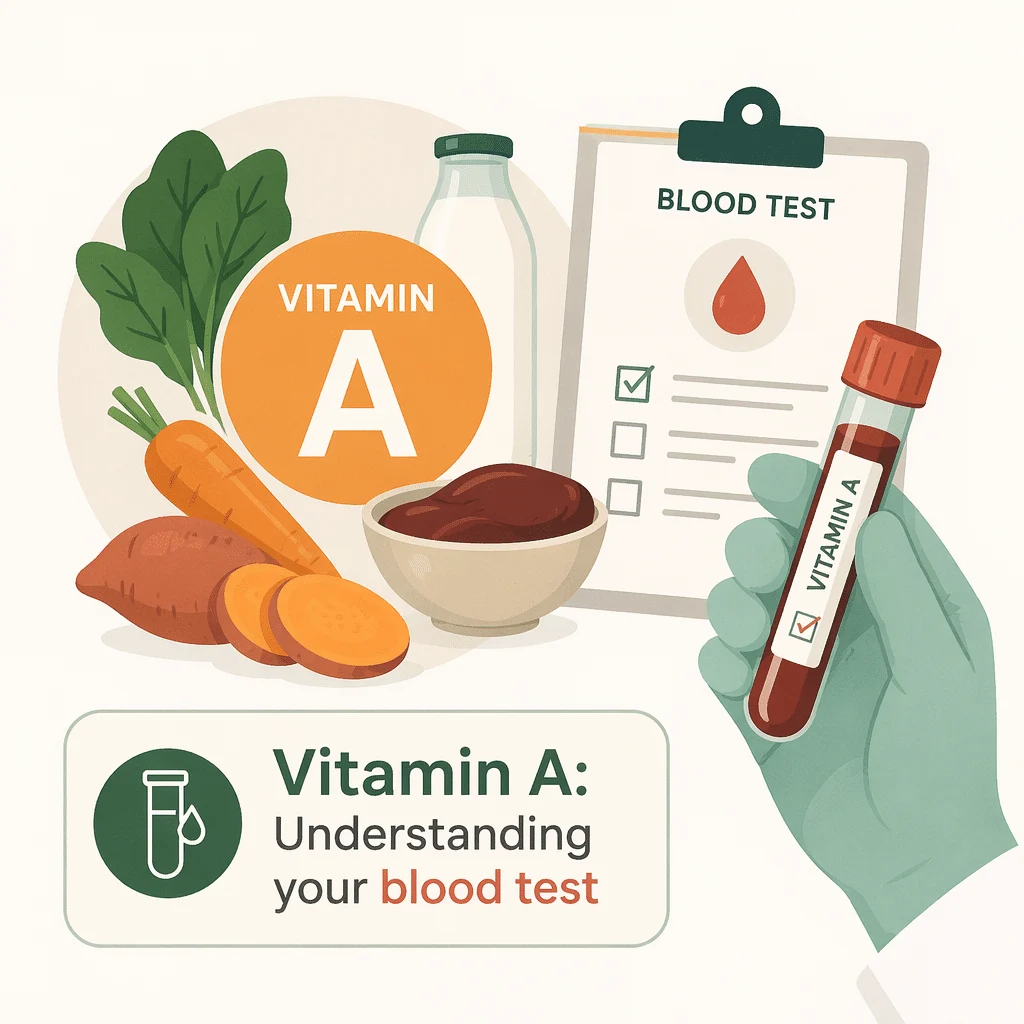
A vitamin A blood test measures retinol, the active form of vitamin A circulating in your bloodstream. Laboratories print it as “vitamin A” or “serum retinol”, and the number shows how much of this fat-soluble vitamin is available to your eyes, skin and immune defences right now.
The short answer: a result inside the reference range usually suggests an adequate supply, a low result points towards a shortage or trouble absorbing fats, and a high result almost always traces back to supplements or medicines rather than food. The nuance matters, because your liver holds blood retinol steady until your reserves are already quite depleted.
In this article you’ll learn what the test measures, why doctors order it, how the sample is taken, how to read low and high results, why a normal number does not always rule out low stores, what excess vitamin A means in pregnancy, and when a result deserves a conversation with your doctor.
What a vitamin A blood test actually measures
Vitamin A reaches you by two very different routes, and that distinction explains almost everything else on this page. Preformed vitamin A, chemically called retinol, arrives ready to use in liver, oily fish, eggs and dairy. Provitamin A carotenoids, of which beta-carotene is best known, come from plants such as carrots, sweet potatoes, spinach and mango. Your body converts carotenoids into retinol only as needed, which is why plant sources behave very differently from a capsule.
The test looks at retinol specifically. It does not measure the reserve banked in your liver. Retinol does not travel alone either: it rides through the blood on a carrier called retinol-binding protein, which pairs with a second transport protein, transthyretin, reported on many panels as prealbumin. To understand that carrier, our article covers the prealbumin blood test.
Zinc belongs here too. Your liver needs zinc to build retinol-binding protein, so a zinc shortage can trap retinol in the liver and produce a low reading even when stores are respectable. If that applies to you, read our guide to the zinc blood test.
Why your doctor may order a vitamin A blood test
This is not a routine test. In the United Kingdom, outright deficiency is uncommon because the ordinary diet supplies enough, so doctors reach for it when something specific prompts the question.
- Eye symptoms, above all difficulty seeing in dim light or a persistently dry, gritty eye surface.
- Conditions that block fat absorption, since vitamin A travels with dietary fat: coeliac disease, Crohn’s disease, cystic fibrosis, chronic pancreatitis, or a history of bariatric surgery.
- Liver disease, because the liver both stores vitamin A and makes its carrier protein.
- Suspected excess in someone taking high-dose supplements or a vitamin A-derived medicine.
- Repeated infections or slow growth in children, where a nutritional cause is being explored.
Because the liver sits at the centre of storage and transport, your doctor will often request liver function tests at the same time. When several nutrients are in question, they may instead order a vitamin panel blood test.
How the vitamin A blood test is done
The test needs an ordinary venous blood sample, usually from the crook of your elbow, and takes a couple of minutes.
Fasting is commonly requested. MedlinePlus notes you may be asked not to eat or drink for several hours beforehand, generally overnight, because a recent fatty meal leaves the sample cloudy and can interfere with measurement. Follow your laboratory’s instructions rather than a general rule found online, and mention every supplement you take, including multivitamins and cod liver oil.
You may see the tube wrapped in foil or placed in an amber container. Retinol has long been treated as light-sensitive, so shielding the sample is standard practice, though recent work described below suggests it is sturdier than that reputation implies.
Results appear in micrograms per decilitre (µg/dL) or micromoles per litre (µmol/L), beside a reference range chosen by your laboratory. Those ranges differ between labs, which is why comparing your figure with a friend’s rarely helps. For the broader principle, read our article on abnormal blood test results.
Reading a low vitamin A blood test result
A low reading, sometimes labelled hypovitaminosis A, means little retinol is circulating. It does not by itself tell you why.
The eye reacts first. Retinol builds rhodopsin, the light-catching pigment in the retina that lets you see in near-darkness, so trouble adapting to a dim room is often the earliest complaint. Left uncorrected, the shortage progresses to xerophthalmia, a drying of the eye surface. The NIH Office of Dietary Supplements describes xerophthalmia as the most common sign of vitamin A deficiency and notes it can lead to blindness if untreated. Beyond vision, a long-running shortage weakens the linings of the airways and gut that act as barriers against infection; the same source links long-term deficiency to a higher risk of respiratory illness, infections such as measles, and anaemia.
Poor intake alone is an unusual cause where the food supply is varied. Far more often the culprit is absorption: a gut condition that stops fats being taken up, a pancreas producing too little enzyme, or a liver that can no longer store and release the vitamin. Medicines that bind fats in the gut, such as cholestyramine or orlistat, can also lower levels, whilst pregnancy, breastfeeding and severe infection raise demand.
Reading a high vitamin A blood test result
A high reading, hypervitaminosis A, is nearly always self-inflicted rather than dietary. Food is a poor route to excess, with one classic exception: liver and cod liver oil are extraordinarily concentrated, and eaten daily they add up.
The usual sources are high-dose retinol supplements, protein or “wellness” blends that quietly contain vitamin A, and prescription retinoids such as acitretin for psoriasis or bexarotene for certain lymphomas, which are vitamin A derivatives and stack on top of anything swallowed separately.
The Office of Dietary Supplements sets a daily upper limit for preformed vitamin A from all sources combined at 3,000 micrograms for adults aged 19 and over, with lower limits for children and teenagers, and states that too much preformed vitamin A can cause severe headache, blurred vision, nausea, dizziness, muscle aches and coordination problems. High intakes of beta-carotene do not produce the same toxicity; they may turn the skin a harmless yellow-orange that fades.
Excess vitamin A can also push blood calcium up, so your doctor may want the total calcium blood test alongside it.
Low versus high vitamin A at a glance
| Feature | Low vitamin A (deficiency) | High vitamin A (toxicity) |
|---|---|---|
| Usual origin | Poor fat absorption, liver disease, very limited diet, raised needs | High-dose supplements, retinoid medicines, daily liver or cod liver oil |
| Eyes | Trouble seeing in dim light, dry eye surface, xerophthalmia | Blurred or double vision, pressure behind the eyes |
| Skin and hair | Dry, rough skin | Dry skin, cracked lips, hair thinning |
| General | Repeated infections, anaemia, slowed growth in children | Headache, nausea, dizziness, bone and joint pain, raised blood calcium |
| Beta-carotene involved? | Plant sources help correct a shortage | Not a cause of toxicity; may tint the skin orange harmlessly |
| First step with a doctor | Look for an absorption or liver cause behind the number | Review every supplement and medicine being taken |
Why a normal vitamin A blood test result doesn’t always rule out low stores
This is the most useful thing to understand about the test, and the reason your doctor will not treat the number as a verdict.
Your liver banks vitamin A and releases retinol into the blood at a tightly controlled rate. That regulation is so effective that blood retinol stays within the normal range until liver reserves fall a long way, and stops rising once reserves are ample. Serum retinol is therefore a late marker: it moves once the buffer is exhausted, not whilst it is quietly draining. A comfortable number cannot confirm generous stores, nor exclude an early shortfall.
Inflammation adds a second wrinkle. During an infection or a flare of inflammatory disease, the body redirects transport proteins, and retinol falls temporarily alongside retinol-binding protein. The reading drops even though nothing about your nutrition has changed. This is why doctors read retinol beside inflammation markers, and may check the CRP blood test at the same time or simply retest once you have recovered.
The same caution applies to the other fat-soluble vitamins, which share vitamin A’s absorption pathway. You can also read our guide to the vitamin D blood test, our article on the vitamin E blood test, and our guide to the vitamin K blood test.
Vitamin A, pregnancy and retinoid medicines
Vitamin A is essential in pregnancy: it drives development of the eyes, heart, lungs and skeleton. The requirement rises modestly, and the Office of Dietary Supplements lists a recommended daily amount of 770 micrograms of retinol activity equivalents for pregnant women, and 750 micrograms for pregnant teenagers.
At the same time, too much preformed vitamin A is a known cause of birth defects. The Office of Dietary Supplements states that taking too much preformed vitamin A whilst pregnant can cause birth defects including abnormal eyes, skull, lungs and heart, and advises that anyone who is or might be pregnant or breastfeeding should not take high-dose supplements of preformed vitamin A. Prescription retinoids carry stricter rules again, with dedicated pregnancy-prevention programmes attached.
None of this is a reason for alarm about your dinner. The upper limit concerns preformed vitamin A from supplements, medicines and concentrated foods such as liver; ordinary meals and beta-carotene from fruit and vegetables do not carry the same risk. The practical move is to show your midwife or doctor every bottle in your cupboard before taking it. For the wider picture, see our overview of blood tests during pregnancy.
Latest scientific advances in vitamin A testing
Research published between 2023 and 2026 has focused less on new machines than on a humbler question: how far can we trust the retinol number itself?
Serum retinol can flag a deficiency that isn’t there
Sombié and colleagues compared vitamin A indicators in young children in rural Burkina Faso against retinol isotope dilution, a research technique that tracks a labelled dose of vitamin A to estimate what is actually banked in the liver. Serum retinol classified roughly a third of the children as deficient; the liver measurement found no true deficiency at all. Adjusting for inflammation improved accuracy only partly.
What this means for you: a single low retinol result can overstate a shortage. It is a reason to investigate, not a diagnosis.
Inflammation shifts the reading in both directions
A second study from the same team measured children’s total liver vitamin A reserves directly, finding no deficiency whilst about one child in three had reserves in the hypervitaminosis range. C-reactive protein, a blood protein that rises when the body is inflamed, was weakly associated with the measured stores.
What this means for you: an inflamed body is a poor moment to judge vitamin A status. If you were unwell when your sample was taken, the number deserves a second look.
Even a recent fever can pull the number down
Ntenda and colleagues studied school-age children in Malawi and found that raised C-reactive protein and raised alpha-1-acid glycoprotein, another protein that rises during infection, both went hand in hand with lower retinol-binding protein. Recent fever and a positive malaria test also shifted readings.
What this means for you: infection can temporarily depress a vitamin A reading, so mentioning a recent illness genuinely changes how your result should be read.
The carrier protein is a good stand-in, with a catch
Matsuki and colleagues re-examined retinol-binding protein as a substitute for retinol, which needs specialised equipment to measure. In healthy adults the two tracked each other almost perfectly; in people with cirrhosis, advanced cancer or acute bacterial infection, the carrier slightly overestimated retinol. Adding transthyretin corrected nearly all that bias. The same work found retinol stayed stable across storage temperatures, repeated freezing and thawing, and days of light exposure.
What this means for you: laboratories have reliable alternatives when direct measurement isn’t practical, and ordinary handling of your sample is unlikely to distort your result.
Vitamin A toxicity comes from bottles, not meals
Padmakar gathered every published account of hypervitaminosis A into a systematic review of 31 reports. Capsules or tablets were the source in around two-thirds of cases. The commonest consequence was raised blood calcium, followed by digestive, neurological, liver, bone-and-joint and skin effects. Sudden overdose leaned neurological, with headache, double vision and raised pressure around the brain; long-running excess leaned toward the liver, skeleton and calcium. Treatment began, in essentially every case, with stopping the vitamin A.
What this means for you: excess vitamin A is preventable and largely reversible, and it is spotted through an honest inventory of what you take. Over-the-counter products count, which is exactly why your doctor asks.
When to see a doctor
A number outside the range is information, not an emergency. These situations, though, deserve a prompt appointment rather than a wait-and-see.
- You are struggling to see in dim light, or your eyes feel persistently dry and gritty.
- You have a persistent headache with blurred or double vision whilst taking any vitamin A supplement.
- Your result is low and you live with a gut, pancreatic or liver condition affecting absorption.
- Your result is high, or you take a retinoid medicine alongside a supplement containing vitamin A.
- You are pregnant, breastfeeding or planning a pregnancy and are unsure what is in your supplements.
- You are considering starting or stopping a vitamin A supplement, which is a decision to make with your doctor.
Glossary
| Term | Definition |
|---|---|
| Retinol | The active, ready-to-use form of vitamin A, and the substance the blood test measures. |
| Serum retinol | The retinol circulating in the liquid part of your blood, reported in µg/dL or µmol/L. |
| Retinol-binding protein (RBP) | The carrier protein that ferries retinol from the liver through the bloodstream to your tissues. |
| Transthyretin (prealbumin) | A second transport protein that pairs with retinol-binding protein and appears on many panels as prealbumin. |
| Preformed vitamin A | Vitamin A that arrives already active, from animal foods, supplements or retinoid medicines. |
| Provitamin A carotenoid | A plant pigment such as beta-carotene that your body converts into vitamin A only as needed. |
| Xerophthalmia | Drying and damage of the eye surface caused by prolonged vitamin A deficiency. |
| Hypervitaminosis A | An excess of vitamin A in the body, usually from supplements or vitamin A-derived medicines. |
| Retinoid | A medicine derived from vitamin A, such as acitretin or bexarotene, prescribed for skin or blood conditions. |
| Retinol activity equivalent (RAE) | The unit used for dietary recommendations, accounting for how efficiently each source becomes usable vitamin A. |
Frequently asked questions
What is the vitamin A blood test called on a lab report?
Laboratories label it several ways, all meaning the same measurement: “Vitamin A”, “Retinol”, “Vitamin A (retinol)” or “Serum retinol”. It usually sits in the vitamins or nutritional assessment section rather than among routine chemistry results. If your report instead shows “retinol-binding protein”, that is the carrier protein used as a stand-in for retinol in some settings. The unit is a useful clue: retinol appears in micrograms per decilitre or micromoles per litre.
Does a standard blood panel or vitamin panel include vitamin A?
Generally not. A full blood count and a comprehensive metabolic panel include no vitamin measurement at all. Even a panel marketed as a “vitamin panel” most often covers vitamin D, vitamin B12 and folate, the deficiencies clinicians encounter most often. Vitamin A is usually added deliberately, when there is a reason such as an absorption disorder, liver disease, eye symptoms or a question of excess. If you want it, ask for it by name rather than assuming a broad panel covers it.
What is a normal vitamin A blood test range?
Each laboratory sets its own range from measurements in a large group of healthy people, so figures differ slightly between reports. Adult ranges are frequently printed somewhere around 30 to 80 µg/dL, but the range beside your own result is the only one that applies to you. Age matters too: children and teenagers have different expected values. Read your result against your own report’s range, in the context of your health, medicines and symptoms.
Can beta-carotene supplements raise my vitamin A blood test result?
Only modestly, and this is a genuine difference between the two forms. Your body converts beta-carotene into retinol according to demand and slows conversion when it has enough, so beta-carotene does not push blood retinol into the toxic zone the way high-dose preformed vitamin A can. The Office of Dietary Supplements notes there is no upper limit for beta-carotene, though very high intakes can tint the skin a harmless yellow-orange. One caution stands: studies link high-dose beta-carotene supplements to increased lung cancer risk in people who smoke or used to smoke.
Does a retinol skin cream affect my vitamin A blood test?
Retinol applied to the skin is absorbed only in small quantities, and used as directed a cosmetic or dermatological cream is not expected to move your blood level meaningfully. Prescription oral retinoids are an entirely different matter, because they are taken by mouth and act throughout the body. Mention any topical retinoid to your doctor anyway, alongside your supplements: it costs nothing and removes one variable from the interpretation.
How quickly do vitamin A levels change after diet or supplements change?
More slowly than most people expect. Because the liver buffers the blood level, circulating retinol may barely move at first while reserves quietly refill or drain in the background. Blood levels can begin shifting within a few weeks, but restoring depleted liver stores may take several months. That gap is precisely why your doctor may repeat the test after an interval rather than immediately, and why chasing the number week to week tells you very little.
Sources
- National Institutes of Health, Office of Dietary Supplements — Vitamin A and Carotenoids: Fact Sheet for Consumers — https://ods.od.nih.gov/factsheets/VitaminA-Consumer/
- MedlinePlus, U.S. National Library of Medicine — Vitamin A blood test — https://medlineplus.gov/ency/article/003570.htm
- Gilbert C., Sarhan M. — Vitamin A Deficiency — StatPearls, NCBI Bookshelf, National Library of Medicine — https://www.ncbi.nlm.nih.gov/books/NBK567744/
- Sombié O.O. et al. — A comparative study on indicators of vitamin A status and risk factors for sensitivity and specificity of the methods to detect vitamin A deficiency — Nutrition & Metabolism, 2023 — https://consensus.app/papers/details/56935d536a1d539fad55a40e071341a2/
- Sombié O.O., Zeba A.N., Somé J.W. et al. — Association between vitamin A status, inflammations, and infections in children 36-59 months of age in rural Burkina Faso: a cross-sectional study — Journal of Health, Population and Nutrition, 2025 — https://doi.org/10.1186/s41043-025-00840-3
- Ntenda P.A.M., El-Meidany W.M.R., Mbewe R.B., Tiruneh F.N. — Relationships between infection, inflammation and biomarkers of micronutrient among school-age children in Malawi — International Health, 2026 — https://doi.org/10.1093/inthealth/ihag056
- Matsuki Y. et al. — Reappraisal of serum retinol-binding protein as a surrogate marker for retinol and discovery of a novel retinol estimation formula — Clinical Nutrition ESPEN, 2024 — https://consensus.app/papers/details/213346b8bc7d51d2b3bff5621d884493/
- Padmakar S. — Clinical Spectrum and Management of Hypervitaminosis A: A Systematic Review of Case-Based Evidence — Clinica Chimica Acta, 2026 — https://consensus.app/papers/details/83125504d32456aa99241935aa5816e1/
Further reading
- To place any result in context, consult our reference chart of normal blood test ranges.
- To decode a report line by line, follow our simple guide to reading blood test results.
- To explore another vitamin marker, read our analysis of vitamin C levels.
- To understand a frequently ordered nutrient test, see our guide to the vitamin B12 blood test.
- To see what a broad work-up covers, browse our overview of the full blood panel.
Understand your lab results with AI DiagMe
Markers such as vitamin A, vitamin D, liver function tests and CRP make far more sense together than apart, and that is exactly where a report becomes hard to read alone. AI DiagMe turns the numbers on your lab sheet into plain language, so you arrive at your appointment with better questions. It helps you understand your results; it does not diagnose, and it does not replace your doctor.
Get your results interpreted in minutes