






































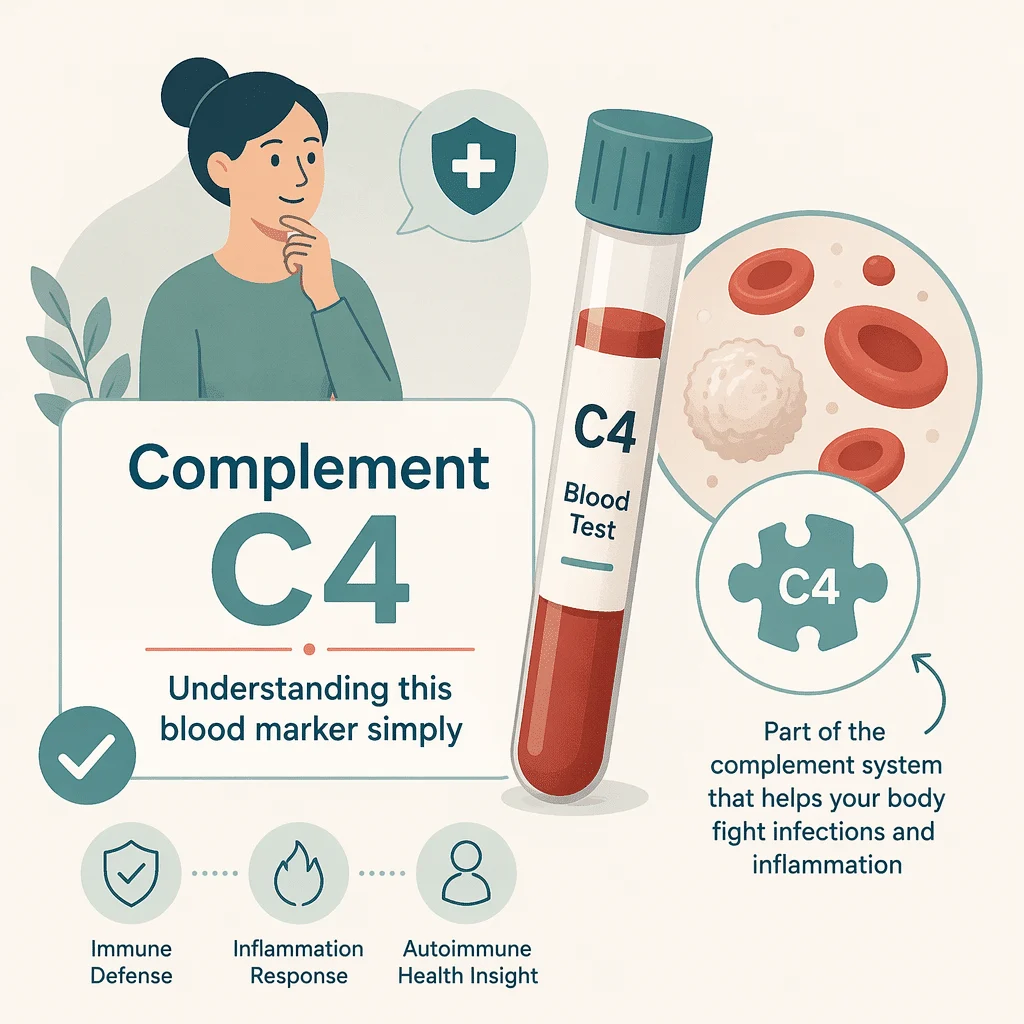
Complement C4 is a protein of the immune system, and a complement C4 blood test measures how much of it is circulating in your blood. It belongs to the complement system, a fast-acting part of your innate (inborn) defences. Doctors most often check C4 alongside a related protein called C3 to look for clues about inflammation and autoimmune disease. For this marker, a low level usually matters more than a high one: it can reflect an active autoimmune condition such as lupus, or a separate disorder called hereditary angioedema. A high level is usually a nonspecific sign of inflammation. In this article you will learn what C4 does, why and when it is tested, how to read your result alongside C3, what low and high values can mean, and the newest research. Only a doctor can interpret your result within your full picture.
What is complement C4?
Complement C4 is a protein made mainly by your liver that circulates quietly in the blood. It is one of more than thirty proteins that make up the complement system, a rapid arm of your innate immunity — the general-purpose defences you are born with, as opposed to the tailored antibodies you build up after infections or vaccines.
Think of the complement system as a chain of alarms and tools. When it detects a threat, its proteins switch on one after another in a cascade, each one activating the next. The end result can be to tag microbes for removal, draw inflammation to the area, or punch holes in bacteria. C4 acts early in this chain.
Where C4 fits in
C4 works mostly in what is called the classical pathway, the branch of complement usually switched on by antibodies that are stuck to their target — for example, antibodies bound to a virus or to an immune complex. Because of this, C4 is closely involved whenever antibodies and antigens clump together, which is exactly what happens in several autoimmune diseases.
C4 also helps with everyday housekeeping. It supports the clearance of dead cells and of immune complexes (small clusters of antibodies bound to their targets) so they do not build up and irritate tissues. When this clean-up falters, inflammation can follow.
Why doctors measure complement C4, and when
A complement C4 blood test is not part of routine screening. Your doctor orders it to answer a specific question, usually about the immune system. Because C4 can be used up when the immune system is very active, its level offers an indirect readout of certain disease processes.
Common reasons to check C4 include:
- Suspected autoimmune disease, especially lupus, when symptoms such as joint pain, a facial rash, or unexplained fatigue point that way.
- Monitoring a known autoimmune disease, to help judge whether it is flaring or settling down.
- Investigating kidney inflammation (glomerulonephritis) or inflamed blood vessels (vasculitis).
- Working up recurrent, unexplained swelling of the skin or throat without hives, which can signal hereditary angioedema.
C4 is almost always interpreted with C3, the other complement protein measured most often. Sometimes a doctor also orders a CH50 test, which gauges the overall activity of the whole classical pathway. Reading these together tells a fuller story than any single number. To see how the sister protein behaves, it helps to review our guide to the complement C3 blood test.
How to read your complement C4 results
On a lab report, complement C4 usually appears in the immunology section. It is reported as a concentration, most often in grams per litre (g/L) or milligrams per decilitre (mg/dL). A symbol, arrow, or colour often flags a value that sits outside the printed range.
Reference range
Laboratories generally consider a normal serum C4 to be roughly 0.1 to 0.4 g/L, which is about 10 to 40 mg/dL. This is only a guide: the exact range depends on the method and the laboratory, so always compare your result with the reference interval on your own report rather than a figure from elsewhere. For a plain-language overview, the National Library of Medicine describes the complement blood test in patient terms. A single value outside the range is not a diagnosis; trends over time and the clinical picture matter more.
The quick guide below shows how doctors tend to think about C4 results. It is a simplification, not a substitute for medical advice.
| C4 result | What it often suggests | Typical next step |
|---|---|---|
| Low C4 | Complement is being used up, often by immune complexes; seen in active lupus, some vasculitis, and hereditary angioedema | Check C3, antibodies such as ANA and anti-dsDNA, and, if swelling is the problem, C1-inhibitor testing |
| Normal C4 | Complement activity is likely balanced, making some active immune-complex diseases less likely | Interpret alongside symptoms and the rest of the results |
| High C4 | A nonspecific sign of inflammation, called an acute-phase response | Look for a source of inflammation or infection, often with CRP |
Because C3 and C4 move in patterns, doctors read the pair together. The next table shows how common combinations are often interpreted.
| C3 and C4 pattern | How doctors often read it |
|---|---|
| Low C4 with low C3 | Active complement consumption, as in a lupus flare or immune-complex disease |
| Low C4 with normal C3 | Points towards the classical pathway, seen in hereditary angioedema and some early or mild immune-complex activity |
| Normal C4 with low C3 | Points towards the alternative pathway, as in certain kidney diseases |
| Both normal | Complement is less likely to be driving the problem |
What a low complement C4 can mean
For C4, the low side is usually the more informative direction. A low level often means the protein is being used up faster than the liver can replace it, typically because the immune system is busy forming and clearing immune complexes.
Lupus and immune-complex disease
The best-known cause of a low C4 is systemic lupus erythematosus, an autoimmune disease in which the body makes antibodies against its own tissues. These antibodies form immune complexes that switch on complement and consume both C3 and C4. A falling C4 can accompany a flare, and it is watched especially closely when the kidneys are involved, a complication called lupus nephritis. If lupus is suspected, doctors also check antinuclear antibodies and more specific tests. You can read our plain-language overview of systemic lupus erythematosus for the bigger picture.
Other immune-complex conditions can lower C4 too, including some forms of vasculitis (inflammation of blood vessels) and glomerulonephritis (inflammation of the kidney’s filters). Low complement in these settings is a clue rather than a diagnosis, and doctors often run a broader autoimmune panel to place it in context.
Hereditary angioedema
A low C4 has a second, very different meaning. In hereditary angioedema, a rare inherited condition caused by a lack or malfunction of a control protein called C1 inhibitor, C4 is typically low — and it is almost always low during an attack of swelling. According to research indexed in PubMed, C4 is reduced during acute attacks and can act as a fast, widely available surrogate that flags the condition whilst more specific tests are arranged. This matters because hereditary angioedema causes recurrent swelling of the skin, gut, or airway without the hives seen in allergic reactions, and it does not respond to antihistamines or adrenaline.
Inherited C4 deficiency
Much more rarely, a person can inherit a shortage of C4 itself. Because complement helps clear microbes and cellular debris, this can raise the risk of certain infections and is linked to a higher chance of autoimmune disease. It is uncommon and is diagnosed with specialised testing.
What a high complement C4 can mean
A high C4 is far less specific than a low one. C4 is an acute-phase protein, which means the liver produces more of it during inflammation. A raised level therefore usually reflects a general inflammatory state rather than one particular disease.
Situations that can nudge C4 upward include:
- Acute or chronic inflammation and infection, when the body ramps up many defensive proteins at once.
- Tissue injury or the period of recovery after surgery.
- Some cancers and certain liver conditions, usually as part of a wider inflammatory picture rather than as a specific marker.
Because a high C4 rarely points to one cause, doctors interpret it in context. They often measure other inflammation markers, including C-reactive protein (CRP) and the erythrocyte sedimentation rate (ESR), to gauge how much inflammation is present. On its own, a mildly high C4 is seldom a cause for alarm.
Related tests your doctor may order
Complement C4 rarely travels alone. Depending on the question, your doctor may pair it with:
- Complement C3 and, sometimes, a CH50 total complement test, to read the system as a whole.
- Antinuclear antibodies and anti-dsDNA antibodies, when lupus or another connective tissue disease is suspected.
- C1-inhibitor level and function, the confirmatory tests for hereditary angioedema.
- Blood counts and kidney checks, such as a complete blood count and a kidney function panel, to look for organ involvement.
If you want to understand how all these numbers fit on a report, our guide to reading blood test results walks through the basics. For the wider picture of these conditions, you can also read our overview of autoimmune disease symptoms, causes, and treatments.
Latest scientific advances
The summary below reflects recent studies indexed in PubMed and other research databases. It describes promising directions, not settled practice, and none of it changes the fact that only a doctor can interpret your result.
Complement testing in lupus is being refined. Serum C3 and C4 remain the everyday tools, but they track disease activity imperfectly. Reviews of the last decade conclude that newer measures — the small fragments released when complement is activated (called split products), and complement markers measured on the surface of blood cells (cell-bound complement activation products) — appear more sensitive than C3 and C4 for spotting active disease. These tests are not yet routine everywhere, but they point towards a more precise future.
Monitoring the kidneys in lupus is a particular focus. A 2025 review notes that conventional markers such as C3, C4, and CH50 can struggle to reflect what is happening inside an inflamed kidney, and it discusses emerging blood and tissue markers — including antibodies against a complement protein called C1q — that may track disease and outlook more faithfully. What this means for you is that a normal C4 does not always guarantee quiet kidneys, which is why doctors also rely on urine tests.
Everyday factors may matter too. A 2025 systematic review that pooled dozens of studies found that people with lupus tended to have lower vitamin D levels, and that higher vitamin D went hand in hand with higher C3 and C4 and with calmer disease. This is an association rather than proof that vitamin D controls complement, and the authors urge caution, but it fits the broader advice to look after general health in autoimmune disease.
For hereditary angioedema, the emphasis is on speed and access. A 2025 emergency-medicine case report underlined that C4 is reliably low during attacks and, because the test is widely available and quick, can help doctors act whilst specialised tests are pending. Separately, a 2023 study showed that C4 and C1 inhibitor can be measured from a dried blood spot, raising the prospect of simpler screening that could one day be done closer to home. Both remain steps towards better detection rather than finished tools.
When to see a doctor
A complement C4 result is only meaningful when a clinician reads it alongside your symptoms and other tests. Still, some situations deserve prompt attention:
- A low C4 together with symptoms such as persistent joint pain, a sun-sensitive facial rash, unusual fatigue, or foamy urine, which can point to active autoimmune disease.
- Repeated, unexplained episodes of swelling of the lips, face, hands, gut, or throat without hives, especially if antihistamines do not help — a pattern that warrants testing for hereditary angioedema.
- Any swelling that threatens breathing or swallowing, which is a medical emergency and needs urgent care.
- A family history of lupus, other autoimmune disease, or angioedema, combined with suggestive symptoms.
Whatever your result, the interpretation belongs with a doctor who knows your history. A single number, high or low, is a starting point for a conversation rather than an answer on its own.
Glossary
| Term | Definition |
|---|---|
| Complement system | A group of more than thirty blood proteins that work in a chain to fight microbes, flag them for removal, and clear cellular debris. |
| Innate immunity | The general, fast-acting defences you are born with, as opposed to the tailored antibody response built up over time. |
| Classical pathway | The branch of complement usually switched on by antibodies bound to a target; C4 acts here. |
| Immune complex | A small cluster of antibodies bound to their target that can activate complement and settle in tissues. |
| Acute-phase protein | A protein the liver makes more of during inflammation; C4 is one of them. |
| Complement C3 | The complement protein measured most often alongside C4; the two are read together. |
| CH50 | A test of the total activity of the classical complement pathway. |
| Hereditary angioedema | A rare inherited condition, linked to a faulty C1 inhibitor, that causes recurrent swelling and a low C4. |
| C1 inhibitor | A control protein that keeps the classical pathway in check; its lack causes hereditary angioedema. |
| Lupus nephritis | Inflammation of the kidneys caused by lupus, often monitored with complement and urine tests. |
Frequently asked questions
What is a normal complement C4 level?
Most laboratories put a normal serum C4 at roughly 0.1 to 0.4 g/L, which is about 10 to 40 mg/dL. The exact range depends on the testing method and the laboratory, so the figures printed on your own report are the ones that count. A result a little outside the range is common and not automatically a problem; what matters is the size of the change, whether C3 is also affected, and how you feel. Your doctor will read the number in that fuller context rather than on its own.
What does a low C4 with a normal C3 mean?
This particular pattern can be a useful clue. Because C4 sits in the classical pathway whilst C3 is more central, a low C4 with a normal C3 can point towards conditions that mainly involve that classical branch. Hereditary angioedema is the classic example, and some early or mild immune-complex activity can look this way too. It is a signpost rather than a diagnosis, and your doctor will decide whether tests such as C1-inhibitor level and function are needed to follow it up.
Can you raise complement C4 levels naturally?
There is no diet, supplement, or lifestyle change proven to raise C4 directly. When C4 is low because the immune system is consuming it, the level improves only when the underlying condition is treated and settles. When C4 is low because of a rare inherited deficiency, no natural approach can replace the missing protein. General healthy habits support your immune system and are worthwhile, but they are not a substitute for diagnosing and treating the cause, which is a conversation to have with your doctor.
What does a high complement C4 blood test mean?
A high C4 is usually a nonspecific sign that the body is inflamed, because C4 is one of the proteins the liver makes more of during inflammation. It can rise with infection, injury, or ongoing inflammation, and occasionally alongside some cancers or liver conditions as part of a broader picture. On its own, a mildly raised C4 rarely points to a single disease, so doctors interpret it together with your symptoms and other markers rather than treating the number itself.
Can medicines change my complement C4 level?
Yes. Some treatments can influence C4. Medicines that calm an overactive immune system, such as certain immunosuppressants used in autoimmune disease, may allow a consumed C4 to recover as the disease quietens. Other drugs can have different effects. This is one reason it is important to tell your doctor about every medication and supplement you take, so your result can be read accurately.
Can a low complement C4 be temporary?
It can. A passing infection or a bout of significant physical stress can lower complement for a while, and the level often returns to normal within a few weeks. This is why a single low reading is usually not treated as the final word: doctors frequently repeat the test later and look at the trend, along with C3 and your symptoms, before drawing conclusions.
Sources
- MedlinePlus, National Library of Medicine — Complement Blood Test — https://medlineplus.gov/lab-tests/complement-blood-test/
- Cleveland Clinic — C4 Complement Blood Test: What It Is, Procedure and Results — https://my.clevelandclinic.org/health/diagnostics/c4-complement-blood-test
- Lupus Foundation of America — Glossary of Lupus Blood Tests — https://www.lupus.org/resources/glossary-of-lupus-blood-tests
- Ayano M, Horiuchi T — Complement as a Biomarker for Systemic Lupus Erythematosus — Biomolecules, 2023 — https://doi.org/10.3390/biom13020367
- Clavarino G, et al. — Complement in systemic lupus erythematosus across time and space — Current Opinion in Immunology, 2025 — https://consensus.app/papers/details/a76b1c2710b85f63b04596997517953d/
- Ranjan S, et al. — Vitamin D Is Associated With Susceptibility and Disease Severity in Systemic Lupus Erythematosus: A Systematic Review and Meta-Analysis — International Journal of Rheumatic Diseases, 2025 — https://doi.org/10.1111/1756-185X.70379
- Sinnathamby ES, et al. — Hereditary Angioedema: Diagnosis, Clinical Implications, and Pathophysiology — Advances in Therapy, 2023 — https://doi.org/10.1007/s12325-022-02401-0
- Dungan L, et al. — Urgent diagnosis of hereditary angioedema in the ICU and ED: the critical role of rapid complement testing — International Journal of Emergency Medicine, 2025 — https://consensus.app/papers/details/eb92f0891e4f50a49dad60e5a316ce8a/
- Iurascu M, et al. — A dried blood spot proteomic and genetic assay for diagnosing hereditary angioedema — Clinical and Translational Allergy, 2023 — https://consensus.app/papers/details/686e290d579b52729bdadaa3a06f0543/
Further reading
- IgG (immunoglobulin G): understanding your blood test
- Protein electrophoresis and immunoglobulins: how to read your results
- Anti-CCP antibodies: what the test means
- IgM (immunoglobulin M): understanding your lab results
- Arthritis: causes, symptoms, and treatments
Complement C4 is easier to make sense of when you can see it beside the rest of your report — C3, antinuclear antibodies, inflammation markers, and kidney or urine results often tell the real story together. AI DiagMe reads your blood, urine, and stool test results and explains what each value means in clear, everyday language, with analysis reviewed by a panel of doctors. It is built to help you understand your results and prepare for your appointment, not to diagnose any condition or replace your physician.
Understand your lab results with AI DiagMe
Get your results interpreted in minutes