





































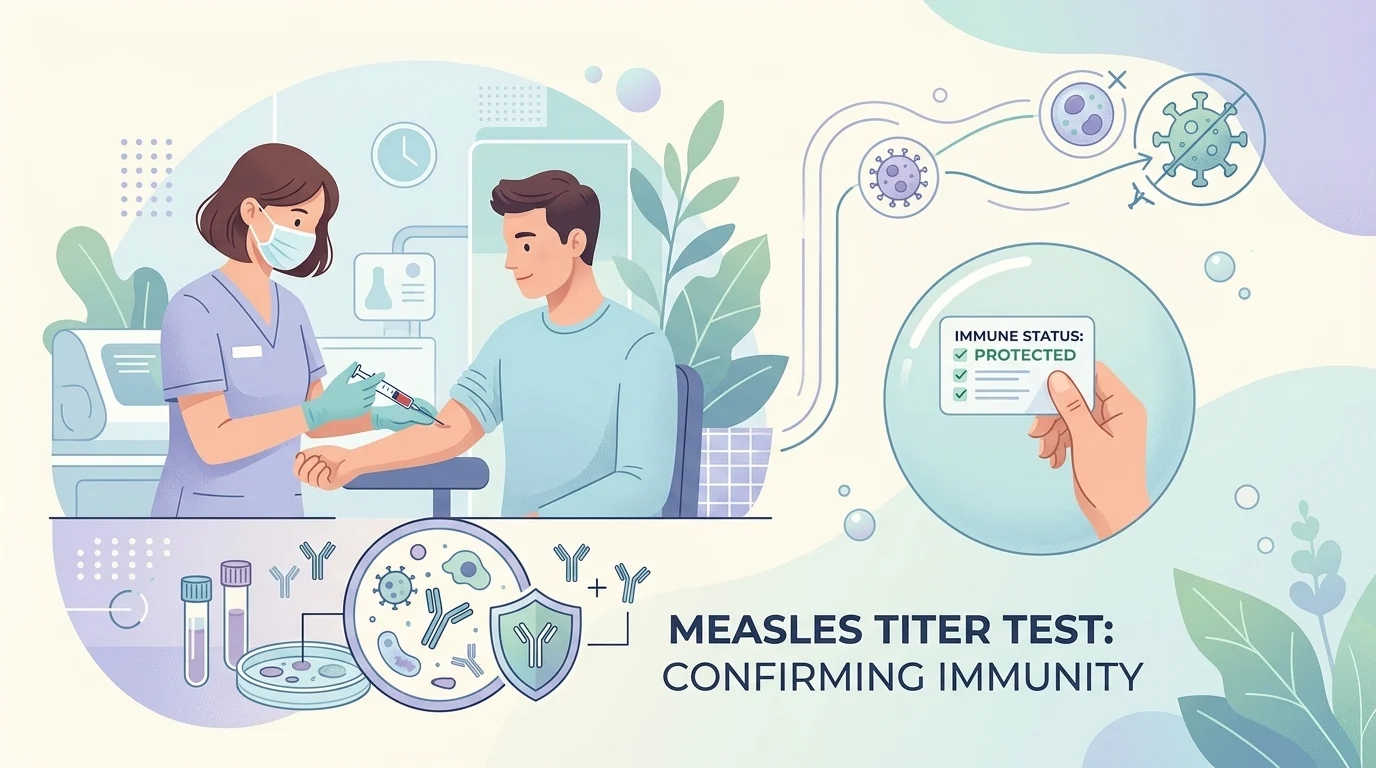
The United States has now recorded more measles cases in 2026 than in any year since 1991, and a growing number of adults are asking the same practical question: am I actually protected? A measles titer test, a blood test that looks for measles antibodies, can answer part of that question. It cannot answer all of it, and public health agencies do not recommend it for everyone. This article explains what is new, what the test measures, how to read the result, and when a vaccine record is a better answer than a blood draw.
What is new: the 2026 measles outbreak in numbers that matter
The Centers for Disease Control and Prevention (CDC) reports 4,080 confirmed measles cases in the United States for 2026 as of early October, with 42 new outbreaks this year. Nearly all of those cases, about 96 percent, are linked to outbreaks rather than isolated infections. News reports citing state data say Pennsylvania alone has passed 1,000 cases, and the CDC announced on October 13 that it is sending additional Epi-Aid support to the state.
Why does this send people looking for a titer test? Because measles is one of the most contagious viruses known, and adults who cannot find their childhood vaccine record start wondering whether a blood test can settle it. That reaction is understandable. The answer depends on your age, your records, and your situation.
What a measles titer test actually measures
A measles titer test is a blood test that measures antibodies your immune system makes against the measles virus. Laboratories most often report IgG, the type of antibody that appears after vaccination or a past infection and tends to stay for years. A second type, IgM, appears early in an active or very recent infection. Reading the two together tells a clinician whether you are likely protected, unprotected, or currently infected.
If you want the wider picture of how these proteins work, read our IgG blood test guide.
How to read the result
According to MedlinePlus, a positive IgG result means you are immune, whether from vaccination or a past infection, and a negative IgG result means you are not. A positive IgM result points to a current or recent infection. Each laboratory prints its own reference ranges and may add a borderline category, so the wording on your report matters.
| Result on your report | 通常代表的意義 | 常見的下一步處置 |
|---|---|---|
| IgG positive | Antibodies present, so you are considered immune | Keep the report as proof of immunity |
| IgG negative | No measurable protection | Discuss MMR vaccination with your clinician |
| IgG equivocal or borderline | Result is unclear | Your clinician may repeat the test or recommend a dose |
| IgM positive | Current or recent infection, especially with symptoms | Call your doctor before visiting a clinic in person |
Do you need the test at all?
For most adults, the CDC says no. Its guidance states that providers generally do not need to screen adults for measles immunity outside outbreak areas, and that testing after vaccination to confirm immunity is not necessary. Presumptive evidence of immunity can instead be shown by written documentation of vaccination, laboratory evidence of immunity, laboratory confirmation of past disease, or, for some groups, birth before 1957. The CDC adds that verbal reports of vaccination should not be accepted without written documentation.
For most adults, one dose of the MMR vaccine or other presumptive evidence of immunity is enough, while some people need two doses depending on risk factors such as health care work or international travel. If your records are lost, a titer test is one accepted way to document immunity. Vaccination is the other, and it is the more common route.
When a titer test makes sense
MedlinePlus lists several situations: pregnancy or planning a pregnancy, proof of immunity required for school or work, and health care work with possible exposure. People who are pregnant should not receive the MMR vaccine, so knowing your antibody status before pregnancy can matter. For a broader view of routine prenatal screening, see 我們的懷孕期間血液檢查指南.
Latest scientific advances: why antibody levels can drop
Several recent studies, retrieved through PubMed, look at the same puzzle: some people who were vaccinated as children no longer show measurable antibodies as adults. Research from blood donors in southern Italy found that the share of people without detectable antibodies was highest among young adults, even where vaccination coverage had been high. A large Austrian laboratory study reached a similar conclusion, with more people born after 1990 testing negative than people born before 1970, and noted that these gaps existed before the pandemic.
What does this change for you? It does not mean the vaccine failed. A Taiwanese review found that measurable antibodies had declined in younger groups, yet outbreaks stayed small, which suggests immune memory still protects many people even when the blood test reads low. Studies in Australian university students and Turkish adults also point to lower antibody levels in people vaccinated in childhood. Researchers are still debating whether a routine extra dose is warranted or whether boosters should target higher-risk groups instead. These are observational studies, so they describe patterns, not individual risk.
The practical reading is cautious: a negative titer in a vaccinated adult is a reason to talk with a clinician, not a reason to panic.
What to do if you are unsure about your status
Start with paperwork. Check childhood records, a school or military file, or your state immunization registry. If nothing turns up, ask your clinician whether a titer test or simply a dose of MMR makes more sense for you, since the vaccine can be given without testing first when records are missing. Understanding your wider immune picture can also help, and 我們的血液檢查報告解讀指南 shows how antibody and immune markers fit into a standard report.
何時應與醫師討論
Contact a health professional promptly if you have a fever with a spreading rash, red eyes, or a cough after possible exposure, and call ahead so the clinic can limit contact with others. Also speak with your doctor before any vaccine decision if you are pregnant, have a weakened immune system, or have had a severe reaction to a previous dose.
詞彙表
- 效價: a measure of how much antibody your blood contains against a specific germ.
- IgG: the antibody type that signals past vaccination or infection and usually lasts for years.
- IgM 抗體: the early antibody that rises during a current or very recent infection.
- Presumptive evidence of immunity: documentation that lets a clinician consider you protected without further testing.
- MMR vaccine: the combined vaccine against measles, mumps, and rubella.
- Epi-Aid: a CDC emergency team sent at a state’s request to investigate an outbreak.
常見問題
Does a positive measles IgG mean I am protected for life? It means antibodies were detected and you are generally considered immune. Studies show levels can decline over time, so discuss unusual circumstances with a clinician.
Can I take the vaccine if I am already immune? Health authorities say there is no known harm in getting an extra dose, because existing antibodies neutralize the weakened vaccine virus.
Is a titer test better than a vaccine record? Written vaccination records are the CDC’s first-line evidence. A titer is an alternative when records are missing.
Should I get tested because of the outbreak? Not automatically. The CDC does not recommend routine screening of adults outside outbreak areas, but if you live near an outbreak or have exposure risk, ask your clinician.
Can pregnant women get the MMR vaccine? No. Pregnant people should not receive it, so immunity is usually checked before pregnancy.
參考資料
- CDC: Measles cases and outbreaks
- CDC: Measles vaccine considerations for health care providers
- MedlinePlus: Measles and mumps tests
- FOX 29: US measles cases top 4,000 as Pennsylvania outbreak grows
- Associated Press via Hawaii Tribune-Herald: CDC to deploy additional support to Pennsylvania
- According to PubMed: Immunity gap for measles in young adults, blood donors in southern Italy (DOI)
- According to PubMed: Seroprevalence against measles in Austria by birth year (DOI)
- According to PubMed: Taiwan’s strategy toward measles elimination (DOI)
- According to PubMed: Persistence of measles, mumps, and rubella immunity in Australian health science students (DOI)
- According to PubMed: Waning measles immunity among adults in Istanbul (DOI)
其他文章
用AI DiagMe讀懂您自己的血液檢查報告
Have an antibody result and not sure what it means? 用 AI DiagMe 讀懂您的檢驗報告.