




O exame de proteínas totais no sangue mede a quantidade combinada de albumina e globulinas que circulam no soro sanguíneo, sendo um dos marcadores mais solicitados em exames de rotina. Se você está analisando um resultado marcado como alto ou baixo, este guia explica o que esse número representa, o que é considerado normal, e quais são os próximos passos habituais. Você encontrará uma explicação em linguagem simples sobre resultados baixos e altos, como esse exame se relaciona com albumina, globulinas e a relação albumina/globulina, e quando vale a pena conversar com seu médico sobre o resultado.
O que o exame de proteínas totais no sangue mede
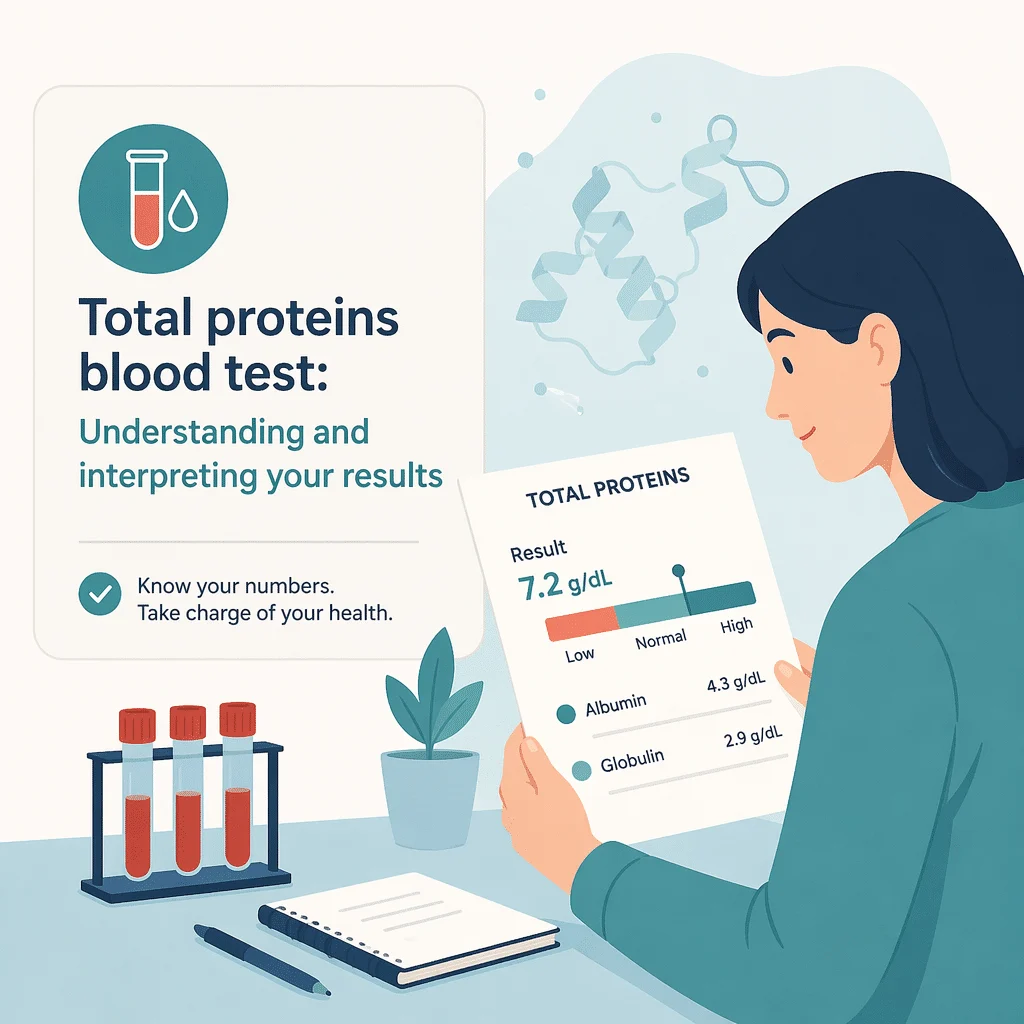
O exame de proteínas totais no sangue soma duas famílias de proteínas que circulam na parte líquida do sangue, chamada soro. A primeira é a albumina, uma proteína produzida quase exclusivamente pelo fígado. A segunda são as globulinas, um grupo variado que inclui anticorpos, proteínas transportadoras e diversas proteínas relacionadas à inflamação. Juntas, essas duas categorias representam praticamente todas as proteínas medidas nesse exame.
Os médicos solicitam esse marcador por vários motivos: como parte de um painel metabólico de rotina, para investigar sintomas como inchaço ou cansaço, ou para avaliar o fígado, os rins e o sistema imunológico ao mesmo tempo. Como o resultado combina dois tipos de proteínas bem diferentes, um valor fora do esperado é um ponto de partida para investigação, e não um diagnóstico definitivo. Seu médico geralmente verifica individualmente as nível de albumina junto com as proteínas totais, já que separar os dois valores muitas vezes revela qual parte do equilíbrio foi alterada.
Valores de referência para proteínas totais
Os valores de referência variam um pouco entre os laboratórios, dependendo dos equipamentos e métodos utilizados, por isso o intervalo impresso no seu próprio laudo é o que mais importa. Como referência geral, a maioria dos laboratórios considera que um resultado de aproximadamente 6,0 a 8,3 gramas por decilitro (g/dL) está dentro da faixa típica para adultos, equivalente a cerca de 60 a 83 gramas por litro (g/L) nos laboratórios que utilizam essa unidade.
A tabela abaixo resume os valores de referência para adultos mais utilizados para proteínas totais e seus dois principais componentes, para que você possa ver onde cada um se encaixa em relação ao seu próprio laudo.
| Marcador | faixa etária típica de adultos | O que isso reflete |
|---|---|---|
| Proteína total | 6,0–8,3 g/dL (60–83 g/L) | Albumina e globulinas combinadas |
| Albumina | 3,5–5,0 g/dL (35–50 g/L) | Proteína produzida pelo fígado, equilíbrio de líquidos |
| Globulinas | 2,0–3,5 g/dL (20–35 g/L) | Anticorpos e proteínas transportadoras |
| Relação albumina/globulina (A/G) | aproximadamente 1,0–2,2 | Equilíbrio entre os dois grupos de proteínas |
*Esses valores são aproximados e fornecidos apenas como referência geral. Compare sempre o seu resultado com o intervalo de referência impresso no seu próprio laudo, pois os valores podem variar conforme a idade, o sexo, a gravidez e o método utilizado pelo laboratório.
Causas de proteínas totais baixas
Um resultado de proteínas totais abaixo do valor de referência é chamado de hipoproteinemia. Em geral, indica um de três mecanismos principais: o organismo está produzindo menos proteína do que o normal, está perdendo proteína mais rápido do que consegue repor, ou o próprio sangue ficou diluído por excesso de líquido.
Produção reduzida
Doenças hepáticas crônicas, como cirrose ou hepatite de longa duração, podem comprometer a capacidade do fígado de produzir albumina e outras proteínas, já que as proteínas totais e a albumina são dois dos valores avaliados em um exame padrão painel de função hepática acompanha para avaliar essa produção. A desnutrição proteico-calórica age por um caminho diferente: sem proteínas e calorias suficientes na alimentação, o organismo simplesmente não tem a matéria-prima necessária para manter a produção estável.
Perda excessiva
A síndrome nefrótica, uma condição renal abordada em detalhes em uma análise mais ampla sobre exames de função renal, permite que grandes quantidades de proteína vazem do sangue para a urina. Certas doenças intestinais causam uma perda semelhante pelo trato digestivo, e queimaduras extensas podem eliminar proteína pela pele lesionada em uma velocidade que o organismo dificilmente consegue repor.
Diluição
A hiperidratação dilui a concentração de proteínas no sangue sem reduzir de fato a quantidade total presente no organismo, e a gravidez normal tem um efeito semelhante, pois o volume sanguíneo aumenta consideravelmente. Em ambas as situações, a produção de proteínas pode estar completamente normal, mesmo que a concentração medida pareça baixa.
Causas de proteínas totais altas
Um resultado acima do valor de referência, chamado de hiperproteinemia, tem menos causas comuns, sendo a desidratação de longe a mais frequente: quando a parte líquida do sangue diminui, todas as substâncias dissolvidas, incluindo as proteínas, ficam mais concentradas.
Infecções crônicas como hepatite B, hepatite C ou HIV podem provocar um aumento prolongado, pois o sistema imunológico continua produzindo anticorpos por um longo período. Doenças autoimunes, incluindo lúpus e artrite reumatoide, atuam por um mecanismo semelhante, já que a ativação imunológica contínua eleva as globulinas ricas em anticorpos — um processo que o médico pode acompanhar junto com os níveis de PCR quando há suspeita de inflamação.
Uma causa mais específica é um grupo de condições chamadas gamopatias monoclonais, nas quais uma única linhagem de células produtoras de anticorpos se multiplica e produz uma proteína idêntica em quantidades incomumente grandes. Os médicos reconhecem esse padrão com mais frequência como mieloma múltiplo, e um resultado elevado de proteína total é, às vezes, o primeiro indício que leva a uma investigação mais aprofundada, bem antes de outros sintomas aparecerem. Como as cadeias capa e lambda que compõem cada anticorpo podem se acumular de forma desigual nessa situação, o médico também pode solicitar a relação cadeias leves livres kappa/lambda junto com a proteína total.
Proteínas totais versus albumina, globulinas e relação A/G
A proteína total por si só é um valor combinado, por isso os laboratórios frequentemente a detalham para tornar o resultado mais informativo. Subtraindo o valor da albumina da proteína total, obtém-se o valor das globulinas; dividindo a albumina pelas globulinas, calcula-se a relação albumina/globulina, ou Relação A/G. Essa comparação simples muitas vezes revela mais do que o valor isolado da proteína total, pois a albumina e as globulinas podem se mover em direções opostas e ainda assim deixar o total aparentemente normal.
Uma relação A/G baixa geralmente indica que a albumina caiu, as globulinas subiram, ou ambas ao mesmo tempo — padrões observados em doenças hepáticas crônicas, perda de proteína pelos rins e gamopatias. Uma relação A/G alta é menos comum e geralmente aponta para uma produção relativamente baixa de globulinas, às vezes por imunodeficiência, ou para albumina concentrada por desidratação. Para um quadro mais detalhado, o médico pode solicitar eletroforese de proteínas, um exame que separa a família das globulinas em suas frações distintas, incluindo a gamaglobulinas que carregam a maioria dos anticorpos.
Quando a proteína total indica a necessidade de acompanhamento
Nem todo resultado alterado de proteína total exige atenção urgente, mas certos padrões aumentam a probabilidade de que sejam solicitados exames adicionais. A tabela abaixo oferece um guia simples para os cenários mais comuns.
| Padrão no seu exame | O que isso pode sugerir | Próximo passo comum |
|---|---|---|
| Levemente baixa, sem sintomas | Alimentação, desidratação leve no sentido inverso, variação laboratorial | Repetir o exame em algumas semanas |
| Baixa com inchaço ou cansaço | Causa hepática, renal ou nutricional | Painel hepático e renal, exame de proteína na urina |
| Levemente alta, sem outros sintomas | Desidratação | Hidratar-se bem e repetir o exame |
| Alta com relação A/G alterada | Infecção crônica, doença autoimune, gamopatia | Eletroforese de proteínas, dosagem de imunoglobulinas |
| Qualquer nível com dor óssea ou anemia | Requer avaliação rápida | Consulta médica na mesma semana |
Quando consultar um médico sobre seus resultados de proteína total
A maioria dos resultados isolados com alteração não é uma emergência, e seu médico orientará o momento adequado para qualquer acompanhamento. Ainda assim, certas combinações de achados merecem uma conversa rápida, em vez de uma postura de esperar para ver.
- Inchaço persistente nas pernas, tornozelos ou ao redor dos olhos
- Cansaço inexplicável que não melhora com repouso
- Dor óssea, especialmente nas costas ou costelas, ou fratura por trauma leve
- Urina espumosa ou mudança perceptível no padrão urinário
- Infecções frequentes ou de difícil resolução
- Um resultado de proteína total que permanece alterado em um exame repetido
Buscar uma avaliação não significa que algo grave está garantido. Isso simplesmente permite que o médico solicite os exames complementares específicos, como um painel hepático ou painel de função renal, que pode identificar a causa subjacente.
Avanços científicos recentes
Pesquisadores têm investigado como proteínas comuns do sangue — incluindo a proteína total e seus componentes — podem identificar certas condições mais cedo do que os sintomas sozinhos permitiriam.
Um estudo de 2025 comparou a relação albumina/globulina em pessoas com mieloma múltiplo, doença hepática, doença renal e controles saudáveis. O resultado: essa relação simples distinguiu o mieloma múltiplo das demais condições com alto grau de precisão, superando a proteína total isolada. O que isso significa para você: se sua proteína total ou relação A/G estiver alterada, calcular essa relação e compará-la com outras condições é uma forma legítima e de baixo custo para o médico identificar as possíveis causas antes de solicitar exames mais especializados. A AUC mencionada no estudo é uma medida estatística de quão bem um teste diferencia dois grupos, com valores mais próximos de 1 indicando melhor desempenho (Lv et al., 2025, DOI).
Um segundo estudo publicado em 2025 desenvolveu um modelo computacional usando vinte valores laboratoriais de rotina, incluindo proteína total, albumina e cálcio, extraídos de anos de registros anteriores ao diagnóstico de mieloma múltiplo. A conclusão: o modelo conseguia estimar o risco de uma pessoa desenvolver mieloma múltiplo em cinco anos usando exames que muitas pessoas já realizam em consultas de rotina. O que isso significa para você: esse tipo de pesquisa aponta para um futuro em que exames de sangue de rotina, interpretados em conjunto em vez de marcador por marcador, poderiam ajudar a identificar riscos mais cedo, sem a necessidade de nenhum exame novo ou invasivo. Um modelo preditivo, nesse contexto, é simplesmente um cálculo que combina vários resultados para estimar a probabilidade — semelhante a como um score de crédito combina vários fatores financeiros em um único número (Mittelman et al., 2025, DOI).
Ambos os estudos são tranquilizadores, não alarmantes: sugerem que exames de sangue simples e acessíveis podem se tornar cada vez mais úteis com o tempo, e não que um resultado alterado de proteínas totais deva causar preocupação por si só.
Glossário
| Prazo | Definição |
|---|---|
| Albumina | A proteína sanguínea mais abundante, produzida pelo fígado, que ajuda a manter o líquido dentro dos vasos sanguíneos e transporta hormônios e medicamentos. |
| Globulinas | Um grupo variado de proteínas sanguíneas que inclui anticorpos (imunoglobulinas) e diversas proteínas relacionadas ao transporte e à inflamação. |
| Relação albumina/globulina (A/G) | Um cálculo que compara os níveis de albumina e globulina, usado como triagem rápida para identificar alterações na produção ou perda de proteínas. |
| Hipoproteinemia | O termo médico para um nível de proteína total abaixo do intervalo de referência normal. |
| Hiperproteinemia | O termo médico para um nível de proteína total acima do intervalo de referência normal. |
| Eletroforese de proteínas | Um método laboratorial que separa as proteínas do sangue em frações distintas, incluindo albumina e as globulinas alfa, beta e gama. |
| Gamopatia monoclonal | Uma condição em que uma única linhagem de plasmócitos produz um anticorpo idêntico em excesso, às vezes associada ao mieloma múltiplo. |
| Síndrome nefrótica | Uma doença renal que causa perda significativa de proteínas pela urina, frequentemente reduzindo os níveis de proteínas no sangue. |
Perguntas frequentes
Medicamentos podem interferir no exame de proteínas totais no sangue?
Sim, certos medicamentos podem alterar seu resultado para cima ou para baixo. Corticosteroides em doses altas, por exemplo, podem elevar levemente a proteína total, enquanto estrogênios e alguns anticoncepcionais orais podem reduzi-la um pouco. Nenhuma dessas alterações, por si só, costuma indicar uma doença. É um bom hábito informar todos os medicamentos e suplementos que você toma ao fazer exames de sangue, pois esse contexto ajuda seu médico a interpretar o resultado corretamente, sem buscar uma causa não relacionada.
A idade muda o que é considerado um nível normal de proteína total?
Os intervalos de referência podem variar um pouco com a idade. Adultos mais velhos às vezes ficam na faixa inferior do intervalo típico para adultos, o que pode ser uma parte normal do envelhecimento e não um sinal de doença. Os intervalos também são diferentes para bebês e crianças em comparação com adultos. Por causa dessas variações, o médico interpreta seu resultado com base nos intervalos adequados para a sua faixa etária, e não em um único valor universal.
Só a alimentação consegue elevar um nível baixo de proteínas totais?
A alimentação tem um efeito real, mas limitado, em pessoas que são saudáveis de modo geral. Aumentar o consumo de proteínas de boa qualidade — como carnes magras, peixes, ovos, laticínios e leguminosas — pode elevar os níveis gradualmente ao longo de algumas semanas, caso a causa original tenha sido simplesmente uma ingestão insuficiente. No entanto, a dieta não consegue corrigir um resultado baixo causado por doença hepática, perda de proteínas pelos rins ou má absorção intestinal, pois o mecanismo subjacente não tem relação com a quantidade de proteína que você consome.
Qual é a diferença entre o exame de proteína total e a eletroforese de proteínas?
O exame de proteínas totais no sangue fornece um único valor combinado de todas as proteínas do soro. A eletroforese de proteínas vai além e separa esse total em suas frações individuais, mostrando a quantidade relativa de albumina e de cada grupo de globulinas. Pense nas proteínas totais como o valor final de uma nota fiscal e na eletroforese como a lista detalhada dos itens. Os médicos geralmente começam pelo exame de proteínas totais e solicitam a eletroforese apenas quando o resultado inicial ou o quadro clínico exige uma avaliação mais detalhada.
As proteínas totais podem estar alteradas durante a gravidez?
Sim, e isso costuma ser um achado normal, não algo preocupante. O volume de sangue aumenta bastante durante a gravidez, o que dilui a concentração de proteínas e frequentemente resulta em um nível levemente baixo de proteína total ou albumina, especialmente no segundo e terceiro trimestres. Seu médico do pré-natal acompanha esse valor junto com outros marcadores, por isso um resultado levemente baixo na gravidez geralmente é interpretado de forma diferente do que o mesmo valor fora da gestação.
Um resultado alto de proteína total é sempre algo grave?
Não. A causa mais comum, de longe, é a simples desidratação, que concentra todas as proteínas no sangue sem refletir nenhuma doença de base. Reidratar-se e repetir o exame frequentemente faz o valor voltar ao normal. O que leva a uma investigação mais aprofundada é uma elevação persistente, especialmente acompanhada de uma relação albumina/globulina alterada ou de sintomas como cansaço ou dor nos ossos — não um único resultado alto isolado.
Fontes
- MedlinePlus (National Library of Medicine, NIH) — Total Protein and Albumin/Globulin (A/G) Ratio, 2024 — link
- Cleveland Clinic — High Blood Protein (Hyperproteinemia): Levels, Causes and Treatment, 2022 — link
- Gounden V, Vashisht R, Jialal I — Hypoalbuminemia — StatPearls, NCBI Bookshelf (National Institutes of Health), 2023 — link
- Lv XM, Yan LW, Yu GQ, Chen ZZ, Xiao L, Yu HL — The Diagnostic and Differential Value of the Serum Albumin-to-Globulin Ratio in Multiple Myeloma — Clinical Laboratory, 2025 — link
- Mittelman M, Israel A, Oster HS, et al. — Can we identify individuals at risk to develop multiple myeloma? A machine learning-based predictive model — British Journal of Haematology, 2025 — link
Leitura complementar
- Exame de sangue para albumina: entendendo seus resultados
- Níveis de pré-albumina: seu guia completo para entender os resultados do seu exame de sangue.
- Relação albumina/globulina: interpretação e níveis
- Testes de Função Hepática (TFH): Como Interpretar o Seu Painel Hepático
- Painel de Função Renal: Como Interpretar seus Exames de Sangue Renais
A proteína total raramente conta a história completa por si só, por isso os médicos costumam analisá-la junto com a albumina, a função renal e os exames do fígado para ter uma visão completa da sua saúde. Entender como esses marcadores se relacionam entre si pode tornar sua próxima consulta mais produtiva e suas perguntas mais precisas. O AI DiagMe foi criado para ajudar você a entender o que seus resultados mostram em linguagem simples, para que você chegue preparado — e não para diagnosticar uma condição ou substituir a orientação do seu médico.
Entenda os resultados dos seus exames com o AI DiagMe.
Obtenha a interpretação dos seus resultados em minutos.