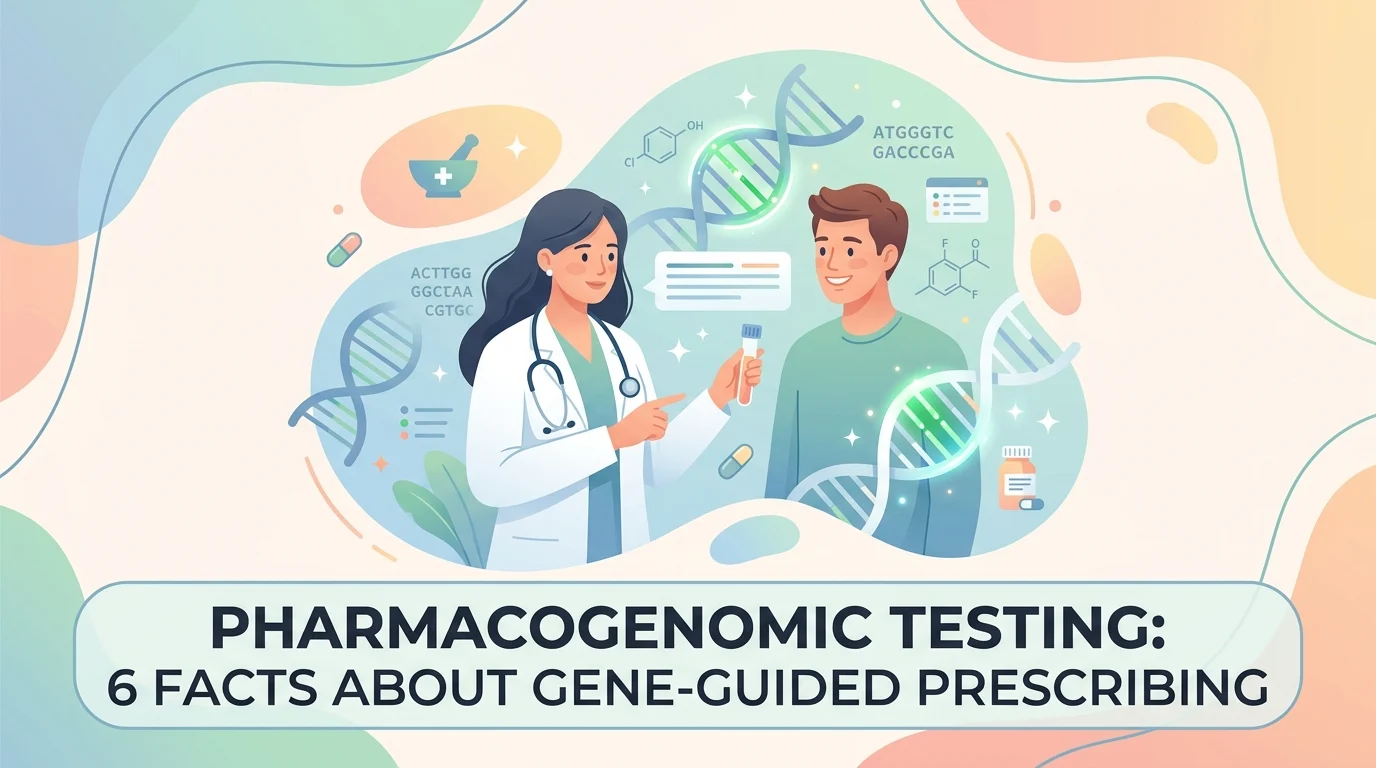
Two people can swallow the same pill, at the same dose, and end up in completely different places. One feels better. The other feels nothing at all, or lands in hospital with a side effect. Part of that gap is written in their genes, and an explainer published on 14 September 2026 by The Conversation, syndicated the same day across health outlets, put the idea back in front of a general audience. Pharmacogenomic testing is the laboratory test that reads those genes. Here is what it measures, what it cannot promise, and how to make sense of a result if one lands in your file.
What pharmacogenomic testing actually measures
A pharmacogenomic test looks at inherited variants in a short list of genes that govern how your body activates, breaks down or transports certain medicines. The sample is simple: a blood tube or a cheek swab. The laboratory does not measure the drug itself, and it says nothing about how ill you are. It reports which version of each gene you carry, then translates that into a predicted metaboliser status, usually described as poor, intermediate, normal, rapid or ultrarapid depending on the gene.
One feature sets this result apart from almost every other line on a lab report. Your DNA does not drift. A creatinine value from last winter tells you very little today, whereas a pharmacogenomic result stays valid for life and can be pulled up again every time a new prescription comes along. What does change over time is the interpretation, as clinical guidance is revised and new gene-drug pairs are added.
The genes prescribers look at most
Only a handful of gene-drug pairs currently carry enough evidence to change what a clinician does. The table below lists the ones most often included on a panel.
| Gene | What it influences | Medicines most often concerned |
|---|---|---|
| CYP2C19 | How quickly the body activates or clears a drug | Clopidogrel, omeprazole, some antidepressants |
| CYP2D6 | How quickly the body clears many everyday drugs | Codeine, tamoxifen, some antidepressants |
| DPYD | How the body breaks down fluoropyrimidine chemotherapy | 5-fluorouracil, capecitabine |
| SLCO1B1 | How much statin reaches the liver rather than the muscle | Simvastatin and other statins |
| TPMT and NUDT15 | How the body handles thiopurine drugs | Azathioprine, mercaptopurine |
| HLA-B | Risk of a severe immune reaction to a specific drug | Abacavir, some anticonvulsants |
Almost everyone carries at least one relevant variant. An analysis of close to 500,000 UK Biobank participants found that 99.5% were predicted to respond atypically to at least one drug across 14 well-studied genes, and that roughly a quarter had already been prescribed a medicine affected by one of them. That headline is less dramatic than it sounds. A variant only becomes actionable when you are actually taking, or about to be offered, the matching medicine, and when there is solid evidence about what a prescriber should do differently.
Why the topic resurfaced in September 2026
The renewed attention is about plumbing rather than biology. The science behind the best-evidenced pairs has been settled for years. What has changed is the effort to move results out of research databases and into the software a clinician actually uses at the moment of prescribing.
In England, a small number of drug-gene pairs are already tested relatively routinely, and a nationally funded project is examining how a broader pharmacogenomic testing service could work, including how advice would surface inside clinical computer systems. The Netherlands offers the comparison most often cited: national prescribing advice is embedded in the medicines database used by doctors and pharmacists, so guidance appears at the point of care whenever a patient result exists. The open question has shifted from whether testing works to whether a busy practice can act on it.
What a pharmacogenomic result cannot tell you
Genes are one input among several. Age, kidney function, liver function, other medicines and the condition being treated all shape how a drug behaves. A pharmacogenomic result never replaces that clinical picture, and it does not predict whether a treatment will work for you.
It also does not cover true drug allergy, which runs on a different mechanism, with the notable exception of a few specific immune-gene pairs such as HLA-B and abacavir. And it explains only a proportion of adverse drug reactions, which remain a substantial cause of hospital admission: one 2022 English study of a month of adult medical admissions found that an adverse reaction caused or contributed to 16.5% of them.
Your organs still set much of the dose. Dosing depends heavily on the kidneys, so you may want to check the kidney function test guidelines, and anyone curious about drug metabolism in the liver can read the AST and ALT ratio guide.
Who is most likely to benefit today
People taking several long-term medicines have more chances of meeting a relevant gene-drug combination, which is why older adults on complex regimens are a natural priority. Beyond that, a few clinical moments already justify a targeted test on their own: before certain chemotherapy drugs, before the HIV medicine abacavir, and in some cardiology settings before an antiplatelet drug is chosen after a heart attack.
Our newsroom already covered DPYD testing before chemotherapy, which is the clearest example of a single-gene test preventing serious harm. Readers on a statin can also review statin muscle pain and the CK blood test.
Kiedy porozmawiać z lekarzem
- You are about to start a fluoropyrimidine chemotherapy, abacavir, azathioprine or clopidogrel.
- You have had an unusually strong or unusually absent response to a medicine in the past.
- A close relative had a severe, unexplained reaction to a drug.
- You take five or more long-term medicines and keep running into side effects.
- You already hold a pharmacogenomic report and nobody has explained what the metaboliser status means for your current prescriptions.
Bring the actual report, not a summary. The gene names and the metaboliser categories are what a prescriber needs.
Najnowsze osiągnięcia naukowe
The strongest evidence to date comes from PREPARE, a European trial published in The Lancet in 2023. Nearly 7,000 patients across seven countries were genotyped for a 12-gene panel, and prescribers received drug-specific advice when a result was actionable. Among those patients, clinically relevant adverse drug reactions occurred within twelve weeks in 21.0% of the tested group against 27.7% of the standard-care group. In plain terms, testing removed roughly three in ten of those reactions. What it changes for you: this is a randomised implementation study rather than a laboratory experiment, so it shows the approach survives contact with real health systems, but it measured harms over twelve weeks in mostly European participants.
A 2023 review in the British Journal of Clinical Pharmacology set out what is still unresolved: whether a pre-emptive panel pays for itself, how to handle patients on many interacting medicines at once, how well guidance built on European data transfers to other ancestries, and how many rare variants current genotyping simply misses. A 2025 methods paper drawing lessons from PREPARE made a related point for readers: these trials are hard to blind and hard to standardise, so results should be read as encouraging rather than definitive.
Słowniczek pojęć
- Pharmacogenomics: the study of how inherited genetic variants change a person response to medicines.
- Allele: one of the alternative versions of a gene that a person can inherit.
- Metaboliser status: the predicted speed at which you process a drug, from poor to ultrarapid.
- Drug-gene pair: a specific medicine plus a specific gene, for which guidance exists.
- Pre-emptive testing: genotyping done before a prescription is needed, rather than after a problem.
- Adverse drug reaction: an unwanted and harmful effect of a medicine taken at a normal dose.
Często zadawane pytania
Is pharmacogenomic testing a blood test?
It can be. A blood tube works, and so does a cheek swab, because both provide the DNA the laboratory needs. The choice usually depends on the provider rather than on accuracy.
Do I need to repeat the test later?
No. Inherited variants do not change, so a good-quality result stays valid for life. What may need revisiting is the interpretation, since guidance for a given gene-drug pair can be updated.
Will the test tell me which antidepressant to take?
Not on its own. Variants in CYP2D6 and CYP2C19 can influence the blood levels of some antidepressants, and guidance exists on how to use that information, but drug choice still rests on diagnosis, history and clinical judgement.
Is this the same as a consumer DNA kit?
No. Consumer ancestry kits are not designed for prescribing decisions, may not cover the relevant variants, and are not interpreted against clinical guidance. A prescriber needs a clinical-grade result.
Does a normal result mean I will have no side effects?
No. Genetics explains only part of the risk. Kidney function, liver function, dose, age and drug interactions all continue to matter.
Źródła
- FDA, Table of Pharmacogenetic Associations
- MedlinePlus Genetics, National Library of Medicine
- Pharmacogenomics: how your genes could help doctors choose the right medicine and dose, The Conversation, 14 September 2026
- According to PubMed, Swen JJ et al., A 12-gene pharmacogenetic panel to prevent adverse drug reactions, The Lancet, 2023 — DOI
- According to PubMed, Peruzzi E et al., Implementation of pre-emptive testing of a pharmacogenomic panel in clinical practice, British Journal of Clinical Pharmacology, 2023 — DOI
- According to PubMed, Guchelaar HJ et al., Pharmacogenetic Implementation Studies, Lessons Learned From the PREPARE Study, Clinical Pharmacology and Therapeutics, 2025 — DOI
Inne artykuły
- DPYD testing before 5-FU chemotherapy
- Statin muscle pain and the CK blood test
- The AST and ALT ratio guide
- Kidney function test guidelines for heart patients
Zrozum swoje wyniki badań laboratoryjnych z AI DiagMe
A pharmacogenomic report, a liver panel, a kidney result: each one makes more sense when it is read in plain language and placed next to the rest of your file. Zrozum swoje wyniki badań laboratoryjnych z AI DiagMe, an online interpretation service reviewed by a committee of physicians.