






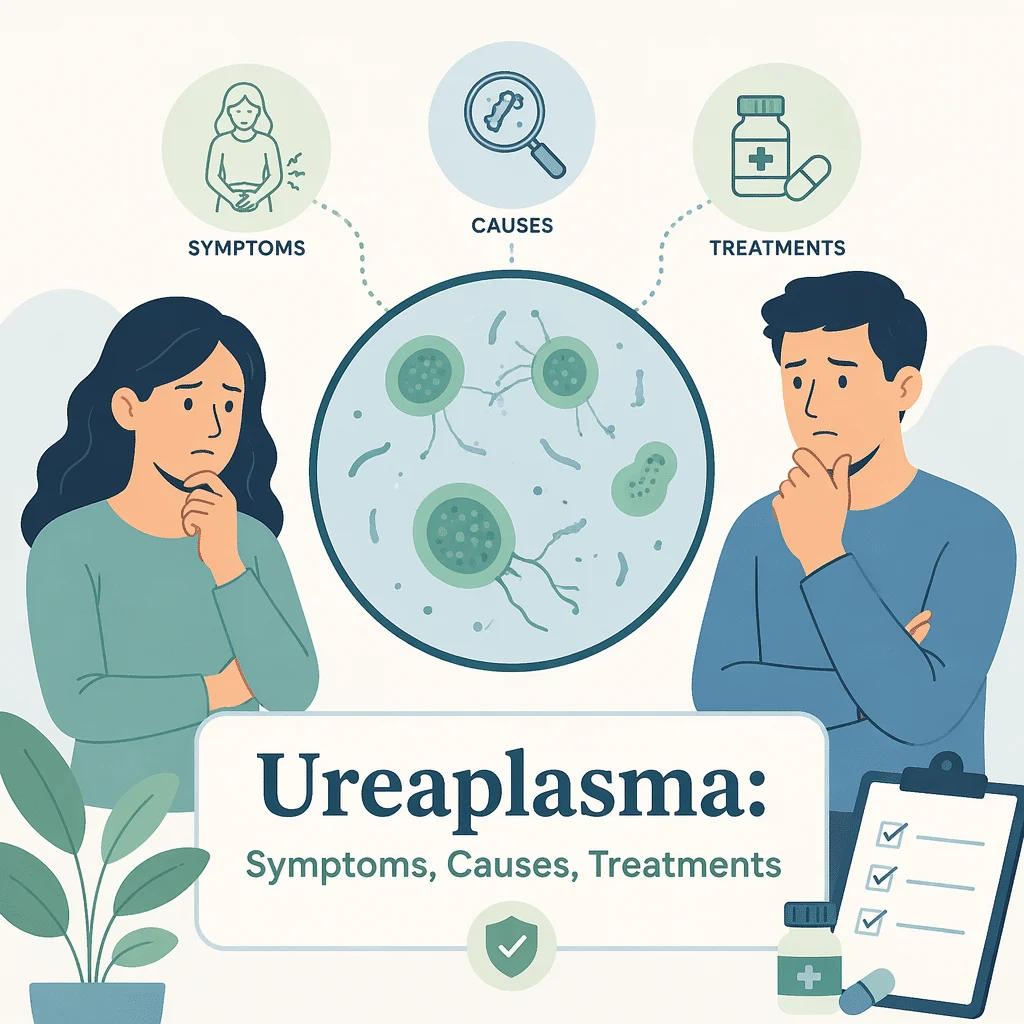
Most people start looking up ureaplasma symptoms after a lab report comes back with an unfamiliar name on it, not because they feel unwell. That order matters, because Ureaplasma sits in an unusual category: it is a bacterium that lives quietly in the genital and urinary tract of a large share of healthy adults, and only occasionally causes disease. A positive test, on its own, is therefore not a diagnosis. In this article you’ll learn what Ureaplasma is, which complaints are genuinely linked to it, how laboratories detect it, and how to read a positive result against your own situation, whether you have no symptoms at all, active urinary or genital complaints, or a pregnancy or fertility work-up under way. You’ll also find what recent research says about antibiotic resistance and about the strength of the evidence tying Ureaplasma to fertility and preterm birth.
What Ureaplasma actually is
Ureaplasma is a genus of very small bacteria that colonize the lining of the genital and urinary tract. Two species live in humans: Ureaplasma urealyticum and Ureaplasma parvum. Both share one unusual feature: they have no cell wall. That quirk explains much of how they are treated, because the antibiotics most people think of first, penicillin and amoxicillin, attack bacterial cell walls. Against an organism that has none, they do nothing.
Two species, one confusing name
Reports often print only Ureaplasma species, though many panels separate the two. Ureaplasma parvum is the more common of the pair in healthy people and generally regarded as less likely to cause disease. Ureaplasma urealyticum is found less often but appears more frequently in studies of urethral inflammation and of altered semen measures.
Commensal, pathogen, or both?
The word for a microbe that lives on the body without causing harm is commensal. Ureaplasma is best understood as a commensal that can occasionally behave as an opportunistic pathogen, an organism that causes trouble only when circumstances favor it. Those circumstances appear to involve how much of the bacterium is present, the balance of the surrounding microbial community, whether the genital lining has been disturbed, and the state of a person’s immune defenses. This dual identity is why two people can carry the same organism and receive completely different advice.
Ureaplasma symptoms in men and women
Ureaplasma symptoms, when they appear at all, are not distinctive. Nothing about them announces this organism rather than a dozen others, which is why clinicians investigate the common causes first. Every complaint below is shared with chlamydia, gonorrhea, Mycoplasma genitalium, trichomoniasis, yeast overgrowth and bacterial vaginosis.
Ureaplasma symptoms men report most often
- Burning or stinging while passing urine
- A thin, watery or cloudy discharge from the penis, often most noticeable in the morning
- Itching inside the tip of the urethra
- Needing to urinate more often, or more urgently, than usual
- Aching in the testicles
Together these are described as urethritis, meaning inflammation of the urethra, the tube that carries urine out of the body. When gonorrhea tests come back negative, clinicians call the picture non-gonococcal urethritis, and Ureaplasma is one of several organisms considered at that stage.
Ureaplasma symptoms women report most often
- Burning while passing urine, or a persistent urge with little urine produced
- A change in vaginal discharge, in volume, color or odor
- Soreness at the vaginal opening; many women first notice vaginal burning
- Discomfort during or after sex
- Lower abdominal or pelvic aching
Because these ureaplasma symptoms overlap so completely with far more common conditions, a positive result in a woman with pelvic pain rarely settles the question. The same complaints can equally indicate a urinary tract infection, and that possibility is normally checked first.
Signs that point somewhere else
A few findings sit outside the usual range of ureaplasma symptoms and point toward something needing its own attention: fever, a thick yellow-green discharge, genital ulcers or blisters, one-sided testicular swelling with pain, and bleeding after sex. A pelvic examination may also reveal a friable cervix. Where the complaint is a rash rather than discharge, clinicians will want to exclude chlamydia, which can itself produce a chlamydia rash. For raised bumps on genital skin, it helps to compare folliculitis and herpes symptoms.
How laboratories detect Ureaplasma
From stubborn cultures to molecular panels
Because Ureaplasma has no cell wall and grows poorly on ordinary culture plates, it was historically hard to detect. Modern testing relies on nucleic acid amplification, usually a PCR-based method that copies and then detects fragments of bacterial DNA. Samples come from a first-catch urine specimen or a urethral, vaginal or endocervical swab. Many laboratories bundle Ureaplasma into a multiplex panel alongside chlamydia, gonorrhea, Mycoplasma genitalium and trichomonas, which is how many people discover they carry it without ever asking.
What else appears on the report
A molecular result rarely travels alone. A urinalysis may also show raised leukocytes in urine, a sign that the immune system is responding to something in the urinary tract. The dipstick portion of the same test measures leukocyte esterase, an enzyme released by those white cells. To see how each line is read in practice, consult our urinalysis results interpretation guide. Where inflammation looks more widespread, a clinician may also check C-reactive protein levels.
Why a positive result is not a diagnosis
A PCR test answers one narrow question, whether this organism’s DNA is present, and it answers it very sensitively. It says nothing about whether the organism is causing anything. Because Ureaplasma is carried harmlessly by a large proportion of sexually active adults, detecting it in someone who feels well is an expected finding rather than a discovery. A diagnosis of Ureaplasma-associated disease needs three things at once: ureaplasma symptoms or measurable inflammation, a positive test, and the reasonable exclusion of more likely causes.
Your result is positive: what it means in your situation
The same line on a laboratory report means different things depending on who is reading it. The table below sets out the three situations clinicians meet most often.
| Your situation | What a positive result usually means | What typically happens next |
|---|---|---|
| No symptoms; Ureaplasma appeared on a panel you did not request | Carriage of a common commensal organism. This is by far the most frequent scenario and is not treated as an infection. | Usually no treatment. Antibiotics are generally not advised, because no benefit has been established while the costs in side effects and resistance are real. |
| Ureaplasma symptoms are present, urinary or genital | A possible contributor, but only once chlamydia, gonorrhea, Mycoplasma genitalium, trichomonas, yeast and bacterial vaginosis have been excluded. | Assessment for measurable inflammation, exclusion of the common causes, then a discussion of whether a targeted antibiotic course is justified. |
| Pregnancy, or a fertility work-up under way | Interpreted with more caution, because Ureaplasma is linked to inflammation inside the uterus and to altered semen measures, though the evidence is uneven. | Individual assessment by the obstetric or fertility team, resting on the whole clinical picture rather than the test alone. |
Why routine screening is not recommended
Major clinical bodies do not recommend screening people without symptoms for Ureaplasma. Cleveland Clinic states plainly that clinicians do not routinely screen for it, and that testing belongs to people with symptoms in whom the more common causes have already been ruled out. The reasoning has four strands.
- Carriage is common. A test that comes back positive in a large share of healthy people cannot, by itself, separate the well from the unwell.
- Treatment has never been shown to help carriers without symptoms. There is no demonstrated benefit in eradicating an organism that is not causing trouble.
- Antibiotics carry real costs. Side effects, disruption of the normal microbial community and the risk of resistance all fall on someone who was not unwell to begin with.
- Overdiagnosis leads to overtreatment. A positive line on a healthy chart can set off anxiety, repeat testing, unnecessary partner treatment and needless strain, a chain of harm triggered by a finding of no clinical significance.
None of this is a reason to ignore genuine symptoms. It is a reason to treat the test as one piece of information rather than a verdict.
Treatment and the resistance problem
Which antibiotics are used
Since Ureaplasma has no cell wall, penicillins and cephalosporins are ineffective. Treatment, where it is warranted, draws on drug classes that act inside the bacterial cell: tetracyclines such as doxycycline, and macrolides such as azithromycin. Which drug, at what dose and for how long are decisions for a clinician who knows your history, and they shift with pregnancy status and local resistance patterns. A course is considered only when ureaplasma symptoms are present and other causes have been excluded.
Resistance is rising
Resistance to both macrolides and tetracyclines has been documented in Ureaplasma populations worldwide, and it varies substantially between regions. A course that once reliably cleared symptoms may no longer do so. Where symptoms persist after treatment, the useful next step is to return to the clinician rather than repeat the same antibiotic, because persistent complaints more often signal a missed alternative diagnosis than a stubborn Ureaplasma. The same pressure is reshaping how other genital infections are managed, a pattern already visible in drug-resistant gonorrhea testing.
Where partners fit in
Ureaplasma can pass between partners through sexual contact, and from mother to baby around the time of birth. Because carriage is widespread and usually harmless, treating a partner who has no symptoms is not standard practice. Condoms reduce transmission and remain worth using for the infections that matter more.
Pregnancy, newborns and fertility
In pregnancy
This is the setting in which Ureaplasma is taken most seriously. Ureaplasma species are among the organisms most often recovered from the amniotic fluid of women with infection inside the uterus, and inflammation there is an established pathway toward early labor. Carrying Ureaplasma in the vagina does not predict a premature birth, and most women who carry it deliver at term. What it does mean is that when there are signs of infection during pregnancy, Ureaplasma is one of the organisms an obstetric team will have in mind. Routine prenatal care already includes standard blood tests during pregnancy.
In newborns
In babies born very prematurely, colonization of the airway with Ureaplasma has been studied as a possible contributor to bronchopulmonary dysplasia, a chronic lung condition of prematurity. This is a neonatal intensive care question, and it has no bearing on a healthy adult’s positive swab.
In fertility investigations
Fertility is where the evidence is weakest and the marketing loudest. Studies have reported associations between Ureaplasma urealyticum and changes in semen measures, but the research is inconsistent and largely observational, meaning it can show that two things occur together without showing that one causes the other. A fertility investigation usually includes a fertility blood test alongside semen analysis, and a Ureaplasma result is read inside that fuller picture.
When to seek care
The list below turns all of the above into practical thresholds for acting on ureaplasma symptoms.
- Arrange prompt assessment for fever with pelvic or testicular pain, one-sided testicular swelling, genital ulcers, or heavy discharge.
- Book a routine appointment for burning on urination, a change in discharge, or discomfort during sex lasting more than a few days.
- Go back to your clinician if symptoms persist after a completed antibiotic course, rather than repeating the same treatment.
- Raise it with your obstetric team if you are pregnant and have been told you carry Ureaplasma.
- Mention it during a fertility work-up, alongside your other results.
- Ask for reassurance rather than antibiotics if you have no symptoms and Ureaplasma simply appeared on a panel.
Latest scientific advances
Research from the past three years has sharpened the picture in three areas: whether these organisms cause disease at all, how well antibiotics still work, and what they mean for fertility and pregnancy. Each study below is summarized in plain language.
A review asked directly: commensals or pathogens?
A 2023 review in Revue Medicale Suisse weighed the evidence on Ureaplasma urealyticum, Ureaplasma parvum and the related Mycoplasma hominis, and concluded that their role in disease remains genuinely unsettled. Testing widely, the authors argued, invites overdiagnosis, meaning finding and treating something that was never going to cause harm.
What this means for you: when a positive result arrives without symptoms, reassurance rather than antibiotics is the evidence-based response, and a clinician who declines to treat is following the research.
Resistance was mapped across regions
A 2024 review in Critical Reviews in Microbiology pulled together global data on how often Ureaplasma resists the antibiotics used against it, and on the mechanisms behind that resistance. Rates differ widely between countries, and both macrolides and tetracyclines, the two mainstays, are affected.
What this means for you: a treatment that works well in one country may work less well in another, and a failed course is not necessarily anyone’s mistake. It is also a concrete reason not to take antibiotics for a positive test without symptoms.
A pooled analysis looked at semen quality
A 2025 systematic review and meta-analysis, a method that combines many separate studies into one overall estimate, found that men testing positive for Ureaplasma urealyticum tended to have more white blood cells in their semen and somewhat poorer semen measures than men who tested negative.
What this means for you: if you are being investigated for difficulty conceiving, this result may be one factor your specialist weighs. It does not establish a cause, and it does not mean antibiotics will restore semen quality.
A broader review found the fertility evidence evenly balanced
A 2023 systematic review assessed eleven sexually transmitted organisms, Ureaplasma among them, against male infertility. Its verdict was that the evidence sits close to a tie, with roughly as many studies of similar quality pointing one way as the other.
What this means for you: treat confident online claims that Ureaplasma causes infertility with real skepticism. The honest summary is that researchers do not yet know.
Preterm infants and chronic lung disease
A 2024 systematic review and meta-analysis pooled studies of very premature babies and found that those whose airways carried Ureaplasma urealyticum were more likely to develop bronchopulmonary dysplasia. The underlying studies varied in design, so the finding still needs confirmation.
What this means for you: this concerns neonatal intensive care, not adult sexual health. For an adult with a positive swab and no symptoms, it changes nothing.
The organism found most often in infection inside the womb
A 2023 review of clinical chorioamnionitis, meaning infection or inflammation of the membranes surrounding the baby, reported that Ureaplasma species are the microorganisms identified most commonly in these cases, usually alongside others. Antibiotic choices here need to cover bacteria without cell walls, which standard combinations do not always do.
What this means for you: in a pregnancy complicated by signs of infection, Ureaplasma is on the specialist’s list. That is a reason to report fever or unusual discharge promptly, not a reason to test while well.
Glossary
| Term | Definition |
|---|---|
| Commensal | A microbe that lives on or in the body without causing disease. Much of the bacteria on healthy skin and in the genital tract is commensal. |
| Opportunistic pathogen | An organism that normally causes no harm but can cause illness when conditions change, for example when the immune system is weakened or a tissue surface is damaged. |
| Colonization | The presence of bacteria on a body surface without signs of infection. Colonization is not the same as disease. |
| Urethritis | Inflammation of the urethra, the tube carrying urine out of the body. It typically causes burning on urination and sometimes discharge. |
| Non-gonococcal urethritis (NGU) | Urethritis that is not caused by gonorrhea. Several organisms can be responsible, and in many cases no organism is identified at all. |
| Nucleic acid amplification test (NAAT) | A laboratory method, often PCR-based, that copies tiny amounts of an organism’s DNA until they can be detected. Very sensitive, which is both its strength and its limitation. |
| Multiplex panel | A single laboratory test that looks for several different organisms at once from one sample. |
| Macrolide | A class of antibiotic that includes azithromycin and clarithromycin. Macrolides work inside the bacterial cell rather than on its wall. |
| Tetracycline | A class of antibiotic that includes doxycycline, also acting inside the bacterial cell. |
| Chorioamnionitis | Infection or inflammation of the membranes surrounding a baby during pregnancy. It is diagnosed and managed by an obstetric team. |
Frequently asked questions
Do ureaplasma symptoms go away on their own?
Often the question does not quite apply, because Ureaplasma is not something most people need to clear. It lives in the genital tract of many healthy adults as a normal resident, so there is nothing to get rid of. Levels of the bacterium do shift over time on their own, and a test taken months apart can easily change from positive to negative without any treatment. Where genuine symptoms are present and the common causes have been excluded, they may settle by themselves, but persistent complaints deserve assessment rather than waiting.
What is the difference between Ureaplasma parvum and Ureaplasma urealyticum?
They are two separate species within the same genus. Ureaplasma parvum is the more commonly carried of the two and is generally regarded as less likely to cause disease. Ureaplasma urealyticum is detected somewhat less often but shows up more frequently in studies of urethral inflammation and of semen quality. In practice, the distinction rarely changes what happens next, because the decision to treat rests on whether you have symptoms and whether other causes have been excluded, not on which species the report names.
If I have Ureaplasma, does my partner need testing?
Not automatically. Because so many people carry Ureaplasma without any problem, testing or treating a partner who feels well is not standard practice and can create worry without any health benefit. The picture changes if your partner has symptoms of their own, or if your symptoms return after a completed course of treatment. In that situation a clinician may want to assess both of you together. It is also worth remembering that a positive Ureaplasma result says nothing reliable about when or from whom it was acquired.
Are at-home Ureaplasma tests worth it?
They are technically capable, but they answer a question that is rarely useful on its own. A home kit will tell you whether the organism’s DNA is present, which for most people it will be, and it cannot tell you whether that finding explains anything you are feeling. The result then arrives without the context a clinician would supply. If you have symptoms, testing for the common causes with clinical follow-up is more useful. If you have none, a positive result is likely to cause more concern than it resolves.
Can Ureaplasma be treated without antibiotics?
There is no proven non-antibiotic treatment that eradicates Ureaplasma, and no supplement or probiotic has been shown to do so. That said, the more relevant point for most people is that eradication is usually not the goal. Where there are no symptoms, no treatment of any kind is generally recommended. Where symptoms exist and other causes have been excluded, an antibiotic prescribed by a clinician is the option with evidence behind it. Anything marketed as a natural Ureaplasma cure should be treated with caution.
Is Ureaplasma classed as a sexually transmitted infection?
It sits awkwardly outside the usual categories. Ureaplasma can pass between partners during sex, which is one route by which people acquire it, but it is not generally classified alongside infections such as chlamydia or gonorrhea, because it is carried harmlessly by so many people and because a positive result does not indicate disease. Cleveland Clinic notes that it is not considered a sexually transmitted infection for exactly that reason. A positive result is not evidence that anyone has done anything wrong.
Sources
- Cleveland Clinic – Ureaplasma: infection, causes, symptoms and treatment – https://my.clevelandclinic.org/health/articles/ureaplasma
- Young A, Toncar A, Leslie SW, Wray AA – Urethritis – StatPearls, National Library of Medicine, 2024 – https://www.ncbi.nlm.nih.gov/books/NBK537282/
- MedlinePlus Medical Encyclopedia – Urethritis – National Library of Medicine – https://medlineplus.gov/ency/article/000439.htm
- Stavart L, Baud D, Eyer M – Ureaplasma urealyticum, Ureaplasma parvum and Mycoplasma hominis: commensals or pathogens? – Revue Medicale Suisse, 2023 – https://doi.org/10.53738/REVMED.2023.19.845.1835
- Liu W, Yang T, Kong Y, Xie X – Ureaplasma infections: update on epidemiology, antimicrobial resistance and pathogenesis – Critical Reviews in Microbiology, 2024 – https://doi.org/10.1080/1040841X.2024.2349556
- Kukoyi OS, Ashonibare VJ, Adegbola CA, Akhigbe TM, et al. – Ureaplasma urealyticum upregulates seminal fluid leukocytes and lowers human semen quality: a systematic review and meta-analysis – Basic and Clinical Andrology, 2025 – https://doi.org/10.1186/s12610-025-00262-5
- Khalafalla K, El Ansari W, Sengupta P, Majzoub A, et al. – Are sexually transmitted infections associated with male infertility? A systematic review and in-depth evaluation of the evidence and mechanisms of action of 11 pathogens – Arab Journal of Urology, 2023 – https://doi.org/10.1080/2090598X.2023.2218566
- Chen X, Huang X, Zhou Q, Kang H, et al. – Association between Ureaplasma urealyticum colonization and bronchopulmonary dysplasia in preterm infants: a systematic review and meta-analysis – Frontiers in Pediatrics, 2024 – https://doi.org/10.3389/fped.2024.1436568
- Jung E, Romero R, Suksai M, Gotsch F, et al. – Clinical chorioamnionitis at term: definition, pathogenesis, microbiology, diagnosis and treatment – American Journal of Obstetrics and Gynecology, 2023 – https://doi.org/10.1016/j.ajog.2023.02.002
Further reading
- Nitrites in urine: causes, symptoms and risks
- Mucus in urine: causes, symptoms and tests
- Human papillomavirus: causes, symptoms and treatments
- A normal Pap result with a positive HPV test
- Hyperspermia: causes, symptoms and risks
Understand your lab results with AI DiagMe
A Ureaplasma result makes sense only next to everything else on the report, which is exactly where most people get stuck. AI DiagMe reads your laboratory documents and explains them in plain language, from a urinalysis and its white cell count to inflammation markers such as C-reactive protein and the hormone panels used in fertility work-ups. It helps you arrive at your appointment understanding what each line measures and which questions are worth asking. It does not diagnose, and it does not replace your doctor.
Get your results interpreted in minutes