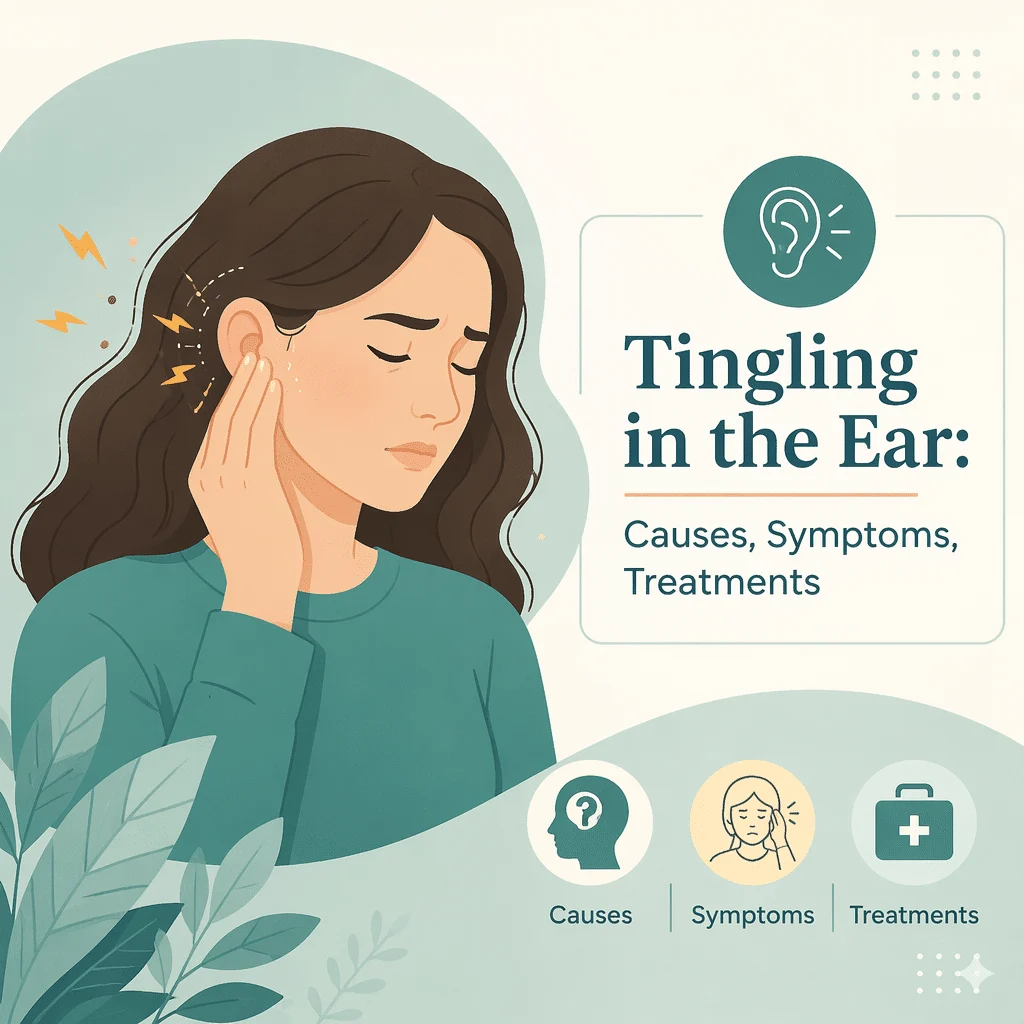
Tingling in the ear is a prickling, buzzing, or pins-and-needles feeling inside the ear canal, on the outer ear, or in the skin just around it. Most of the time it is brief and harmless, set off by something ordinary such as trapped water, a head cold, or a night spent sleeping on one side. Sometimes, though, it is the ear’s version of a message coming from somewhere else entirely: an irritated nerve, a strained jaw joint, or a vitamin or blood sugar problem that a routine lab test can reveal. In this article you’ll learn what causes tingling in the ear, which companion signs matter, which blood tests clinicians commonly order, how treatment is matched to the cause, and the warning signs that mean you should be seen quickly.
What tingling in the ear actually is
Doctors call an abnormal skin sensation paresthesia. It covers prickling, buzzing, crawling, burning, and numbness, and it happens when a nerve that carries touch information is irritated, compressed, inflamed, or poorly nourished. The nerve fires when nothing is touching you, and your brain interprets that firing as a sensation on the skin.
The ear is unusually well supplied with nerves, which is why such a small area can produce so many odd feelings. That density is also why tingling in the ear is rarely a disease in itself. It is a symptom, and the useful question is not what the tingling is, but what is irritating the nerve behind it.
Tingling, pain, and itching are different signals
Distinguishing the three helps a lot at the appointment. Tingling and numbness point toward the nerve supply. Deep aching or throbbing points toward pressure, inflammation, or infection inside the ear. Itching points toward the skin of the ear canal, and often toward dryness, eczema, or an allergic reaction. Many people have a mixture, and the mixture itself is a clue worth describing.
Which nerves reach the ear
Four main nerves share the territory. The great auricular nerve, which comes from the upper neck, covers most of the outer ear and the skin behind it. A branch of the trigeminal nerve, the main sensory nerve of the face, covers the front of the ear and part of the canal. The facial nerve and the vagus nerve each supply small patches deeper inside. Because these nerves originate in the neck, the face, and the brainstem, a problem far from the ear can surface as tingling in the ear.
Common causes of tingling in the ear
Causes inside the ear itself
Earwax pressed against the canal wall is one of the most frequent culprits, especially after using cotton swabs or wearing earbuds for long stretches. Water trapped after swimming or showering can do the same. Outer ear infection, known as otitis externa or swimmer’s ear, irritates the canal skin and often adds itching and pain when the earlobe is pulled. Middle ear problems and Eustachian tube dysfunction, common after a cold or a flight, create pressure and fullness that many people describe as a buzzing or prickling. Our library explains the symptoms, causes, and treatments of ear infections.
The jaw joint, an under-recognized cause
The temporomandibular joint sits directly in front of the ear canal, and its muscles and ligaments share nerve pathways with the ear. When that joint is strained by clenching, grinding, or a habit of chewing on one side, the discomfort is frequently felt as ear fullness, tingling, or ringing rather than as jaw pain. People often visit an ear specialist first and are told their ears look normal. If your symptom rises and falls with chewing, wakes you with a tight jaw, or comes with clicking, the jaw joint deserves a look.
Nerve causes
Irritation of the great auricular nerve can follow a whiplash injury, a long period of poor neck posture, or prolonged pressure from headphones or a phone held against the shoulder. Trigeminal nerve conditions produce brief, electric, shock-like pain that can be triggered by touch, chewing, or even a breeze, sometimes with tingling in between attacks. Shingles affecting the ear, called Ramsay Hunt syndrome, typically begins with burning or tingling a day or two before a blistering rash appears and can be accompanied by facial weakness. That combination is urgent. Our team details the symptoms, causes, and testing of shingles.
Whole-body causes that show up on a blood test
This is the group most often missed. Vitamin B12 deficiency damages the protective coating around nerves and classically produces tingling, usually in the hands and feet first but sometimes elsewhere. Poorly controlled blood sugar damages small nerve fibers over time. Thyroid disease, low calcium, low magnesium, and anemia can all alter how nerves conduct signals. Certain medications, including some chemotherapy agents and some antibiotics, do the same. When tingling in the ear appears on both sides, comes with tingling elsewhere in the body, or persists for weeks, a whole-body cause becomes considerably more likely than an ear problem.
Anxiety, hyperventilation, and migraine
Rapid breathing during anxiety lowers carbon dioxide in the blood and temporarily changes nerve excitability, producing tingling around the mouth, in the fingers, and sometimes in the ears. It is genuinely uncomfortable but not dangerous, and it settles as breathing normalizes. Migraine can also generate spreading tingling as part of an aura. Our team covers the causes, symptoms, and treatments of migraine.
Cause, companion signs, and the tests usually ordered
Clinicians rarely rely on the tingling alone. They read it alongside whatever else is happening. The table below maps the most common explanations to the signs that tend to travel with them and to the investigations a clinician may consider. It is a conversation aid, not a self-diagnosis tool.
| Possible cause | Signs often present alongside | Tests a clinician may order |
|---|---|---|
| Earwax blockage or trapped water | Muffled hearing, fullness and itching on one side | Otoscopic examination, sometimes tympanometry |
| Outer ear infection (swimmer’s ear) | Pain when the earlobe is pulled, discharge, redness | Otoscopic examination, ear swab culture if it persists |
| Eustachian tube dysfunction | Pressure, popping, recent cold or air travel | Otoscopic examination, tympanometry, hearing test |
| Jaw joint (TMJ) disorder | Jaw clicking, morning jaw tightness, teeth grinding | Jaw and bite examination, dental review, imaging only if surgery is weighed |
| Shingles of the ear (Ramsay Hunt syndrome) | Blistering rash near the ear, facial weakness, intense pain | Clinical examination, viral swab of a lesion, urgent referral |
| Vitamin B12 deficiency | Tingling in hands and feet, fatigue, pallor, unsteady balance | Complete blood count, serum vitamin B12, folate, sometimes methylmalonic acid |
| Diabetes or prediabetes | Tingling starting in the feet, thirst, frequent urination, slow healing | Fasting blood glucose, HbA1c |
| Thyroid disorder | Cold or heat intolerance, weight change, fatigue, dry skin | TSH, free T4 |
| Low calcium or low magnesium | Cramps, twitching, tingling around the mouth and fingertips | Electrolyte panel, calcium, magnesium |
| Trigeminal or great auricular nerve irritation | Brief electric-shock pain triggered by touch, chewing, or a breeze | Neurological examination, MRI to rule out other causes |
| Migraine with aura | Headache, light sensitivity, visual changes, tingling that spreads | Clinical diagnosis, imaging only if features are unusual |
Which blood tests help explain tingling in the ear
No blood test detects tingling. What a blood panel does is rule in or rule out the systemic conditions that make nerves misfire, which is exactly why it is so often ordered when the ear examination comes back normal.
Vitamin B12, folate, and the blood count
Vitamin B12 keeps the myelin sheath, the insulating layer around nerve fibers, in good repair. When levels fall, nerves conduct poorly and tingling follows. Risk rises with age, with a vegetarian or vegan diet, after weight-loss surgery, and with long-term use of metformin or acid-reducing medication. A complete blood count often shows enlarged red cells before symptoms become obvious. Our team explains the symptoms, causes, and treatments of low vitamin B12.
Blood sugar and HbA1c
Persistently high blood sugar injures the smallest nerve fibers first. Classically that shows up in the feet, but nerve involvement can be patchier than the textbook picture, and many people are unaware they have prediabetes until a routine panel flags it. Our guide breaks down the three main diabetes blood tests.
Thyroid, electrolytes, and minerals
An underactive thyroid slows nerve conduction and can produce tingling along with fatigue and cold intolerance. Low calcium and low magnesium make nerves hyperexcitable, causing twitching and tingling around the mouth and fingertips. These are inexpensive, widely available tests. This resource reviews the normal thyroid hormone ranges, and we detail the four markers of a standard electrolyte panel.
How the evaluation usually unfolds
A clinician starts with the story, because it narrows the field faster than any machine. Expect questions about which ear, whether the feeling is constant or comes in waves, what makes it better or worse, whether hearing has changed, whether there is jaw clicking, and whether anything else in the body tingles.
The physical examination follows: a look inside the canal and at the eardrum, a check of facial movement and facial sensation, palpation of the jaw joint while you open and close, and an examination of the neck. A hearing test is added when hearing has changed. Tympanometry measures how the eardrum moves and helps identify middle ear pressure problems.
Blood work is ordered when the ear looks healthy, when the tingling is on both sides, or when it has lasted more than a few weeks. Imaging is reserved for specific situations: facial weakness, a sudden change in hearing, a neurological finding, or nerve pain that does not respond to first-line treatment.
Treatment follows the cause
There is no single treatment for tingling in the ear, and that is a good thing, because it means the fix is usually specific and often simple.
- Earwax blockage is treated by softening drops or professional irrigation. Cotton swabs push wax deeper and should be avoided.
- Outer ear infection responds to prescription ear drops, sometimes with a wick if the canal is swollen shut.
- Eustachian tube dysfunction improves with treatment of the underlying congestion, gentle pressure-equalizing techniques, and time.
- Jaw joint problems are managed conservatively first: a night guard, jaw rest, a softer diet for a period, heat, targeted physical therapy, and stress management.
- Shingles of the ear requires antiviral medication started as early as possible, usually with corticosteroids, and is treated as urgent.
- Nerve pain conditions such as trigeminal neuralgia are managed with specific nerve-stabilizing medications rather than ordinary painkillers.
- Nutritional and metabolic causes are corrected at the source: B12 replacement, better blood sugar control, thyroid hormone, or mineral repletion.
Where hearing is affected or ringing accompanies the tingling, management overlaps with the approach to ear noise. We describe the causes and relief options for tinnitus.
Self-care that genuinely helps
Simple measures resolve a surprising share of cases and cost nothing to try for a couple of weeks.
- Stop inserting anything into the ear canal, including cotton swabs and fingertips.
- Dry the ears gently after swimming or showering by tilting the head and using a towel corner, never a hot dryer held close.
- Limit earbud sessions, lower the volume, and clean the tips regularly.
- Change the side you sleep on for a few nights to see whether the sensation follows the pressure.
- Notice jaw habits: unclench during the day, avoid chewing gum and hard foods for a trial period, and check whether the tingling eases.
- Practice slow nasal breathing when anxious, which reverses hyperventilation-related tingling within minutes.
- Keep a short symptom diary noting the ear involved, timing, triggers, and companion signs. It is the single most useful thing to bring to an appointment.
When to see a doctor
Most tingling in the ear is benign, but a small set of features changes the timeline. Call emergency services immediately for sudden weakness or numbness on one side of the body, a drooping face, slurred speech, sudden confusion, or sudden loss of vision, because these can signal a stroke.
Seek same-day care for any of the following:
- Sudden hearing loss in one ear, which is treated as a medical emergency because early treatment improves recovery.
- Weakness or drooping on one side of the face.
- A blistering rash on, in, or around the ear.
- Severe ear pain with fever, or discharge from the ear.
- Tingling that starts after a head or neck injury.
- Spinning dizziness that prevents you from standing.
Book a routine appointment when tingling in the ear lasts more than two to three weeks, affects both ears, comes with tingling in the hands or feet, follows a new medication, or keeps returning without an obvious trigger.
Latest scientific advances
Research published since 2023 has not produced a new cure for this symptom, but it has sharpened two practical points: where the sensation often comes from, and how a workup should be organized. Everything below is summarized in plain language, and none of it replaces an individual medical opinion.
The jaw joint is a bigger contributor than most people expect
A 2026 review in the journal Diagnostics gathered the evidence on ear symptoms in people with temporomandibular disorders, meaning problems of the jaw joint and its muscles. Its central finding is that ear fullness, ear pain, ringing, dizziness, and hearing changes occur consistently in these patients even when the ear itself is completely healthy, and that they are frequently misattributed to a primary ear disease, which delays the right treatment. What this means for you: if your ears have been examined and declared normal but the sensation persists, asking about your jaw is a reasonable and evidence-informed next step.
Treating the jaw often improves the ear symptom
A 2024 systematic review, which is a study that pools and grades all the trials on a question, looked at rehabilitation approaches for ear symptoms in people with jaw joint disorders. It found that occlusal splints, which are custom night guards, along with physical therapy and low-level laser therapy, appeared to improve ear pain and ringing linked to the jaw. The authors were careful: only five randomized trials met their standard, so the result is encouraging but still preliminary and needs larger studies. A separate 2023 clinical study followed forty people whose unexplained ear symptoms were traced to a jaw disorder, and more than half reported complete or partial improvement after jaw-directed treatment. What this means for you: conservative, non-surgical jaw treatment is a legitimate avenue worth discussing, and it is low risk.
Tingling deserves a structured workup, not a wait-and-see
A 2024 overview of abnormal tingling sensations proposed a step-by-step approach for clinicians and confirmed the metabolic causes worth checking, with diabetes and vitamin B12 deficiency named as leading candidates. It also flagged the pattern that should prompt faster action: tingling that appears over days, spreads quickly, is severe, affects one side more than the other, or comes with muscle weakness. What this means for you: persistent tingling justifies a basic blood panel rather than watchful waiting, and a rapidly changing pattern justifies a prompt appointment.
Facial nerve pain is now better defined
A 2024 international disease overview and a 2025 evidence review both restated how trigeminal neuralgia is recognized: sudden, brief, electric-shock-like pain in the face, often set off by light touch, chewing, or a draft of air, with a physical examination that is typically normal between episodes. Both recommend an MRI of the brain in suspected cases to exclude other explanations, and both name carbamazepine as the first medication to try. A further 2024 review focused on the version of this pain that follows shingles of the face, and stressed that vaccination and early antiviral treatment are the main levers for reducing it. What this means for you: if your ear sensation includes sudden electric jolts triggered by touch or chewing, describe it in exactly those words, because that description is what points a clinician toward the right diagnosis.
Glossary of key terms
| Term | Definition |
|---|---|
| Paresthesia | The medical word for an abnormal skin sensation such as tingling, prickling, crawling, or numbness that occurs without anything touching the skin. |
| Great auricular nerve | A nerve arising from the upper neck that carries sensation from most of the outer ear and the skin behind it. |
| Trigeminal nerve | The main sensory nerve of the face. One of its branches supplies the front of the ear and part of the ear canal. |
| Temporomandibular joint (TMJ) | The hinge joint connecting the jaw to the skull, located directly in front of the ear canal. Strain there is often felt as an ear symptom. |
| Otitis externa | Infection or inflammation of the outer ear canal, commonly called swimmer’s ear. It typically causes itching, pain, and sometimes discharge. |
| Eustachian tube dysfunction | Poor opening of the small tube linking the middle ear to the back of the nose, which leaves the ear feeling blocked, full, or popping. |
| Ramsay Hunt syndrome | Shingles affecting the nerves of the ear. It combines ear pain, a blistering rash near the ear, and weakness of one side of the face, and needs urgent treatment. |
| Tympanometry | A quick, painless test that measures how the eardrum moves in response to pressure changes, used to detect middle ear problems. |
| HbA1c | A blood marker reflecting average blood sugar over roughly the previous three months, used to screen for and monitor diabetes. |
| Methylmalonic acid | A substance that builds up when vitamin B12 is lacking. Measuring it can confirm a deficiency when the B12 result alone is borderline. |
| Sudden sensorineural hearing loss | A rapid, unexplained loss of hearing in one ear, usually over less than three days. It is a medical emergency because early treatment improves recovery. |
Frequently asked questions
Does tingling in the left ear mean something different from the right?
Not in any symbolic or predictive sense. Popular folklore attaches meanings to the left or right ear, and none of it has a medical basis. Clinically, however, the side does matter, because it helps narrow the cause. Tingling confined to one ear points toward something local: earwax, an infection, a jaw joint on that side, an irritated nerve, or sleeping position. Tingling in both ears points instead toward a whole-body cause such as a vitamin deficiency, a metabolic problem, a medication effect, or anxiety-related hyperventilation. Tell your clinician which side, and whether it ever switches.
Is tingling in the ear a sign of a stroke?
On its own, almost never. A stroke rarely announces itself with an isolated tingling ear. What matters is the company it keeps. Sudden weakness or numbness on one side of the body, a drooping face, slurred or confused speech, sudden severe headache, loss of balance, or sudden vision loss are the recognized warning signs, and any of them warrants calling emergency services immediately, even if they pass. If your ear tingling is isolated, has been coming and going for weeks, and nothing else is happening neurologically, a stroke is a very unlikely explanation, though the symptom still deserves an evaluation.
Why does my ear feel numb and muffled when I wake up?
The most common explanation is simple pressure. Lying on one ear for several hours compresses the small nerves and blood vessels in the outer ear, exactly as a foot falls asleep. The sensation normally fades within minutes of changing position. A muffled quality that persists after you get up suggests something else, usually wax against the eardrum or fluid behind it after a cold. If the muffled hearing does not clear within a day or two, have the ear looked at, and seek same-day care if hearing dropped suddenly.
Will ear numbness go away on its own?
Frequently, yes. Numbness caused by pressure, trapped water, a mild cold, or a temporary bout of anxiety usually resolves within hours to days once the trigger is removed. Numbness from wax clears as soon as the wax does. What does not tend to resolve unaided is numbness driven by an ongoing cause, such as a jaw joint under daily strain, an untreated infection, a vitamin deficiency, or high blood sugar. A practical rule: give a harmless-seeming episode two to three weeks, and book an appointment if it is still there, is spreading, or is joined by hearing change or facial weakness.
Why does it feel like something is crawling in my ear when nothing is there?
That crawling or tickling quality is a classic form of paresthesia, and it usually reflects irritation of the fine nerves in the ear canal skin rather than anything actually moving. Dry or eczema-prone canal skin, a hair touching the eardrum, healing after an infection, and wax shifting position all produce it. It can also accompany allergy or a recent cold. Resist the urge to probe, which worsens the irritation. If it persists for weeks, or comes with discharge, pain, or hearing loss, have the canal examined.
Can stress or anxiety cause tingling in the ear?
Yes, through two separate routes. The first is hyperventilation: anxious breathing lowers carbon dioxide in the blood and temporarily makes nerves more excitable, producing tingling in the ears, around the mouth, and in the fingers. It is harmless and eases as breathing slows. The second is muscular: sustained stress promotes jaw clenching and neck tension, which irritate the nerves and joint structures around the ear. Stress is a genuine contributor, but it is a diagnosis reached after other causes have been considered, not before.
Sources
- MedlinePlus Medical Encyclopedia (U.S. National Library of Medicine) — Numbness and tingling — https://medlineplus.gov/ency/article/003206.htm
- Cleveland Clinic — Paresthesia: What It Is, Causes, Symptoms and Treatment — https://my.clevelandclinic.org/health/symptoms/24932-paresthesia
- Mayo Clinic — TMJ disorders: Symptoms and causes — https://www.mayoclinic.org/diseases-conditions/tmj/symptoms-causes/syc-20350941
- National Institute on Deafness and Other Communication Disorders (NIDCD) — Sudden Sensorineural Hearing Loss — https://www.nidcd.nih.gov/health/sudden-deafness
- Ebrahimi F, Akbar A, Jin V, Kaul VF, Pearl CB — Otologic Manifestations of Temporomandibular Disorders — Diagnostics, 2026 — https://doi.org/10.3390/diagnostics16121757
- Ferrillo M, Marotta N, Viola P, et al. — Efficacy of rehabilitative therapies on otologic symptoms in patients with temporomandibular disorders: a systematic review of randomised controlled trials — Journal of Oral Rehabilitation, 2024 — https://doi.org/10.1111/joor.13716
- Naderi Y, Karami E, Chamani G, Amizadeh M, Rad M, Shabani M — Temporomandibular treatments are significantly efficient in improving otologic symptoms — BMC Oral Health, 2023 — https://doi.org/10.1186/s12903-023-03627-2
- Slouma M, Ben Dhia S, Cheour E, Gharsallah I — Acroparesthesias: An Overview — Current Rheumatology Reviews, 2024 — https://doi.org/10.2174/0115733971254976230927113202
- Ashina S, Robertson CE, Srikiatkhachorn A, et al. — Trigeminal neuralgia — Nature Reviews Disease Primers, 2024 — https://doi.org/10.1038/s41572-024-00523-z
- Amaechi O — Trigeminal Neuralgia: Rapid Evidence Review — American Family Physician, 2025 — https://pubmed.ncbi.nlm.nih.gov/40378323/
- Niemeyer CS, Harlander-Locke M, Bubak AN, Rzasa-Lynn R, Birlea M — Trigeminal Postherpetic Neuralgia: From Pathophysiology to Treatment — Current Pain and Headache Reports, 2024 — https://doi.org/10.1007/s11916-023-01209-z
Further reading
- Our team explains the meaning of your blood glucose levels.
- This page details the causes and risks of a high TSH result.
- We cover the symptoms, causes, and tests for anemia.
- Our library reviews the causes and treatment of low ferritin.
- You can also consult an A1C to average glucose conversion chart.
Understand your lab results with AI DiagMe
Because tingling in the ear so often traces back to something outside the ear, a blood panel is frequently part of the answer. AI DiagMe reads your laboratory report and explains, in everyday language, what markers such as vitamin B12, fasting glucose, HbA1c, thyroid-stimulating hormone, and your electrolyte panel actually say about you. It is built to help you understand your own results and walk into your appointment with better questions. It does not diagnose, and it does not replace your doctor.
Get your results interpreted in minutes