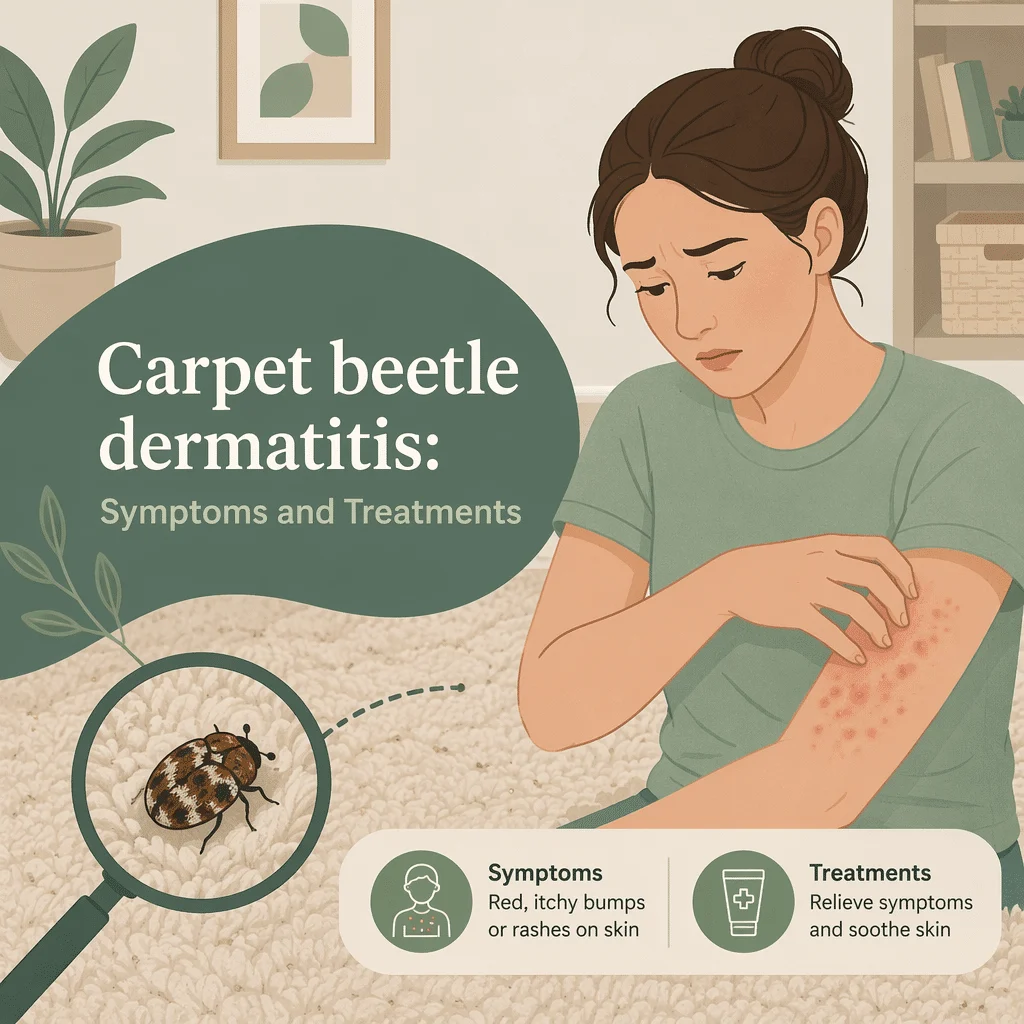
Carpet beetle dermatitis is an itchy rash triggered by contact with the tiny barbed hairs shed by carpet beetle larvae. Carpet beetles do not bite people. That single fact explains why so many people with this rash are told there are no bite marks and sent away, while the itching keeps returning week after week.
If that has happened to you, the rash is still real. Carpet beetle dermatitis is a recognized entity in the dermatology literature, and the absence of puncture marks is exactly what a clinician should expect to find.
In this article you’ll learn how the reaction works, what the rash looks like, why it is mistaken for bed bugs, scabies or fleas, how the cause is identified, and what helps.
What carpet beetle dermatitis is, and why there are no bites
Carpet beetles are small household insects in the family Dermestidae. The adults are a few millimeters long, feed on pollen outdoors, and are harmless to people. They are often noticed on windowsills in spring.
The larvae are the problem. They feed on keratin, the fibrous protein in wool, fur, silk, feathers, leather, pet hair and the dried remains of dead insects. That diet is why they turn up in carpets and stored clothing rather than on people.
Larvae of many carpet beetle species carry rows of specialized detachable hairs called hastisetae. These hairs are spear-shaped, barbed, and break off very easily. Once loose, they drift on household air currents, settle on fabrics and lodge in skin that touches them. Shed larval skins carry them too, so the hairs remain long after a larva has died.
What follows is an irritant and allergic reaction to a foreign particle, not an injury from mouthparts. There is no puncture and no feeding site, because nothing has fed on you. The itching and swelling come from your own immune response. Our guide describes basophils and their role in allergic reactions.
Sensitivity varies, so one person can develop dozens of spots while everyone else in the same rooms stays clear.
What a carpet beetle rash looks like and where it appears
The most consistent feature is itching, and it is often intense. The spots are usually small red bumps, known as papules. They can look hive-like, with raised pink weals that come and go, and in some people they turn into small blisters. They tend to be scattered and isolated rather than clustered.
Location follows contact. The rash appears where skin has met an infested surface: bedding, carpets, upholstered furniture, or stored wool and clothing. Because these hairs collect inside clothes and bedding, spots often show up on covered skin such as the thighs, trunk and upper arms rather than on hands and face. A separate guide reviews the causes of ankle itching at night, and we also cover itchy feet at night and their causes.
The rash arrives in waves: spots fade over roughly a week, then new ones appear as fresh hairs reach the skin. That relapsing rhythm, with no obvious trigger, is one reason the problem drags on for months before anyone thinks of the carpet. Airborne hairs can also irritate the eyes and airways. A broader overview covers the most common skin rash causes and treatments.
Why carpet beetle dermatitis is so often misdiagnosed
Almost everyone reaches for bed bugs first, so mattresses get stripped and furniture gets thrown out. When no bed bugs turn up, the search moves to scabies or fleas. Eczema and allergic contact dermatitis can look similar too. We also describe eczema and how it affects the skin, and another article explains spongiotic dermatitis and its symptoms.
Then comes the outcome that does real harm. When no insect is found and no bite marks are visible, some patients are told the problem is psychological, with a label such as delusional infestation or delusory parasitosis. Published case reports warn clinicians about this trap, because a genuine environmental cause can be sitting untouched under the rug. An itchy rash without visible bite marks is not evidence that nothing is wrong.
The opposite error is just as costly. This page cannot tell you what your rash is. Scabies in particular is contagious, spreads within households and needs prescribed treatment; leaving it untreated because you decided it must be the carpet would be a serious mistake. The table below exists to help you describe your rash to a clinician, not to replace an examination.
| What to compare | Carpet beetle dermatitis | Bed bug bites | Scabies | Flea bites |
|---|---|---|---|---|
| Pattern | Scattered isolated bumps; sometimes hive-like | Often groups of three or four in a line | Widespread bumps plus thin tracks or burrows | Small bumps in groups with a central point |
| Usual location | Skin covered by clothing or touching infested fabric | Uncovered skin: face, neck, hands, arms | Finger webs, wrists, waistline, armpits | Lower legs, ankles, feet, waistline |
| Timing | Waves over weeks; commoner in late winter and spring | Any season; worsens steadily if untreated | Builds over weeks; itch classically worse at night | Any season; linked to a pet or animal nest |
| Itch | Intense at the contact site | Moderate to intense | Severe and relentless, especially in bed | Intense and immediate |
| Key distinguishing feature | No bite marks; larvae or shed skins found in fabrics | Live insects or dark spotting on the mattress | Contagious; close contacts itch too | Fleas visible on a pet or in carpet |
| What to do | Have the rash examined; search fabrics for larvae | Have the rash examined; arrange a pest inspection | See a doctor promptly; contacts may need treatment | See a doctor; have pets checked by a vet |
How carpet beetles get into homes and where the larvae live
Adult carpet beetles usually arrive under their own power, flying in through open windows, doors and vents, or hitching a ride indoors on cut flowers. A few adults on a windowsill are not, by themselves, a crisis.
The females then look for somewhere dark and undisturbed to lay eggs near a food supply, and that is where infestations become hard to find. University extension entomologists list the edges and undersides of carpets, especially where carpet meets the tack strip along a baseboard; folds and seams of stored woolen clothing; the underside of upholstered furniture; floor vents and ducts where pet hair and lint collect; and rarely opened closets. Less obvious sources are often decisive: old bird or rodent nests in attics, dead flies in light fittings, and abandoned spider webs.
Two signs show larvae have been present even when you cannot see one: shed skins, which look like empty bristly husks, and fecal pellets the size of a grain of salt. Fabric damage appears as a grazed patch rather than the scattered holes left by clothes moths.
Air movement spreads the hairs. In one published cluster of cases, the person with the most spots was a child whose bed sat beneath an air conditioning unit, so the rash can appear some distance from the larvae.
How the cause of a carpet beetle rash is actually identified
No blood test and no swab confirms carpet beetle dermatitis. Identification comes from putting three things together.
First, a clinician examines the rash. Its appearance, its distribution, how long it has lasted, whether it comes in waves and who else at home is affected all narrow the possibilities. This step also rules out contagious look-alikes: a doctor who suspects scabies can look for burrows, use dermoscopy or take a skin scraping.
Second, someone searches the environment. Finding larvae, shed skins or adult beetles near where the rash occurs is the strongest practical evidence. Inspect carpet edges, closets, stored wool, furniture undersides and vents. Sticky traps can reveal an infestation that inspection misses, and a pest control professional can identify specimens you collect.
Third, the rash settles once the source is gone. That retrospective confirmation is often the clearest evidence of all.
Blood tests do not diagnose this condition. A doctor investigating persistent itching may order tests reflecting allergy or inflammation rather than any insect. Our explainer covers eosinophils and what they measure, we describe the allergy blood test and its results, and we explain the complete blood count and its components.
What helps: environmental control first, skin care from a clinician
The lasting fix is environmental: as long as those hairs keep reaching your skin, creams only manage the symptoms.
Start by removing the source. Launder or dry-clean infested fabrics, since hot washing and tumble dryer heat kill eggs and larvae. Discard badly infested items, bagging them first so the beetles do not spread. Store clean woolens and linens in sealed containers rather than open closets.
Then vacuum thoroughly and repeatedly, paying attention to carpet edges and baseboards, underneath furniture, inside closets, and in floor vents and ducts where lint builds up. Empty the canister or dispose of the bag outside the house straight away, because it will contain eggs, larvae and loose hairs. Clean air conditioning units in affected rooms. For a persistent infestation, call a licensed pest control operator, who can locate hidden sources and treat spaces such as wall voids.
Do not improvise with insecticides. This article gives no application instructions on purpose. Misusing pesticides carries real risks to the people and pets in your home, some products should never touch clothing or bedding, and treating the wrong pest wastes money while the real source keeps shedding hairs. The US Environmental Protection Agency publishes guidance on using pest control safely.
Managing the skin while you clear the source
Skin treatment is symptomatic, and the decisions belong with a clinician who has seen the rash. Depending on severity, a doctor may consider a topical anti-inflammatory treatment, an oral antihistamine-type medicine, or a short course of systemic treatment. Which product, which strength and for how long are medical judgements, and this article gives no dosing advice.
Cool compresses reduce the burning sensation. Keeping fingernails short and not scratching lowers the risk of a secondary skin infection, the most common complication. Another page explains C-reactive protein as an inflammation marker, one of the tests a doctor may use when infection is suspected.
Why the rash can persist after the beetles are gone
The hairs are durable, and they stay embedded in carpet fibers, mattress covers, upholstery and ductwork long after every living larva is gone. They keep reaching skin whenever those surfaces are disturbed.
A rash that carries on for weeks after successful pest control is not a sign that the treatment failed. It usually means fabric still holds hairs, and systematic laundering and repeated vacuuming is what clears them.
If new spots keep appearing after several weeks of cleaning, go back to the search. An untouched source, such as a stored rug or a duct full of pet hair, is the usual explanation.
When to see a doctor about an itchy rash
See a clinician rather than a web page if the rash has lasted more than a week or two, keeps returning, is spreading, disturbs your sleep, or if you are not sure what it is. Several look-alike conditions need specific treatment, and one of them is contagious.
Bring useful detail: photographs of the rash at its worst, a note of when and where the spots appear, who else at home is affected, and any insects or shed skins you collected in a sealed container. We also cover a painful skin rash and its possible causes.
Red flags: seek medical care promptly
- Redness that is spreading, or skin that feels warm or tender to the touch
- Pus, yellow crusting or weeping from the spots
- Fever, chills or feeling generally unwell
- A rash that is worsening rapidly rather than gradually
- Blistering, especially if the blisters are large or the skin breaks down
- Any involvement of the eyes or eyelids
- Facial or lip swelling, wheezing, or difficulty breathing or swallowing, which need emergency care
What the research says about carpet beetle dermatitis
According to PubMed, the evidence on this condition is thin and consists mainly of case reports and short case series. A case report describes a single patient; a case series describes a small group written up together.
A cluster of 11 patients in France, 2021
Doctors in Nice described 11 people from seven unrelated families who attended a dermatology clinic over three months with itchy red bumps lasting several weeks. No bed bugs or fleas were found in any home. A medical entomologist, a specialist in insects affecting human health, found carpet beetle larvae in clothing and upholstery instead, and most spots were on covered skin. The families cleaned, vacuumed and laundered without insecticide, and the lesions healed.
What this means for you: the rash can affect several people in one home and be missed entirely, and here cleaning alone was enough, with no pesticide spraying.
A clinical review of dermestid beetle reactions, 2024
This review summarizes what is known about skin problems caused by carpet beetles and their relatives. It describes hastisetae, notes that reactions can be immediate or delayed, and reports effects ranging from dermatitis to eye and nose irritation and asthma. Treatment, it says, is largely empiric, meaning chosen from experience rather than trial data.
What this means for you: this is the most recent overview available. It confirms the mechanism and is honest that there is no specific test and no cure; treatment aims at comfort while the source is dealt with.
Two 2015 reports on misdiagnosis
The first describes a two-year-old girl with a papulovesicular rash, meaning small bumps mixed with small blisters, alongside a review of earlier reports. Its authors state plainly that this reaction is often mistaken for bed bug or other arthropod bites, for scabies mite infestation, or used as the basis for a diagnosis of delusory parasitosis, the assumption that a patient only imagines an infestation. The second was titled “Carpet beetle dermatitis: a possibly under-recognized entity.”
What this means for you: if you have been told your rash is imagined, these are the papers that say specialists should think again. Both name scabies as a look-alike, which is why an examination matters.
A rash mistaken for a bacterial infection, 2020
A 13-year-old had three months of recurring blisters and crusted sores on the face, neck and shoulder, treated without benefit for presumed bullous impetigo, a bacterial skin infection. Samples from her home revealed carpet beetles in a wool rug. The lesson: a treatment that is not working is a reason to reconsider the cause.
How strong is this evidence?
Case reports and case series sit near the bottom of the evidence hierarchy: they describe a handful of individuals, cannot show how often something occurs, and cannot prove a treatment worked rather than the rash settling on its own. There are no randomized trials on carpet beetle dermatitis, and much of the literature is old, with the first detailed description published in 1981. Guidance therefore rests on clinical experience and a well-understood mechanism, not on strong trial evidence. That is a reason to see a clinician, not a reason to doubt that your rash is real.
Glossary of key terms
| Term | Definition |
|---|---|
| Carpet beetle | A small household beetle of the family Dermestidae whose larvae feed on wool, fur, feathers and other animal materials. |
| Larva | The immature, grub-like stage of an insect, which often looks nothing like the adult. |
| Hastisetae | The spear-shaped, barbed, easily detached hairs on carpet beetle larvae that lodge in skin and trigger the rash. |
| Papule | A small solid raised bump on the skin, usually less than a centimeter across. |
| Urticarial | Hive-like in appearance: raised, pink, itchy weals that typically come and go within hours. |
| Vesicle | A small blister containing clear fluid. |
| Hypersensitivity reaction | An exaggerated immune response to something harmless, which is what produces the itching and redness here. |
| Differential diagnosis | The list of conditions a clinician considers and works through before settling on an explanation. |
| Delusional infestation | Also called delusory parasitosis: a psychiatric diagnosis of believing oneself infested, which has sometimes been applied in error to people who really did have carpet beetles. |
| Case series | A report describing a small group of patients together; useful for spotting patterns, but weak evidence about cause or treatment. |
Frequently asked questions
Do carpet beetles bite?
No. Carpet beetles do not bite people at any stage of their life. Adults feed on pollen and nectar, and the larvae feed on wool, fur, feathers and similar animal materials, not on blood or skin. What people call a carpet beetle bite is an allergic and irritant reaction to the barbed hairs shed by the larvae, which lodge in the outer layers of skin. That is why there is no puncture mark, no central feeding point and nothing to find when someone inspects the mattress. The reaction is real; the bite is not.
How do I tell a carpet beetle rash from bed bug bites?
You cannot tell them apart reliably from the skin alone, which is why an examination matters. A few patterns help, though. Bed bug bites usually appear on uncovered skin such as the face, neck, hands and arms, often in short lines or clusters of three or four, and there is normally physical evidence on the mattress: live insects, shed cases or dark spotting. Carpet beetle spots tend to be isolated, scattered and mostly on skin under clothing, with no bite marks and no bugs in the bed, but with larvae or shed skins somewhere in the fabrics.
How long does a carpet beetle rash last?
Individual spots usually fade over about a week. The overall rash, however, often continues for several weeks or longer, because new hairs keep reaching the skin. It can also persist after pest control succeeds, since the hairs stay in carpets, mattresses and ducts for some time and are released when those surfaces are disturbed. Repeated vacuuming and laundering shortens that tail. If new spots are still appearing after several weeks of thorough cleaning, an untreated source is probably still present, and it is worth seeing a clinician to reconsider the diagnosis.
Is carpet beetle dermatitis contagious?
No. The rash itself cannot pass from person to person. Several people in one household can develop it at the same time, but that is because they share the same environment, not because they infect each other. Loose hairs can transfer on clothing and bedding, so a shared laundry basket or sofa can spread the exposure. This is an important difference from scabies, which is genuinely contagious and needs treatment for the affected person and often for close contacts too.
Why is only one person in my home affected?
Because sensitivity to the hairs varies a great deal between individuals. In published reports of household clusters, some family members developed dozens of spots while others sharing the same rooms and bedding had none at all. Sleeping position, how much time is spent on an infested sofa or carpet, and how close a bed sits to an air vent all change the exposure too. An unequal rash across a household is therefore expected here, and it is not a reason to doubt that a real environmental cause exists.
Can carpet beetle larvae cause breathing or eye symptoms?
They can. Because the hairs are light enough to travel on air currents, they can reach the eyes and the lining of the nose and airways as well as the skin. Published reports describe eye and nose irritation, and asthma has been linked to heavy exposure in some cases. If you develop wheezing, breathlessness, or persistent eye irritation alongside the rash, tell a doctor rather than treating it as a skin problem alone. Sudden facial swelling or difficulty breathing needs emergency care.
Sources
- University of Kentucky Entomology, ENTFACT-601: Carpet Beetles
- UC Statewide IPM Program, Pest Notes: Carpet Beetles (UC ANR Publication 7436)
- US Environmental Protection Agency, Citizen’s Guide to Pest Control and Pesticide Safety
- MedlinePlus (US National Library of Medicine), Rashes
- Simon L, Boukari F, Almou Oumarou H, Hubiche T, Marty P, Pomares C, Delaunay P. Anthrenus sp. and an Uncommon Cluster of Dermatitis. Emerging Infectious Diseases, 2021 (via PubMed)
- Johnson AG, Rohr BR. What’s Eating You? Carpet Beetles (Dermestidae). Cutis, 2024 (via PubMed)
- Hoverson K, Wohltmann WE, Pollack RJ, Schissel DJ. Dermestid Dermatitis in a 2-Year-Old Girl: Case Report and Review of the Literature. Pediatric Dermatology, 2015 (via PubMed)
- MacArthur KM, Richardson V, Novoa RA, Stewart CL, Rosenbach M. Carpet beetle dermatitis: a possibly under-recognized entity. International Journal of Dermatology, 2015 (via PubMed)
- Gumina ME, Yan AC. Carpet beetle dermatitis mimicking bullous impetigo. Pediatric Dermatology, 2020 (via PubMed)
- Ruzzier E, Kadej M, Battisti A. Occurrence, ecological function and medical importance of dermestid beetle hastisetae. PeerJ, 2020 (via PubMed)
Further reading
- Our library explains the most common skin rash causes and treatments
- We describe eczema and how it affects the skin
- Another article covers spongiotic dermatitis and its treatments
- We explain the allergy blood test and how to read it
- Our explainer covers eosinophils and what a high result can mean
Understand your lab results with AI DiagMe
Blood tests cannot diagnose a rash, and AI DiagMe cannot see your skin. If a doctor is investigating persistent itching more broadly, though, they may order things like a full blood count or allergy-related markers, and those reports are often hard to read. AI DiagMe explains what such results mean in plain language so you can have a clearer conversation with your clinician. It does not diagnose anything and does not replace medical advice.
Get your results interpreted in minutes