








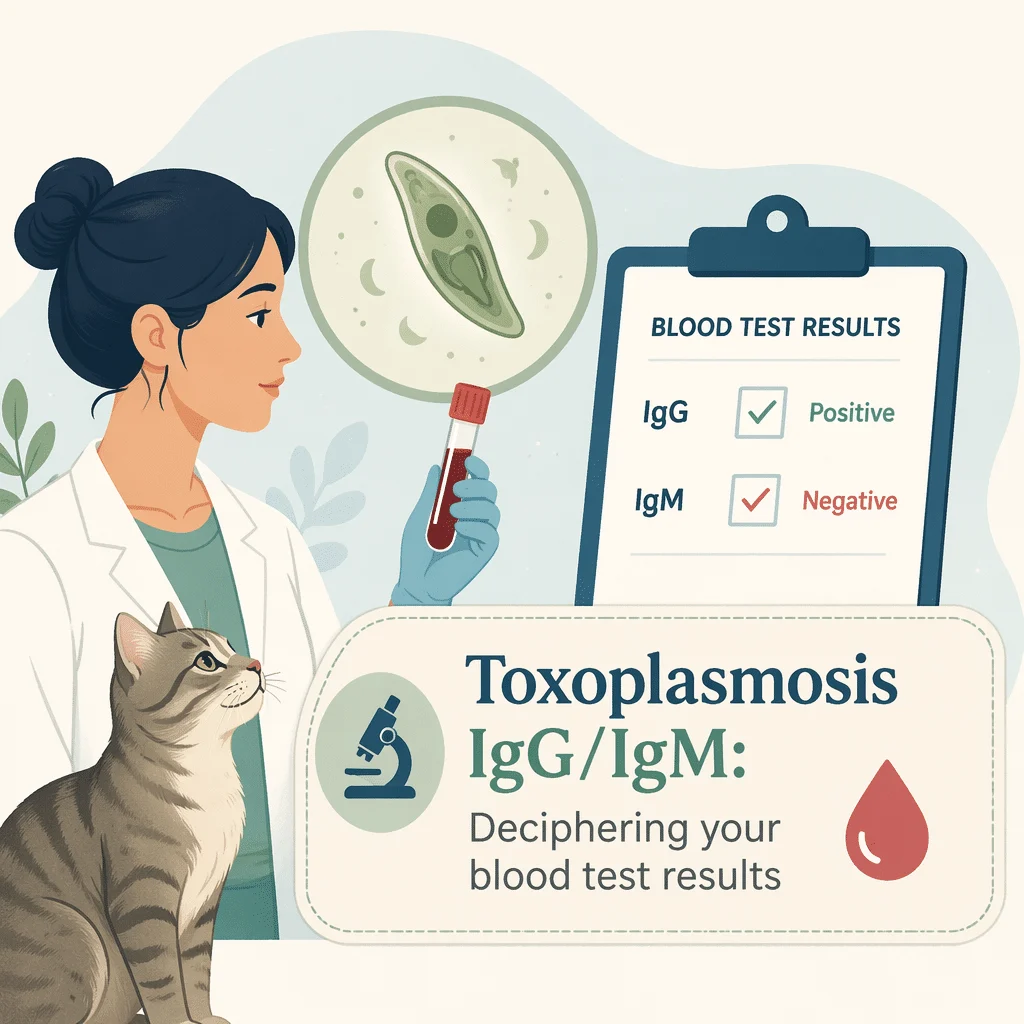
Toxoplasmose IgG en IgM zijn de twee antistoffen die uw laboratorium heeft gemeten om te bepalen of u ooit in contact bent gekomen met een veelvoorkomende parasiet genaamd Toxoplasma gondii en, zo ja, ongeveer wanneer. Als u zwanger bent en nu naar een positieve IgM-lijn kijkt, haal dan eerst even diep adem: een positieve IgM betekent niet betrouwbaar dat u deze infectie recent heeft opgelopen. IgM kan een jaar of langer in uw bloed aanwezig blijven na een oude infectie, en standaard testkits geven vrij vaak fout-positieve uitslagen. Dat ene feit verandert hoe de meeste van deze uitslagen gelezen moeten worden.
In dit artikel leert u wat IgG en IgM elk meten, hoe u alle vier mogelijke combinaties van de twee kunt lezen, waarom een positieve IgM zo vaak misleidend blijkt te zijn, welk onderzoek de vraag werkelijk beantwoordt, en wat dit allemaal betekent tijdens de zwangerschap of als uw immuunsysteem verzwakt is.
Wat toxoplasmose is, en wat IgG en IgM meten
Toxoplasmose is een infectie veroorzaakt door Toxoplasma gondii, een microscopische parasiet die werkelijk veel voorkomt. De meeste mensen die hem oplopen merken er niets van: bij gezonde volwassenen veroorzaakt hij meestal helemaal niets, of een milde griepachtige periode die vanzelf overgaat. De parasiet nestelt zich vervolgens in een slapende toestand in spier- en hersenweefsel en blijft daar rustig aanwezig, in toom gehouden door uw immuunsysteem, voor de rest van uw leven.
Een bloedtest kan de parasiet niet rechtstreeks zien. Wat hij in plaats daarvan meet, is uw immuunreactie: de antistoffen die u heeft aangemaakt. Antistoffen zijn eiwitten die uw immuunsysteem aanmaakt om één specifieke indringer te herkennen, en ze komen in klassen voor. Twee ervan zijn hier van belang.
IgM, de eerste responder
IgM is de antistofklasse die uw lichaam als eerste aanmaakt, doorgaans binnen één tot twee weken na een nieuwe infectie. Omdat het vroeg verschijnt, wordt IgM al lang beschouwd als een marker van een recente infectie. Het probleem — en dit is de kern van dit artikel — is dat IgM niet altijd verdwijnt zodra de infectie oud is. Ons afzonderlijke artikel behandelt de bredere rol van Immunoglobuline M.
IgG, het langetermijngeheugen
IgG verschijnt later, doorgaans één tot drie weken na IgM, stijgt gedurende een paar maanden en blijft daarna levenslang aanwezig. Bij toxoplasmose betekent het ook bescherming: als u het heeft, is de kans zeer klein dat u een nieuwe infectie oploopt. Onze gids legt uit Immunoglobuline G.
De twee markers beantwoorden dus verschillende vragen. IgG vraagt of u deze parasiet ooit heeft ontmoet. IgM probeert te vragen of u hem recent heeft ontmoet, en is daar veel slechter in dan zijn reputatie doet vermoeden. Toxoplasma-serologie staat gewoonlijk naast andere infectiemarkers, die we behandelen in onze gids over de serologietest.
De vier combinaties van toxoplasmose IgG en IgM begrijpen
Geen van beide markers zegt veel op zichzelf. De combinatie is wat telt. Hieronder staan de vier mogelijke uitkomsten die een uitslag kan laten zien. Lees de laatste kolom als een algemene leidraad, niet als instructies: uw arts bepaalt wat er verder gebeurt.
| IgG | IgM | Wat het doorgaans betekent | Gebruikelijke volgende stap |
|---|---|---|---|
| Positief | Negatief | Vroegere infectie, langdurige immuniteit | Meestal geen verdere actie nodig; geruststellend tijdens zwangerschap |
| Negatief | Negatief | Nooit geïnfecteerd, niet immuun | Preventieadvies, vooral tijdens zwangerschap |
| Negatief | Positief | Meestal een fout-positieve uitslag; soms een zeer vroege infectie | Test herhalen over ongeveer twee tot drie weken |
| Positief | Positief | Onduidelijk: kan wijzen op een oude of een recente infectie | IgG-aviditeitstest, meestal met bevestiging door een referentielaboratorium |
IgG positief, IgM negatief: een vroegere infectie en blijvende immuniteit
Dit is het meest voorkomende positieve patroon, en het is goed nieuws. U heeft op een bepaald moment in het verleden toxoplasmose opgelopen — waarschijnlijk jaren geleden — uw immuunsysteem heeft dit aangepakt, en u heeft nu blijvende bescherming. Tijdens de zwangerschap is deze combinatie over het algemeen geruststellend, omdat bestaande immuniteit de kans op een nieuwe infectie die de baby kan bereiken zeer klein maakt. Doorgaans is geen verdere controle nodig. De uitzondering vormen mensen bij wie de afweer later ernstig verzwakt raakt.
IgG negatief, IgM negatief: nooit geïnfecteerd en niet immuun
U heeft de parasiet nooit ontmoet. Er is niets mis: de meeste volwassenen in Nederland vallen in deze groep. Er is geen immuniteit te verliezen en niets te behandelen. Wat deze uitslag wél duidelijk maakt, is dat preventie de moeite waard is om te kennen — zeker als u zwanger bent of dat wilt worden — omdat u vatbaar blijft voor een eerste infectie.
IgG negatief, IgM positief: meestal een fout-positieve uitslag
Deze combinatie veroorzaakt de meeste onnodige ongerustheid, en is tegelijkertijd het vaakst onjuist. Een geïsoleerde positieve IgM zonder IgG is in de grote meerderheid van de gevallen een fout-positieve uitslag: de test reageert op iets anders dan toxoplasmose. De andere mogelijkheid is een werkelijk gloednieuwe infectie die is opgelopen voordat IgG de tijd heeft gehad om te verschijnen — wat ongebruikelijk is. Omdat beide mogelijk zijn, is het antwoord niet raden, maar de test herhalen over ongeveer twee tot drie weken. Als IgG verschijnt, was de infectie echt en recent. Als IgG negatief blijft terwijl IgM positief blijft, was de eerste uitslag een vals alarm.
IgG positief, IgM positief: onduidelijk, en vereist datering
Beide markers positief is werkelijk dubbelzinnig, en het is niet de noodsituatie die het lijkt. Het is verenigbaar met een infectie van de afgelopen maanden, maar even goed met een infectie van jaren geleden waarbij het IgM simpelweg nooit is verdwenen. Dit patroon alleen kan de twee niet van elkaar onderscheiden. Om dat te doen is een andere test nodig, de zogenaamde IgG-aviditeitstest, en doorgaans bevestiging in een gespecialiseerd laboratorium.
Waarom een positief IgM niet betekent dat de infectie recent is
Als je één ding uit dit artikel onthoudt, laat het dit zijn. De aanname dat positief IgM gelijkstaat aan een verse infectie is de meest voorkomende fout bij het lezen van toxoplasmose-serologie, en die heeft echte schade aangericht: angst, onnodige onderzoeken, en in het verleden zelfs beëindigde zwangerschappen op basis van een uitslag die nooit betrouwbaar was. Twee afzonderlijke problemen liggen eraan ten grondslag.
IgM blijft lang aanwezig nadat de infectie voorbij is
Toxoplasma-IgM verdwijnt niet netjes wanneer een infectie is uitgewoed. Het CDC merkt op dat Toxoplasma-specifiek IgM nog tot 18 maanden aantoonbaar kan zijn na een nieuw opgelopen infectie, en sommige mensen dragen het jarenlang bij zich. Iemand die drie jaar geleden besmet raakte, kan vandaag nog steeds een positief IgM laten zien. Het antilichaam is echt; het tijdsverhaal dat het lijkt te vertellen, niet.
Gangbare testkits geven fout-positieve uitslagen
De commerciële IgM-kits die de meeste ziekenhuis- en eerstelijnslaboratoria gebruiken, zijn bedoeld voor screening, niet voor het dateren van een infectie. Ze geven bij een aantal mensen een positieve uitslag terwijl er geen recente infectie is. De betrouwbaarheid verschilt ook per fabrikant en laboratorium, wat verklaart waarom hetzelfde bloed op verschillende plaatsen verschillende antwoorden kan opleveren.
Combineer die twee problemen en je krijgt wat Amerikaanse specialisten in de praktijk zien. Van de patiënten die naar het nationale referentielaboratorium werden verwezen omdat hun lokale test zowel IgM als IgG positief toonde — het patroon dat het meest verontrustend lijkt — bleek ongeveer driekwart een oude, chronische infectie te hebben in plaats van een recente.
Wat de vraag werkelijk beantwoordt
Drie methoden, in globale volgorde van toepassing:
- Herhalingstest. Een tweede bloedafname twee tot drie weken later laat zien of er iets verandert. Antilichamen die reageren op een werkelijk nieuwe infectie veranderen in dat tijdsbestek; een verouderd IgM blijft stabiel.
- IgG-aviditeit. Aviditeit meet hoe stevig uw IgG-antistoffen de parasiet vasthouden. Deze bindingskracht neemt toe met de tijd, waardoor zwak bindend IgG wijst op een recentere immuunrespons en sterk bindend IgG op een oudere. Een hoge aviditeit is het echt nuttige resultaat: het bevestigt dat de infectie minstens drie tot vijf maanden geleden heeft plaatsgevonden, wat vroeg in de zwangerschap een infectie tijdens die zwangerschap in feite kan uitsluiten. Een lage aviditeit is minder veelzeggend dan het lijkt, omdat deze maandenlang kan aanhouden en op zichzelf geen bewijs is van een recente infectie.
- Bevestiging door een referentielaboratorium. Omdat acute toxoplasmose van nature moeilijk te diagnosticeren is, adviseert de CDC artsen om bevestigend onderzoek aan te vragen via het gespecialiseerde referentielaboratorium van Sutter Health in Palo Alto, Californië, dat deze rol op nationaal niveau vervult. Dit is in de VS de standaardprocedure bij een vermoedelijk acuut resultaat, en geen uitzonderlijke maatregel.
Dit is niets wat u zelf regelt; uw arts vraagt het aan. Maar het helpt om te weten dat deze weg bestaat terwijl u wacht.
Wat de IgG- en IgM-resultaten voor toxoplasmose betekenen tijdens de zwangerschap
Twee stukjes context zijn hier nuttig, en beide ontbreken doorgaans in wat mensen online vinden.
Het eerste is dat de Verenigde Staten niet elke zwangerschap screenen op toxoplasmose. Anders dan Frankrijk, dat vatbare zwangere vrouwen al sinds het begin van de jaren negentig maandelijks test, is het in de VS gebruikelijk om selectief te testen — meestal omdat een echografische bevinding een vraag oproept, of omdat er sprake is van een specifieke blootstelling of klacht die nader onderzoek rechtvaardigt. Dit is belangrijk bij het interpreteren van uw uitslag: als u in de VS getest bent, was daar waarschijnlijk een reden voor, en het is de moeite waard om uw arts te vragen wat die reden was. Het betekent ook dat veel van het verontrustende materiaal online geschreven is voor een screeningssysteem dat anders werkt dan het uwe.
Het tweede is dat de volgorde van resultaten belangrijker is dan één enkel resultaat. Iemand die al IgG had vóór de conceptie is beschermd. Het risico voor een baby ontstaat specifiek door een eerste infectie die tijdens de zwangerschap of kort daarvoor wordt opgelopen — en precies daarom draait alles om het dateren van een infectie, niet alleen om het aantonen van antistoffen. Congenitale toxoplasmose is zeldzaam in de VS, een eerste infectie leidt niet altijd tot overdracht op de baby, en de uitkomsten zijn beter wanneer de situatie vroeg wordt vastgesteld en behandeld.
Als uw uitslag onduidelijk is, is de juiste volgende stap een gesprek met uw gynaecoloog, die eventueel een specialist in maternale en foetale geneeskunde kan inschakelen. Die kan een aviditeitstest aanvragen, monsters opsturen voor referentiebevestiging en een echografische follow-up regelen. Beslissingen over uw zwangerschap zijn aan u en uw medisch team, op basis van een bevestigde uitslag — nooit op grond van één onduidelijke IgM op een screeningstest. Als u wilt weten wat er verder routinematig wordt gecontroleerd, behandelen we dat in bloedonderzoek tijdens de zwangerschap.
Als u niet immuun bent, dit is wat infectie werkelijk voorkomt
Een negatieve IgG-uitslag betekent simpelweg dat u vatbaar bent. Preventie is praktisch uitvoerbaar, en het is de moeite waard om duidelijk te zijn over waar het echte risico ligt — want de gangbare versie van dit advies is zowel onjuist als onnodig verontrustend.
Voeding is de belangrijkste besmettingsroute
- Verhit vlees goed. De CDC-richtlijnen schrijven voor: hele stukken vlees tot 63°C, gehakt tot 71°C en gevogelte tot 74°C. Ook het invriezen van vlees gedurende meerdere dagen bij -18°C doodt de parasiet.
- Spoel fruit en groenten af voor u ze eet, met name alles wat dicht bij de grond groeit.
- Vermijd rauwe of onvoldoende verhitte schelpdieren en ongepasteuriseerde geitenmelk.
- Was uw handen, snijplanken en messen na het hanteren van rauw vlees.
Grond, tuinieren en zandbakken
De parasiet overleeft in de grond. Draag handschoenen bij het tuinieren of bij elk werk met grond of zand, was uw handen daarna en houd zandbakken afgedekt.
Over uw kat: nee, u hoeft hem niet weg te doen
Katten maken deel uit van de levenscyclus van de parasiet, wat hen een reputatie heeft bezorgd die ze grotendeels niet verdienen. Een kat scheidt de parasiet slechts gedurende een korte periode uit, namelijk vlak nadat ze zelf besmet zijn geraakt — doorgaans door te jagen of rauw vlees te eten. Het ACOG stelt het duidelijk: een binnenkat die kattenvoer eet en niet jaagt, vormt een zeer laag risico. Bovendien is de parasiet in kattenfeces de eerste één tot vijf dagen niet besmettelijk, dus de kattenbak dagelijks verschonen verwijdert het grootste deel van wat er overblijft. Als u zwanger bent en niet immuun, is de eenvoudigste oplossing dat iemand anders de bak leegt; als dat niet mogelijk is, volstaan handschoenen en handen wassen. Het hebben van een kat is geen reden voor schuldgevoel. Onvoldoende verhit vlees en ongewassen groenten en fruit verdienen veel meer uw aandacht.
Toxoplasmose bij een verzwakt immuunsysteem
Hier verandert de betekenis van een positief IgG. Voor de meeste mensen betekent IgG-positief: beschermd en klaar. Voor iemand wiens afweersysteem ernstig verzwakt is — door gevorderd hiv, een orgaan- of stamceltransplantatie, bepaalde kankertherapieën of langdurig gebruik van immunosuppressiva — wordt die slapende parasiet in toom gehouden door een immuunsysteem dat dit mogelijk niet langer aankan. De parasiet kan opnieuw actief worden, met name in de hersenen.
Daarom wordt de IgG-status voor toxoplasmose gecontroleerd vóór transplantaties en bij mensen met gevorderd hiv. Weten of de parasiet überhaupt aanwezig is, bepaalt waar een behandelteam op let en welke preventieve maatregelen worden overwogen. We leggen de bijbehorende tests uit in ons artikel over HIV-screening, en immuunceltellingen komen aan bod in onze gids over lymfocyten.
Reactivering is iets anders dan een eerste infectie. Als u gezond bent en IgG-positief, gaat dit gedeelte niet over u.
Wanneer moet je een arts raadplegen?
Neem snel contact op met uw arts als:
- U zwanger bent en een toxoplasmose-uitslag positief of onduidelijk is. Vraag om uitleg voordat u conclusies trekt.
- Uw IgM positief is en niemand u heeft verteld wat de volgende test is.
- U zwanger bent, IgG-negatief bent en denkt dat u mogelijk blootgesteld bent geweest.
- U een verzwakt immuunsysteem heeft en last krijgt van aanhoudende hoofdpijn, verwardheid, toevallen, eenzijdige zwakte of veranderingen in het gezichtsvermogen. Dit vereist dringende aandacht.
- U last heeft van opgezette klieren, koorts of oogsymptomen zoals wazig zien, vliegende vlekken of oogpijn die niet overgaan.
- U een zwangerschap plant en uw immunologische status van tevoren wilt weten.
Een opmerking over urgentie: een onduidelijk IgM tijdens de zwangerschap vraagt om een spoedige afspraak met uw arts, niet om een bezoek aan de spoedeisende hulp. Een echte acute infectie vereist wel tijdige specialistische zorg — en dat is precies waarom het belangrijk is de uitslag zonder vertraging te laten beoordelen.
Nieuwste wetenschappelijke ontwikkelingen in toxoplasmose-diagnostiek
Recent onderzoek komt steeds tot dezelfde conclusie: IgM alleen kan een infectie niet dateren, en aviditeitsonderzoek is wat serologie betrouwbaar maakt.
Een systematische review en meta-analyse uit 2025 in BMC Pregnancy and Childbirth — een studie die resultaten van vele eerdere onderzoeken samenvoegt tot één grote analyse — bundelde 67 studies naar toxoplasma-antilichaamtests tijdens de zwangerschap. Wat werd gevonden: van zwangere vrouwen met een positief IgM vertoonde slechts ongeveer drie op de tien een lage IgG-aviditeit die zou wijzen op een recente infectie. Wat dit voor u betekent: een positief IgM tijdens de zwangerschap weerspiegelt veel vaker een oude infectie dan een nieuwe, en aviditeitsonderzoek is de test die beide van elkaar onderscheidt.
Een retrospectief tweecenter-onderzoek uit 2024 in het Australian and New Zealand Journal of Obstetrics and Gynaecology (retrospectief betekent dat onderzoekers terugkeken in de dossiers van eerder behandelde patiënten) analyseerde 718 zwangerschappen waarbij TORCH-panels waren afgenomen, de groep tests die ook toxoplasma omvat. Wat werd gevonden: 15 vrouwen hadden een positief toxoplasma-IgM, maar slechts één had een daadwerkelijke acute infectie. Wat dit voor u betekent: een bevestiging uit de praktijk van hoe vaak een positief IgM géén recente infectie aantoont.
Een narratieve review uit 2024 in het Iranian Journal of Parasitology (een expertoverzicht van de huidige stand van de wetenschap) bracht de diagnostische mogelijkheden voor de zwangerschap in kaart. Wat werd gevonden: wanneer een foetale infectie daadwerkelijk bevestigd moet worden, blijft het testen van vruchtwater via PCR — een methode die rechtstreeks naar het DNA van de parasiet zoekt in plaats van uw antilichaamrespons te meten — de gouden standaard. Wat dit voor u betekent: antilichamen zijn het startpunt, niet het definitieve antwoord.
Een overzichtsartikel uit 2026 in Expert Review of Anti-infective Therapy onderzocht hoe landen omgaan met congenitale toxoplasmose. Wat werd gevonden: de aanpak verschilt wereldwijd opvallend sterk, van intensieve prenatale screening tot helemaal geen systematisch onderzoek. Wat dit voor u betekent: informatie die u online leest, kan zijn geschreven voor een land met een heel ander systeem dan het uwe.
Dit verandert niets aan de kernboodschap. Een onduidelijke uitslag moet door uw medisch team worden beoordeeld, met de juiste bevestigende tests, voordat er enige conclusie aan verbonden kan worden.
Glossarium
| Termijn | Definitie |
|---|---|
| Toxoplasma gondii | De microscopisch kleine parasiet die toxoplasmose veroorzaakt. Hij komt wereldwijd voor en is bij mensen met een normaal functionerend immuunsysteem doorgaans onschadelijk. |
| Antilichaam | Een eiwit dat uw immuunsysteem aanmaakt om één specifieke indringer te herkennen. Antilichamen komen in verschillende klassen voor, waaronder IgM, IgG en IgA. |
| IgM | De antilichaamklasse die als eerste wordt aangemaakt na een infectie. Bij toxoplasmose kan deze lang na het doormaken van de infectie aanwezig blijven, waardoor hij op zichzelf onbetrouwbaar is om het tijdstip van infectie te bepalen. |
| IgG | De langdurig aanwezige antilichaamklasse die het immunologisch geheugen weerspiegelt. Bij toxoplasmose blijft deze doorgaans levenslang aanwezig en duidt op immuniteit. |
| Serologie | Onderzoek waarbij in het bloed naar antilichamen wordt gezocht in plaats van naar de ziekteverwekker zelf, om te bepalen hoe uw immuunsysteem heeft gereageerd. |
| Seroconversie | Het moment waarop antilichamen voor het eerst verschijnen bij iemand die er eerder geen had. Het waarnemen van seroconversie in een herhaald bloedmonster is de manier waarop een daadwerkelijk nieuwe infectie wordt bevestigd. |
| IgG-aviditeit | Een test die meet hoe sterk IgG-antilichamen zich aan de parasiet binden. De bindingssterkte neemt toe met de tijd, dus een hoge aviditeit wijst op een infectie die minstens drie tot vijf maanden geleden is opgelopen. |
| Vals-positief resultaat | Een testuitslag die positief aangeeft terwijl de aandoening niet aanwezig is. Toxoplasma IgM-tests geven dit relatief vaak als resultaat. |
| Referentielaboratorium | Een gespecialiseerd laboratorium dat complexe bevestigingstests uitvoert en interpreteert, waarvoor gewone laboratoria niet zijn ingericht. |
| Congenitale toxoplasmose | Toxoplasmose die van een zwangere persoon op het ongeboren kind wordt overgedragen. Dit kan alleen gebeuren na een eerste infectie die tijdens of kort voor de zwangerschap is opgelopen. |
Veelgestelde vragen
Betekent een positieve toxoplasmose IgG dat ik ziek ben?
Nee. Een positieve IgG in combinatie met een negatieve IgM betekent op zichzelf dat uw immuunsysteem in het verleden in contact is gekomen met deze parasiet, dit heeft aangepakt en daarna een beschermend geheugen heeft opgebouwd. Het is een bewijs van iets dat al heeft plaatsgevonden, geen teken van een huidige infectie, en het hoeft niet behandeld te worden. Voor de meeste mensen is dit het meest geruststellende resultaat op het rapport, omdat het betekent dat een nieuwe infectie zeer onwaarschijnlijk is. De uitzondering zijn mensen bij wie het immuunsysteem later ernstig verzwakt raakt; zij moeten ervoor zorgen dat hun behandelteam op de hoogte is van hun IgG-status.
Ik heb een kat. Moet ik die weggeven tijdens mijn zwangerschap?
Nee, en doe dat alstublieft niet. Het ACOG maakt duidelijk dat het houden van uw kat prima is. Het risico komt van katten die buiten lopen en jagen, en zelfs dan alleen tijdens een korte periode waarin ze de parasiet uitscheiden. Een binnenkat die commercieel kattenvoer eet en niet jaagt, vormt een zeer laag risico. Praktische maatregelen dekken de rest af: laat iemand anders de kattenbak verschonen als dat mogelijk is, of draag handschoenen en was uw handen; maak de bak dagelijks schoon, want de parasiet is de eerste één tot vijf dagen niet besmettelijk. Statistisch gezien verdient uw keuken meer voorzichtigheid dan uw kat.
Kan ik toxoplasmose twee keer krijgen?
In principe niet. Zodra u IgG-antilichamen heeft, bent u beschermd tegen een nieuwe infectie, en die bescherming is over het algemeen levenslang. Daarom wordt een positieve IgG met een negatieve IgM voor of tijdens de zwangerschap als geruststellend beschouwd in plaats van zorgwekkend. Een apart scenario om te kennen is reactivering, waarbij een slapende parasiet bij iemand met een ernstig verzwakt immuunsysteem opnieuw actief wordt. Dat is niet hetzelfde als een tweede infectie oplopen, en het treedt niet op bij mensen met een normaal werkend immuunsysteem.
Mijn IgG-waarde is hoog. Betekent een hogere waarde een ernstiger of recentere infectie?
Nee. Dit is een begrijpelijke en veelvoorkomende zorg. De IgG-concentratie geeft geen informatie over het tijdstip van de infectie en meet ook niet de ernst ervan. De waarden variëren aanzienlijk van persoon tot persoon en van laboratorium tot laboratorium, en een hoog getal kan heel goed een infectie van tien jaar geleden weerspiegelen. Wat het tijdstip van een infectie aangeeft, is aviditeitsonderzoek en, indien nodig, het vergelijken van monsters die een paar weken na elkaar zijn afgenomen. Als een getal op uw uitslag u zorgen baart, vraag dan waarmee het wordt vergeleken, want referentiewaarden verschillen per laboratorium.
Moet ik om een toxoplasmosetest vragen als ik zwanger ben in de VS?
Routinematige screening op toxoplasmose is in de Verenigde Staten geen standaardpraktijk, dus de meeste zwangere mensen worden hier niet getest tenzij er een specifieke reden is, zoals een bevinding bij de echo, een symptoom of een bekende blootstelling. Dat is een bewuste beleidskeuze, geen omissie. Als u een specifieke zorg heeft, zoals een immuunstoornis of een blootstelling waar u zich zorgen over maakt, bespreek dit dan met uw gynaecoloog, zodat zij kunnen beoordelen of een test in uw situatie nuttige informatie oplevert.
Hoe lang moet ik wachten op een duidelijk antwoord, en waarom kunnen ze me dat nu niet vertellen?
Wachten is echt het moeilijkste deel. Een herhalingsmonster wordt doorgaans twee tot drie weken na het eerste monster afgenomen, omdat dat tijdsverschil laat zien of uw antilichamen veranderen. Aviditeitsonderzoek en bevestiging door een referentielaboratorium kosten extra tijd. De reden dat niemand eerder een antwoord kan geven, is dat één onduidelijk resultaat eerlijk gezegd geen antwoord bevat, en een voorbarig antwoord geven zou het risico inhouden dat u verkeerd wordt geïnformeerd op de manier die de meeste schade kan veroorzaken. Vraag uw zorgteam om een concrete tijdlijn; een vaste datum helpt meestal.
Bronnen
- Centers for Disease Control and Prevention — Over toxoplasmose
- Centers for Disease Control and Prevention, DPDx — Toxoplasmose: laboratoriumdiagnose en serologie
- Centers for Disease Control and Prevention — Toxoplasmose voorkomen
- MedlinePlus, US National Library of Medicine — Toxoplasma bloedtest
- StatPearls, NCBI Bookshelf — Toxoplasmose
- American College of Obstetricians and Gynecologists — Is het veilig om een kat te houden tijdens de zwangerschap?
- Tork M, Sadeghi M, Asgarian-Omran H, et al. — Assessment of simultaneous IgM, IgG avidity, and IgA testing in diagnosis of acute toxoplasmosis in pregnant women: a systematic review and meta-analysis study — BMC Pregnancy and Childbirth, 2025 — https://doi.org/10.1186/s12884-025-07580-6
- Wade CA, Atkinson N, Holmes NE, Hui L — Klinisch nut van maternale TORCH-screening bij foetale groeirestrictie: een retrospectieve tweecentrische studie — Australian and New Zealand Journal of Obstetrics and Gynaecology, 2024 — https://doi.org/10.1111/ajo.13802
- Teimouri A, Mahmoudi S, Behkar A, et al. — Huidige en opkomende technieken voor de diagnose van toxoplasmose tijdens de zwangerschap: een narratieve review — Iranian Journal of Parasitology, 2024 — https://doi.org/10.18502/ijpa.v19i4.17159
- Nguyen TG, Garnaud C, Brenier-Pinchart MP, Robert MG — Diagnose en behandeling van congenitale toxoplasmose: een bijgewerkt overzicht — Expert Review of Anti-infective Therapy, 2026 — https://doi.org/10.1080/14787210.2026.2673215
- Dhakal R, Gajurel K, Pomares C, Talucod J, Press CJ, Montoya JG — Betekenis van een positieve Toxoplasma-immunoglobuline M-testuitslag in de Verenigde Staten — Journal of Clinical Microbiology, 2015 — https://doi.org/10.1128/JCM.01663-15
- Peyron F, Mc Leod R, Ajzenberg D, et al. — Congenitale toxoplasmose in Frankrijk en de Verenigde Staten: één parasiet, twee uiteenlopende benaderingen — PLoS Neglected Tropical Diseases, 2017 — https://doi.org/10.1371/journal.pntd.0005222
Verder lezen
- Serologietest uitgelegd: wat uw infectieziektenpanel betekent
- Bloedonderzoek tijdens de zwangerschap: wat wordt er getest en wat betekenen uw uitslagen
- IgG-bloedtest: wat immunoglobuline G-waarden betekenen
- IgM bloedtest: wat hoge en lage waarden betekenen
- Hoe lees je de resultaten van je bloedonderzoek: een complete handleiding
Begrijp uw laboratoriumresultaten met AI DiagMe.
Toxoplasma IgG, toxoplasma IgM, IgG-aviditeit en de andere serologielijnen op een prenataal panel zijn geschreven voor clinici, niet voor de persoon die ze thuis om 23.00 uur leest. AI DiagMe vertaalt die bewoordingen naar begrijpelijke taal, zodat u kunt zien wat elke marker werkelijk meet en beter voorbereide vragen kunt stellen bij uw afspraak. Het helpt u uw rapport te begrijpen; het stelt geen diagnose en vervangt uw arts niet — die blijft de persoon die uw uitslag beoordeelt in de context van uw gezondheid.
Ontvang binnen enkele minuten een interpretatie van uw resultaten.