





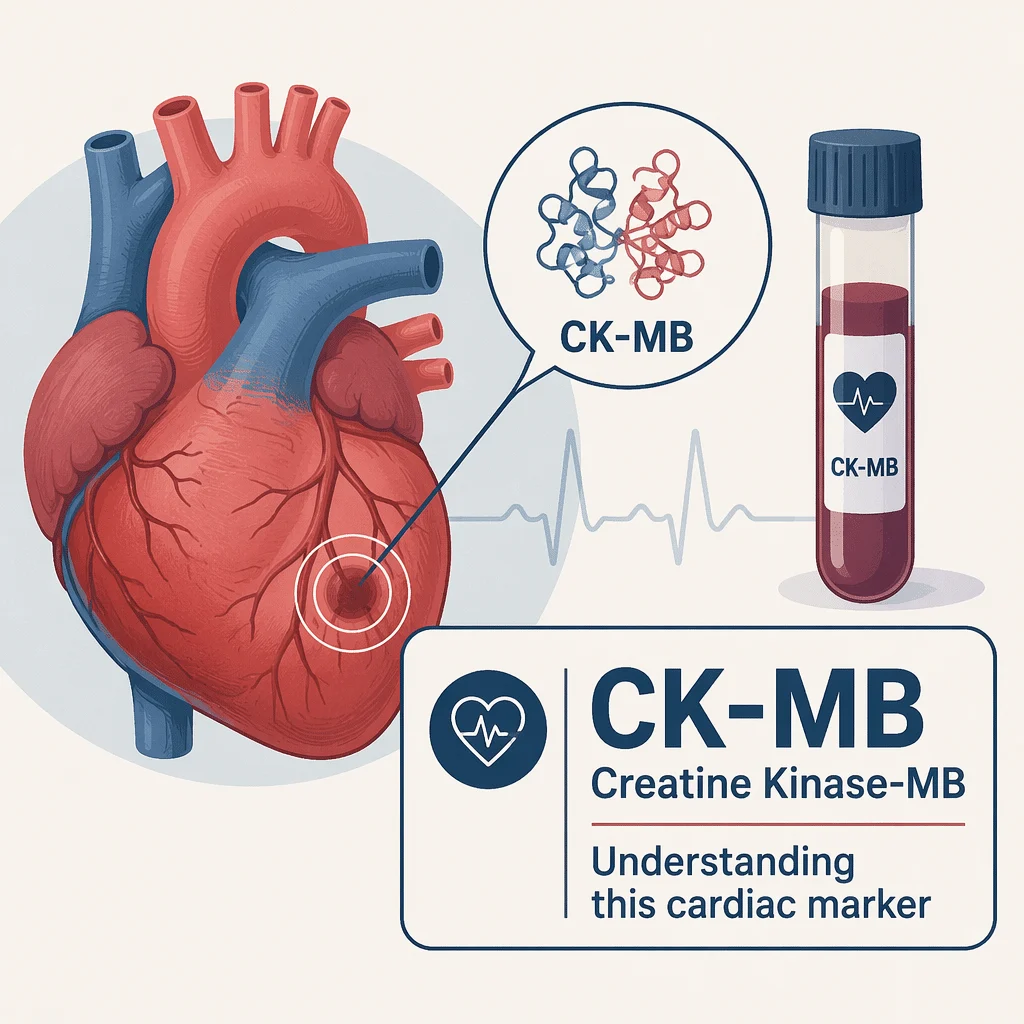
Als uw laboratoriumrapport een CK-MB bloedtest vermeldt, ziet u een marker die vroeger de standaardmethode was om een hartaanval op te sporen, en die de meeste ziekenhuizen inmiddels grotendeels hebben verlaten. CK-MB, of creatinekinase-MB, is een fractie van een enzym dat creatinekinase heet. Het bevindt zich voornamelijk in het hartspierweefsel, maar ook in de skeletspieren waarmee u beweegt. Tegenwoordig is hooggevoelig troponine zowel gevoeliger als specifieker voor het hart, en het is de marker die de belangrijkste richtlijnen als eerste noemen.
Als u denkt dat u nu een hartaanval heeft, bel dan onmiddellijk 112 en wacht niet op een bloeduitslag.
In dit artikel leest u wat de test meet, waarom troponine hem heeft vervangen, waarom uw rapport hem mogelijk nog steeds vermeldt, hoe de relatieve CK-MB-index wordt gebruikt, en waarom een verhoogd CK-MB niet automatisch een hartaanval betekent.
Bel eerst 112, lees daarna over markers
Pijn op de borst of een drukkend gevoel, pijn die uitstraalt naar de arm, kaak, nek of rug, plotselinge kortademigheid, koud zweet, misselijkheid of duizeligheid vereisen allemaal onmiddellijke spoedhulp. Bel 112, of uw lokale alarmnummer, en rijd niet zelf. Geen enkele bloedmarker, CK-MB inbegrepen, kan een hartaanval op zichzelf uitsluiten of bevestigen, en behandeling werkt het best wanneer die vroeg begint.
Wat de CK-MB-bloedtest werkelijk meet
Creatinekinase is een enzym dat cellen helpt energie te transporteren. Uw lichaam maakt het aan op plaatsen waar de energiebehoefte snel wisselt: skeletspieren, hartspier en hersenen.
De drie CK-iso-enzymen
Creatinekinase bestaat in drie nauw verwante vormen, iso-enzymen genoemd. Elk is opgebouwd uit twee subeenheden, M (spier) of B (hersenen).
- CK-MM bevindt zich voornamelijk in de skeletspieren en vormt het grootste deel van het creatinekinase in uw bloed.
- CK-MB is de hybride vorm. Het is geconcentreerd in het hartspierweefsel, dat ongeveer 15% van zijn creatinekinase als CK-MB bevat.
- CK-BB wordt voornamelijk aangetroffen in hersenen en glad spierweefsel.
Het detail dat voor u het meest van belang is, is dit: skeletspieren bevatten ook CK-MB, zij het in kleine hoeveelheden — ongeveer 1% tot 3%. Omdat u veel meer skeletspieren heeft dan hartspierweefsel, kan schade aan armen, benen of rug de CK-MB-waarde verhogen zonder dat uw hart er ook maar iets mee te maken heeft.
Hoe CK-MB zich verhoudt tot totaal CK
Een laboratorium kan het totale creatinekinase meten, of dat totaal opsplitsen in isoënzymen. CK-MB is een deel van het totaal, geen afzonderlijke stof. Dat verband is de reden waarom de twee waarden doorgaans samen worden beoordeeld in plaats van afzonderlijk. Een apart artikel behandelt het totale creatinekinase, dat vaak wordt gerapporteerd als CPK bloedtest.
Waarom troponine CK-MB heeft vervangen als voorkeursbiomarker
Dit is het deel dat veel pagina's overslaan, dus hier staat het duidelijk. CK-MB is een verouderde marker. Decennialang was het de belangrijkste bloedtest voor de diagnose van een hartaanval, maar inmiddels is het ingehaald.
Troponine is een eiwitcomplex in spiercellen. Cruciaal is dat het hart zijn eigen versies van troponine I en troponine T aanmaakt, die volwassen skeletspieren niet produceren. Daardoor kan een bloedtest worden ontwikkeld die specifiek schade aan het hartspierweefsel opspoort — iets wat geen enkele CK-MB-test kan evenaren. Moderne hooggevoelige troponine-tests detecteren kleinere hoeveelheden schade, en doen dat met veel minder verstoring door uw armen en benen.
Gezaghebbende instanties zeggen dit rechtstreeks. De ACC/AHA/ACEP/NAEMSP/SCAI-richtlijn uit 2025 over acute coronaire syndromen, van het American College of Cardiology en de American Heart Association, baseert de diagnose van een hartaanval op cardiale troponine. MedlinePlus van de National Library of Medicine stelt dat een troponinetest vaker wordt gebruikt dan creatinekinasebepaling, omdat troponine beter is in het opsporen van schade aan het hartspierweefsel. StatPearls, gepubliceerd op de NCBI Bookshelf van het NIH, zegt het onomwonden: cardiale troponines hebben CK-MB in de dagelijkse klinische praktijk grotendeels verdrongen, en troponine is de biomarker bij uitstek voor het aantonen van hartspierschade van welke oorzaak dan ook.
De praktische consequentie: wanneer troponine beschikbaar is, levert het toevoegen van CK-MB aan hetzelfde panel doorgaans extra kosten op zonder dat het veel toevoegt. Zelden verandert het wat een arts vervolgens doet.
| Functie | CK-MB | Hooggevoelig troponine |
|---|---|---|
| Waar het vandaan komt | Voornamelijk hartspier, maar skeletspieren bevatten ook een klein aandeel | Hartspecifieke vormen van troponine I of T die volwassen skeletspieren niet aanmaken |
| Wat een stijging aantoont | Schade aan hart- of skeletspierweefsel | Schade aan hartspierweefsel |
| Tijdstip na het begin van de klachten | Stijgt in ongeveer 4 tot 6 uur, bereikt een piek rond 24 uur, terug naar normaal binnen 48 tot 72 uur | Stijgt in ongeveer 4 tot 6 uur, bereikt een piek rond 18 tot 24 uur, blijft aantoonbaar gedurende 72 tot 96 uur |
| Specifiek voor het hart | Minder: skeletspierweefselschade kan de waarde verhogen | Meer: veel minder beïnvloed door skeletspierweefselschade |
| Huidige rol | Verouderde marker, bewaard voor specifieke toepassingen zoals vermoedelijk hernieuwd hartinfarct of wanneer troponine niet beschikbaar is | Voorkeurs- en doorgaans voldoende marker bij vermoeden van een hartaanval |
Voor een breder overzicht van hoe deze tests zich tot elkaar verhouden, kunt u ons overzicht lezen van de hartmarkerspanel.
Waarom uw rapport mogelijk nog steeds CK-MB vermeldt
CK-MB op een rapport zien, betekent niet dat uw arts een fout heeft gemaakt. Er zijn verschillende gewone verklaringen voor.
- Oudere standaardpakketten. Ziekenhuizen stellen vaste testpanelen samen die meerdere tests bundelen. Sommige pakketten werden opgesteld toen CK-MB de standaard was en zijn sindsdien nooit herzien.
- Lokale praktijk en beschikbaarheid. Niet elk laboratorium of elke regio beschikt over hooggevoelig troponine. Waar troponinebepalingen beperkt beschikbaar zijn, levert CK-MB nog steeds nuttige informatie op.
- Vermoeden van re-infarct. Dit is de klassieke niche. Troponine blijft dagenlang verhoogd, waardoor een tweede hartaanval kort na de eerste verborgen kan blijven in een troponinewaarde die nooit is gedaald. CK-MB daalt sneller, zodat een nieuwe stijging na een daling op een nieuw event kan wijzen. Zelfs in dit geval merkt StatPearls op dat het gebruik van CK-MB hiervoor is afgenomen en dat directe vergelijkingen met troponine schaars zijn.
- Hartchirurgie en ingrepen. CK-MB wordt soms gevolgd om de spierweefselschade rondom een operatie te beoordelen.
Als u zich afvraagt waarom een bepaalde waarde op uw uitslag staat, is dat een goede vraag voor uw arts — en een volkomen terechte vraag om te stellen.
Hoe een verhoogde CK-MB-waarde te interpreteren
Een verhoogde CK-MB geeft aan dat spiercellen ergens hun inhoud hebben vrijgegeven. Het zegt niet welke spier. Om de waarde te interpreteren, moet u drie vragen stellen.
Ten eerste: wat is het klinische beeld? Pijn op de borst, kortademigheid en zweten wijzen op iets heel anders dan een marathon vorig weekend of een val van de trap.
Ten tweede: wat is de trend? Eén waarde is een momentopname. Markers die in de loop van uren stijgen en vervolgens dalen, vertellen een verhaal dat één getal niet kan vertellen.
Ten derde: waar kan het anders vandaan komen? Dit is waar de relatieve index een rol speelt.
De CK-MB relatieve index
De CK-MB relatieve index vergelijkt CK-MB met het totale creatinekinase en drukt het ene uit als een percentage van het andere. De logica is eenvoudig. Als er een grote hoeveelheid CK in uw bloed is terechtgekomen en slechts een klein deel daarvan CK-MB is, is de bron waarschijnlijk skeletspierweefsel. Als CK-MB een groter aandeel uitmaakt, wordt het hart waarschijnlijker.
Als globale richtlijn beschrijft StatPearls een relatieve index van minder dan ongeveer 3% als passend bij een skeletspieroorsprong, en van meer dan ongeveer 5% als meer passend bij een cardiale oorsprong.
Die richtlijn heeft echter duidelijke beperkingen, en eerlijkheid vereist dat we die benoemen. Dezelfde bron merkt op dat de relatieve index er niet in is geslaagd om skeletspierweefsel te onderscheiden van hartschade bij patiënten met trauma en langdurige spieraandoeningen. Het is een aanwijzing, geen uitspraak. Bovendien kan de index helemaal niet worden berekend als het totale CK niet tegelijk met CK-MB is gemeten.
Niet-cardiale oorzaken van een verhoogd CK-MB
Een verhoogd CK-MB is niet automatisch een hartaanval. Erkende niet-cardiale en niet-infarctgerelateerde oorzaken zijn onder meer:
- Rabdomyolyse, een snelle afbraak van skeletspierweefsel na kneusletsels, extreme inspanning, hitte of bepaalde geneesmiddelen.
- Extreme of ongewone lichamelijke inspanning, en lichamelijk letsel of een operatie waarbij skeletspieren betrokken zijn.
- Myositis en inflammatoire myopathieën, waarbij spieren gedurende langere perioden ontstoken zijn en herstellen.
- Geneesmiddelen die spieren kunnen beschadigen, waaronder statines, daptomycine en bepaalde antiretrovirale middelen.
- Hypothyreoïdie, waardoor de afbraak van creatinekinase uit het bloed vertraagt.
- Nierfalen, alcoholintoxicatie, zwangerschap en bepaalde vormen van kanker.
- Laboratoriuminterferentie. Ongewone CK-varianten zoals macro-CK, of stoffen in het bloedmonster, kunnen een vals verhoogde uitslag geven.
Sommige hartgerelateerde oorzaken zijn ook geen hartaanvallen: myocarditis, een ontsteking van de hartspier die vaak door een virus wordt veroorzaakt, en hartoperaties geven beide CK-MB vrij. Als uw nieren ook een rol spelen, legt onze gids de nierfunctiepanel. Andere markers die u in de buurt kunt tegenkomen zijn de myoglobine spiermarker, de LDH bloedtest, en de BNP hartmarker, die eerder hartbelasting weerspiegelt dan celdood in de hartspier.
Wat een normale CK-MB-uitslag betekent
CK-MB bevindt zich normaal gesproken op zeer lage of niet-detecteerbare niveaus in het bloed, omdat het enzym in de cellen blijft totdat er iets is dat ze beschadigt.
Een normaal CK-MB is geruststellend in de juiste context, maar het heeft dezelfde beperking als elke afzonderlijke marker. Timing is belangrijk: CK-MB begint pas te stijgen ongeveer 4 tot 6 uur nadat een hartspierletsel begint, en keert binnen 48 tot 72 uur terug naar normaal. Een test die zeer vroeg wordt afgenomen kan normaal zijn, zelfs als er iets mis is, en een test die dagen later wordt afgenomen kan normaal zijn, zelfs na een echte gebeurtenis. Dat is precies waarom spoedeisende hulpafdelingen bloedtests herhalen en deze samen met een ECG en uw klachten beoordelen, in plaats van op één enkele afname te vertrouwen.
Referentiewaarden verschillen ook per laboratorium en per meetmethode, dus vergelijk uw waarde altijd met het bereik dat op uw eigen uitslag staat vermeld. Onze tabel legt uit normale bloedtestwaarden, en een aanvullend artikel behandelt afwijkende bloedtestresultaten.
Alarmsignalen die om 112 vragen, niet om een laboratoriumtest
Geen enkel deel van dit artikel mag worden gebruikt om te beslissen of uw klachten ernstig zijn. Bel 112 of het plaatselijke alarmnummer als u of iemand anders last heeft van:
- Pijn, druk, strakheid of een knellend gevoel op de borst, vooral als dit langer dan een paar minuten aanhoudt of steeds terugkomt.
- Pijn of een ongemakkelijk gevoel dat uitstraalt naar een arm, de kaak, nek, rug of maag.
- Plotselinge kortademigheid, al dan niet gepaard met pijn op de borst.
- Koud zweet, misselijkheid of braken, of plotselinge onverklaarbare duizeligheid.
- Extreme, ongewone vermoeidheid, wat bij vrouwen vaker een eerste teken kan zijn.
- Donkere, colakleurige urine met ernstige spierpijn en spierzwakte, wat kan wijzen op rabdomyolyse.
Mensen met diabetes en oudere volwassenen kunnen minder duidelijke of atypische klachten hebben, dus het is verstandig om snel hulp te zoeken bij de minste twijfel. Neem een ambulance in plaats van zelf te rijden. Hulpverleners kunnen onderweg al beginnen met bewaking en behandeling.
Nieuwste wetenschappelijke ontwikkelingen in CK-MB-testen
Recent onderzoek heeft vooral verfijnd waar deze oudere marker nog steeds zijn waarde bewijst en waar hij misleidend kan zijn.
Een narratieve review uit 2026 in Cureus heronderzocht één taak die CK-MB goed vervulde: het schatten van hoeveel hartspierweefsel verloren was gegaan. De auteurs erkennen dat troponine CK-MB terecht heeft vervangen voor de diagnose, omdat het gevoeliger en specifieker is. Maar zij betogen dat herhaalde CK-MB-metingen die in de tijd worden uitgezet nog steeds een praktische schatting geven van de infarctgrootte — de hoeveelheid beschadigd hartspierweefsel — omdat de trage, langgerekte afgifte van troponine moeilijker in een getal is om te zetten. Wat dit voor u betekent: dit is een discussie over onderzoeksopzet en klinische studies, niet een reden om CK-MB aan te vragen. Een narratieve review is een expertoverzicht van bestaande literatuur en geen nieuw experiment; het bepleit een standpunt in plaats van dat het er een beslecht.
Een rapport uit 2026 in Clinical Chemistry and Laboratory Medicine beschreef een patiënt bij wie troponine T opnieuw steeg tijdens behandeling met een immuuncheckpointremmer, een kankermedicijn dat hart- of skeletspierweefsel kan ontsteken. Een sterk verhoogde CK-MB-relatieve index wees op skeletspierweefsel — en niet het hart — als de waarschijnlijke bron. Wat dit voor u betekent: dit is het specifieke geval waarbij CK-MB nog een bijdrage kan leveren, namelijk om een spieroorsprong te onderscheiden van een hartoorsprong wanneer troponine alleen niet eenduidig is. Het betreft één casus gepubliceerd als een brief, de zwakste vorm van klinisch bewijs, die aantoont dát iets kan voorkomen maar niet hoe vaak.
Een studie uit 2026 in het American Journal of Clinical Pathology mat de uitgangswaarden van hooggevoelig troponine bij 173 gezonde universitaire atleten uit 21 sporten. Waarden boven de gebruikelijke afkapwaarde kwamen regelmatig voor, met name binnen 48 uur na training, en vaker bij mannen dan bij vrouwen. Troponine vertoonde bij deze atleten geen verband met CK-MB. Wat dit voor u betekent: intensieve training kan hartmarkers bij volkomen gezonde mensen licht verhogen, waardoor het tijdstip van meting en de context belangrijker zijn dan één afwijkend getal. Omdat deze studie een momentopname maakte van gezonde atleten in plaats van patiënten met klachten te volgen, beschrijft zij normale variatie en niet hoe een hartaanval te diagnosticeren.
Een studie uit 2026 in het Journal of Human Kinetics liet gezonde vrijwilligers 40 minuten hardlopen in koude en in milde omstandigheden. CK-MB steeg na inspanning in de kou, maar niet bij de mildere temperatuur. Wat dit voor u betekent: recente zware inspanning, met name in de kou, is een plausibele onschuldige verklaring voor een licht verhoogd CK-MB. De studie was klein, maakte gebruik van jonge en overwegend fitte deelnemers, en mat markers in plaats van hartgebeurtenissen, zodat niet kan worden aangetoond dat er enige schade is opgetreden.
Ten slotte beschreef een casus uit 2024 in Clinical Laboratory een patiënt bij wie CK-MB op één methode dramatisch hoog leek, terwijl het hartecho en het kransslagaderonderzoek normaal waren. Herhaling met een massa-immunoassay, die de hoeveelheid CK-MB-eiwit meet in plaats van de activiteit ervan, gaf een normaal resultaat: de eerste methode was verstoord door interferentie. Wat dit voor u betekent: een verontrustend hoge CK-MB is soms een laboratoriumartefact, en dat kan worden nagegaan. Ook dit is een enkel casusverslag, dus beschouw het als een nuttige waarschuwing en niet als een maatstaf voor hoe vaak dit voorkomt.
Glossarium
| Termijn | Definitie |
|---|---|
| Creatinekinase (CK) | Een enzym dat helpt energie te transporteren binnen cellen, aanwezig in skeletspieren, hartspier en hersenen. Ook wel CPK genoemd. |
| Iso-enzym | Een van de nauw verwante vormen van hetzelfde enzym, elk het meest voorkomend in bepaalde weefsels. |
| CK-MB | Het creatinekinase-iso-enzym dat geconcentreerd is in de hartspier, hoewel skeletspierweefsel ook een kleine hoeveelheid bevat. |
| CK-MB relatieve index | CK-MB uitgedrukt als percentage van het totale CK, gebruikt als aanwijzing of een stijging afkomstig is van de hartspier of de skeletspieren. |
| Troponine | Een spierproteïne waarvan de hartspecifieke vormen de voorkeursbloedmarker zijn voor het opsporen van hartspierschade. |
| Myocardinfarct | De medische term voor een hartaanval, waarbij de bloedtoevoer naar een deel van de hartspier wordt geblokkeerd en cellen afsterven. |
| Herinfarcering | Een tweede hartaanval die kort na een eerste optreedt, terwijl de markers van de eerste aanval nog verhoogd kunnen zijn. |
| Rhabdomyolyse | Snelle afbraak van skeletspierweefsel waarbij de bloedbaan wordt overspoeld met spierinhoud, wat de nieren kan beschadigen. |
| Myocarditis | Ontsteking van de hartspier, vaak na een virale infectie. |
| Macro-CK | Een ongewone, grote vorm van creatinekinase die op sommige methoden tot fout-hoge CK-MB-waarden kan leiden. |
Veelgestelde vragen
Wat is een normale CK-MB-waarde in ng/mL?
CK-MB is normaal gesproken zeer laag of niet aantoonbaar. Veel laboratoria rapporteren resultaten in nanogram per milliliter (ng/mL) met behulp van een massa-assay, en beschouwen waarden boven ongeveer het 99e percentiel van gezonde personen als verhoogd. Er bestaat geen universeel getal, omdat de grenswaarde afhankelijk is van de assay, de analysator en de populatie die het laboratorium heeft gebruikt om deze vast te stellen. Sommige laboratoria hanteren ook aparte waarden voor mannen en vrouwen. De enige referentiewaarde die van toepassing is op uw uitslag, is de waarde die naast uw resultaat op uw eigen rapport staat vermeld; vergelijk daarmee en niet met een getal dat u online heeft gevonden.
Wat is het verschil tussen CK-MB en totaal CK?
Totaal CK meet alle creatinekinase in uw bloed, ongeacht de bron, en wordt voornamelijk bepaald door skeletspieren. CK-MB meet slechts één iso-enzym binnen dat totaal: de vorm die geconcentreerd voorkomt in hartspierweefsel. CK-MB is dus een onderdeel van het totale CK, niet een andere stof. Totaal CK stijgt bij vrijwel elke spierbeschadiging en is nuttig bij spierproblemen zoals rabdomyolyse. CK-MB was bedoeld om gerichter naar het hart te wijzen, maar dat lukte nooit volledig, omdat skeletspieren ook een kleine hoeveelheid CK-MB bevatten.
Welke buiskleur wordt gebruikt voor een CK-MB bloedtest?
De meeste laboratoria meten CK-MB in serum of plasma, wat doorgaans een rode of gouden serumbuis betekent, of soms een groene lithiumheparinebuis. De werkwijze verschilt per laboratorium en analysator, zodat de phlebotomist lokale instructies volgt in plaats van een universele regel. Dit is iets wat u zelf niet hoeft te regelen. Eén detail is klinisch wel van belang: een gehemolyseerd monster, waarbij rode bloedcellen zijn opengebarsten, kan de meting van creatinekinase verstoren, wat soms de reden is dat een bloedafname wordt herhaald.
Kan intensieve lichaamsbeweging mijn CK-MB verhogen?
Ja. Skeletspieren bevatten een kleine hoeveelheid CK-MB, en ongewone of zware inspanning brengt spierinhoud in het bloed. Marathons, intensief krachttraining en lange duursessies kunnen creatinekinase verhogen en, in mindere mate, ook CK-MB. Recent onderzoek suggereert bovendien dat koude omstandigheden het effect kunnen versterken. Dit is één reden waarom een verhoogde uitslag bij een verder gezonde persoon die twee dagen geleden hard heeft getraind, heel anders moet worden beoordeeld dan hetzelfde getal bij iemand met pijn op de borst. Vertel uw arts over recente lichamelijke inspanning, blessures en valpartijen voordat er bloed wordt afgenomen.
Moet ik om een CK-MB-test vragen als mijn troponine normaal was?
Over het algemeen niet. Waar hooggevoelig troponine beschikbaar is, is het gevoeliger en specifieker voor het hart, en het toevoegen van CK-MB aan hetzelfde panel verhoogt doorgaans de kosten zonder dat dit de besluitvorming verandert. Daarom is het routinematig aanvragen van beide markers uit de gratie geraakt. Er zijn uitzonderingen, zoals bij vermoeden van herinfarcering of in situaties zonder troponinebepalingen, maar dat zijn oordelen voor uw behandelend arts. Als u zich zorgen maakt dat iets over het hoofd is gezien, is het nuttiger om te praten over uw klachten en het tijdsverloop daarvan, in plaats van een oudere marker toe te voegen.
Hoe lang blijft CK-MB verhoogd na een hartaanval?
CK-MB begint doorgaans ongeveer 4 tot 6 uur na het begin van de hartspierletsel te stijgen, bereikt een piek rond 24 uur en keert binnen ongeveer 48 tot 72 uur terug naar normaal. Troponine blijft aanzienlijk langer aantoonbaar, ongeveer 72 tot 96 uur en vaak nog meerdere dagen daarna. Die snellere daling was precies wat CK-MB vroeger nuttig maakte voor het opsporen van een tweede hartaanval kort na de eerste, omdat een nieuwe stijging dan duidelijk opvalt. Het is ook de reden waarom een CK-MB die enkele dagen na de klachten wordt afgenomen, volledig normaal kan lijken, zelfs als er wel degelijk een hartaanval heeft plaatsgevonden.
Bronnen
- Creatinekinase — MedlinePlus, U.S. National Library of Medicine
- Kurapati R, Zubair M. Creatine Kinase MB: Diagnostic Utility and Limitations. StatPearls, NCBI Bookshelf, National Library of Medicine (updated 2026)
- Heart Attack — Diagnosis. National Heart, Lung, and Blood Institute (NHLBI), National Institutes of Health
- Rao SV, O’Donoghue ML, Ruel M, et al. 2025 ACC/AHA/ACEP/NAEMSP/SCAI Guideline for the Management of Patients With Acute Coronary Syndromes. Circulation. 2025;151(13):e771-e862
- Lippmann AJ, Qureshi A, Khan M, et al. Estimating Infarct Size in the Troponin Era: Why No Biomarker Has Replaced Creatine Kinase-Myocardial Band Area Under the Curve (CK-MB AUC) and Where the Field Must Go Next. Cureus. 2026;18(5):e109879
- Usami Y, Suzuki H, Suzuki S, et al. A markedly increased CK-MB relative index suggests a skeletal muscle contribution to re-elevated troponin T in immune checkpoint inhibitor-associated myositis. Clinical Chemistry and Laboratory Medicine. 2026
- Jamal YA, Montiel A, Jones S, et al. Defining baseline high-sensitivity cardiac troponin levels in healthy collegiate athletes. American Journal of Clinical Pathology. 2026;165(5)
- Sebin SO, Sebin E, Gulakar B, et al. Aerobic Exercise under Cold Conditions May Affect the Cardiac Structure by Elevating the Galectin 3 and CK-MB Levels. Journal of Human Kinetics. 2026;101:87-102
- Li G, Lu T, Shan N. A Case of Pseudo-Elevation of CK-MB without Myocardial Infarction. Clinical Laboratory. 2024;70(11)
Verder lezen
- Ons aanvullende artikel legt de cardiale marker troponine.
- Een aparte gids behandelt de CPK creatinekinase bloedtest.
- U kunt ook het hartmarkerspanel.
- Wij beschrijven de myoglobine spier- en bloedmarker.
- Ons team legt uit Hoe lees je de resultaten van je bloedtest?.
Begrijp uw laboratoriumresultaten met AI DiagMe.
Labuitslagen leggen zelden uit waarom de ene marker wel en de andere niet wordt gemeten. AI DiagMe leest uw uitslag en vertaalt waarden zoals CK-MB, troponine en totaal CK naar begrijpelijke taal, zodat u weet welke vragen u aan uw arts kunt stellen. Het helpt u uw uitslagen te begrijpen; het stelt geen diagnose en is niet bedoeld voor noodgevallen. Heeft u op dit moment klachten, bel dan 112.
Ontvang binnen enkele minuten een interpretatie van uw resultaten.