





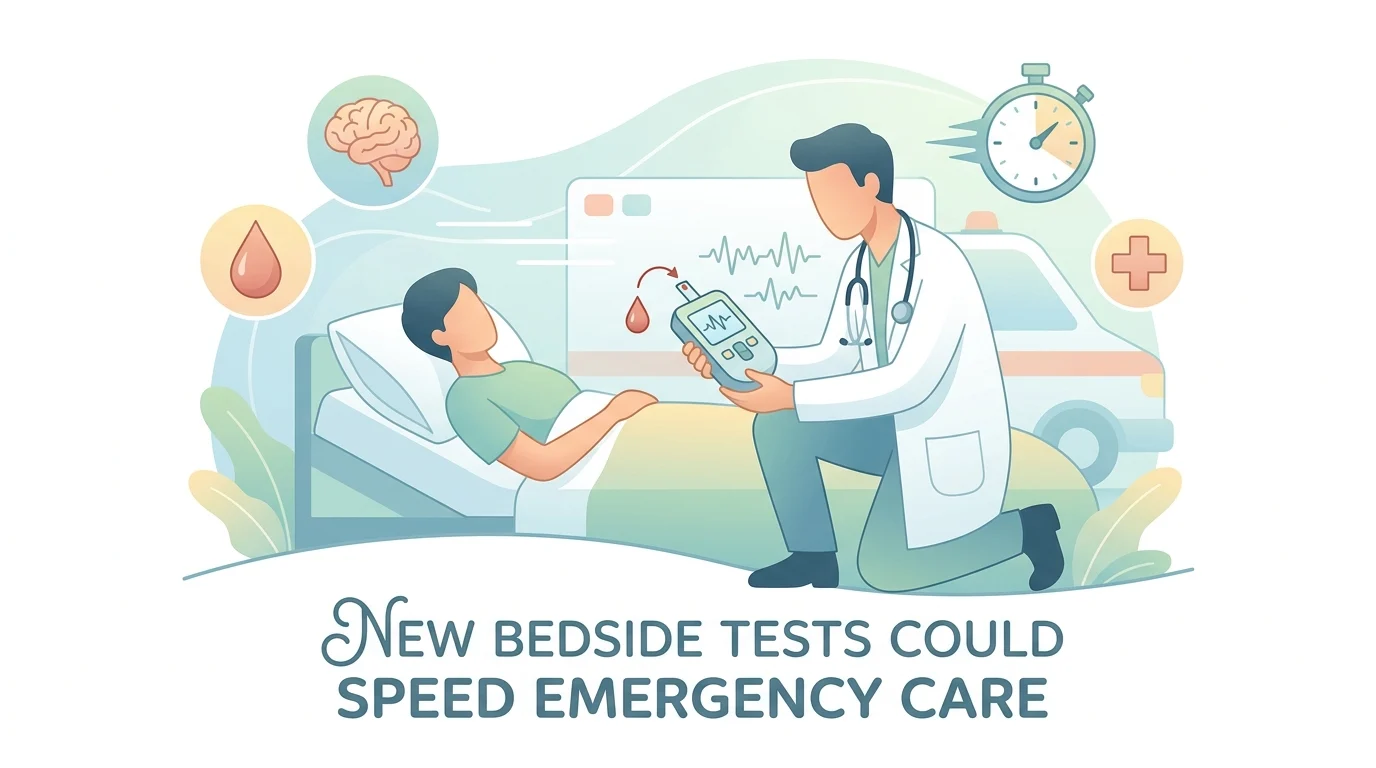
Can a simple blood draw tell doctors that someone is having a stroke? Not yet, at least not on its own. A stroke is still diagnosed with a brain scan and a neurological exam. But two bedside blood tests reported in 2026 aim to give emergency teams useful clues within minutes, before the scan is even done. This article explains what a stroke blood test can and cannot do today, what the new research shows, and what it means for you.
In late September 2026, a Danish team drew attention to a portable device that measures blood thinner levels in under 10 minutes. Around the same time, studies on a brain-injury protein called GFAP kept building the case for rapid tests in ambulances. Both are still being evaluated.
Why a stroke blood test is so hard to build
A stroke happens when blood flow to part of the brain is blocked (ischemic stroke) or when a vessel bleeds inside the brain (hemorrhagic stroke). The two types need opposite treatments, which is why doctors must know which one they are facing before giving clot-dissolving drugs.
Routine lab tests, such as a blood count or a cholesterol panel, do not show a stroke in progress. They help in other ways: they reveal risk factors, check clotting, and flag problems that change treatment. If you want the full picture of symptoms, causes, and care, read our complete guide to stroke signs, causes, tests, and treatment.
The CDC lists sudden numbness or weakness on one side, confusion, trouble speaking, vision loss, dizziness, and a severe headache among the warning signs of a stroke (see the CDC page in the sources below). If you notice these signs, call emergency services right away. Do not wait for a blood test.
Two new bedside tests: what they measure
A rapid blood thinner level test
Many people with atrial fibrillation or past blood clots take direct oral anticoagulants, often called blood thinners. When one of them has a stroke, doctors need to know whether enough of the drug is still in the blood before they consider clot-dissolving treatment. Standard lab assays can take longer than an emergency allows.
Researchers at Aarhus University in Denmark developed a disposable cartridge that quantifies these drugs in whole blood within about 10 minutes. It targets dabigatran, rivaroxaban, and apixaban, as well as the cancer drug methotrexate and the antibiotic linezolid. In the published study, dabigatran levels measured in 52 clinical plasma samples were comparable to commercial assays and to mass spectrometry, the reference laboratory method.
A rapid GFAP test for bleeding in the brain
GFAP is a protein found in support cells of the brain. When a vessel bleeds into brain tissue, GFAP leaks into the bloodstream quickly. Several studies tested portable GFAP analyzers in ambulances or emergency rooms to help separate a brain bleed from a clot-type stroke. The results are promising, especially for ruling a bleed in, but they are not a replacement for a scan.
GFAP is also studied in other conditions. For example, our report on the GFAP blood test in multiple sclerosis monitoring shows how the same protein is used in a very different setting.
What the studies found, side by side
| 검사 항목 | 연구 | Key finding | 주요 한계 |
|---|---|---|---|
| Blood thinner level (cartridge) | ACS Sensors, 2026 | Result in about 10 minutes; dabigatran readings matched reference methods in 52 samples | Laboratory validation; not yet tested in real emergency use |
| GFAP alone (portable analyzer) | Neurology, 2025 (353 patients) | Higher GFAP in brain bleeds; very few false alarms; about 15 minutes per test | Misses a share of bleeds; age-specific cutoffs needed |
| GFAP plus a clinical stroke scale | Stroke, 2026 (353 patients) | Adding GFAP improved detection of large vessel blockages | Retrospective analysis; needs replication |
| GFAP plus D-dimer (dual test) | Stroke (journal), 2026 (210 patients) | Good at ruling out large blockages and at confirming bleeds | Samples analyzed after the fact; field trials still needed |
최신 과학적 발전
The big change is where the test happens. Until now, most stroke biomarkers needed a hospital lab. The 2026 work shows that small cartridge-based devices can run in an ambulance or at the emergency room door. For the reader, this means faster information for the team treating a stroke, not a way to diagnose yourself.
The research also shows teamwork between tools. A blood marker adds the most when it is combined with the paramedic’s stroke scale, rather than used alone. In plain terms, the blood test refines the doctor’s judgment instead of replacing it.
Finally, these are early results. Most come from single hospitals or lab validations, and the authors themselves call for larger field trials. Guidelines have not changed, and no bedside stroke blood test is a standard of care today.
이것이 나에게 의미하는 것
If you take a blood thinner, keep an up-to-date medication list on your phone or in your wallet. In an emergency, the care team needs to know which drug you take and when you took your last dose. Related markers such as D-dimer and clotting times are explained in our coagulation panel guide covering PT, PTT, INR, and D-dimer.
Stroke risk also depends on long-term blood markers. One example is lipoprotein(a), covered in our article on very high lipoprotein(a) and stroke risk. Rapid tests are also reshaping heart care, as in our report on the rapid troponin test for heart attacks.
의사와 상담해야 할 때
Call emergency services immediately for any sudden stroke sign. Outside an emergency, talk to your doctor if you have atrial fibrillation, high blood pressure, high cholesterol, or diabetes, or if you take a blood thinner and have questions about monitoring. Bring your recent lab results so they can be reviewed together.
용어 설명
- GFAP: a protein from brain support cells that rises in the blood after some brain injuries.
- 허혈성 뇌졸중: a stroke caused by a blocked artery in the brain.
- Intracerebral hemorrhage: bleeding inside the brain tissue.
- Point-of-care test: a test run near the patient, such as in an ambulance, with a fast result.
- Direct oral anticoagulant: a pill that lowers the blood’s tendency to clot, such as apixaban or rivaroxaban.
자주 묻는 질문
Can a blood test detect a stroke?
Not by itself today. Diagnosis relies on a neurological exam and brain imaging. Blood tests under study may add clues, especially about brain bleeds.
Is a bedside stroke blood test available now?
The tests described here are research tools or prototypes. Some portable GFAP analyzers exist, but they are not part of routine stroke guidelines.
Do blood thinners change stroke treatment?
Yes. Whether a person recently took a blood thinner is one of the key facts doctors check before giving clot-dissolving treatment.
Should I get a GFAP test on my own?
No. GFAP is not a screening test for healthy people. It is studied in people who already have stroke symptoms.
출처
- CDC: Signs and Symptoms of Stroke
- MedlinePlus: Stroke
- Hansen-Bruhn M et al. A Point-of-Care System for the Quantification of Small-Molecule Drugs in Blood. ACS Sensors, 2026
- Kalra LP et al. Rapid Diagnosis of Intracerebral Hemorrhage by Measuring Prehospital GFAP on a Point-of-Care Device (DETECT). Neurology, 2025
- Kalra LP et al. Integrating GFAP Testing With Clinical Scores for Prehospital Large Vessel Occlusion Detection (DETECT LVO). Stroke, 2026
- Ghosh A et al. Prehospital Detection of Large Vessel Occlusion and Intracerebral Hemorrhage Using a Dual-Biomarker Point-of-Care Test. Stroke: Vascular and Interventional Neurology, 2026
관련 글 더 보기
- Reading a D-dimer blood test result
- Using GFAP in a multiple sclerosis blood test
- Speeding up emergency diagnosis with a rapid troponin test
AI DiagMe로 내 검사 결과 이해하기
Have blood work in hand and want to make sense of it? AI DiagMe로 내 검사 결과 이해하기, an AI interpretation reviewed by a committee of physicians.