




















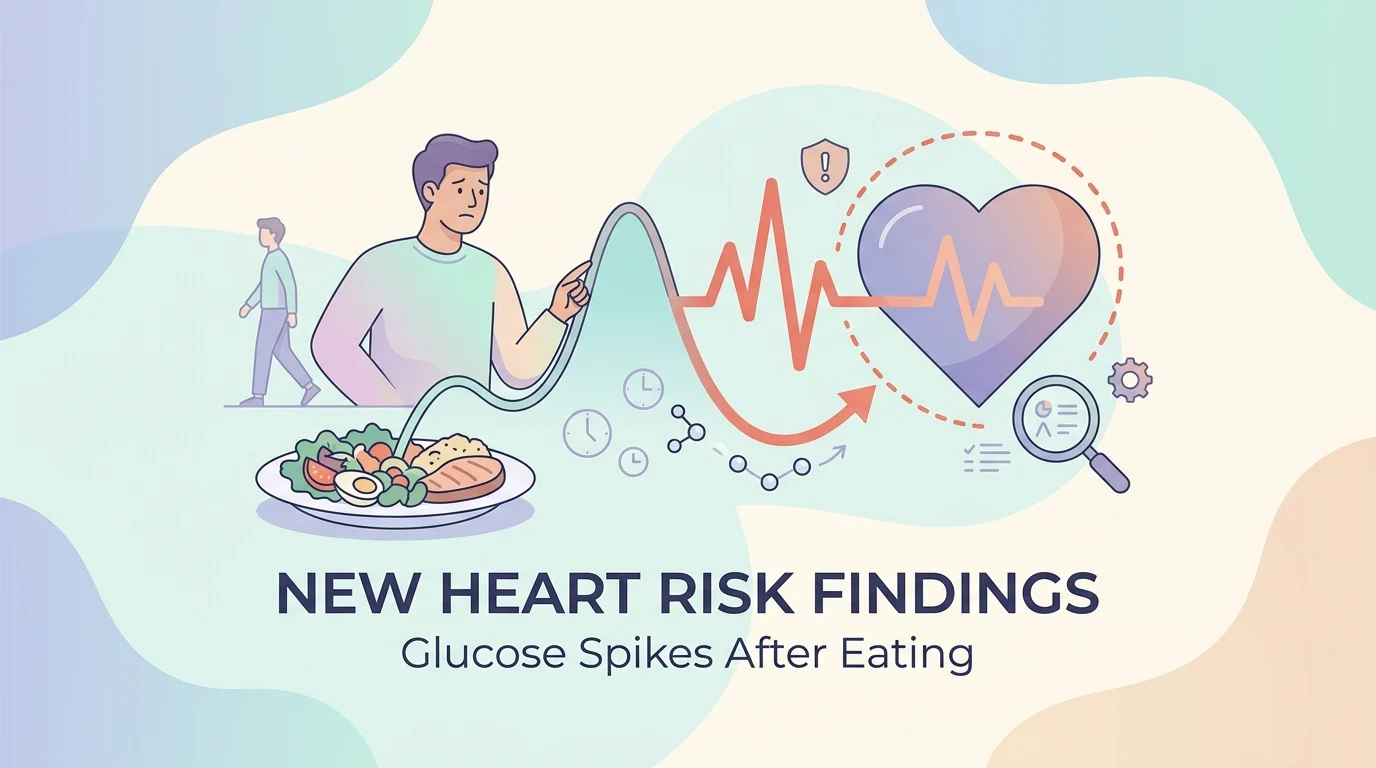
You can have a normal fasting blood sugar and still spend part of your day with glucose running high. A new study published in Diabetes Care suggests that this hidden pattern may matter for your heart, even if you have never been told you have diabetes. Researchers at Boston University looked at glucose spikes after eating in about 1,300 adults from the Framingham Heart Study, using a wearable sensor that recorded glucose every few minutes. The more time people spent above 140 mg/dL (7.8 mmol/L), the less healthy their blood pressure, blood fats and predicted heart risk tended to look. The finding is an association, not proof of cause, but it explains why one fasting number may not tell the whole story.
새로운 연구에서 밝혀진 내용
The analysis was led by Bahar Bakhshi and Nicole Spartano at the Boston University Chobanian and Avedisian School of Medicine. It included adults with no diabetes and no known cardiovascular disease, who wore a continuous glucose monitor (a small sensor on the arm or belly) for about a week and a half. They also drank a standard liquid meal and had their blood sugar checked two hours later.
According to the Boston University release and to Healio’s coverage, three measures were linked to a higher predicted 10-year risk of cardiovascular disease: a higher two-hour glucose after the test meal, a higher average glucose, and a larger share of the day above 140 mg/dL. These patterns also went along with higher triglycerides, lower HDL cholesterol and more high blood pressure.
The researchers also grouped participants into four glucose profiles. The group with both a high glucose burden and large swings had the least favorable cardiometabolic profile.
Why a normal fasting glucose can miss glucose spikes after eating
A fasting blood sugar is a snapshot taken after a night without food. It says little about how your body handles a meal. Each common test looks at a different slice of the picture:
| 검사 항목 | 확인 가능한 내용 | 놓칠 수 있는 것 |
|---|---|---|
| 공복 혈당 | Blood sugar after an overnight fast | Rises after meals |
| 당화혈색소(A1C) | Average over about 2 to 3 months | Short peaks that average out |
| 2-hour glucose tolerance test | Response to a sugary drink at one moment | What happens on ordinary days |
| 연속 혈당 측정기 | A reading every few minutes for days | Clear “normal” ranges for people without diabetes are not yet established |
According to the CDC, a fasting reading of 99 mg/dL or lower is considered normal, 100 to 125 mg/dL falls in the prediabetes range, and 126 mg/dL or higher points to diabetes. On the two-hour glucose tolerance test, 140 mg/dL or lower is normal. If you want to see where your own result sits, read our guide to fasting blood glucose levels.
What “time above 140 mg/dL” means
In this study, 140 mg/dL (7.8 mmol/L) was used as a practical line. Time above it is simply the share of the monitoring period spent over that value. A short rise after a meal is normal. What the researchers looked at was how much time accumulated above the line across several days.
This is not a diagnostic threshold, and the study did not define one. The authors themselves point out that outside the lab, the glucose patterns of healthy people are still being mapped. If you want the three-month view instead, check our A1C conversion chart and target levels.
이 연구가 알려줄 수 없는 것
Several limits are worth keeping in mind before drawing conclusions:
- The design was cross-sectional. It compared glucose patterns and risk markers at one point in time, so it cannot show that spikes cause heart problems.
- Heart risk was estimated with an equation, not measured as actual heart attacks or strokes.
- Participants were mostly older and mostly white, so the results may not apply equally to younger adults or other groups.
- Some authors consult for or received funding from glucose monitor makers, and one maker supplied devices at a discount. This is disclosed, and it is a reason to read the findings with care.
The lead author says larger studies that follow people over time are needed to confirm the findings.
최신 과학적 발전
According to PubMed, other recent work points in the same direction: a glucose reading taken after a challenge can carry information that a fasting reading does not.
A 2025 analysis of about 14,000 American adults who were not taking diabetes medication compared three standard measures: fasting glucose, A1C and the two-hour glucose from an oral glucose tolerance test. When the three were considered together, only the two-hour reading stayed clearly linked to dying from any cause or from cardiovascular causes (Journal of Diabetes and Its Complications, 2025). What this means for you: if a doctor orders a post-meal or two-hour test, it is not redundant, because it can capture something fasting misses. This is an observational study, so it shows a link and not a cause.
A Chinese cohort of about 3,000 adults without diabetes followed for roughly three years found that a larger gap between the two-hour glucose and the fasting glucose went with a higher chance of developing prediabetes or diabetes (BMJ Open Diabetes Research and Care, 2025). What this means for you: how your glucose responds after a challenge may flag changes early, but this research is preliminary and was done in a specific population.
For a different angle on monitors, see our report on glucose monitors and kidney health.
의사와 상담해야 할 때
This study does not mean you need a sensor, and it does not change how diabetes is diagnosed. It is a good reason to bring up your numbers if any of the following applies:
- Your fasting glucose or A1C is in the prediabetes range.
- You have high blood pressure, high triglycerides or low HDL cholesterol alongside normal-looking glucose.
- Diabetes or early heart disease runs in your family.
- You feel very thirsty, urinate often or notice unusual fatigue after meals.
Your doctor can decide whether a fasting test, an A1C, a glucose tolerance test or another check makes sense for you. Do not change medication or diet on the basis of a news study alone.
용어 설명
- Continuous glucose monitor (CGM): a wearable sensor that measures glucose in the fluid under the skin every few minutes.
- Postprandial glucose: blood sugar measured after a meal.
- A1C: a blood test showing average blood sugar over about two to three months.
- Cross-sectional study: research that looks at a group at one point in time and cannot prove cause and effect.
- 당뇨병 전단계: blood sugar higher than normal but below the diabetes threshold.
자주 묻는 질문
Is a blood sugar of 140 mg/dL after eating normal?
A rise after a meal is expected. For the two-hour glucose tolerance test, the CDC lists 140 mg/dL or lower as normal. The study looked at how long glucose stays above that value, which is a different question.
Do I need a continuous glucose monitor if I do not have diabetes?
This study does not recommend that. Normal ranges for people without diabetes are not established, so readings can be hard to interpret without medical guidance.
Can a normal fasting glucose still hide a problem?
It can, because it does not capture what happens after meals. Your doctor may combine fasting glucose, A1C and other markers to get a fuller view.
Does this prove that glucose spikes cause heart disease?
No. The study found associations at one point in time. Longer studies are needed.
Which blood tests help me track my glucose?
Fasting glucose and A1C are the most common. For the basics of reference ranges, review our guide to normal glucose levels and tests.
출처
- Glucose patterns captured by continuous glucose monitors linked to cardiometabolic risk in adults without diabetes — Boston University release, EurekAlert, 2026
- CGM may help predict future CVD risk for adults without diabetes — Healio, October 2026
- Normal blood sugar tests may miss hidden risks to heart health — Earth.com, October 2026
- Diabetes Testing — Centers for Disease Control and Prevention
- Blood Glucose Test — MedlinePlus, National Library of Medicine
- Associations of three diagnostic glycemic measures with all-cause and cardiovascular mortality — Journal of Diabetes and Its Complications, 2025 (PubMed)
- Dose-response relationship between the postload-fasting gap and the risk of developing diabetes — BMJ Open Diabetes Research and Care, 2025 (PubMed)
관련 글 더 보기
- 공복 혈당: 내 수치가 의미하는 것
- 당화혈색소(A1C) 변환표: A1C를 평균 혈당으로 확인하기
- Glucose levels: normal ranges, tests, and what results mean
- Glucose monitors and kidney health: what the new study shows
AI DiagMe로 내 혈액 검사 결과 직접 이해하기
Upload your lab report and get a plain-language explanation of each value, built with a committee of physicians. Start here: AI DiagMe로 내 검사 결과 이해하기.