



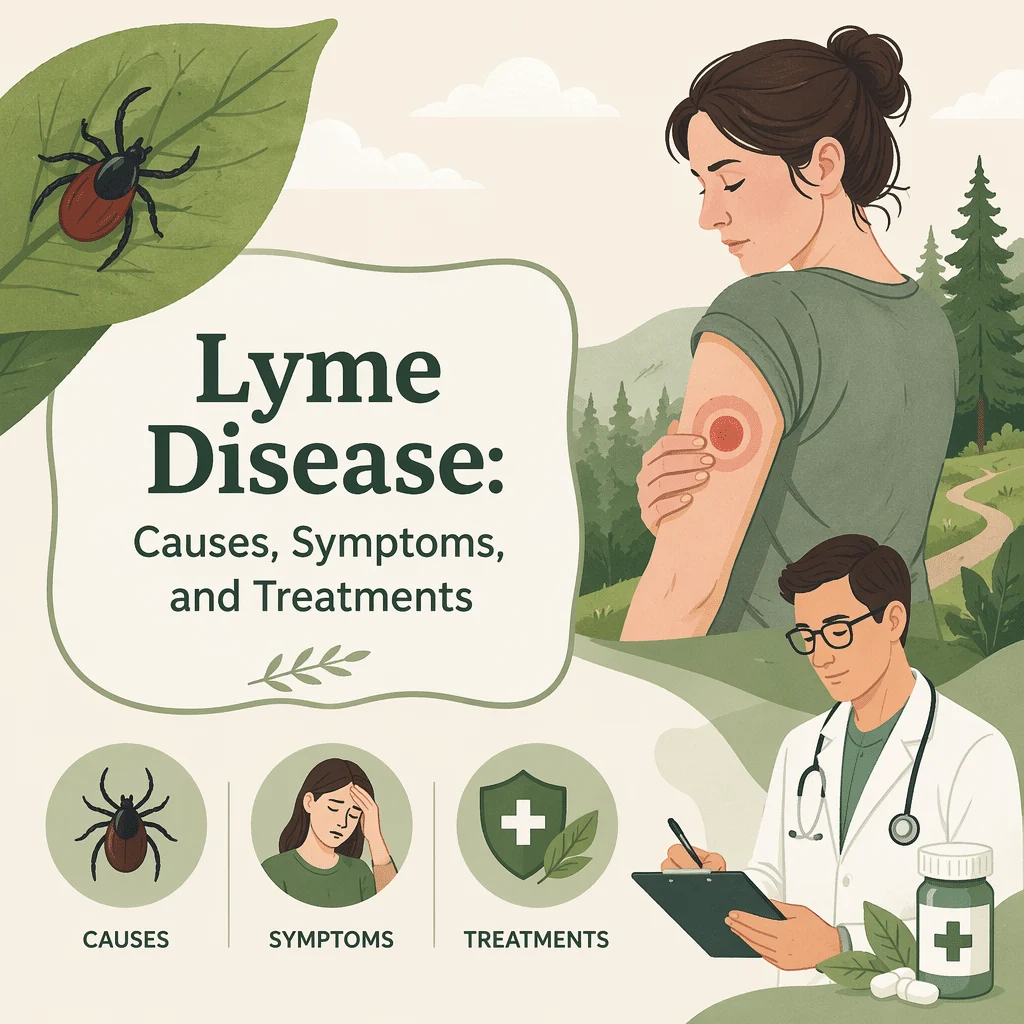
La enfermedad de Lyme es una infección bacteriana transmitida por garrapatas que se puede contraer por la picadura de una garrapata de patas negras infectada, también conocida como garrapata del venado. Si se detecta a tiempo, generalmente se cura con un ciclo corto de antibióticos; si no se trata, puede extenderse a la piel, las articulaciones, el corazón y el sistema nervioso. Como la primera señal suele ser un sarpullido en la piel que se expande lentamente, más que un valor anormal en los estudios de laboratorio, identificar el patrón a tiempo marca una gran diferencia. En este artículo aprenderás cómo se contagia la enfermedad de Lyme, sus etapas y síntomas, cómo la prueba de anticuerpos en sangre de dos niveles confirma la exposición, cómo la tratan los médicos y cómo reducir tu riesgo. También encontrarás las investigaciones más recientes sobre pruebas más rápidas y un candidato a vacuna que actualmente está en ensayos clínicos.
¿Qué es la Enfermedad de Lyme?
La enfermedad de Lyme es una infección causada por bacterias del grupo Borrelia, más frecuentemente Borrelia burgdorferi en Estados Unidos. Las bacterias viven en el intestino de ciertas garrapatas duras y se transmiten a las personas durante una picadura. En América del Norte, el principal portador es la garrapata de patas negras — Ixodes scapularis en el este y el medio oeste, e Ixodes pacificus en la costa oeste.
Las garrapatas adquieren las bacterias cuando se alimentan de animales infectados como ratones y venados, y luego las transmiten al siguiente huésped que pican, incluidos los humanos. La enfermedad de Lyme es la enfermedad transmitida por garrapatas más común en Estados Unidos, con cientos de miles de personas tratadas cada año, según los Centros para el Control y la Prevención de Enfermedades. En la mayoría de los casos afecta primero la piel, pero puede comprometer las articulaciones, el sistema nervioso y el corazón si no se trata. Es importante saber que no se contagia de persona a persona, por el aire ni a través de los alimentos.
Cómo se Contagia la Enfermedad de Lyme
No puedes contraer la enfermedad de Lyme de otra persona, de una mascota ni de un mosquito. Solo se transmite por la picadura de una garrapata infectada. Dos factores determinan tu riesgo real: dónde estás y cuánto tiempo permanece la garrapata adherida.
La mayoría de los casos ocurren en el noreste, el centro-atlántico y el norte del medio oeste de Estados Unidos, con actividad adicional en partes de la costa del Pacífico. Las garrapatas son más activas en los meses cálidos, aproximadamente de primavera a otoño, aunque las picaduras pueden ocurrir en cualquier momento en que el clima sea templado. Las mismas garrapatas también pueden transmitir otros gérmenes, por lo que una sola picadura puede ocasionar más de una infección.
Una garrapata adherida generalmente necesita alimentarse durante muchas horas antes de poder transmitir la bacteria. Las recomendaciones actuales indican que el riesgo es bajo en las primeras 24 horas y aumenta cuanto más tiempo permanece la garrapata en su lugar, por eso retirarla de inmediato es una de las mejores formas de protegerse. Las ninfas —garrapatas inmaduras del tamaño aproximado de una semilla de amapola— causan la mayoría de las infecciones en humanos porque son muy fáciles de pasar por alto.
Etapas y síntomas de la enfermedad de Lyme
La enfermedad de Lyme tiende a avanzar por etapas. No todas las personas pasan por cada una de ellas y los signos pueden superponerse, pero pensar en etapas te ayuda a saber qué vigilar y cuándo es útil hacerse pruebas.
Etapa temprana localizada (días a semanas)
El signo temprano clásico es el eritema migratorio, un sarpullido que se expande lentamente y aparece en el sitio de la picadura entre aproximadamente 3 y 30 días después. Con frecuencia se describe como un ojo de buey, aunque muchos sarpullidos son sólidos y ovalados en lugar de tener anillos. El sarpullido suele estar caliente, pero no pica ni duele, lo cual es una razón por la que puede pasarse por alto. Junto con esto, las personas pueden sentirse como si tuvieran gripe, con fiebre, escalofríos, dolor de cabeza, cansancio y dolores corporales. Si no estás seguro de si una marca está relacionada con una garrapata, nuestro equipo explica los más comunes causas y tratamientos del sarpullido en la piel.
Etapa temprana diseminada (semanas a meses)
Si la infección no se trata, las bacterias pueden diseminarse por el torrente sanguíneo. En esta etapa pueden aparecer varios sarpullidos más pequeños en otras partes del cuerpo, dolor articular que se mueve de un lugar a otro, y signos neurológicos como caída de un lado o ambos lados de la cara (parálisis facial), entumecimiento u hormigueo, o rigidez y dolor en el cuello por meningitis. Algunas personas desarrollan cambios en el ritmo cardíaco conocidos como carditis de Lyme, que pueden causar pulso lento, mareos o desmayos.
Etapa tardía (persistente) (meses a años)
Sin tratamiento, la enfermedad de Lyme puede llegar a una etapa tardía meses después de la picadura. La manifestación más común es la artritis de Lyme: episodios de inflamación y dolor, especialmente en articulaciones grandes como la rodilla. Estos brotes pueden parecerse a otras formas de artritis, por lo que el médico buscará distinguir la artritis de Lyme de rheumatoid arthritis. Los problemas del sistema nervioso de mayor duración, como dificultad para recordar o concentrarse y dolor nervioso persistente, son menos frecuentes pero pueden ocurrir.
| Etapa | Momento típico | Características comunes |
|---|---|---|
| Localizada temprana | De 3 a 30 días después de la picadura | Sarpullido de eritema migrans en expansión; fiebre, fatiga, dolor de cabeza, dolores corporales |
| Diseminación temprana | Semanas a algunos meses | Múltiples sarpullidos; parálisis facial; dolor nervioso; meningitis; carditis de Lyme |
| Tardía (persistente) | Meses a años | Artritis de Lyme (generalmente una rodilla inflamada); problemas ocasionales de memoria o nerviosos |
Diagnóstico y la prueba de sangre de dos niveles
Los médicos diagnostican la enfermedad de Lyme combinando tus síntomas, tu exposición reciente a garrapatas y los análisis de sangre. Cuando el sarpullido de eritema migrans aparece en alguien que ha estado en zonas donde la enfermedad de Lyme es común, el tratamiento suele comenzar de inmediato, sin esperar los resultados de un análisis.
Los análisis de sangre no buscan la bacteria directamente. En cambio, detectan anticuerpos — las proteínas que produce tu sistema inmunológico para combatir la infección. El método estándar es la prueba de dos niveles: una primera prueba de detección (un EIA, o ensayo de inmunoabsorción enzimática) y, si el resultado es positivo o dudoso, una segunda prueba de confirmación. En la versión tradicional, el segundo paso es un Western blot (inmunoblot); en el método modificado de dos niveles más reciente, un segundo EIA reemplaza al blot.
Las pruebas tempranas tienen una limitación importante. En las primeras semanas, es posible que tu cuerpo no haya producido suficientes anticuerpos para ser detectados, por lo que el resultado puede ser negativo aunque estés infectado. Según los Centros para el Control y la Prevención de Enfermedades, las pruebas de anticuerpos se vuelven mucho más confiables después de aproximadamente cuatro a seis semanas, razón por la cual un resultado negativo temprano no descarta la enfermedad de Lyme. Para más detalles, puedes consultar la guía de la agencia sobre pruebas y diagnóstico de la enfermedad de Lyme.
Aquí importan dos tipos de anticuerpos. Al inicio, los laboratorios analizan la sangre en busca de anticuerpos de inmunoglobulina M (IgM); un poco después también miden anticuerpos de inmunoglobulina G (IgG), que permanecen elevados por más tiempo. Para evaluar la inflamación general, el médico también puede solicitar un biometría hemática (BH), y en ocasiones revisar Proteína C reactiva (PCR) o velocidad de sedimentación globular (VSG). Estos marcadores no confirman la enfermedad de Lyme por sí solos, pero ayudan a construir el panorama general.
| Pregunta | Lo que debes saber |
|---|---|
| ¿Cuándo ayudan las pruebas? | Generalmente unas semanas después de una picadura sospechosa, una vez que se han desarrollado los anticuerpos; un sarpullido claro de eritema migrans puede tratarse sin necesidad de un análisis de sangre |
| ¿Cómo funciona la serología de dos niveles? | Una primera detección con EIA, seguida de una segunda prueba de confirmación — un Western blot, o un segundo EIA en el método modificado |
| ¿Por qué puede ser negativa una prueba temprana? | Los anticuerpos tardan semanas en desarrollarse, por lo que hacerse la prueba demasiado pronto puede no detectar una infección real; los médicos pueden repetir el análisis unas semanas después |
Tratamiento de la enfermedad de Lyme
La mayoría de las personas con enfermedad de Lyme se recuperan por completo con antibióticos, especialmente cuando el tratamiento comienza a tiempo. Para una infección en etapa temprana, los médicos suelen recetar un ciclo de dos a tres semanas de antibióticos orales como doxiciclina, amoxicilina o cefuroxima. La doxiciclina se elige con frecuencia porque también actúa contra otras infecciones transmitidas por garrapatas que pueden llegar con la misma picadura.
La enfermedad en etapas más avanzadas —por ejemplo, ciertos problemas neurológicos o carditis de Lyme grave— puede requerir antibióticos intravenosos como ceftriaxona. Los analgésicos o antiinflamatorios pueden aliviar el dolor en las articulaciones mientras los antibióticos hacen su trabajo. Solo un médico puede elegir el medicamento, la dosis y la duración del tratamiento adecuados, según la etapa de la enfermedad y el estado de salud general. Los antibióticos no te protegen de volver a contraer la enfermedad de Lyme, por lo que la prevención sigue siendo importante después de recuperarte.
Prevención y cuándo consultar al médico
Puedes reducir tu riesgo mucho antes de que una garrapata llegue a picarte. Cuando camines por zonas con pasto, arbustos o áreas boscosas, usa mangas largas y pantalones, aplica un repelente registrado ante la EPA que contenga DEET o picaridina, y trata tu ropa y equipo con permetrina. Después, báñate en un par de horas y revisa todo tu cuerpo, incluyendo el cuero cabelludo, detrás de las orejas, las axilas, la ingle y la parte posterior de las rodillas. Si encuentras una garrapata adherida, retírala de inmediato con pinzas de punta fina: agárrala cerca de la piel y jala hacia arriba con presión constante, luego limpia el área. Mantener el pasto corto y retirar las hojas secas acumuladas reduce el hábitat de las garrapatas cerca del hogar.
Cuándo consultar al médico
Consulta a un médico si notas alguno de los siguientes síntomas:
- una erupción que se expande o tiene forma de ojo de toro, aunque no recuerdes haber tenido una picadura de garrapata;
- una picadura de garrapata conocida en una zona donde la enfermedad de Lyme es común, especialmente si la garrapata estuvo adherida por mucho tiempo;
- una enfermedad parecida a la gripe durante los meses más cálidos, después de haber estado al aire libre;
- inflamación en las articulaciones, caída de un lado de la cara, cuello rígido, palpitaciones o desmayos.
Una evaluación temprana le da a los antibióticos la mejor oportunidad de funcionar y ayuda a descartar otras condiciones con síntomas similares.
Avances científicos recientes sobre la enfermedad de Lyme
La investigación sobre la enfermedad de Lyme avanza rápidamente, especialmente en lo que respecta a las pruebas diagnósticas y la prevención. Según estudios indexados en PubMed, esto es lo que sugieren los trabajos recientes revisados por expertos, en términos sencillos.
Análisis de sangre más rápidos y sensibles
La prueba estándar de dos niveles ha combinado durante mucho tiempo un EIA de detección con un Western blot. El nuevo método modificado de dos niveles reemplaza el blot con un segundo EIA más sencillo. En una amplia comparación en el mundo real de más de 130,000 pacientes estadounidenses, el método modificado detectó más resultados positivos en adultos que el método estándar, mientras que tuvo un desempeño similar en niños y adolescentes (Li y colaboradores, PLoS One, 2025 — estudio). Lo que esto significa para ti: los laboratorios ahora tienen una forma más rápida y completamente automatizada de realizar pruebas de anticuerpos para la enfermedad de Lyme, lo que puede acelerar la entrega de tus resultados.
Los científicos también están evaluando pruebas de un solo paso que detectan varios objetivos de anticuerpos al mismo tiempo. Una de estas pruebas multiplex identificó una proporción de casos tempranos que la prueba estándar de dos niveles no detectó, manteniendo bajos los falsos positivos (Hickman y colaboradores, Journal of Clinical Microbiology, 2025 — estudio). Lo que esto significa para ti: mejores pruebas tempranas podrían reducir la frustrante ventana en la que la infección está presente pero los anticuerpos aún son demasiado bajos para detectarse, aunque estas herramientas todavía están siendo validadas para su uso cotidiano.
Una vacuna contra la enfermedad de Lyme en ensayos clínicos
Hoy en día no existe ninguna vacuna contra la enfermedad de Lyme disponible para uso humano, pero una candidata llamada VLA15 es la que ha avanzado más. Entrena al sistema inmunológico para producir anticuerpos contra una proteína en la superficie de la bacteria (OspA). En un ensayo de fase intermedia realizado en sitios de Estados Unidos con personas de entre 5 y 65 años, VLA15 generó respuestas de anticuerpos sólidas y fue generalmente bien tolerada, con efectos principalmente leves y de corta duración, como dolor en el brazo (Wagner y colaboradores, The Lancet Infectious Diseases, 2025 — estudio). Un informe de seguimiento encontró que una dosis de refuerzo aproximadamente un año y medio después elevó los niveles de anticuerpos por encima de su pico anterior (Wagner y colaboradores, The Lancet Infectious Diseases, 2025 — estudio del refuerzo). Lo que esto significa para ti: la vacuna aún no está disponible y primero deben concluirse estudios más amplios, pero la investigación en prevención está avanzando claramente.
Entendiendo los síntomas persistentes
Una minoría de personas —citada con frecuencia como aproximadamente 1 de cada 10 a 1 de cada 5 de quienes reciben tratamiento— reporta fatiga, dolores o dificultad para concentrarse que persisten más de seis meses después del tratamiento. Los médicos llaman a esto síndrome post-tratamiento de la enfermedad de Lyme, un conjunto de síntomas que continúan después de que la infección en sí ha sido eliminada. Las revisiones señalan que su causa aún es incierta, con teorías que van desde inflamación persistente hasta cambios en el sistema inmunológico (Wester y colaboradores, Cureus, 2024 — revisión). Los especialistas también han pedido formas más claras e inclusivas de clasificar estos síntomas persistentes, para que los pacientes sean tomados en serio y estudiados adecuadamente (Baarsma y Hovius, The Journal of Infectious Diseases, 2024 — análisis). Lo que esto significa para ti: si los síntomas persisten después del tratamiento, son reconocidos y vale la pena comentarlos con tu médico; la evidencia actual no respalda el uso repetido o prolongado de antibióticos para tratarlos.
Glosario
| Término | Definición |
|---|---|
| Anticuerpo | Una proteína que produce el sistema inmunitario para reconocer y combatir un germen específico. Los análisis de sangre para la enfermedad de Lyme buscan anticuerpos en lugar de las bacterias en sí. |
| Garrapata de patas negras (garrapata del venado) | La especie de garrapata que transmite la bacteria de Lyme a las personas en América del Norte. |
| Borrelia burgdorferi | La principal bacteria que causa la enfermedad de Lyme en los Estados Unidos. |
| Enzimoinmunoanálisis (EIA) | Un análisis de laboratorio común que detecta anticuerpos en una muestra de sangre; se usa como primer paso en las pruebas de dos niveles. |
| Eritema migratorio | El sarpullido expansivo, a veces con forma de ojo de toro, que es el signo clásico temprano de la enfermedad de Lyme. |
| Inmunoglobulina (IgM, IgG) | Tipos de anticuerpos. La IgM aparece al inicio de una infección; la IgG aparece más tarde y dura más tiempo. |
| Carditis de Lyme | Afectación del corazón por la enfermedad de Lyme, que puede reducir o alterar el ritmo cardíaco. |
| Síndrome post-tratamiento de la enfermedad de Lyme | Fatiga, dolor o síntomas cognitivos que persisten más de seis meses después de haber recibido tratamiento para la enfermedad de Lyme. |
| Pruebas de dos niveles | El método de análisis de sangre en dos pasos para la enfermedad de Lyme: una prueba de detección seguida de una prueba confirmatoria. |
| Western blot (inmunoblot) | Una prueba confirmatoria de anticuerpos que se usa como segundo paso en las pruebas estándar de dos niveles. |
Preguntas frecuentes
¿La enfermedad de Lyme tiene cura?
Para la mayoría de las personas, sí. Cuando se detecta a tiempo y se trata con los antibióticos adecuados, la enfermedad de Lyme suele desaparecer por completo; cuanto antes se inicia el tratamiento, mejor es el resultado. Las etapas más avanzadas también pueden tratarse, aunque la recuperación puede tardar más y algunos síntomas articulares o nerviosos pueden persistir. Un pequeño porcentaje de personas reporta fatiga o dolores prolongados después del tratamiento, los cuales los médicos monitorean y manejan con apoyo. Si crees que estuviste expuesto, una revisión médica temprana te da la mejor oportunidad de recuperarte por completo.
¿Cómo se ve el sarpullido de la enfermedad de Lyme?
El sarpullido típico, llamado eritema migratorio, es una mancha rosada o roja que crece lentamente en días, y con frecuencia alcanza varios centímetros de diámetro. Algunos sarpullidos se aclaran en el centro y forman un patrón de ojo de toro, pero muchos son sólidos y ovalados. Por lo general es plano, tibio, y no produce comezón ni dolor; suele aparecer cerca de la picadura entre 3 y 30 días después. No todas las personas con enfermedad de Lyme desarrollan un sarpullido visible, por lo que su ausencia no descarta la infección.
¿Cuánto tiempo necesita estar pegada una garrapata para transmitir la enfermedad de Lyme?
En general, una garrapata infectada necesita estar adherida durante muchas horas —se menciona con frecuencia un período de alrededor de 36 a 48 horas— antes de que sea probable que transmita la bacteria. El riesgo es bajo durante el primer día y aumenta cuanto más tiempo se alimenta la garrapata. Por eso revisar el cuerpo a fondo y retirarla rápidamente es tan efectivo. Quitarla a tiempo y limpiar bien la zona reduce considerablemente el riesgo de infección.
¿Cuáles son los síntomas tempranos de la enfermedad de Lyme?
La enfermedad de Lyme en etapa temprana suele parecerse a una gripe de verano acompañada de un sarpullido que va creciendo. Los signos más comunes incluyen el sarpullido de eritema migratorio, fiebre, escalofríos, dolor de cabeza, cansancio, dolores musculares y en las articulaciones, y ganglios inflamados. Los síntomas suelen comenzar días o algunas semanas después de la picadura. Como estos signos se parecen a los de otras enfermedades, menciona cualquier exposición reciente a garrapatas o actividad al aire libre a tu médico para que considere la enfermedad de Lyme.
¿Qué antibióticos se usan para tratar la enfermedad de Lyme?
La enfermedad de Lyme en etapa temprana generalmente se trata con antibióticos orales —con mayor frecuencia doxiciclina, amoxicilina o cefuroxima— durante aproximadamente dos a tres semanas. La doxiciclina suele ser la primera opción porque también cubre algunas otras infecciones transmitidas por garrapatas. En casos más graves que afectan el sistema nervioso o el corazón, puede ser necesario usar antibióticos intravenosos como la ceftriaxona. Tu médico elegirá el medicamento y la duración específicos, así que sigue sus indicaciones y completa el tratamiento completo.
¿Existe una vacuna contra la enfermedad de Lyme?
Todavía no para personas. Una vacuna candidata llamada VLA15 está siendo estudiada en ensayos clínicos y hasta ahora ha mostrado respuestas de anticuerpos prometedoras y un perfil de seguridad aceptable, pero debe completar estudios más amplios antes de poder estar disponible. Por ahora, la prevención se basa en evitar las picaduras de garrapatas, revisarse el cuerpo en busca de garrapatas y retirarlas rápidamente. Ya existen vacunas para proteger a los perros contra la enfermedad de Lyme, lo que suele generar confusión.
Fuentes
- Centros para el Control y la Prevención de Enfermedades (CDC) — Acerca de la enfermedad de Lyme, 2024 — cdc.gov
- Mayo Clinic — Enfermedad de Lyme: Síntomas y causas — mayoclinic.org
- MedlinePlus, Biblioteca Nacional de Medicina de EE. UU. — Enfermedad de Lyme — medlineplus.gov
- Li Y, et al. — Resultados de pruebas de enfermedad de Lyme en el mundo real usando protocolos de dos niveles modificados vs. estándar — PLoS One, 2025 — doi.org/10.1371/journal.pone.0327376
- Hickman AF, et al. — El ELISA múltiple de un solo nivel InBios Lyme Detect Multiplex es más sensible que las pruebas estándar de dos niveles en las etapas tempranas de la enfermedad de Lyme — Journal of Clinical Microbiology, 2025 — doi.org/10.1128/jcm.00629-25
- Wagner L, et al. — Inmunogenicidad y seguridad de diferentes esquemas de inmunización de la vacuna candidata VLA15 contra la borreliosis de Lyme (ensayo de fase 2) — The Lancet Infectious Diseases, 2025 — doi.org/10.1016/S1473-3099(25)00092-1
- Wagner L, et al. — Inmunogenicidad y seguridad de una dosis de refuerzo a los 18 meses de la vacuna candidata VLA15 contra la borreliosis de Lyme — The Lancet Infectious Diseases, 2025 — doi.org/10.1016/S1473-3099(25)00541-9
- Wester KE, et al. — Qué lo hace funcionar: explorando los mecanismos del síndrome post-tratamiento de la enfermedad de Lyme — Cureus, 2024 — doi.org/10.7759/cureus.64987
- Baarsma ME, Hovius JW — Síntomas persistentes tras la enfermedad de Lyme: características clínicas, factores predictores y clasificación — The Journal of Infectious Diseases, 2024 — doi.org/10.1093/infdis/jiae203
Lecturas recomendadas
- Biometría hemática (BH): cómo leer tus resultados
- Proteína C Reactiva (PCR): qué es y qué indica como marcador de inflamación
- Velocidad de Sedimentación Globular (VSG): Entendiendo Este Marcador
- IgM (Inmunoglobulina M): cómo entender tus resultados de laboratorio
- Artritis: Causas, Síntomas y Tratamientos
Entiende tus resultados de laboratorio con AI DiagMe
La enfermedad de Lyme se diagnostica combinando tus síntomas con una prueba de anticuerpos en sangre de dos niveles, y esos resultados pueden ser difíciles de interpretar por tu cuenta. AI DiagMe te ayuda a entender marcadores como los anticuerpos IgM e IgG, la proteína C reactiva y la biometría hemática (BH) en un lenguaje claro y sencillo. Está diseñado para ayudarte a comprender tus resultados, no para darte un diagnóstico, y nunca reemplaza a tu médico.
Obtén la lectura de tus resultados en minutos