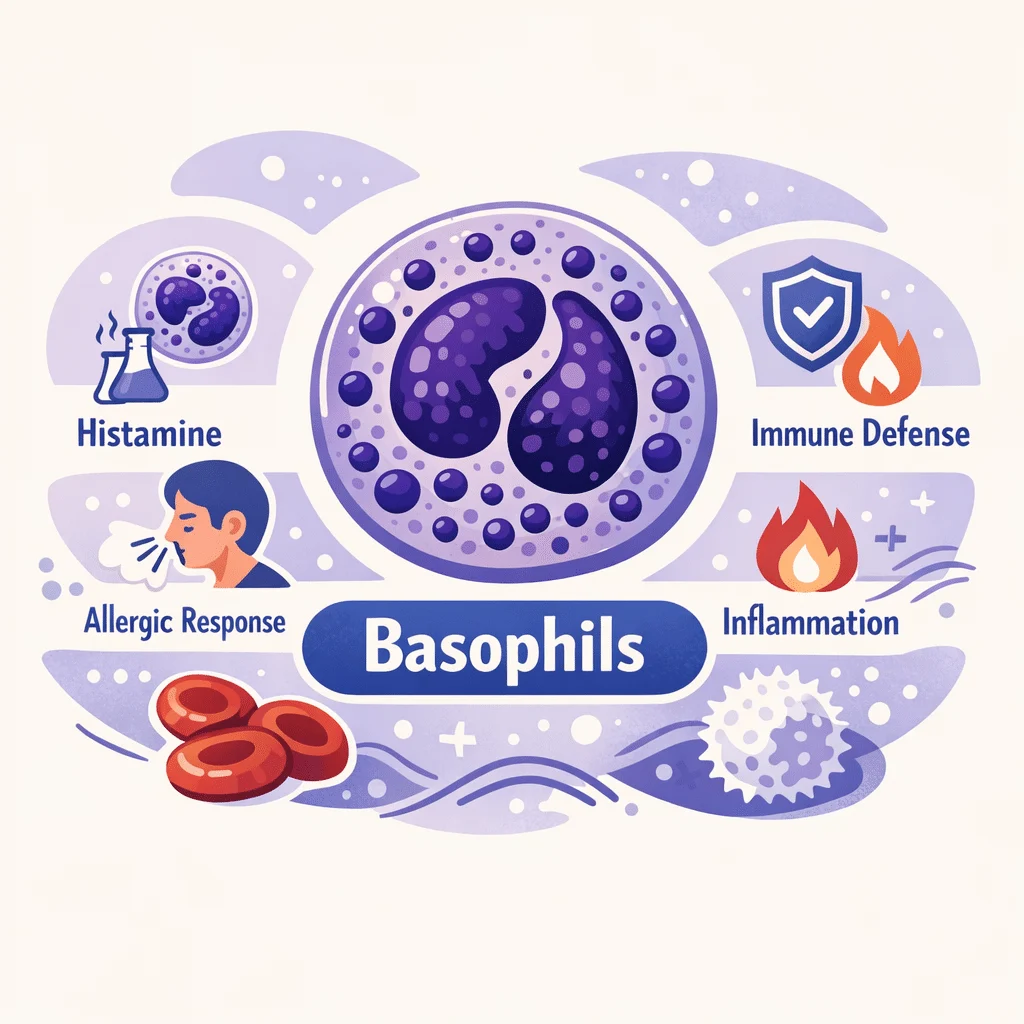
El resultado del análisis de basófilos en sangre puede resultar difícil de interpretar por sí solo. Este valor aparece en una analítica rutinaria de hemograma completo y suele ser un número pequeño entre muchos otros, a veces con una flecha al lado si está fuera del rango esperado. En este artículo aprenderás qué son los basófilos, por qué los laboratorios los miden, qué puede significar un resultado alto o bajo, y cuándo merece la pena comentar tus valores con el médico. El objetivo es ayudarte a leer tu propio informe con más seguridad, no sustituir el consejo médico.
¿Qué son los basófilos?
Los basófilos son un tipo de glóbulo blanco, también llamado leucocito. Los glóbulos blancos son la fuerza de defensa del sistema inmunitario, y los basófilos son uno de los cinco tipos que se cuentan en un análisis de sangre estándar. La médula ósea, el tejido blando que hay dentro de los huesos, produce basófilos y los libera al torrente sanguíneo una vez que maduran. Desde que se forma un basófilo hasta que alcanza la madurez completa pasa aproximadamente una semana, y los basófilos maduros circulan entonces por la sangre en lugar de instalarse de forma permanente en los tejidos del cuerpo, como hacen otros glóbulos blancos.
El nombre proviene de una característica de laboratorio y no de lo que hace la célula en el organismo. Cuando los técnicos añaden un colorante básico (alcalino) a una muestra de sangre, los basófilos lo absorben y adquieren un color azul-violeta intenso bajo el microscopio. Esta tinción los hace fáciles de identificar, aunque son el tipo de glóbulo blanco más escaso y suelen representar menos del 1% del recuento total de glóbulos blancos. Curiosamente, los basófilos son también los más grandes de los glóbulos blancos que se cuentan en un diferencial, a pesar de ser los menos numerosos.
Qué hacen los basófilos en el sistema inmunitario
A pesar de su escaso número, los basófilos desempeñan un papel muy relevante en determinadas reacciones inmunitarias. Actúan como un sistema de alarma especializado que responde principalmente a los alérgenos y, en menor medida, a los parásitos.
Cuando un basófilo detecta un alérgeno que reconoce, libera histamina, un mensajero químico. La histamina dilata los vasos sanguíneos y aumenta su permeabilidad, lo que produce los signos clásicos de una reacción alérgica: hinchazón, enrojecimiento y picor. Los basófilos también almacenan heparina, una sustancia que ayuda a mantener el flujo sanguíneo en la zona afectada durante esta respuesta. Por este motivo, los basófilos están estrechamente relacionados con afecciones como la rinitis alérgica, la urticaria y algunas reacciones a medicamentos.
Cómo se mide el análisis de basófilos en sangre
Los basófilos se cuentan como parte de un hemograma completo con fórmula leucocitaria, uno de los análisis de sangre que se solicitan con más frecuencia. La parte del «diferencial» desglosa el recuento total de glóbulos blancos en sus cinco tipos: neutrófilos, linfocitos, monocitos, eosinófilos y basófilos.
Tu informe mostrará normalmente dos valores relacionados.
- El porcentaje, que indica qué proporción del total de glóbulos blancos son basófilos, expresado habitualmente como un valor del tipo 0,5%.
- El recuento absoluto de basófilos, que indica el número real de células basófilas en un volumen determinado de sangre, expresado con frecuencia en células por microlitro o como un valor del tipo 0,02 x10&sup9;/L.
Ambos valores aparecen junto a un rango de referencia, que representa los valores habituales en una población sana. Como los laboratorios utilizan equipos distintos y se basan en poblaciones locales diferentes, los rangos de referencia pueden variar ligeramente de un laboratorio a otro, por lo que siempre debes comparar tu resultado con el rango impreso en tu propio informe. La mayoría de los analizadores automáticos cuentan los basófilos como parte de una fórmula leucocitaria diferencial de cinco partes de rutina, aunque un técnico de laboratorio puede revisar una extensión de sangre teñida al microscopio cuando un resultado parece inusual, ya que a veces las máquinas tienen más dificultades para contar los basófilos con precisión debido a lo poco frecuentes que son.
Valores normales de basófilos: cómo suelen ser los resultados
La mayoría de los laboratorios consideran normal en adultos un porcentaje de basófilos de aproximadamente el 0,5 % al 1 % del recuento total de leucocitos, lo que corresponde a un recuento absoluto de unos 0 a 300 células por microlitro. La tabla siguiente resume cómo se interpretan generalmente los resultados, aunque el rango de referencia de tu propio laboratorio siempre tiene prioridad.
| Patrón del resultado | Porcentaje típico de basófilos | Lo que comúnmente sugiere |
|---|---|---|
| Recuento normal | Aproximadamente 0,5 % – 1 % | No se detecta ninguna alteración en esta línea celular |
| Basofilia leve (elevado) | Ligeramente por encima del límite superior del laboratorio | Con frecuencia, alergias, inflamación leve o una infección pasajera |
| Basofilia marcada (elevado) | Muy por encima del límite superior, persistente en análisis repetidos | Requiere estudio para descartar una causa crónica o relacionada con la médula ósea |
| Basopenia (bajo o indetectable) | En el 0 % o cerca de él | Con frecuencia es un hallazgo normal, o está relacionado con el estrés, los corticoides o el hipertiroidismo |
Algo que sorprende a mucha gente: un recuento de basófilos exactamente igual a cero es habitual y normalmente no es motivo de preocupación. Como los basófilos son ya los leucocitos más escasos, muchas personas sanas obtienen un valor de 0,0 en un análisis puntual.
Basófilos altos (basofilia): posibles causas
La basofilia es el término médico para un recuento de basófilos por encima del rango de referencia. Varias situaciones pueden elevar el recuento, y la mayoría no son urgencias.
Reacciones alérgicas
Un proceso alérgico activo es la explicación más frecuente de un resultado elevado de basófilos en un análisis de sangre. El organismo recluta más basófilos para liberar histamina cuando detecta un alérgeno, lo que puede producir síntomas como erupciones cutáneas, picor, goteo nasal u ojos llorosos.
Inflamación crónica e infecciones
Las enfermedades inflamatorias crónicas, ciertas infecciones víricas y las infecciones parasitarias (especialmente los gusanos intestinales) también pueden elevar el recuento de basófilos, ya que estas células ayudan al organismo a responder a estímulos inmunitarios prolongados.
Hipotiroidismo
Se ha asociado el hipotiroidismo (glándula tiroides poco activa que produce insuficiente hormona) con un leve aumento de basófilos en algunas personas. Los médicos suelen confirmarlo con una analítica de TSH que mide la hormona estimulante del tiroides, junto con otros síntomas como fatiga y aumento de peso.
Trastornos mieloproliferativos
En raras ocasiones, un recuento de basófilos elevado y persistente, especialmente junto con otras alteraciones en el hemograma, puede ser un signo precoz de una enfermedad de la médula ósea, como la leucemia mieloide crónica. Por eso los médicos toman en serio un resultado marcadamente elevado y repetido, aunque sea una causa poco frecuente.
Medicamentos
Algunos medicamentos pueden aumentar el recuento de basófilos como efecto secundario. Compartir la lista completa de tus medicamentos con tu médico le ayuda a interpretar correctamente un resultado inesperado, ya que un aumento relacionado con un fármaco suele ser inofensivo y desaparece una vez que se suspende o ajusta el tratamiento.
Tras la extirpación del bazo
Las personas a las que se les ha extirpado el bazo, ya sea por una lesión o por una enfermedad, pueden presentar un recuento de basófilos ligeramente elevado después de la intervención. El bazo filtra normalmente algunas células sanguíneas, por lo que su ausencia puede alterar la distribución de ciertos glóbulos blancos en el torrente sanguíneo.
Basófilos bajos (basopenia): posibles causas
La basopenia describe un recuento de basófilos por debajo del rango de referencia, o un recuento indetectable. Dado que los basófilos ya son escasos en condiciones normales, un valor bajo es frecuente y, por sí solo, a menudo no tiene relevancia clínica.
Estrés agudo
Un estrés físico o emocional intenso desencadena la liberación de cortisol, una hormona que puede suprimir temporalmente la producción de basófilos. Las infecciones graves, las cirugías mayores y los traumatismos pueden provocar una caída similar y de corta duración.
Hipertiroidismo
El hipertiroidismo (glándula tiroides hiperactiva que produce un exceso de hormona tiroidea) puede reducir en ocasiones el recuento de basófilos. Otros síntomas del hipertiroidismo incluyen taquicardia, nerviosismo y pérdida de peso sin causa aparente.
Corticosteroides
Las personas que toman corticosteroides como la prednisona suelen presentar recuentos de basófilos más bajos. Se trata de un efecto conocido y bien documentado del medicamento, no de un signo de un nuevo problema.
Reacciones alérgicas graves
Aunque pueda parecer paradójico, una reacción alérgica aguda e intensa puede provocar una basopenia transitoria. Durante una reacción grave, los basófilos abandonan rápidamente el torrente sanguíneo y se desplazan hacia los tejidos, lo que puede hacer que aparezcan reducidos en una muestra de sangre tomada en ese momento.
Análisis de basófilos en sangre: guía práctica de decisión
La tabla siguiente ofrece un marco general sobre cómo se suele abordar un resultado anormal. Su objetivo es ayudarte a entender la conversación con tu médico, no sustituirla.
| Situación | siguiente paso común |
|---|---|
| Ligeramente alto o bajo, sin síntomas, primera vez que aparece | Habitualmente solo seguimiento, a veces una prueba de control en 1–3 meses |
| Moderadamente anormal o acompañado de síntomas alérgicos | Consulta médica para investigar las causas más probables, como alergia o infección |
| Claramente anormal o persistente en varias analíticas | Consulta sin demora; pueden recomendarse análisis de sangre adicionales |
| Recuento anormal junto con cansancio, fiebre, pérdida de peso u otras líneas celulares alteradas | Evaluación oportuna para descartar una enfermedad de base más amplia |
Cuándo consultar al médico por tu recuento de basófilos
Hablar con tu médico es siempre una opción razonable cuando un resultado te sorprende, pero resulta especialmente importante en determinadas situaciones.
- Tu recuento de basófilos se mantiene persistentemente alto o bajo en varias analíticas realizadas en momentos distintos.
- El recuento anormal va acompañado de síntomas generales como cansancio inexplicable, fiebre, sudores nocturnos o pérdida de peso.
- Otros recuentos de células sanguíneas, como los glóbulos rojos o las plaquetas, también aparecen alterados en el mismo informe.
- Tienes síntomas alérgicos nuevos o que empeoran, como urticaria, hinchazón de cara o garganta, o dificultad para respirar, que pueden indicar una reacción alérgica más grave como anafilaxia, lo que puede llevar a solicitar una prueba de triptasa sérica.
Tu médico interpreta el recuento de basófilos dentro del contexto completo de tus síntomas, tu historial médico y el resto de tus valores analíticos, no como un número aislado.
Últimos avances científicos
En los últimos años, la investigación sobre los basófilos ha avanzado mucho más allá del simple esquema alto-versus-bajo, en gran parte gracias a una herramienta de laboratorio llamada test de activación de basófilos, o TAB.
Un documento de consenso de 2025 de la Academia Europea de Alergia e Inmunología Clínica explica que el TAB mide con qué intensidad reaccionan los basófilos de un paciente al exponerse a un alérgeno sospechoso en el laboratorio, en lugar de limitarse a contar cuántos basófilos hay. (Nota aclaratoria: un «documento de consenso» es un texto en el que un panel de especialistas revisa conjuntamente la evidencia disponible y acuerda recomendaciones comunes, lo que tiene más peso que un único estudio.) En términos sencillos, esta prueba puede mostrar cómo se comportan las células inmunitarias de una persona cuando entran en contacto con un desencadenante específico, como un alimento, un veneno o un medicamento, sin necesidad de exponer a la persona directamente de nuevo. Lo que esto significa para ti: para las personas con sospecha de alergia a medicamentos o alimentos que no pueden someterse de forma segura a una nueva prueba de exposición, este análisis basado en células ofrece a los médicos otra forma de investigar la causa sin arriesgarse a provocar una reacción.
Una revisión relacionada de 2024 centrada en niños concluyó que la prueba de activación de basófilos funcionaba bien como alternativa menos invasiva a las pruebas de provocación oral con alimentos, que son el método tradicional —aunque más exigente— para confirmar una alergia alimentaria. Lo que esto significa para ti: en algunos niños con sospecha de alergia alimentaria, este análisis de sangre puede reducir la necesidad de realizar una prueba de provocación supervisada en consulta, aunque no la sustituye en todos los casos.
Una investigación publicada en 2023 sobre reacciones alérgicas inmediatas a medicamentos indicó que esta misma prueba de activación mostró una alta precisión para identificar alergias reales a fármacos en un grupo pequeño y cuidadosamente estudiado de pacientes. (Una aclaración: una «cohorte pequeña» significa simplemente un grupo limitado de personas seguidas durante el estudio; se trata de un resultado preliminar, pendiente de confirmación en grupos más amplios, y no de un hecho definitivamente establecido.) Lo que esto significa para ti: si alguna vez has tenido una reacción a un medicamento y te dijeron que «no existe ninguna prueba clara», esta herramienta en desarrollo podría estar cada vez más disponible como evidencia adicional para tu alergólogo.
Por otro lado, investigadores que revisaron la urticaria crónica (urticaria crónica espontánea) en 2023 describieron cómo un recuento de basófilos inusualmente bajo en sangre, junto con ciertos patrones de anticuerpos, puede ayudar a identificar un subtipo autoinmune específico de esta afección cutánea. Lo que esto significa para ti: si tienes urticaria persistente sin causa aparente, el recuento de basófilos es una de las varias pistas que tu dermatólogo o alergólogo puede utilizar para determinar qué enfoque de tratamiento tiene más probabilidades de ayudarte.
En conjunto, estos hallazgos muestran que los basófilos se consideran cada vez más no solo como un número en un informe, sino como células vivas cuyo comportamiento en el laboratorio puede orientar decisiones diagnósticas y terapéuticas reales en alergología e inmunología.
Basófilos y eosinófilos: ¿cuál es la diferencia?
Los basófilos se tratan con frecuencia junto con los eosinófilos, otro tipo de glóbulo blanco que responde a los alérgenos y a los parásitos. Ambos tipos de células suelen aumentar juntos durante una reacción alérgica o una infección parasitaria, y ambos pueden verse afectados de forma similar por los corticosteroides. La diferencia clave está en la especialización: los eosinófilos participan más directamente en la lucha contra los parásitos y en ciertas formas de inflamación crónica, como el asma eosinofílica, mientras que los basófilos están más estrechamente relacionados con la liberación inmediata de histamina que desencadena los síntomas clásicos de alergia. Los médicos suelen analizar ambos valores juntos, junto con los neutrófilos, que responden principalmente a las infecciones bacterianas, para obtener una imagen completa de lo que está haciendo el sistema inmunitario.
Entender tus glóbulos blancos no termina en los basófilos. Otros marcadores que tu médico también podría revisar incluyen un análisis de sangre de alergia que mide anticuerpos IgE específicos cuando se sospecha un desencadenante alérgico, y un análisis más amplio de síntomas y causas de enfermedades autoinmunes si los recuentos alterados persisten sin una explicación clara. Si tu recuento de basófilos es marcadamente elevado de forma persistente, tu médico también podría querer descartar una enfermedad de la médula ósea, que se explica con más detalle en nuestra guía sobre cómo se interpretan los análisis de sangre para la leucemia.
Glosario
| Término | Definición |
|---|---|
| Basofilia | Un recuento de basófilos por encima del rango de referencia, relacionado con mayor frecuencia con alergias, infecciones o inflamación. |
| Basopenia | Un recuento de basófilos por debajo del rango de referencia, o un recuento indetectable, relacionado habitualmente con el estrés, los corticosteroides o el hipertiroidismo. |
| Hemograma completo (CSC) | Un análisis de sangre habitual que cuenta los glóbulos rojos, los glóbulos blancos y las plaquetas. |
| Diferencial | La parte del hemograma completo que desglosa el recuento de glóbulos blancos en sus cinco tipos. |
| Histamina | Una sustancia química liberada por los basófilos y otras células inmunitarias que dilata los vasos sanguíneos y produce síntomas alérgicos. |
| Leucocito | El término médico para referirse a un glóbulo blanco, una célula que interviene en la defensa del organismo frente a infecciones y enfermedades. |
| Trastorno mieloproliferativo | Un grupo de enfermedades de la médula ósea que provocan la sobreproducción de uno o más tipos de células sanguíneas. |
| Test de activación de basófilos (TAB) | Un análisis de laboratorio especializado que mide la intensidad de la reacción de los basófilos ante un alérgeno específico, utilizado para ayudar a diagnosticar ciertas alergias. |
| Rango de referencia | El intervalo de valores considerados habituales en una población sana, establecido por cada laboratorio. |
Preguntas frecuentes
¿Qué significa tener los basófilos altos en un análisis de sangre?
Un resultado elevado, denominado basofilia, suele reflejar una reacción alérgica en curso, una enfermedad inflamatoria crónica o, en ocasiones, una infección parasitaria. En raras ocasiones, un recuento muy alto y persistente puede apuntar a una alteración de la médula ósea que requiere una evaluación más detallada. Una sola lectura levemente elevada, especialmente sin síntomas, no suele ser motivo de preocupación y, en general, simplemente se repite al cabo de unas semanas.
¿Qué significa tener los basófilos bajos en un análisis de sangre?
Un resultado bajo o indetectable, denominado basopenia, es frecuente y a menudo no tiene relevancia clínica, ya que los basófilos son el tipo de glóbulo blanco menos abundante. Cuando tiene una causa, suele estar relacionado con estrés agudo, medicamentos corticosteroides, hipertiroidismo o una reacción alérgica grave reciente. Tu médico valorará tus síntomas y el resto de los resultados antes de decidir si es necesario algún seguimiento.
¿Cuáles son los valores normales de basófilos en un análisis de sangre?
La mayoría de los laboratorios considera que el rango habitual en adultos es de aproximadamente el 0,5% al 1% del recuento total de glóbulos blancos, o entre 0 y 300 células por microlitro. Como los rangos exactos varían entre laboratorios, compara siempre tu resultado con los valores de referencia que figuran en tu propio informe, en lugar de con cifras encontradas en internet.
¿Cómo puedo aumentar mis basófilos de forma natural?
No existe ningún método probado para elevar deliberadamente el recuento de basófilos y, en la mayoría de los casos, un recuento bajo no necesita “corregirse”, ya que a menudo es un hallazgo normal o un efecto temporal del estrés o de algún medicamento. En lugar de intentar cambiar el número en sí, céntrate en hábitos de vida saludables como una alimentación equilibrada, dormir lo suficiente y gestionar el estrés, y deja que tu médico trate cualquier causa subyacente si se encuentra alguna.
¿Cuál es la relación entre basófilos y eosinófilos?
Los basófilos y los eosinófilos son ambos glóbulos blancos implicados en las respuestas alérgicas y antiparasitarias, y es habitual que ambos aumenten juntos durante una reacción alérgica. Aunque suelen actuar de forma conjunta, los eosinófilos están más estrechamente relacionados con la defensa frente a parásitos y ciertas enfermedades inflamatorias crónicas, mientras que los basófilos son los principales responsables de la liberación inmediata de histamina.
¿Pueden el estrés o la hora del día afectar a mis basófilos?
Sí. El recuento de basófilos puede variar ligeramente con el ritmo natural del organismo a lo largo del día y tiende a bajar en períodos de estrés físico o emocional agudo, principalmente debido a la hormona cortisol. Estos cambios suelen ser pequeños y temporales, lo que explica que los médicos prefieran observar la evolución a lo largo de varios análisis en lugar de basarse en una sola lectura.
Fuentes
- Anthony J, et al. — The Evolution of the Basophil Activation Test (BAT) in Clinical Allergy Practice: 2025 EAACI Position Update — Allergy, 2025 — https://doi.org/10.1111/all.16607
- Boyd H, Santos AF — Novel diagnostics in food allergy — Journal of Allergy and Clinical Immunology, 2024 — https://doi.org/10.1016/j.jaci.2024.12.1071
- Koumaki D, et al. — Real-Life Utility of Basophil Activation Test in the Diagnosis of Immediate Hypersensitivity Drug Reactions — Dermatology and Therapy, 2023 — https://consensus.app/papers/details/e55b8198369d59d5beb4cda610f9c124/?utm_source=claude_code
- Larenas-Linnemann D — Biomarkers of Autoimmune Chronic Spontaneous Urticaria — Current Allergy and Asthma Reports, 2023 — https://doi.org/10.1007/s11882-023-01117-7
- Basófilos: función, valores normales y enfermedades relacionadas — Cleveland Clinic
- Análisis diferencial de sangre — MedlinePlus, Biblioteca Nacional de Medicina (NIH)
- Basofilia — StatPearls, NCBI Bookshelf (NIH)
Lecturas adicionales
- Hemograma completo (CBC): Cómo interpretar los resultados
- Análisis de sangre para detectar alergias: Explicación de los paneles de IgE y de alergias.
- Eosinófilos: qué son y para qué sirven estas células sanguíneas clave
- Neutrófilos altos: causas, síntomas y riesgos para la salud
- Cómo interpretar los resultados de un análisis de sangre: una guía completa
Los basófilos son solo una línea dentro de un informe mucho más amplio, y un hemograma completo suele incluir glóbulos rojos, plaquetas y otros tipos de glóbulos blancos que aportan contexto a tus resultados. Pruebas como un panel de alergias, una revisión del tiroides como la TSH o un marcador de inflamación como la PCR pueden añadir cada una una pieza más al cuadro cuando el recuento de basófilos parece anormal. AI DiagMe puede ayudarte a entender estos valores en conjunto, aunque está diseñado para ayudarte a comprender tu informe, no para diagnosticarte ni sustituir a tu médico.
Comprenda los resultados de su laboratorio con AI DiagMe.
Obtén la interpretación de tus resultados en minutos.