




















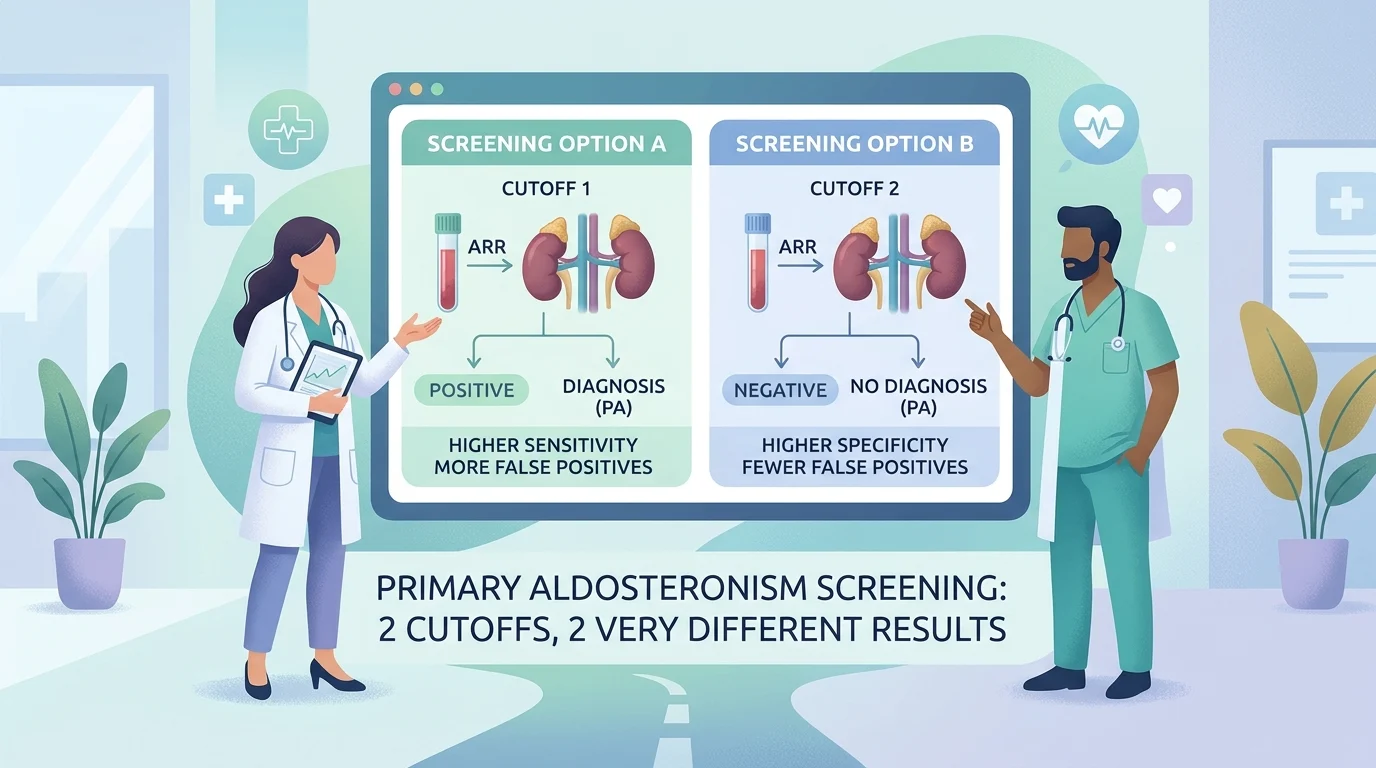
A new study in the journal Hypertension compares two ways of reading the same hormone tests, and the result is striking: the choice of cutoff roughly doubles the number of people flagged for primary aldosteronism, a treatable hormonal cause of high blood pressure. The findings were released on October 19, 2026 by Quest Diagnostics and its academic co-authors. They are retrospective and not yet confirmed, but they raise a practical question: what exactly counts as a positive primary aldosteronism screening result? This article explains what was compared, where the 2025 Endocrine Society guideline stands, and what the study cannot tell you.
What the new primary aldosteronism study compared
According to the press release from Quest Diagnostics, researchers from Quest, Mass General Brigham, Harvard Medical School, and UT Southwestern analyzed deidentified lab results from more than 60,000 U.S. patients who had aldosterone and renin measured. They applied two sets of criteria to the same results. The release describes the work as a retrospective analysis published in Hypertension, an American Heart Association journal.
| Criterion | 2025 Endocrine Society criteria (as summarized in the release) | More permissive criteria tested |
|---|---|---|
| Plasma renin activity | 1 ng/mL/h or lower | 1 ng/mL/h or lower |
| Aldosterone | 7.5 ng/dL or higher | Above 5 ng/dL |
| Aldosterone-to-renin ratio | Above 15 | Not required |
| Patients flagged | 13.0% | 26.2% |
Under the stricter set, 13.0% of patients were flagged. Under the permissive set, 26.2% were. The release says about 79% of the additional patients had an aldosterone value between 5 and 7.5 ng/dL, the range the stricter cutoff leaves out.
Why the headline needs a careful reading
The press-release headline says current thresholds may miss half of patients. That framing reflects the share of the additional flagged patients, not a measured count of missed diagnoses. Several limits matter:
- The analysis is retrospective and did not include confirmatory testing, so the extra patients flagged are not confirmed cases.
- Links with conditions such as atrial fibrillation were based on insurance billing codes, which are an imperfect record.
- The release projects that up to 25 to 30% of people with high blood pressure could be diagnosed if the criteria were confirmed prospectively. That confirmation has not happened.
- The authors include employees of the company that ran the tests, and the source is a company communication that has not been independently evaluated.
Where the 2025 Endocrine Society guideline stands
According to the guideline published in the Journal of Clinical Endocrinology and Metabolism in August 2025, the panel suggests that everyone with hypertension be screened by measuring aldosterone and renin and calculating their ratio. It describes the condition as common yet markedly underdiagnosed. A 2026 review written for clinical laboratories adds that universal screening will increase testing volumes, and that thresholds are method-specific because aldosterone assays differ from one laboratory to another. A UK audit of laboratories likewise found considerable variation in reference intervals and cutoffs between centers.
In practice, then, there is no single magic number. Your laboratory report, your medicines, and your overall picture all shape how a result is read. For the basics of the hormone itself, read our aldosterone test guide.
What can change your aldosterone and renin results
MedlinePlus explains that preparation matters. You may be asked to limit salt for about two weeks before the test, and to avoid natural black licorice for at least two weeks. Blood levels also vary with posture, so you may be asked to lie down or stand before the blood draw. Some blood pressure medicines can affect results, and Cleveland Clinic notes that providers may adjust medicines to improve accuracy. Never stop a prescribed medicine on your own.
Timing is another factor. A separate September 2026 study suggests aldosterone is released in bursts, which is why a single normal result may not close the question. To see how that study fits in, read our aldosterone renin ratio article.
Latest scientific advances
A 2026 review in Nature Reviews Disease Primers concludes that primary aldosteronism remains underdiagnosed and that simple testing of renin and aldosterone is recommended in all people with hypertension. It also notes that most people with the condition have it in both adrenal glands, in which case treatment is usually medicine rather than surgery. What this changes for you: if you live with high blood pressure, asking whether you have ever been screened is a reasonable question.
The systematic review that supports the guideline adds an honest caveat. Its authors found no trials that directly tested whether screening improves outcomes, so much of the evidence is observational and, for some questions, of very low certainty. Screening is recommended on balance, not proven in a trial.
Finally, a 2026 multicenter study from Korea built a decision tree to predict who would test positive on a confirmatory saline infusion test, with the goal of sparing some patients an extra test. It is retrospective and early, so it changes nothing today. It does show where the field is heading: toward testing guided by probability rather than by a single cutoff.
When to talk to your doctor
According to Cleveland Clinic, it is worth asking about testing if you have consistently high blood pressure or low potassium. Risk factors include:
- Low blood potassium, especially if unexplained.
- High blood pressure that started before age 30.
- Blood pressure that needs three or more medicines.
- An adrenal tumor found on imaging.
A lab result is only one piece of the picture, and only your doctor can interpret it with your history and your medicines.
Glossary
- Aldosterone: a hormone made by the adrenal glands that helps regulate blood pressure and the balance of sodium and potassium.
- Renin: an enzyme from the kidneys that normally drives aldosterone production; in primary aldosteronism it is usually low.
- Aldosterone-to-renin ratio: the screening calculation that compares the two hormones.
- Primary aldosteronism: excess aldosterone made by one or both adrenal glands, also called Conn’s syndrome.
- Retrospective study: research that analyzes data collected in the past rather than following patients forward.
- Confirmatory test: a follow-up test, such as a saline infusion test, used to confirm or exclude the diagnosis after a positive screen.
Frequently asked questions
What is primary aldosteronism?
It is a condition in which the adrenal glands make too much aldosterone. According to MedlinePlus, most cases are caused by a noncancerous tumor of an adrenal gland. It can cause high blood pressure and low potassium.
Who should ask about screening?
The 2025 Endocrine Society guideline suggests screening everyone with hypertension. Cleveland Clinic highlights low potassium, early-onset high blood pressure, needing three or more medicines, and an adrenal tumor as particular reasons to ask.
Should I stop my blood pressure medicine before the test?
No, not on your own. MedlinePlus advises following your provider’s instructions and not stopping prescribed medicines unless you are told to.
Does a normal result rule it out?
Not always. Aldosterone levels can fluctuate, and medicines and preparation can shift results. If symptoms or risk factors persist, discuss repeat testing with your doctor.
Sources
- Quest Diagnostics press release on the Hypertension study, October 19, 2026
- MedlinePlus: Primary and secondary hyperaldosteronism
- MedlinePlus: Aldosterone test
- Cleveland Clinic: Primary aldosteronism (Conn’s syndrome)
- Adler et al., Primary Aldosteronism: An Endocrine Society Clinical Practice Guideline, J Clin Endocrinol Metab, 2025
- Farah et al., A Systematic Review Supporting the Endocrine Society Clinical Practice Guideline on Management of Primary Aldosteronism, J Clin Endocrinol Metab, 2025
- Vaidya et al., Primary aldosteronism, Nat Rev Dis Primers, 2026
- Sawyer et al., Impact of the 2025 Endocrine Society clinical practice guideline on the diagnosis and management of primary aldosteronism for the clinical laboratory, Pathology, 2026
- Davies et al., A United Kingdom-wide audit of the laboratory investigation of primary aldosteronism, Ann Clin Biochem, 2025
- Kim et al., Decision Tree Prediction of Saline Infusion Test Outcomes in Suspected Primary Aldosteronism, J Clin Endocrinol Metab, 2026
Journal articles were identified through PubMed.
Other articles
- Aldosterone renin ratio: why a single blood test can miss Conn’s syndrome
- Aldosterone test: how to understand your results
- Undiagnosed high blood pressure: how to know if you have it
Understand your own blood test results with AI DiagMe
Got lab results you cannot make sense of? Understand your lab results with AI DiagMe.