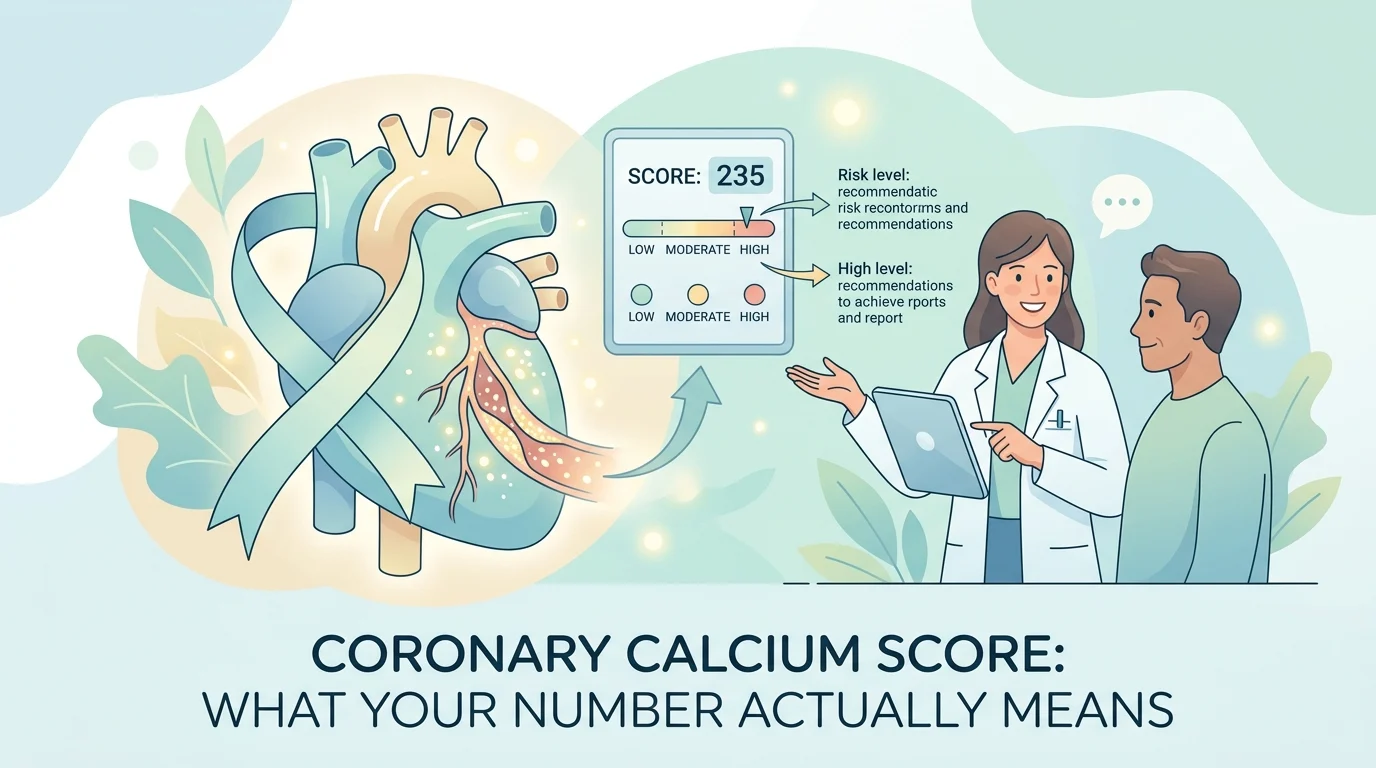
A coronary calcium score arrives as a single number, often with a percentile beside it and a line of text that says something like moderate or extensive. It looks like a measurement of how blocked your arteries are. It is not. It is a count of how much hardened plaque the scanner found, weighted by how dense that plaque is, and it answers a question about the future rather than the present: how likely a heart attack or stroke is over the next ten years or so.
That distinction changes almost everything about how to read the result. It explains why a high score is not an emergency, why a score of zero is not a lifetime guarantee, why the same number means different things at forty-five and at seventy-five, and why the score often rises once treatment starts working. This guide takes each of those in turn. If you are still deciding whether to have the scan at all, our separate article on who actually needs a coronary calcium score covers that decision.
What the scan measures, and what it does not
The test is a short, non-contrast CT scan of the heart. It looks for calcium in the walls of the coronary arteries, the vessels that supply the heart muscle. Calcium appears there because plaque, the fatty build-up that drives heart disease, calcifies as it ages. Cleveland Clinic notes that calcium deposits typically develop after plaque has been accumulating for around five years, so the score is a record of disease that has been present for some time rather than something that appeared recently.
The radiation dose is low; Cleveland Clinic describes it as roughly the amount you would receive naturally over a year. The result is usually reported as an Agatston score, named after the method used to calculate it.
| The score tells you | The score does not tell you |
|---|---|
| How much calcified plaque is in your coronary arteries | Whether any artery is narrowed or blocked |
| Your likely risk of a heart attack or stroke over the coming years | Whether you are having a heart problem right now |
| Which arteries contain calcium, if the report lists them | How much softer, uncalcified plaque is present |
| How your plaque burden compares with others of your age and sex | Whether you need a stent or any procedure |
RadiologyInfo, the patient resource of the Radiological Society of North America and the American College of Radiology, states the core limitation plainly: a calcium score describes plaque that has hardened, does not measure softer plaque that has not yet calcified, and does not show whether an artery is narrowed. It also notes that heart disease, especially in people under fifty, can be present without calcium and may not be detected by the scan.
This is why the scan is a risk test and not a diagnostic test. The American Heart Association is explicit that it is not the right test for someone with chest pain or other active symptoms, which need a different evaluation. If you have symptoms, the score is not the tool that answers your question.
About the widowmaker label
Many reports break the score down by artery, and the left anterior descending artery, which supplies the front of the heart, is often nicknamed the widowmaker. Seeing calcium listed in it is understandably alarming. But calcium in that artery is a statement about plaque burden in that artery, not a statement that it is narrowed. A score by artery helps your clinician understand where the disease is, and it carries prognostic weight, but on its own it does not mean a blockage has been found.
Reading the number: two ways reports group scores
This is a common source of confusion. Your report and the website you are reading may be using different categories, because two groupings are in circulation.
| Current AHA patient grouping | What the AHA says it means | Older grouping often seen on reports |
|---|---|---|
| 0 | Absent. Short-term risk is likely lower than estimated | 0: no evidence of plaque |
| 1 to 9 | Minimal. Early atherosclerosis is confirmed | 1 to 10: minimal |
| 10 to 99 | Mild. A statin is often recommended depending on overall profile | 11 to 100: mild |
| 100 to 299 | Moderate. Statin therapy with lifestyle changes | 101 to 400: moderate |
| 300 to 999 | Severe. High-intensity statin strongly recommended, possibly with other lipid-lowering drugs | Over 400: extensive |
| 1,000 or more | Extensive. Intensive statin therapy, typically combined with other medicines | Over 400: extensive |
The left-hand columns come from the American Heart Association's patient fact sheet on reading a coronary calcium score. The right-hand column is the grouping RadiologyInfo still publishes and many radiology reports still print. The difference matters most at the top end: the older system stops at over 400, while the current one separates 300 to 999 from 1,000 or more, because risk and recommended treatment keep climbing well beyond 400.
Two features of the AHA grouping are worth noticing. The word severe is applied to a score of 300, not to your arteries, and every band from 10 upward is linked to a treatment conversation rather than to a procedure. The categories are about how hard to push prevention, not about whether something needs fixing.
Why your age changes what the number means
Calcium accumulates with age in almost everyone. A score of 100 is a common finding in a seventy-five-year-old and an unusual one in a forty-five-year-old, and it means more in the younger person because it signals that disease has arrived early and has decades to progress.
That is what the percentile on your report is for. It compares your score with people of the same age and sex, and often the same ethnicity, drawn from large reference studies. A percentile of 80 means your score is higher than 80 per cent of comparable people. The absolute score tells you how much plaque you have; the percentile tells you how early you have it.
The effect of age shows up clearly in outcome data. According to PubMed, a study of 4,529 adults who had calcium scoring in Taiwan found all-cause mortality rates of 2.94, 4.88, 17.6 and 33.1 per 1,000 person-years for scores of 0, 1 to 100, 101 to 400 and over 400. Compared with scores of 400 or less, a score over 400 carried a hazard ratio of 6.46 in adults under 65 but 1.94 in older adults (DOI). The same number carried roughly three times the relative weight in the younger group.
The 2026 US guideline has formalised this. According to PubMed, a review of how calcium scoring has evolved in American prevention guidelines notes that the 2026 multisociety dyslipidaemia guideline incorporates age- and sex-adjusted percentiles alongside the absolute score (DOI). If your report gives a percentile, it is not a decorative extra; it is now part of how treatment is decided.
What a score of zero really means
A score of zero is the most reassuring result the test can give. The AHA fact sheet describes it as meaning your short-term heart risk is likely lower than estimates suggested, and notes that medication may be deferred if there are no other major risk factors, with the scan considered again in three to seven years. For many people with borderline risk, a zero genuinely changes the plan.
It is not unconditional, and there are three situations where it reassures less than people expect.
When your other risk factors already put you over the line
A 2026 analysis of 5,698 participants in the Multi-Ethnic Study of Atherosclerosis looked at what zero means for people at different predicted risk levels using the new PREVENT risk equations. According to PubMed, the gap between a zero and a positive score was large at every level, but people at higher predicted risk still had meaningful event rates even with a score of zero (DOI).
| 10-year predicted risk (PREVENT) | Events per 1,000 person-years, score 0 | Events per 1,000 person-years, score above 0 |
|---|---|---|
| Under 3 percent | 1.1 | 3.0 |
| 3 to under 5 percent | 2.7 | 5.2 |
| 5 to under 10 percent | 5.9 | 11.3 |
| 10 percent or higher | 6.2 | 20.9 |
The authors concluded that among people who already meet guideline thresholds for treatment, a score of zero should not generally be used to withhold a statin. A zero moves your risk down; it does not necessarily move it below the level at which treatment is recommended. In the same study, the scan added the most value exactly where the decision was closest, in people with borderline predicted risk.
When the plaque has not calcified yet
Plaque starts soft and calcifies over years, so a young person, a smoker, or someone with a strong family history can have plaque that the score cannot see. According to PubMed, a study in Pakistan of 534 people with chest symptoms and a calcium score of zero found that at least 28.8 percent had some degree of soft plaque on CT angiography, and 5.8 percent had narrowing of more than 50 percent (DOI). The long-term outlook in that group was still good, but the finding makes the point: zero means no calcium, not no plaque.
A 2025 case report describes a 48-year-old man with a score of zero whose uncalcified plaque grew steadily over a decade of serial CT angiography before a high-intensity statin slowed it (DOI). A single patient proves nothing about how common this is, but it illustrates exactly what the score is blind to.
When time has passed
A zero describes your arteries on the day of the scan. That is why the AHA suggests considering a repeat after three to seven years rather than treating the result as permanent. Clinicians sometimes call this the warranty period of a zero: long enough to be genuinely useful, short enough that it should not be relied on indefinitely.
What a high score means, and what it does not
Searches for life expectancy with a high calcium score, and whether a high score is a death sentence, are among the most common questions people ask after this test. The honest answer is that a high score raises risk substantially and deserves to be taken seriously, and that it is not a verdict.
Three points put a high result in perspective. First, it is a risk estimate for a population of people with similar scores, not a prediction about you. Second, the risk it describes is the risk before treatment, and the entire purpose of finding it is to change that. The AHA grouping pairs every band from 100 upward with specific lipid-lowering treatment, and pairs a score of 1,000 or more with intensive statin therapy combined with other medicines and close follow-up.
Third, what you do next measurably changes the outlook. According to PubMed, a study of 2,318 adults aged 65 to 84 followed for an average of 10.6 years found that among people with scores of 400 or higher, mortality rose stepwise as physical activity fell. Those with scores of 400 or more who reported high physical activity had a mortality rate similar to people with scores of only 0 to 99 who were inactive: 19.9 against 16.3 deaths per 1,000 person-years (DOI). That is an observational association, not proof that exercise alone offsets calcium, but it is a strong signal that the number is where the conversation starts rather than where it ends.
Why the score often rises on treatment
This surprises almost everyone, and it causes a great deal of unnecessary worry. People start a statin after a high score, have a repeat scan a few years later, and find the number has gone up.
The explanation lies in how the score is built. The Agatston method multiplies the area of each calcium deposit by a factor for its density, so denser calcium produces a higher score. Statins appear to push plaque towards a denser, more calcified and more stable form. According to PubMed, a 2025 study of 316 people with serial scans an average of 3.8 years apart found that statin therapy was associated with a shift towards denser calcium, which the authors describe as a more stable phenotype. In people whose calcium was all in the lowest-density band at baseline, statin use was associated with a fall in calcium volume; in those with mixed densities, it was associated with growth across every density band (DOI).
So a rising score on a statin does not mean the treatment is failing. It may mean the plaque is becoming less likely to rupture, which is what causes most heart attacks. This is why most clinicians do not use repeat calcium scans to judge whether treatment is working, and rely on LDL cholesterol, blood pressure and other measurable targets instead. Our guides to LDL cholesterol levels and ranges and to reading a lipid panel cover those numbers, and if your LDL looks different from one report to the next, it may be because the way LDL is calculated has changed.
Can you lower a calcium score?
Not in any reliable way, and chasing the number is the wrong goal. Once calcium is in the artery wall, it tends to stay there, and Cleveland Clinic's overview of coronary artery calcification describes management, not reversal. The goal after a positive score is to lower the risk the score describes, which is achievable, rather than to lower the score itself, which usually is not.
Supplements marketed for calcium have not delivered. According to PubMed, a randomised trial of 242 people with coronary disease already taking statins found that high-dose omega-3 fatty acids did not reduce calcium progression over 30 months, and in the subgroup with diabetes were associated with a greater increase than in the control group (DOI). Our review of what the evidence shows for cholesterol supplements covers the wider picture.
What does reduce risk after a positive score is familiar: lowering LDL cholesterol, controlling blood pressure and blood sugar, not smoking, and staying physically active. The dietary evidence supports eating patterns that lower LDL rather than any food that dissolves calcium, and our guide to high cholesterol and how to act on it sets that out.
What usually happens after your result
The score is read together with the rest of your cardiovascular picture, and most of that picture comes from ordinary blood tests. Your clinician will usually look at your LDL and non-HDL cholesterol, your total cholesterol, your HDL cholesterol and triglycerides, blood sugar, kidney function, blood pressure and smoking history. The 2026 US guideline also recommends measuring lipoprotein(a) at least once in adulthood, which matters here because a high Lp(a) can explain calcium that seems out of proportion to your cholesterol. Inflammation markers such as high-sensitivity CRP are sometimes added to the picture as well.
How the pieces fit is changing. According to PubMed, a review of the 2026 ACC/AHA multisociety guideline's primary prevention recommendations describes risk being estimated with the PREVENT equations, with calcium scoring used alongside that estimate for shared decision-making about starting treatment, and with LDL cholesterol, non-HDL cholesterol and apolipoprotein B treatment goals reintroduced for selected groups (DOI). If your report came with a calcium score and a risk percentage from a calculator, those two numbers are designed to be read together. Our guide to how kidney function enters heart risk estimates explains one of the inputs that is easy to overlook.
What does not usually follow a high score, on its own, is a stent or an angiogram. Those are for symptoms or for evidence that an artery is narrowed and limiting blood flow, which the calcium score cannot show. If you have chest pain, breathlessness on exertion or other symptoms, tell your clinician, because that changes which tests are appropriate.
Latest scientific advances
The most significant change in the past three years is that calcium scoring has moved from an optional tiebreaker to a formal part of treatment decisions in the United States.
According to PubMed, a 2026 review in JACC: Cardiovascular Imaging traces calcium scoring from a weak Class IIb recommendation for selected intermediate-risk adults in 2007, to a Class IIa recommendation for refining risk in the 2018 cholesterol guideline, to Class I recommendations for selected calcium-defined populations in the 2026 multisociety dyslipidaemia guideline. The 2026 document adds age- and sex-adjusted percentiles, calcium-guided treatment intensity and LDL cholesterol goals, and specific management of very high calcium scores (DOI). A 2026 forecast of the international guidelines had anticipated the same shift, noting that calcium scoring improves risk estimation beyond traditional risk factors and that people with a high calcium burden may need combination lipid-lowering therapy (DOI).
The United States and Europe now differ in emphasis. According to PubMed, a 2026 comparison of the 2025 European and 2026 American dyslipidaemia guidelines found that the American framework gives greater operational weight to coronary calcium, lifetime risk, apolipoprotein B and lipoprotein(a), while the European framework places more emphasis on linking fixed risk categories to predefined LDL targets (DOI). If you have been reading guidance from both sides of the Atlantic, that explains why the role of your score may be described differently.
The largest open question is whether treating people according to their calcium score improves outcomes, as opposed to predicting them. ClinicalTrials.gov lists several large randomised trials now testing exactly that. One, with a planned 5,000 participants, is testing aspirin and high-intensity statin therapy in a two-by-two design in people with scores of 300 or more (NCT06676280). DECISION-CAL is comparing high-intensity statin plus ezetimibe with standard care in 6,000 people with any detectable calcium (NCT05845424). A third, with 7,435 participants, compares intensive statin-ezetimibe therapy without aspirin against statin plus aspirin in people with calcification (NCT06722521). A trial led from Duke University is testing rosuvastatin and colchicine in 1,500 people with premature atherosclerosis (NCT07232069). The earliest listed primary completion date amongst them is 2029, so for now treatment decisions rest on risk prediction rather than on calcium-guided trial results.
Research on the scan itself is also shifting. Automated and AI-assisted analysis now separates calcium by density, and studies such as the 2025 statin analysis above suggest that density may capture information about plaque stability that the single Agatston number misses. That work is not yet part of routine reports.
Questions worth asking your clinician
- What is my percentile for my age and sex, and not just the absolute score?
- Given my score and my other risk factors, am I in a group where treatment is recommended, considered or not needed?
- Does my score change the LDL cholesterol level we should be aiming for?
- Has my lipoprotein(a) ever been measured?
- If my score is zero, when would a repeat scan be worth doing, if at all?
- If I start a statin and my score rises on a later scan, how will we interpret that?
- Do any of my symptoms mean I need a different test rather than this one?
Frequently asked questions
What is a good calcium score?
Zero is the best possible result, and scores under 10 indicate minimal plaque. But good is relative to age: a score of 50 is unremarkable at seventy-five and notable at forty-five. The percentile on your report answers this question better than the absolute number, in the same way that a single ratio says less than the individual values behind it, as our guide to what a cholesterol ratio really tells you explains.
What is the Agatston score?
It is the standard way of expressing a coronary calcium result. The software measures each calcium deposit, multiplies its area by a factor for its density, and adds the results across all the coronary arteries. When a report says calcium score or CAC score, it almost always means the Agatston score.
Is a calcium score over 400 dangerous?
It indicates a substantial plaque burden and a higher risk of heart attack or stroke over the coming years, and it is a strong reason for active prevention. It does not mean an artery is blocked or that an event is imminent. The AHA links scores from 300 to 999 with high-intensity statin therapy and scores of 1,000 or more with intensive combination treatment and close follow-up.
My score went up after starting a statin. Is the statin not working?
Not necessarily. Statins appear to make plaque denser and more stable, and because the Agatston method counts denser calcium more heavily, the score can rise even as the plaque becomes less dangerous. Your LDL cholesterol and other targets are a better guide to whether treatment is working.
Can diet or supplements reduce my calcium score?
No diet or supplement has been shown to remove coronary calcium reliably, and a randomised trial found that high-dose omega-3 did not slow its progression. The aim is to reduce the risk the score describes, through lowering LDL cholesterol, blood pressure control, not smoking and regular activity, rather than to reduce the score itself.
Does a score of zero mean I will never have a heart attack?
No. It means your risk over the next several years is likely lower than your other risk factors alone would suggest. It does not detect soft plaque, it describes only the day of the scan, and in people already at high predicted risk a zero may not remove the case for treatment.
How often should the scan be repeated?
There is no routine schedule. For a score of zero, the AHA suggests reconsidering after three to seven years. For a positive score, repeat scanning is rarely needed to make treatment decisions, because the score tends to rise over time regardless and treatment is monitored through blood tests and blood pressure.
Key points to remember
- A calcium score measures how much calcified plaque is in your coronary arteries; it does not measure narrowing or blockage.
- Reports may use an older grouping that stops at over 400, or the current AHA grouping that separates 300 to 999 from 1,000 or more.
- Your percentile for age and sex matters as much as the absolute score, and the 2026 US guideline now builds it into treatment decisions.
- A score of zero is strongly reassuring but not unconditional: it misses soft plaque, it ages, and it may not cancel treatment if other risk factors are high.
- A high score raises risk but is not a verdict; treatment and physical activity are associated with markedly different outcomes at the same score.
- A score that rises on a statin can reflect plaque becoming denser and more stable rather than treatment failing.
- No diet or supplement reliably lowers the score; the goal is to lower the risk it describes.
Sources
- American Heart Association: Coronary artery calcium test
- American Heart Association: Your coronary calcium score, what it means and what to do next
- RadiologyInfo: Cardiac CT for calcium scoring
- Cleveland Clinic: Calcium score test
- Cleveland Clinic: Coronary artery calcification
- PubMed, Irannejad et al., JACC: Cardiovascular Imaging 2026, coronary artery calcium in ACC/AHA prevention guidelines from 2007 to 2026: DOI
- PubMed, Abramov et al., Current Atherosclerosis Reports 2026, ten practice-changing takeaways from the 2026 ACC/AHA multisociety guideline: DOI
- PubMed, Rikhi et al., Journal of the American College of Cardiology 2026, coronary artery calcium and statin eligibility under PREVENT in MESA: DOI
- PubMed, Finocchiaro et al., European Journal of Preventive Cardiology 2026, comparison of the 2025 ESC/EAS and 2026 ACC/AHA dyslipidaemia guidelines: DOI
- PubMed, Razavi et al., American Journal of Preventive Cardiology 2026, forecasting updates across international cholesterol guidelines: DOI
- PubMed, Giovannucci et al., International Journal of Cardiovascular Imaging 2025, statins and progression of coronary calcium composition and density: DOI
- PubMed, Karlsberg, JACC: Case Reports 2025, noncalcified plaque progression despite a zero calcium score: DOI
- PubMed, Shams et al., Global Heart 2024, prognosis of a zero calcium score in symptomatic patients: DOI
- PubMed, Asbeutah et al., American Journal of Cardiology 2024, omega-3 supplementation and coronary calcium progression: DOI
- PubMed, Wang et al., PLoS One 2022, coronary artery calcium and all-cause mortality: DOI
- PubMed, Rozanski et al., Mayo Clinic Proceedings: Innovations, Quality and Outcomes 2020, physical activity, calcium scores and mortality in older adults: DOI
- ClinicalTrials.gov: Aspirin and high-intensity statin in severe coronary calcification, score 300 or more (NCT06676280)
- ClinicalTrials.gov: DECISION-CAL, high-intensity statin plus ezetimibe in coronary calcium (NCT05845424)
- ClinicalTrials.gov: Statin-ezetimibe without aspirin versus statin with aspirin in coronary calcification (NCT06722521)
- ClinicalTrials.gov: Randomised evaluation and management of premature atherosclerosis (NCT07232069)
A calcium score rarely arrives on its own; it sits alongside a lipid panel, a blood sugar result and a kidney function test that together determine what the number means for you. Understand your lab results with AI DiagMe, which reads your report line by line and explains each value in plain language, with interpretation reviewed by a committee of physicians.