





































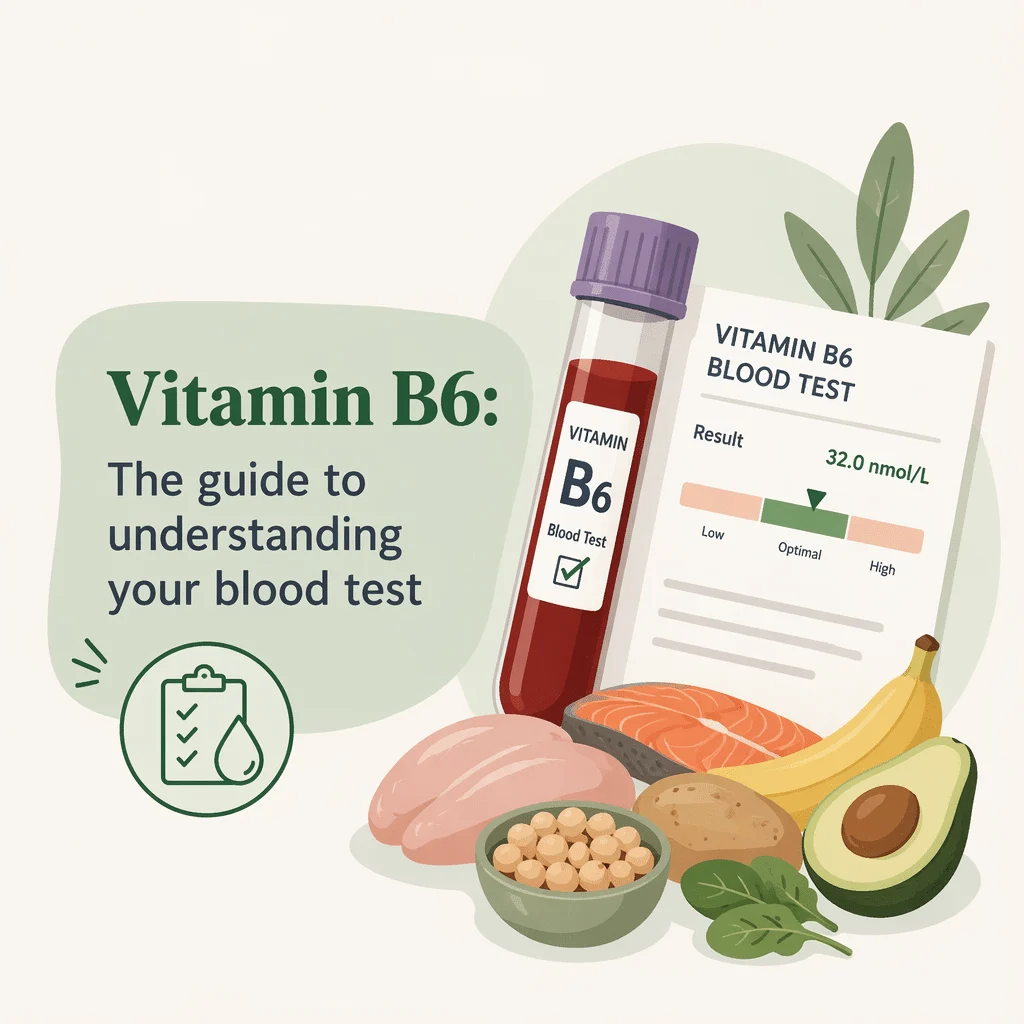
A vitamin B6 blood test measures how much of this essential nutrient is circulating in your blood, almost always in its active form, pyridoxal 5′-phosphate (PLP). If that line appeared on your report, it is natural to wonder what the number means and whether it signals a problem. This guide explains, in plain language, what the test measures, why doctors order it, how to read a low or high result, and what can push your level in either direction. You will also find a reference-range table, the latest research, a glossary, and clear signs of when to speak with a doctor. The goal is to help you understand your result, not to replace your physician’s advice.
What a vitamin B6 blood test measures
Vitamin B6 is a water-soluble vitamin that your body cannot make on its own, so it has to come from food or supplements. It exists in several related forms, but the one that does most of the work inside your cells is pyridoxal 5′-phosphate, usually shortened to PLP. Because PLP is the active form, laboratories measure it in the blood as the most reliable snapshot of your overall B6 status.
When a report says “vitamin B6,” it therefore almost always means plasma PLP. The sample is drawn from a vein, and the laboratory typically uses a method called high-performance liquid chromatography to measure the exact concentration. A fasting sample is often preferred, and the tube has to be shielded from light, because B6 breaks down when exposed to it.
What vitamin B6 does in the body
PLP acts as a helper, or cofactor, for more than one hundred enzyme reactions. In simple terms, it is a tool that many chemical steps in your metabolism cannot run without. It helps your body break down proteins, fats and carbohydrates for energy, and it supports the formation of red blood cells and a healthy immune response.
Vitamin B6 is also needed to build neurotransmitters, the chemical messengers that nerve cells use to communicate. It helps convert the amino acid tryptophan into serotonin, which influences mood and sleep. Finally, it works with two other B vitamins to keep an amino acid called homocysteine within a normal range, which matters for blood-vessel health.
Why doctors order a vitamin B6 test
A vitamin B6 test is not part of a routine check-up for most people. Doctors usually request it when symptoms or a person’s history suggest that B6 could be too low or, less often, too high. It offers an objective number to confirm or rule out a suspicion rather than guessing from symptoms alone.
Your doctor may consider the test if you have unexplained tiredness, mouth or tongue soreness, skin changes, mood changes, or tingling and numbness in the hands and feet. It may also be checked in people at higher risk of a shortfall, such as those with heavy alcohol use, gut conditions that limit absorption, kidney disease, or certain long-term medications.
Because B vitamins work as a team, the test is rarely read alone. Your clinician may include it in a broader vitamin panel blood test, and will often check a vitamin B12 blood test at the same time. Reading these markers together gives a clearer picture than any single value.
How to read your vitamin B6 (PLP) results
Your report lists three things side by side: your result, the unit of measurement, and the laboratory’s reference range. The result on its own means little until you compare it with that range. Vitamin B6 is usually reported in nanomoles per litre (nmol/L) or in nanograms per millilitre (ng/mL), so always check which unit your lab used before comparing your figure to anything you read elsewhere.
Many laboratories use an adult reference range of roughly 20 to 125 nmol/L, which is about 5 to 30 ng/mL. Deficiency is often defined as a PLP below about 20 nmol/L, and some laboratories flag values under 30 nmol/L as insufficient. These thresholds are set by each laboratory and can differ slightly, so the range printed on your own report is the one that counts. It can help to review our guide to reading your blood test results as a whole rather than reacting to a single line.
| Result | What it usually means |
|---|---|
| Low (roughly below 20 nmol/L or 5 ng/mL) | Possible vitamin B6 deficiency from low intake, alcohol, malabsorption, some medicines, or ongoing inflammation |
| Within range (about 20 to 125 nmol/L or 5 to 30 ng/mL) | Adequate B6 status for most people |
| High (above the laboratory’s upper limit) | Almost always high-dose supplements; over time this can be linked to nerve symptoms |
A value just outside the range, with no symptoms, is often rechecked rather than acted on immediately. Only your doctor can interpret the number in the context of your symptoms, your medicines and any other results.
What a low vitamin B6 result means
A low PLP is the more common abnormal finding. A mild shortfall may cause vague symptoms such as fatigue, irritability, or cracked, sore lips and tongue. A more marked deficiency can lead to a skin rash, a form of anaemia (too few healthy red blood cells), confusion, low mood, and tingling or numbness in the hands and feet. Several causes can lower the level, and more than one may act at once.
| Common reason for a low result | What is happening, in plain words |
|---|---|
| Low dietary intake | Too little B6 from food, often with a very restricted diet |
| Heavy alcohol use | Alcohol interferes with how the body activates and holds on to B6 |
| Malabsorption (coeliac disease, Crohn’s disease, gut surgery) | The gut absorbs less B6 from food |
| Certain medicines (isoniazid, some epilepsy drugs, some older contraceptives) | They lower B6 or block its active form |
| Kidney disease or dialysis | Higher losses and altered handling of the vitamin |
| Inflammation or infection | PLP shifts toward inflamed tissues, so the blood level drops even when intake is fine |
That last point is worth keeping in mind. Blood PLP falls during inflammation, so a low result taken during an infection or a flare of an inflammatory condition does not always mean a true dietary shortage. This is one reason clinicians may also measure C-reactive protein, a marker that rises with inflammation, to help interpret a low B6 value. Because the same restricted diet or absorption problem often affects several B vitamins together, low B6 can travel alongside folate deficiency.
What a high vitamin B6 result means
A high PLP is far less common and almost never comes from food. It is very difficult to reach a harmful level through diet alone. Instead, high results come from supplements, often from taking a stand-alone B6 product, or several vitamin products that each contain B6, at high doses over months or years.
The main concern with too much vitamin B6 is nerve related. Taken in large amounts over a long period, it can cause a mainly sensory neuropathy, meaning damage to the nerves that carry sensation. Symptoms include tingling, numbness, unsteadiness and, sometimes, pain in the hands and feet. Other reported effects include heightened sensitivity to sunlight, painful skin patches, nausea and heartburn.
The reassuring part is that these symptoms usually improve once the supplements are stopped, though recovery can take time. The NIH Office of Dietary Supplements explains that very high supplement doses taken for a year or longer can lead to nerve damage, and it sets daily upper limits for adults. If your result is high, the safest step is not to keep supplementing on your own but to review your products with a doctor or pharmacist.
Vitamin B6, homocysteine and the other B vitamins
Vitamin B6 does not work in isolation. Together with folate (vitamin B9) and vitamin B12, it helps the body process homocysteine, an amino acid produced when proteins are broken down. When these vitamins are in short supply, homocysteine can build up, and high levels have been linked to damage in blood vessels over time.
For that reason, a doctor investigating an abnormal B6 result may also test your homocysteine levels, and may order a folate blood test to see the wider B-vitamin picture. It is worth knowing that lowering homocysteine with B vitamins has not been shown to reduce heart attacks or strokes, so the number is treated as one clue amongst many rather than a target to chase.
Because low B6, folate or B12 can each affect red blood cells, these vitamins are often read alongside a blood count. When the body runs short, red cells can become larger than usual, a pattern a doctor looks for when tracking down the cause of tiredness or anaemia.
Latest scientific advances
Research from the last few years has sharpened what a vitamin B6 result can and cannot tell you. The strongest recent evidence concerns the risk of taking too much. A 2023 systematic review that pooled twenty studies concluded that high blood B6, usually the result of supplements, can bring on a mainly sensory neuropathy, and that people often report improvement after stopping the supplement. The authors noted that the evidence points to a genuinely nerve-toxic effect at high levels.
Real-world data support acting on this. After the Netherlands lowered the maximum B6 dose permitted in supplements in 2018, a 2025 analysis found that reports of B6-linked nerve problems eased in the years that followed, a practical sign that sensible dose limits help. A separate 2023 case report described nerve symptoms and a very high B6 level in a man taking only a low-dose daily multivitamin, a reminder that sensitivity varies from person to person. That is a single case and needs confirmation, but it explains why “low dose” is not always the same as “no risk.”
On the low side of the scale, a 2025 study of kidney transplant recipients found that those with a low PLP more often had hand tremors, hinting that B6 status may play a part in nerve-related symptoms in this group. These findings are early and do not prove cause and effect. Researchers have also confirmed a long-standing observation that PLP falls when the body is inflamed, even without any change in diet, which is why a single low result during illness should be read with caution rather than alarm.
When to see a doctor about your result
A vitamin B6 test is a screening tool, not a final answer. Some results are best reviewed with a professional rather than acted on alone. Consider speaking with a doctor if:
- Your level is clearly low or clearly high, rather than just at the edge of the range.
- You have neurological symptoms such as tingling, numbness, unsteadiness or a burning feeling in the hands and feet.
- You are taking a supplement that contains vitamin B6 and notice new nerve symptoms.
- You take a medicine known to affect B6, such as a treatment for tuberculosis or epilepsy.
- Your symptoms do not improve, or get worse, despite changes to your diet.
For a slight, isolated change without symptoms, a review of your diet and a repeat test arranged by your GP is often all that is needed. Seek prompt medical attention if nerve symptoms come on quickly or interfere with walking.
Glossary
| Term | Definition |
|---|---|
| Vitamin B6 | A water-soluble B vitamin that must come from food or supplements and supports many chemical reactions in the body |
| Pyridoxal 5′-phosphate (PLP) | The active form of vitamin B6 that laboratories measure to assess B6 status |
| Cofactor | A helper molecule that an enzyme needs in order to work |
| Deficiency | A level of a nutrient that is too low to meet the body’s needs |
| Peripheral neuropathy | Damage to nerves outside the brain and spinal cord, often felt as tingling or numbness in the hands and feet |
| Homocysteine | An amino acid that B6, folate and B12 help keep in a normal range |
| Reference range | The band of values a laboratory considers typical for a healthy person |
| Inflammation | The body’s response to infection or injury, which can lower blood PLP on its own |
Frequently asked questions
Do you need to fast before a vitamin B6 blood test?
Many laboratories prefer a fasting sample for vitamin B6, so you may be asked not to eat for several hours beforehand. Fasting helps make results more consistent, especially if the B6 test is drawn together with other markers that do require an empty stomach. Requirements vary from one laboratory to another, so the safest approach is to follow the instructions you are given when the test is booked. If you are unsure, ring the laboratory and ask before you go, which avoids the need for a repeat draw.
Is the vitamin B6 test the same as pyridoxine?
They are closely related but not identical. Pyridoxine is one dietary form of vitamin B6 and the form most often used in supplements. The blood test, however, usually measures pyridoxal 5′-phosphate (PLP), the active form your body makes from these dietary types. So a report may say “vitamin B6,” “PLP” or “pyridoxal 5′-phosphate” and still refer to the same measurement. If the wording on your result is unclear, your laboratory or doctor can confirm exactly which form was measured.
Why must the blood sample be protected from light?
Vitamin B6 is sensitive to light and starts to break down when a sample is exposed to it. If the tube is not shielded, the measured level can fall before the analysis is finished, giving a falsely low result. For this reason, laboratories often collect the blood into a protected tube and keep it away from light until it is processed. This is a normal part of good handling and is nothing for you to arrange yourself, though it explains the extra care taken with the sample.
How much does a vitamin B6 blood test cost?
The cost varies widely depending on the country, the laboratory, and whether the test is covered by insurance or a public health system. When a doctor orders it because of symptoms or risk factors, it is frequently covered or reimbursed. If you arrange it yourself, the price is usually modest on its own but rises when B6 is part of a larger panel of vitamins. For an exact figure, ask your laboratory or insurer before the test, since published prices differ from place to place.
Can I have symptoms even if my vitamin B6 result is normal?
Yes. Many early symptoms linked to B6, such as tiredness, irritability or a sore tongue, are non-specific and have many possible causes. A normal result makes a significant B6 problem less likely, but it does not rule out other explanations for how you feel. This is why doctors read the number alongside your symptoms, your history and other tests rather than on its own. If you continue to feel unwell despite a normal result, tell your doctor so that other causes can be considered.
Do vitamin B6 needs change during pregnancy?
Yes, the body needs a little more vitamin B6 during pregnancy, partly to support the developing baby’s nervous system. Vitamin B6 is also sometimes used, under medical guidance, to ease nausea and vomiting in early pregnancy. Most standard prenatal vitamins provide an appropriate amount, so there is usually no need to add a separate high-dose B6 product. If you are pregnant or planning a pregnancy, discuss your supplements with your doctor or midwife so that your intake stays within a safe range.
Sources
- Office of Dietary Supplements, National Institutes of Health — Vitamin B6: Fact Sheet for Consumers, 2023 — ods.od.nih.gov
- MedlinePlus, U.S. National Library of Medicine — Vitamin B6, 2025 — medlineplus.gov
- Mayo Clinic — Vitamin B-6, 2025 — mayoclinic.org
- Muhamad R, et al. — The Role of Vitamin B6 in Peripheral Neuropathy: A Systematic Review — Nutrients, 2023 — consensus.app
- van Hunsel F, et al. — Impact of Regulatory Action on Dose Maximalization for Vitamin B6 Dietary Supplements on the Reporting Pattern for Neuropathy — Pharmacoepidemiology and Drug Safety, 2025 — consensus.app
- Paluszny A, et al. — Vitamin B6 Toxicity Secondary to Daily Multivitamin Use: A Case Report — Cureus, 2023 — consensus.app
- Uysal C, et al. — Vitamin B6 Insufficiency and Tacrolimus-Induced Tremors — Experimental and Clinical Transplantation, 2025 — doi.org/10.6002/ect.2025.0095
- Ueland PM, et al. — Inflammation, vitamin B6 and related pathways — Molecular Aspects of Medicine, 2017 — consensus.app
Further reading
- Full blood count (FBC): how to read your results
- Vitamin D (25-OH): understanding your blood test
- Low vitamin B12: symptoms, causes and treatments
- High folate levels: causes, symptoms and risks
- Normal blood test ranges: a reference chart
Your vitamin B6 level rarely tells the whole story on its own. It makes the most sense next to related results such as folate, vitamin B12 and homocysteine, and alongside how you actually feel. AI DiagMe reads these values together and explains each one in plain language, so you can arrive at your appointment better informed. It is built to help you understand your results, not to diagnose you or replace your doctor.
Understand your lab results with AI DiagMe
Get your results interpreted in minutes