





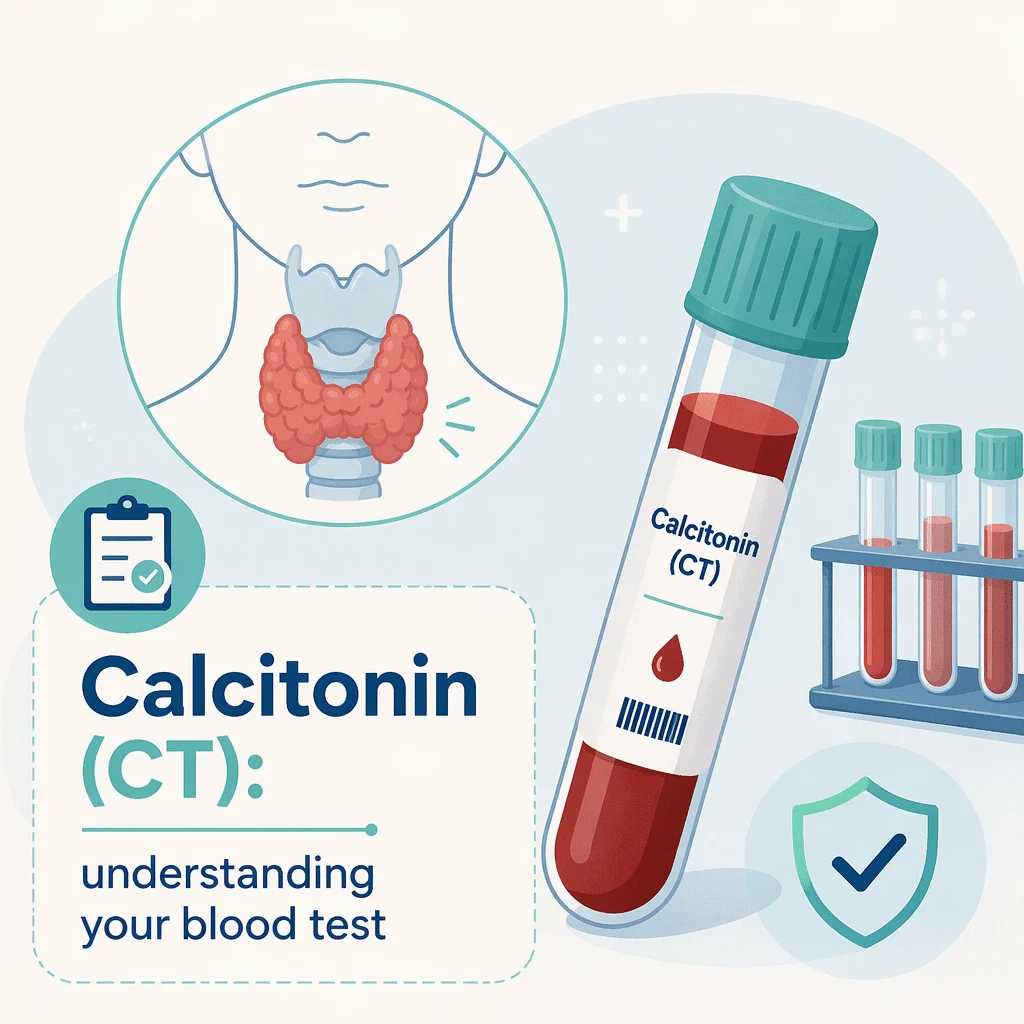
A calcitonin blood test measures a hormone made by specialised cells in your thyroid gland, and it often appears on a lab request when a doctor is investigating a thyroid nodule. Seeing an unfamiliar marker on your results can be unsettling, especially one linked to a rare cancer. The good news is that a single number rarely tells the whole story. This article explains what calcitonin does, what a normal range looks like, why levels rise or fall, and how specialists use the result to screen for and monitor medullary thyroid cancer. You will also find a plain-language look at the latest research, a glossary, and answers to the questions patients ask most. Throughout, the goal is to help you understand your result calmly, not to replace the conversation you will have with your own doctor.
What Is Calcitonin, and What Does the Calcitonin Blood Test Measure?
Calcitonin is a small hormone your body makes in the thyroid, the butterfly-shaped gland at the base of your neck. A calcitonin blood test simply measures how much of this hormone is circulating in a sample of your blood. Because only a very specific group of thyroid cells produce it, the result acts as a window onto how those cells are behaving.
The hormone from thyroid C cells
Calcitonin comes from parafollicular cells, better known as C cells, which sit scattered between the thyroid’s hormone-storing follicles. These C cells are separate from the cells that make the familiar thyroid hormones controlling metabolism. That distinction matters: a calcitonin result reflects C-cell activity, not whether your thyroid is underactive or overactive. To see the wider picture of thyroid function, review our overview of normal thyroid hormone ranges.
How calcitonin helps control calcium
Calcitonin’s classic job is to lower the level of calcium in the blood when it climbs too high. It does this in two main ways: it slows down osteoclasts, the cells that break down bone and release calcium, and it nudges the kidneys to pass more calcium into the urine. In this sense it acts as a counterweight to parathyroid hormone, which pushes calcium up. For the opposite side of that balance, read our overview of parathyroid hormone (PTH) results. Calcium handling also depends on vitamin D, and you can review our analysis of the vitamin D (25-OH) blood test.
Here is a nuance that surprises many people: in adults, calcitonin plays only a minor day-to-day role in calcium control. People who have had their thyroid removed, and even patients whose calcitonin is extremely high, usually keep normal blood calcium. That is why doctors rarely order the test to check calcium itself; its real value lies elsewhere, as a marker of the C cells. For the calcium story in full, consult our guide to the calcium blood test and bone and mineral panel.
Why Doctors Order a Calcitonin Blood Test
Doctors do not include calcitonin in a routine check-up. They order it for a focused reason, almost always connected to the thyroid. Understanding that reason helps explain why the test can feel alarming even when the result turns out to be harmless.
Checking a thyroid nodule for medullary thyroid cancer
The main reason to measure calcitonin is to screen a thyroid nodule for medullary thyroid cancer, an uncommon cancer that begins in the C cells. Because these cells make calcitonin, a tumour that grows from them tends to release more of the hormone, so a raised level can flag the disease early, often before imaging or a needle biopsy would. Catching medullary thyroid cancer whilst it is still confined to the thyroid greatly improves the outlook, which is why some specialists measure calcitonin in people who have a newly found nodule.
Calcitonin is not the only marker in this setting. Doctors often measure a second tumour marker called carcinoembryonic antigen (CEA) as well, and they interpret both with care. To understand how these substances behave and where they fall short, read our explainer on tumour markers and their limits.
Following patients after thyroid surgery
The test also shines after treatment. Once someone has surgery for medullary thyroid cancer, calcitonin becomes a sensitive way to check whether any C-cell tissue remains or whether the cancer returns years later. A level that falls to undetectable is reassuring; one that creeps back up prompts a closer look. In this monitoring role, doctors frequently combine calcitonin with the same CEA marker and with imaging.
Occasionally, calcitonin is checked as part of a family screening when an inherited condition that raises the risk of medullary thyroid cancer runs in a family. In those situations, genetic testing usually leads the way and calcitonin supports it.
Calcitonin Normal Range and How to Read Your Results
Calcitonin is measured in picograms per millilitre, written pg/mL; a picogram is a trillionth of a gram, which tells you how tiny these amounts are. Normal levels are low. As a rough guide, healthy men usually sit below about 10 pg/mL and healthy women below about 5 pg/mL, though every laboratory sets its own reference range depending on the exact test it uses.
The table below shows how doctors generally think about a resting, or basal, calcitonin result. Treat it as an orientation, not a verdict: only a clinician who knows your history can interpret your number.
| Basal calcitonin level | What it often suggests |
|---|---|
| Normal (men below about 10 pg/mL; women below about 5 pg/mL) | C cells behaving normally; medullary thyroid cancer is very unlikely |
| Mildly elevated (up to roughly 50 pg/mL) | Often a non-cancer cause such as kidney disease, certain medicines, or smoking; usually needs a repeat test |
| Moderately elevated (roughly 50 to 100 pg/mL) | Warrants specialist assessment; C-cell hyperplasia or medullary thyroid cancer is possible |
| Markedly elevated (above about 100 pg/mL) | Strongly suggestive of medullary thyroid cancer; prompts a prompt specialist work-up |
Notice how much room there is between a mildly raised value and a clearly worrying one. A slightly elevated calcitonin is common and usually has an innocent explanation, whereas a very high level carries real weight. This is also why the units and the reference range on your own report matter so much. If the figures look confusing, consult our complete guide to reading blood test results, and to see how this marker sits beside others, compare it against our reference chart of normal blood test ranges.
Why cut-offs differ for men and women
Men naturally have slightly more C cells than women, so their calcitonin tends to run a little higher. Using a single threshold for everyone would flag too many healthy men and miss subtle changes in women. That is why modern laboratories are increasingly applying separate reference limits by sex, a point that recent research has reinforced.
How the sample is collected
The test itself is a simple blood draw from a vein in the arm, taking only a few minutes. The U.S. National Library of Medicine describes the procedure in its MedlinePlus calcitonin test overview. You usually do not need to fast, but because smoking and a handful of medicines can influence the reading, it is worth following whatever preparation your lab advises. Doctors also look at thyroid function alongside calcitonin, so the same visit may include a TSH thyroid hormone test, a free T4 thyroid test, or the thyroid antibodies covered in our guide to anti-TPO thyroid antibodies.
What Causes High Calcitonin Levels?
A raised calcitonin has a long list of possible explanations, and most of them are not cancer. Sorting the serious from the harmless is exactly what your doctor does when a result comes back high.
Medullary thyroid cancer and C-cell hyperplasia
The cause everyone worries about is medullary thyroid cancer, and it is the reason the test exists. Closely related is C-cell hyperplasia, a simple increase in the number of C cells that can raise calcitonin modestly and sometimes precedes cancer. As a rule, the higher the resting level, the greater the concern: markedly elevated values point strongly towards medullary thyroid cancer, whilst mild elevations more often reflect something benign.
Common non-cancer causes
Plenty of everyday conditions raise calcitonin without any tumour being present. Reduced kidney function is one of the most common, because the kidneys help clear the hormone. Proton pump inhibitors, the widely used acid-reflux medicines, can raise it, as can heavy smoking, pregnancy, and breastfeeding. Other neuroendocrine conditions and, rarely, laboratory interference can also push the number up. Because a related molecule can behave similarly, doctors sometimes measure the protein described in our guide to the procalcitonin (PCT) marker to cross-check a puzzling result.
The practical takeaway is that one high reading is a starting point, not a diagnosis. A careful doctor repeats the test, reviews your medicines and kidney health, and looks at imaging before drawing any conclusion.
What Low or Undetectable Calcitonin Means
Most people never need to worry about a low calcitonin. Because the hormone plays such a small role in adult calcium control, a low or even undetectable level is generally harmless and is not linked to weak bones or fractures in the way patients sometimes fear. In fact, after a thyroid is fully removed, calcitonin can become undetectable, and that is exactly what doctors hope to see when someone has been treated for medullary thyroid cancer.
A low result only becomes meaningful in specific contexts, for example when a treated patient’s level is tracked to confirm that no C-cell tissue remains. Outside of that follow-up role, a low calcitonin on a general panel is not a cause for concern and rarely needs any action.
When Should You See a Doctor About Your Calcitonin?
Calcitonin is not a test you interpret alone, but a few situations clearly deserve professional attention. Use the points below as a guide for when to book an appointment rather than wait.
- Your calcitonin is clearly elevated, especially well above your laboratory’s upper limit, or it keeps rising on repeat tests.
- You have a thyroid nodule together with a raised calcitonin, or a lump in the neck that is new or growing.
- Medullary thyroid cancer, or one of the inherited syndromes linked to it, runs in your family.
- You have been treated for medullary thyroid cancer and your calcitonin starts to climb during follow-up.
- You notice persistent symptoms such as a hoarse voice, trouble swallowing, or unexplained flushing and diarrhoea alongside an abnormal result.
None of these signs proves you have a serious problem, but each is a good reason to let a doctor interpret the full picture. If your only finding is a mildly raised value with no symptoms, your physician may simply recommend repeating the test before doing anything else.
Latest Scientific Advances in Calcitonin Testing
Research from the last few years has sharpened how doctors use this test. Here is what recent studies suggest, in plain terms.
A single resting measurement is usually enough
In 2023, an umbrella review, which is a study that pools together many earlier systematic reviews, confirmed that calcitonin is the single most reliable blood marker for detecting medullary thyroid cancer. It also found that older stimulation tests, where a drug or calcium is injected to provoke the C cells, rarely add useful information over a simple resting sample. What this means for you: if your doctor orders one well-timed blood draw, that is often all that is needed, and you probably will not require an uncomfortable provocation test.
Men and women are judged against different cut-offs
A 2023 analysis of nearly 13,000 people with thyroid nodules found that using separate reference limits for men and women makes the test more precise, and that a mildly raised result is common and usually not cancer. In that large group, medullary thyroid cancer turned out to be rare, affecting only about one in several hundred people screened. What this means for you: a slightly elevated calcitonin is not a diagnosis; it is a signal to repeat the test and look at the full picture.
Backup markers are emerging
A 2024 review of blood markers concluded that calcitonin and carcinoembryonic antigen (CEA) remain the two key measurements, while procalcitonin, a closely related molecule that is more stable and less disturbed by everyday infections, is a promising backup when calcitonin results are hard to interpret. A 2025 laboratory review agreed that procalcitonin performs comparably to calcitonin, while cautioning that it can also rise during minor infections. What this means for you: if your calcitonin is borderline or possibly affected by another condition, your doctor has complementary tools to clarify the result.
Higher levels carry more weight
The same 2025 review emphasised that the higher the resting calcitonin, the more concerning it becomes: values above roughly 60 to 100 pg/mL point strongly towards medullary thyroid cancer, whereas mild elevations have many harmless explanations. These findings are still being refined, and exact thresholds vary between laboratories. What this means for you: context matters more than a single number, because your doctor weighs the level, the trend over time, and imaging together.
Glossary
| Term | Definition |
|---|---|
| Calcitonin | A hormone made by the thyroid’s C cells that helps lower calcium in the blood and serves as a marker for medullary thyroid cancer. |
| C cells (parafollicular cells) | Specialised thyroid cells that produce calcitonin; they sit scattered amongst the gland’s follicles. |
| Medullary thyroid carcinoma (MTC) | A rare thyroid cancer that starts in the C cells and typically raises calcitonin. |
| C-cell hyperplasia | An increase in the number of C cells that can modestly raise calcitonin and sometimes precedes cancer. |
| Calcium (calcaemia) | A mineral in the blood essential for bones, nerves, and muscles; calcitonin helps keep it from rising too high. |
| Parathyroid hormone (PTH) | A hormone from the parathyroid glands that raises blood calcium, acting opposite to calcitonin. |
| Osteoclast | A cell that breaks down bone and releases calcium; calcitonin slows its activity. |
| Procalcitonin | A precursor molecule related to calcitonin, used as an infection marker and studied as a backup marker for medullary thyroid cancer. |
| Carcinoembryonic antigen (CEA) | A protein used alongside calcitonin to help assess and monitor medullary thyroid cancer. |
| Thyroidectomy | Surgery to remove part or all of the thyroid gland, the main treatment for medullary thyroid cancer. |
Frequently Asked Questions
Do I need to fast before a calcitonin blood test?
In most cases you do not need to fast. Calcitonin is fairly stable, and a routine sample can usually be taken at any time of day. Because some laboratories have their own instructions, and because smoking, certain foods, and a few medicines can nudge the result, it is wise to follow the exact preparation your lab or doctor gives you. If your level is borderline, the test may be repeated under standardised conditions to confirm the reading before any further step is taken.
What are the symptoms of high calcitonin levels?
High calcitonin itself usually causes no symptoms. The hormone rarely disturbs the body’s calcium balance, even at very high levels, so people often feel completely well. When symptoms do appear, they tend to come from the underlying cause, for example a lump in the neck, a hoarse voice, or, in advanced medullary thyroid cancer, flushing and diarrhoea. Because a raised result is silent, it is usually discovered through a blood test rather than through how you feel.
What can cause a falsely elevated calcitonin?
Several everyday factors can raise calcitonin without cancer being present. Reduced kidney function, proton pump inhibitors taken for reflux, heavy smoking, pregnancy, and breastfeeding can all lift the number, as can some other neuroendocrine conditions. Laboratory issues, such as interfering antibodies in the sample, occasionally do the same. This is why a single elevated reading is usually repeated and interpreted alongside your medical history, imaging, and sometimes a second marker before any conclusion is drawn.
Can medullary thyroid cancer exist with a normal calcitonin?
Rarely, yes. A small number of medullary thyroid cancers produce little or no calcitonin, sometimes called calcitonin-negative tumours, so a normal result does not completely rule the disease out when other signs point to it. In these unusual cases, doctors rely on biopsy findings, imaging, and additional markers such as carcinoembryonic antigen. For the vast majority of people, though, a normal calcitonin is reassuring.
Why is my calcitonin still high after thyroid surgery?
After surgery for medullary thyroid cancer, calcitonin should fall, often to undetectable levels, over several weeks. A level that stays raised can mean some C-cell tissue or tumour remains, and it prompts closer follow-up with imaging. Doctors also watch how quickly the number changes over time, because a slowly rising value behaves very differently from a rapidly climbing one. Your care team uses these trends, not a single figure, to plan the next step.
Can you lower calcitonin levels?
There is no diet or supplement that meaningfully lowers calcitonin, and a raised level is not something you treat on your own. Because the number reflects an underlying cause, treatment targets that cause, for instance surgery when medullary thyroid cancer is confirmed, or reviewing a medication that may be nudging the result upward. If your calcitonin is mildly elevated with no serious cause, your doctor may simply monitor it over time.
Sources
- MedlinePlus, U.S. National Library of Medicine — Calcitonin Test, 2024 — https://medlineplus.gov/lab-tests/calcitonin-test/
- Cleveland Clinic — Calcitonin: What It Is, Function and Levels, 2022 — https://my.clevelandclinic.org/health/articles/22330-calcitonin
- Mayo Clinic — Thyroid cancer (including the medullary type): Symptoms and causes, 2024 — https://www.mayoclinic.org/diseases-conditions/thyroid-cancer/symptoms-causes/syc-20354161
- Trimboli P, et al. — Diagnostic tests for medullary thyroid carcinoma: an umbrella review — Endocrine, 2023 — https://consensus.app/papers/details/867f482cf7b7576a8aa01b44c2058af9/
- Broecker-Preuss M, et al. — Update on Calcitonin Screening for Medullary Thyroid Carcinoma (analysis of 12,984 patients with thyroid nodules) — Cancers, 2023 — https://consensus.app/papers/details/fb5ecc9b414b5b8c846e6d2ff0d924c8/
- Liu S, et al. — Serum Biochemical Markers for Medullary Thyroid Carcinoma: An Update — Cancer Management and Research, 2024 — https://consensus.app/papers/details/bf87463cdc625dfbb41c46ab83af816f/
- Bae YJ, Schaab M, Kratzsch J — Calcitonin as Biomarker for the Medullary Thyroid Carcinoma — Recent Results in Cancer Research, 2025 — https://doi.org/10.1007/978-3-031-80396-3_6
Further reading
- The calcium blood test and bone and mineral panel
- Parathyroid hormone (PTH) levels and what they mean
- Normal thyroid hormone ranges explained
- Carcinoembryonic antigen (CEA) as a tumour marker
- Tumour markers and their limits
Understand your lab results with AI DiagMe
A calcitonin result rarely stands alone, and it makes the most sense next to related tests such as blood calcium, parathyroid hormone, and a full thyroid panel. AI DiagMe reads your laboratory report and explains each value in clear, everyday language, so you can walk into your appointment already understanding what your numbers suggest. It is built to help you understand your results, not to diagnose disease or replace your doctor.
Get your results interpreted in minutes