



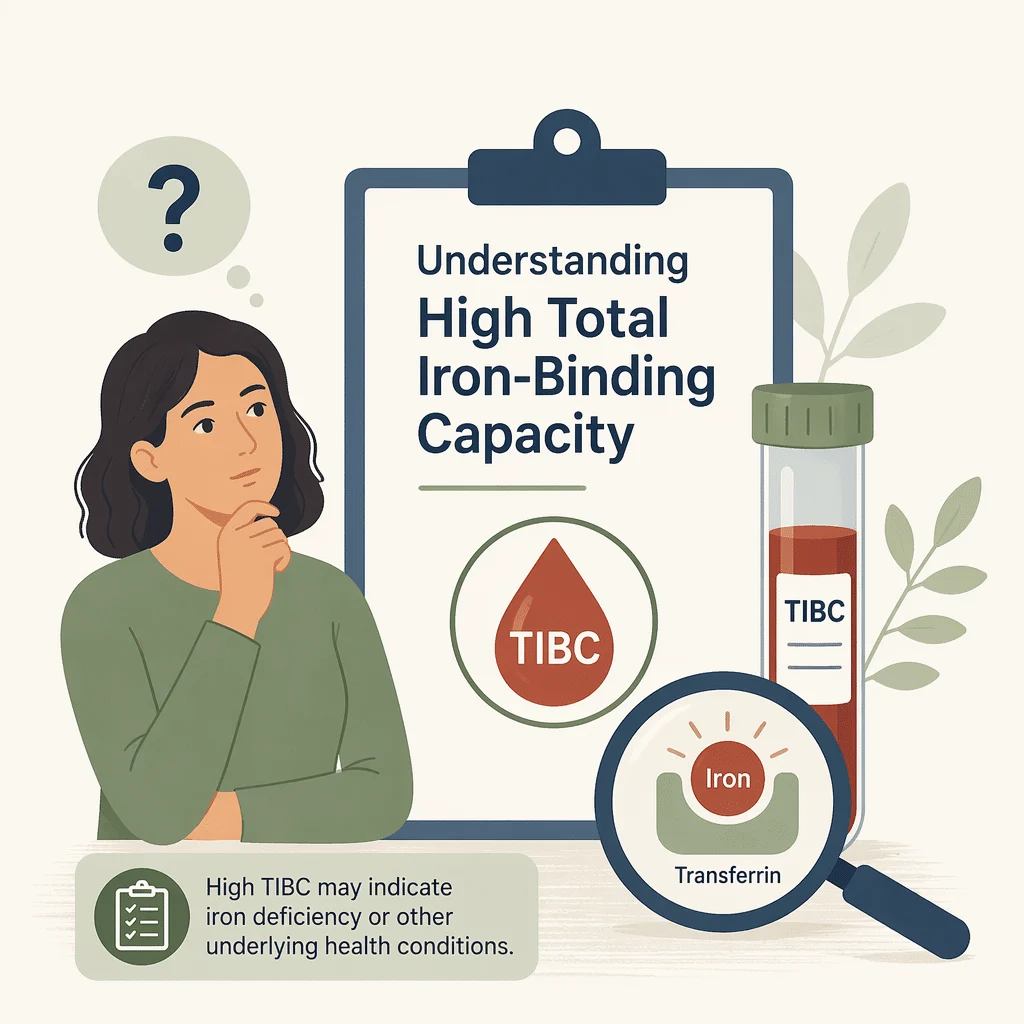
A high total iron-binding capacity on a blood test usually means your body is running short of iron, not that it has too much. That sounds backward, and it is the single most confusing thing about this marker. Total iron-binding capacity, abbreviated TIBC, does not measure how much iron you have. It measures how much iron your blood could carry if every available seat were filled. When iron runs low, the body builds more of the protein that carries it, so the number climbs. In this article you’ll learn what the test actually measures, why TIBC moves in the opposite direction to iron, how it is read alongside serum iron, ferritin and transferrin saturation, and which combinations point to iron deficiency rather than inflammation. You will also learn why the only reference range that matters is the one printed on your own report.
What a high total iron-binding capacity actually measures
Iron does not float freely in the bloodstream. Loose iron is chemically reactive and would damage tissue, so almost all of it travels locked onto a carrier protein made by the liver, called transferrin. Think of transferrin as a fleet of taxis and iron as the passengers. TIBC estimates how many passenger seats exist in that fleet at the moment your blood was drawn.
That is why the marker is described as a capacity rather than a quantity. As the MedlinePlus encyclopedia puts it, the test exists to show how well the carrier protein can transport iron in your blood. A result flagged high on your report tells your clinician that there are more seats than usual, which is a statement about the fleet, not about the passengers. Our team explains the full iron studies panel and how its markers fit together.
TIBC, UIBC and transferrin are three views of one thing
Laboratories reach the same information by different routes, which is why iron reports look inconsistent from one lab to another. Some measure serum iron (the seats already occupied) and unsaturated iron-binding capacity or UIBC (the seats still empty), then add them together to give TIBC. Others measure the transferrin protein directly and calculate TIBC from it. In practice a high TIBC and a high transferrin usually carry the same meaning. This guide covers the role of transferrin in iron transport.
Why TIBC goes up when iron goes down
This inverse relationship is the heart of the marker, and it is worth slowing down on. When iron stores start to empty, the liver responds by producing more transferrin. The body is trying to scavenge harder: more carriers in circulation means a better chance of catching and delivering whatever iron is absorbed from food. More carriers also means more empty seats, and more empty seats means a higher measured capacity.
So the direction reverses. Falling iron pushes TIBC up. Rising or fully stocked iron pushes TIBC down. A high total iron-binding capacity is therefore a signal of scarcity, not abundance, which is the opposite of what most people assume when they see the word high on a lab report.
The mirror image is just as useful. When iron stores are full, or when the body is dealing with ongoing inflammation, chronic illness, liver disease or poor nutrition, transferrin production falls and TIBC drops. A low or even normal TIBC in someone whose iron is clearly low is a meaningful clue in itself, and we come back to it below.
Why a high total iron-binding capacity means little on its own
Taken alone, this number cannot tell you whether you are iron deficient. It is one of four values that are meant to be read as a group: serum iron, ferritin, TIBC and transferrin saturation. Each has a blind spot the others cover.
Serum iron is the amount circulating right now, and it swings considerably through the day and after a meal or an iron tablet, so a single reading is unreliable in isolation. Ferritin reflects how much iron is banked in storage. TIBC reflects carrying capacity. Transferrin saturation ties the picture together.
How transferrin saturation is calculated
Transferrin saturation, often shortened to TSAT, is serum iron divided by TIBC, expressed as a percentage. It answers a simple question: of all the available seats, what share is actually occupied? Because TIBC sits in the denominator, a rising TIBC drags saturation downward even when serum iron has not moved at all. That mathematical link is exactly why the two are never interpreted separately. We also detail iron saturation levels and their common causes.
Ferritin adds the missing dimension, because it is the closest routine estimate of stored iron. Its own weakness is that it rises during infection or inflammation regardless of iron status, which can mask a genuine deficiency. Separate articles cover low ferritin causes, symptoms and treatment and the causes and risks of high ferritin levels.
Reading the pattern across the whole iron panel
The value of TIBC appears only when you line it up beside the other three markers. The table below sets out the classic combinations clinicians look for. The entries describe direction only, because the numeric cut-offs differ from laboratory to laboratory and from one analyzer to another.
| Clinical picture | TIBC | Serum iron | Ferritin | Transferrin saturation |
|---|---|---|---|---|
| Iron deficiency | High | Low | Low | Low |
| Anemia of chronic disease or inflammation | Low or normal | Low | Normal or high | Low or normal |
| Iron overload | Low or normal | High | High | High |
| Pregnancy or estrogen-containing medication | High | Normal or low | Normal or low | Normal or low |
The distinction that matters most
Compare the first two rows. In both, serum iron is low and the person may feel tired, breathless or washed out. What separates them is TIBC. In true iron deficiency the body ramps up transferrin production, so TIBC climbs and ferritin falls. In anemia of chronic disease, sometimes called anemia of inflammation, the body deliberately withholds iron from circulation while inflammation is active: TIBC stays low or normal and ferritin is normal or even raised, because ferritin behaves as an inflammatory protein as well as a storage one.
Getting that fork right changes what happens next, because iron supplements help one situation and not the other. Inflammatory markers are often measured alongside the iron panel for this reason, and we also explain the CRP inflammation marker and how it is interpreted. Our team describes the symptoms, causes and types of anemia in a dedicated guide.
The third row runs the other way. In iron overload the fleet shrinks while the passengers multiply, so saturation climbs. That territory belongs to a different conversation, and a separate guide sets out how to lower high iron levels safely.
Common reasons for a high total iron-binding capacity
Iron deficiency
This is the most frequent explanation by a wide margin. Stores fall because of blood loss, most often from heavy menstrual periods or slow bleeding in the digestive tract; because intake is too low; because absorption is impaired, as happens in celiac disease or after some types of gastric surgery; or because demand has risen faster than supply, as in growth spurts and endurance training.
Pregnancy
Pregnancy raises TIBC through normal physiology rather than illness. Blood volume expands substantially, iron requirements rise, and transferrin production increases as a result. A high reading during pregnancy is expected and is interpreted against pregnancy-specific expectations rather than standard adult ones. Our team reviews the blood tests carried out during pregnancy.
Estrogen-containing medication
Combined oral contraceptives and some forms of hormone therapy raise circulating transferrin, and therefore TIBC, without any underlying iron shortage. This is a well-recognized reason for an isolated high result in someone who feels perfectly well, and it is one of the details worth mentioning when you discuss your report.
The less common directions
A markedly low TIBC points elsewhere entirely, toward inflammation, chronic kidney or liver disease, malnutrition or protein loss, and occasionally toward iron overload. Results can also be affected by a recent iron tablet, a recent transfusion or a sample taken at an unusual time of day, which is why clinicians rarely act on one isolated value.
Why your own lab’s reference range is the only one that matters
TIBC is assay-dependent. The figure that counts as normal shifts with the method a laboratory uses, the equipment it runs and the population it validated against. MedlinePlus states the point directly for this test: normal value ranges may vary slightly among different laboratories, some labs use different measurements or test different samples, and you should talk to your provider about the meaning of your specific results.
The practical consequence is simple. Compare your number with the range printed in the column beside it on your own report, not with a figure found on a forum or in a general article. A result sitting just outside a range is a prompt for a conversation, not a diagnosis. We explain how normal blood test ranges are established in more depth.
Direction over time is usually more informative than any single snapshot. A TIBC that is drifting upward across successive tests, alongside a falling ferritin, tells a clearer story than one borderline value.
When to see a doctor about a high total iron-binding capacity
An isolated high TIBC in someone with no symptoms is rarely an emergency, but it should not simply be filed away either. Arrange a review with your doctor if the raised result comes with any of the following:
- Persistent fatigue, breathlessness on mild exertion, dizziness or a racing heartbeat
- Unusually pale skin, brittle nails, hair shedding, or cracks at the corners of the mouth
- Restless legs at night, or cravings for ice, starch or other non-food items
- Heavy or prolonged menstrual bleeding
- Black, tarry or visibly bloody stools, or unexplained weight loss
- A known digestive condition, recent gastric surgery, or a diet excluding major food groups
Seek prompt medical advice for chest pain, fainting or severe breathlessness. And if a previous test was normal and the picture has changed, bring both reports to the appointment: the comparison is often the most useful thing in the room.
Latest scientific advances
Research on iron testing has moved quickly in the last three years, mostly toward one conclusion: no single marker is trustworthy on its own. Here is what recent work adds, in plain language.
A 2024 review of iron status assessment concluded that every routine marker, TIBC included, becomes harder to read when inflammation is present, and that combining several markers performs better than relying on any one. What this means for you: a doctor who orders four iron tests at once is following good practice, not being excessive.
A 2023 review of diagnostic controversies examined the classic panel, serum iron, ferritin, transferrin and saturation, and set out the blind spots of each. It also looked at newer measurements such as soluble transferrin receptor, a protein that cells release when they are hungry for iron, and hepcidin, a hormone that controls how much iron is allowed into the bloodstream. These remain mostly research tools rather than routine tests, so their absence from your report is normal.
A 2024 review in a hematology journal drew a clearer line between absolute iron deficiency, where the stores really are empty, and functional iron deficiency, where iron exists in the body but is locked away because of inflammation. What this means for you: two people can both feel exhausted with a low saturation and still need quite different treatment, which is one more reason the whole pattern is read rather than one number.
A 2025 analysis in a clinical biochemistry journal argued that the ferritin thresholds many laboratories print are set lower than the evidence supports, so some genuinely iron-depleted people are told their result is normal. Revision is under active discussion rather than settled. What this means for you: a ferritin reported as normal does not always close the question, particularly when TIBC is raised and symptoms persist.
Finally, a 2025 study of iron status in pregnancy found that body composition and inflammation can blur iron markers early in pregnancy, making them less reliable at predicting who will become deficient later. This is a single study rather than a settled conclusion, and it supports what obstetric teams already do: recheck iron status during pregnancy rather than judge it once.
Glossary of key terms
| Term | Definition |
|---|---|
| Total iron-binding capacity (TIBC) | A blood test estimating how much iron your blood could carry, based on the amount of carrier protein in circulation. It rises when iron stores fall. |
| Transferrin | The liver-made protein that carries iron through the bloodstream. TIBC is essentially a measure of how much of it is available. |
| Unsaturated iron-binding capacity (UIBC) | The portion of carrying capacity not currently occupied by iron. Added to serum iron, it gives TIBC. |
| Serum iron | The amount of iron circulating in the blood at the moment of the draw. It varies through the day and after meals or supplements. |
| Ferritin | The protein that stores iron. It is the usual routine indicator of iron reserves, but it also rises with inflammation. |
| Transferrin saturation (TSAT) | Serum iron divided by TIBC, given as a percentage. It shows what share of the available carrying capacity is in use. |
| Anemia of chronic disease | Anemia caused by ongoing inflammation or long-term illness, in which iron is withheld from circulation rather than absent. Also called anemia of inflammation. |
| Reference range | The span of values a particular laboratory considers typical, printed beside your result. It depends on the method and equipment used. |
| Hepcidin | A hormone that regulates how much iron enters the bloodstream from the gut and from storage. Currently mainly a research measurement. |
| Soluble transferrin receptor (sTfR) | A marker reflecting how strongly the body’s cells are calling for iron. Less affected by inflammation than ferritin, but not yet routine. |
Frequently asked questions
Why is TIBC high in iron deficiency anemia?
Because the body reacts to scarcity by increasing production of transferrin, the protein that carries iron. More carrier protein in circulation means more unfilled binding sites, and TIBC measures exactly those sites. So the emptier the stores, the higher the measured capacity tends to be. It is the same logic as sending out extra delivery vans when supplies are short: the fleet grows even though the cargo shrinks. This is why a raised TIBC combined with a low ferritin and a low saturation is the classic laboratory signature of iron deficiency.
What does a high TIBC with normal iron mean?
Most often it means iron stores are being depleted but circulating iron has not yet fallen. The body increases carrier protein early, before the level in the blood drops, so a raised TIBC can appear while serum iron still reads normal. Pregnancy and estrogen-containing medication produce the same pattern without any deficiency at all. Your clinician will typically look at ferritin and transferrin saturation to tell these apart, and may simply repeat the panel after a few months.
Are there symptoms of a high total iron-binding capacity?
The raised number itself causes no symptoms. Anything you feel comes from the underlying situation, most commonly low iron, which can produce fatigue, breathlessness, pallor, brittle nails, hair shedding or restless legs. Many people with a raised TIBC feel entirely well, particularly when the cause is pregnancy or a hormonal medication. That is why the result is judged in the context of your symptoms and the rest of the panel, rather than on its own.
What is the difference between TIBC and UIBC?
They describe the same fleet from opposite ends. UIBC, or unsaturated iron-binding capacity, counts only the binding sites currently empty. TIBC counts all of them, both occupied and empty, and equals UIBC plus serum iron. Some laboratories measure UIBC and calculate TIBC, others do the reverse. When both are reported as high, the message is the same one: there is a lot of unused carrying capacity in your blood.
Does a high TIBC mean cancer?
No. A raised TIBC is not a cancer marker, and on its own it points toward iron deficiency far more often than toward anything serious. It is worth knowing that some cancers cause slow blood loss, which in turn causes iron deficiency, so an unexplained iron deficiency in an adult is usually investigated for a source of bleeding. That investigation is about finding a cause, not about the TIBC value itself, and most causes found are benign.
Can pregnancy raise TIBC?
Yes, and it commonly does. Blood volume expands during pregnancy, iron demand increases, and transferrin production rises accordingly, so a higher TIBC is an expected finding rather than a warning sign. It is interpreted against pregnancy-specific expectations, and iron status is usually rechecked at intervals through the pregnancy rather than judged from a single test.
Sources
- MedlinePlus Medical Encyclopedia — Total iron binding capacity — U.S. National Library of Medicine https://medlineplus.gov/ency/article/003489.htm
- National Heart, Lung, and Blood Institute — Anemia: Iron-Deficiency Anemia — NHLBI, National Institutes of Health https://www.nhlbi.nih.gov/health/anemia/iron-deficiency-anemia
- Mayo Clinic — Iron deficiency anemia: Diagnosis and treatment https://www.mayoclinic.org/diseases-conditions/iron-deficiency-anemia/diagnosis-treatment/drc-20355040
- Ems T. — Assessment of iron status — Current Opinion in Clinical Nutrition and Metabolic Care, 2024 https://pubmed.ncbi.nlm.nih.gov/38847622/
- Diagnosing iron deficiency: Controversies and novel metrics — Best Practice and Research Clinical Anaesthesiology, 2023 https://pubmed.ncbi.nlm.nih.gov/39764832/
- Absolute and functional iron deficiency: Biomarkers, impact on immune system, and therapy — Blood Reviews, 2024 https://pubmed.ncbi.nlm.nih.gov/39142965/
- Re-evaluating ferritin thresholds to diagnose iron deficiency — Clinical Biochemistry, 2025 https://pubmed.ncbi.nlm.nih.gov/41033542/
- Maternal Adiposity and Inflammation: Risk Factors for Iron Deficiency in Pregnancy — The Journal of Nutrition, 2025 https://pubmed.ncbi.nlm.nih.gov/40886951/
Further reading
- How to read a complete blood count
- How to read your blood test results
- Hemochromatosis treatments, a practical guide
- Low vitamin B12 symptoms, causes and treatments
- Normal blood test ranges explained
Understand your lab results with AI DiagMe
An iron panel only makes sense when its markers are read together, and that is precisely the kind of cross-reading that is hard to do alone in front of a report. AI DiagMe takes the values from your own results, including total iron-binding capacity, serum iron, ferritin and transferrin saturation, and explains in plain language what the combination suggests and which questions are worth raising. It is built to help you understand your results, not to diagnose you, and it does not replace your doctor.
Get your results interpreted in minutes