



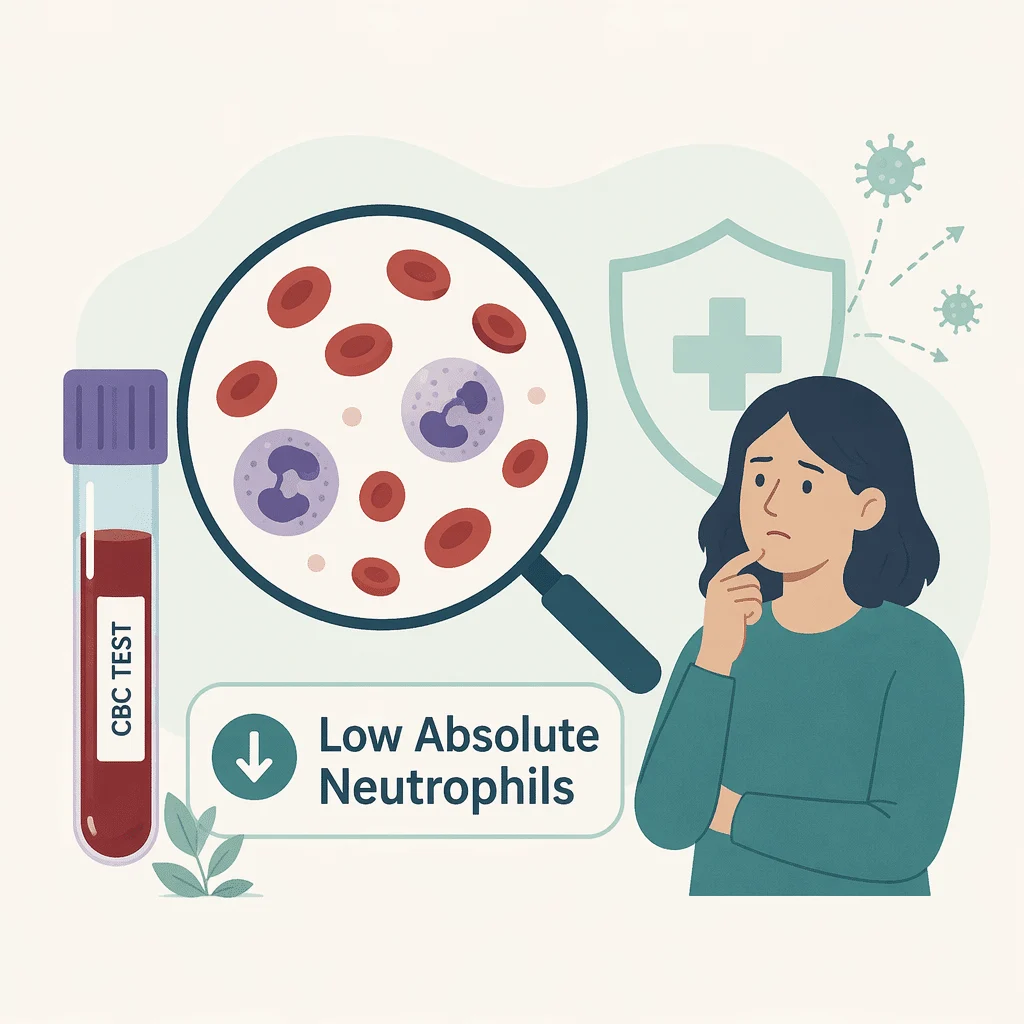
Low absolute neutrophils means your blood holds fewer neutrophils than the normal range, and neutrophils are the white blood cells that act as your body’s first defense against bacteria and other germs. Seeing this result flagged on a report can feel alarming, but the number alone rarely tells the whole story. This guide explains what the value means, the ranges doctors use, the most common causes, the warning signs that need fast action, and the practical steps that lower your infection risk. You will also learn how the count is measured, when a fever becomes an emergency, and why a low reading is normal for some healthy people.
What “low absolute neutrophils” means on your blood test
Neutrophils are the most common type of white blood cell. Your bone marrow makes them, and they travel in your blood to find and destroy germs. The absolute neutrophil count, or ANC, is the actual number of these cells in a set volume of blood, usually reported per microliter (µL).
A result of low absolute neutrophils simply means the ANC sits below the lab’s reference range. In most adults, that range starts at about 1,500 cells/µL, though some labs use 1,800. A count under that limit is called neutropenia. The lower the number drops, the harder it becomes for your body to fight off infection.
This value comes from a routine blood test called the complete blood count (CBC), which also reports red blood cells, platelets, and your total white blood cell count. If you want to see how the CBC fits alongside other common panels, our guide on the difference between a CBC and a CMP breaks it down.
How the absolute neutrophil count is calculated
The lab does not count neutrophils one by one. Instead, the ANC is worked out from the total white blood cell count and the share of cells that are neutrophils. The formula is the total white cell count multiplied by the combined percentage of mature neutrophils plus band cells (young neutrophils), divided by 100.
As a quick example, if your total white blood cell count is 4,000 cells/µL and neutrophils plus bands make up 40% of those cells, your ANC is 4,000 × 0.40 = 1,600 cells/µL, which is just within the normal range. The same percentage with a total white count of 3,000 would give an ANC of 1,200, in the mild range. This is why your doctor reads the ANC rather than the percentage alone: the same neutrophil share can be reassuring or low depending on the total count.
This matters because a single low reading can be misleading. A laboratory or sampling quirk can nudge the number, which is why doctors often repeat the test before drawing conclusions. A low neutrophil result also reads differently from a high one. If your report shows the opposite pattern, see our article on high neutrophils, and if another white cell line looks off, our guide on low lymphocytes may help.
Low absolute neutrophils ranges: mild, moderate, and severe
Doctors group neutropenia by how far the count falls, because severity guides how closely you need to be watched. The table below shows the ranges used in most adult labs and how infection risk changes at each level.
| Severity | ANC (cells/µL) | Infection risk | Typical approach |
|---|---|---|---|
| Normal | 1,500 or above | Baseline | No action needed |
| Mild | 1,000 to 1,500 | Little to none | Often just repeat the test |
| Moderate | 500 to 1,000 | Higher | Find the cause, monitor closely |
| Severe | Below 500 | High | Urgent care; fever is an emergency |
| Profound | Below 100 | Very high | Hospital-level precautions |
These cut-offs are widely used but not absolute, and thresholds can differ slightly between labs and populations. The key point is the trend: infection risk climbs steeply once the ANC falls below 500, and a count under 100 leaves your body with very little defense, even against germs that normally cause no trouble.
Doctors also describe neutropenia by how long it lasts. An acute drop is short-lived, often triggered by a virus or a new medicine, and tends to recover once the trigger passes. Chronic neutropenia lasts three months or longer and is more likely to reflect an autoimmune process, an inherited trait, or a bone marrow condition. How long a low count has been present is therefore just as important to your doctor as how low it is, which is why earlier blood results are so useful to bring along.
Common causes of low absolute neutrophils
Many different conditions can lower the count. Some slow neutrophil production in the bone marrow, while others destroy the cells faster or move them out of the bloodstream into tissues. Identifying the cause is the main goal of any workup.
- Infections. Viral infections are a very common and usually temporary cause. The count often dips during the illness and recovers within a few weeks. Severe bacterial infection (sepsis) can also pull neutrophils into tissues and lower blood readings.
- Medications. Certain antibiotics, anti-seizure drugs, antithyroid drugs, some antipsychotics, and chemotherapy can suppress the bone marrow. Never stop a prescribed medicine on your own; ask your care team first.
- Autoimmune conditions. The immune system can mistakenly attack neutrophils. Learn more about how the body turns on itself in our overview of autoimmune disease.
- Bone marrow disorders. Aplastic anemia, myelodysplastic syndromes, and some blood cancers reduce production. These often affect other lines too, so your doctor may also review your platelet count.
- Nutritional deficiencies. Low vitamin B12, folate, or copper can each lower neutrophil numbers.
- Congenital conditions. Rare inherited syndromes, such as cyclic neutropenia, cause chronic low counts from early in life.
Benign ethnic neutropenia: a normal low count for some people
One cause is often missed in shorter guides: for many healthy people, a low absolute neutrophil count is simply their normal baseline. This is called benign ethnic neutropenia (BEN) and is most common in people of African or Middle Eastern descent. It is linked to a harmless genetic trait (the Duffy-null variant) that keeps more neutrophils in tissues and the bone marrow rather than circulating in the blood.
People with BEN are not at higher risk of infection and respond normally when they do get sick. Recognizing this pattern matters, because it can spare people unnecessary tests, worry, and emergency visits. In 2025, updated grading criteria used in cancer care were revised partly to account for these normal lower baselines. If you have always had a slightly low count and feel well, mention this history to your doctor.
Symptoms and warning signs to watch for
Mild low absolute neutrophils often causes no symptoms at all, and many people only discover it through a routine blood test. As the count drops, the main concern is a reduced ability to fight infection, so the symptoms you notice are usually signs of infection rather than of the low count itself.
Watch for these early warning signs:
- Fever or chills
- A sore throat that lasts or gets worse
- Repeated infections of the skin, mouth, gums, or sinuses
- Sores that heal slowly, or new mouth ulcers
- A cough or shortness of breath that develops quickly
- Severe tiredness during an illness
Because infection is the real risk, the threshold for seeking help is lower than usual. If you know your count is low and you develop a fever, treat it as urgent rather than waiting to see if it passes.
When low absolute neutrophils becomes an emergency (febrile neutropenia)
Fever combined with a low neutrophil count is called febrile neutropenia, and it is a medical emergency. With few neutrophils available, an infection can spread quickly and become dangerous before obvious symptoms appear. Prompt treatment greatly improves outcomes.
Use this simple checklist to decide when to act fast:
- Check your temperature. A reading of 38°C (100.4°F) or higher with a known low count needs same-day medical attention.
- Do not wait for repeat lab results. If you feel unwell and know your count is low, seek care now.
- Call ahead or go in. Contact your doctor or go to the emergency room, and say that you have a low neutrophil count.
- Bring your information. Carry a current list of your medicines and any recent chemotherapy or treatments.
At the hospital, the team may take blood cultures and start antibiotics right away, often before the exact germ is identified. This rapid approach is standard and is designed to stay ahead of infection.
How doctors diagnose and investigate a low count
The starting point is almost always a repeat CBC to confirm the result and rule out a one-off dip. From there, your doctor builds a picture using your history and a few targeted tests.
A typical workup may include questions about recent illnesses, all your medicines, and your family history. Doctors often order a blood film, where a specialist examines the cells under a microscope. They may add tests for infection, including inflammation markers such as C-reactive protein (CRP) or procalcitonin, along with checks for autoimmune markers and nutrient levels.
If the count stays low or drops further, and a production problem seems likely, a bone marrow examination may follow. The aim throughout is to separate a harmless, temporary dip from a cause that needs treatment, so the testing is matched to your individual situation rather than done all at once.
Treatment options for low absolute neutrophils
There is no single treatment, because the right plan depends entirely on the cause and how low the count is. The first step is usually to address what is driving the drop.
- Treat the underlying cause. This may mean treating an infection, correcting a vitamin deficiency, or, with your doctor’s guidance, stopping or switching a medicine that suppresses the marrow.
- Growth factors. Doctors may prescribe granulocyte colony-stimulating factor (G-CSF), a medicine that prompts the bone marrow to make more neutrophils faster.
- Antibiotics or antifungals. In high-risk patients, these are used to treat or sometimes prevent infections.
- Immune-calming therapy. When an autoimmune process is attacking neutrophils, treatment may aim to reduce that immune attack.
- Bone marrow transplant. This is reserved for severe, lasting marrow failure or certain inherited disorders.
- Ongoing monitoring. Regular blood counts let your team track recovery and adjust the plan.
Each option carries its own benefits and trade-offs, so it is worth discussing them openly with your clinician. Mild, temporary neutropenia from a virus or a medicine often needs nothing more than watchful waiting and a repeat test.
Living with a low count: how to lower your infection risk
If your count is low, sensible daily habits make a real difference. None of these replace medical care, but together they reduce your chances of picking up an infection.
- Wash your hands often with soap and water, and use hand sanitizer when that is not possible.
- Be careful with food. Avoid undercooked meat, eggs, and unpasteurized dairy, and wash fruits and vegetables well.
- Keep up gentle dental care. Brush and floss carefully and stay current with dental check-ups.
- Stay current on vaccines, but ask your doctor which ones are right for you, since some vaccines are not suitable when counts are very low.
- Limit contact with people who are sick and avoid crowded indoor spaces during local outbreaks.
- Manage chronic conditions such as diabetes that can raise infection risk.
- Check before starting any new supplement or medicine, including herbal products.
Small, consistent steps add up to meaningful protection while your count recovers or stays stable.
Glossary
- Absolute neutrophil count (ANC): The actual number of neutrophils in a set volume of blood, used to judge infection risk.
- Agranulocytosis: A rare, serious state of very few neutrophils, leaving the body highly vulnerable to infection.
- Band cells: Young, immature neutrophils that are counted along with mature ones when calculating the ANC.
- Benign ethnic neutropenia (BEN): A harmless, lifelong low neutrophil baseline common in people of African or Middle Eastern descent, with no extra infection risk.
- Bone marrow: The soft tissue inside bones where blood cells, including neutrophils, are made.
- Complete blood count (CBC): A common blood test that measures red cells, white cells (including neutrophils), and platelets.
- Febrile neutropenia: Fever combined with a low neutrophil count; a medical emergency.
- Granulocyte colony-stimulating factor (G-CSF): A medicine that stimulates the bone marrow to produce more neutrophils.
- Neutropenia: The medical term for a low neutrophil count.
- Neutrophils: The most common white blood cells, and the body’s first responders against bacteria and fungi.
Frequently asked questions
Is a slightly low absolute neutrophil count dangerous?
Usually not. A mild result, often in the 1,000 to 1,500 cells/µL range, rarely causes problems on its own and may need nothing more than a repeat test to confirm the trend. Risk rises mainly when the count falls below 500. That said, “mild” applies to the number, not necessarily to the cause, so your doctor will still want to know why the count is low. If you feel well and have no signs of infection, a single mildly low reading is generally not a reason to panic.
How long does low neutrophils from a viral infection last?
A dip caused by a common viral illness is usually temporary and tends to recover within a few weeks. Doctors often repeat the blood test about three to four weeks after the infection to confirm the count is rising again. In some cases the low reading can linger longer, occasionally for a couple of months, without signaling anything serious. If the count does not recover, or keeps falling, your doctor will look for another explanation rather than assuming the virus is still to blame.
Can a low count be normal for me?
Yes, for some people it can. Benign ethnic neutropenia is a lifelong, harmless trait, most common in people of African or Middle Eastern descent, where the usual baseline neutrophil count sits below standard reference ranges. People with this pattern are not more prone to infection and respond normally when they do get ill. If your counts have always run a little low and you feel healthy, share that history with your doctor so it is not mistaken for a new problem.
Do I need a special “neutropenic diet”?
There is no proven “neutropenic diet” that raises neutrophil numbers, and formal food restrictions are debated, with advice varying between hospitals. Sensible food-safety habits are more useful: avoid undercooked meat and eggs, skip unpasteurized dairy, and wash produce well. A balanced diet with enough protein, vitamins, and minerals supports healthy blood production in general. If a specific deficiency such as B12, folate, or copper is found, your doctor may recommend targeted supplements rather than a restrictive diet.
Should I stop a medication that lowers my neutrophils?
Not without medical advice. Many drugs that affect neutrophil counts are important for treating other conditions, and stopping suddenly can cause harm. Your doctor weighs the benefit of the medicine against the degree of neutropenia and your infection history. In some cases the dose is adjusted, the drug is swapped, or the count is simply monitored. Always raise your concern with the prescriber and tell any new clinician about a known low count before they start a new medicine.
Who is most likely to get severely low counts?
People receiving chemotherapy are the group most often affected, and their counts tend to fall lowest about a week to two weeks after treatment. Others at higher risk include people with bone marrow disorders, certain inherited conditions, severe infections, or those taking specific high-risk medicines. For chemotherapy patients, doctors plan ahead using dose timing, regular blood checks, and growth factors when needed to reduce how low and how long the count drops.
Sources
- Neutropenia — Cleveland Clinic
- Neutropenia (low neutrophil count) — Mayo Clinic
- Low white blood cell count and cancer — MedlinePlus (NIH)
Further reading
- CBC vs CMP: understanding the tests
- High neutrophils: causes, symptoms, and risks
- Low lymphocytes: causes, symptoms, and risks
- Platelet count explained
- Procalcitonin (PCT): understanding this infection marker
Understand your lab results with AI DiagMe
A low neutrophil reading rarely stands alone. It sits inside your complete blood count (CBC) next to your white blood cell count, and it often makes more sense alongside inflammation markers such as C-reactive protein (CRP). AI DiagMe turns these numbers into clear, plain-language explanations and helps you spot which values may deserve quick attention. It is built to help you understand your results and prepare better questions for your doctor, not to diagnose or replace medical care.
➡️ Get your results interpreted in minutes