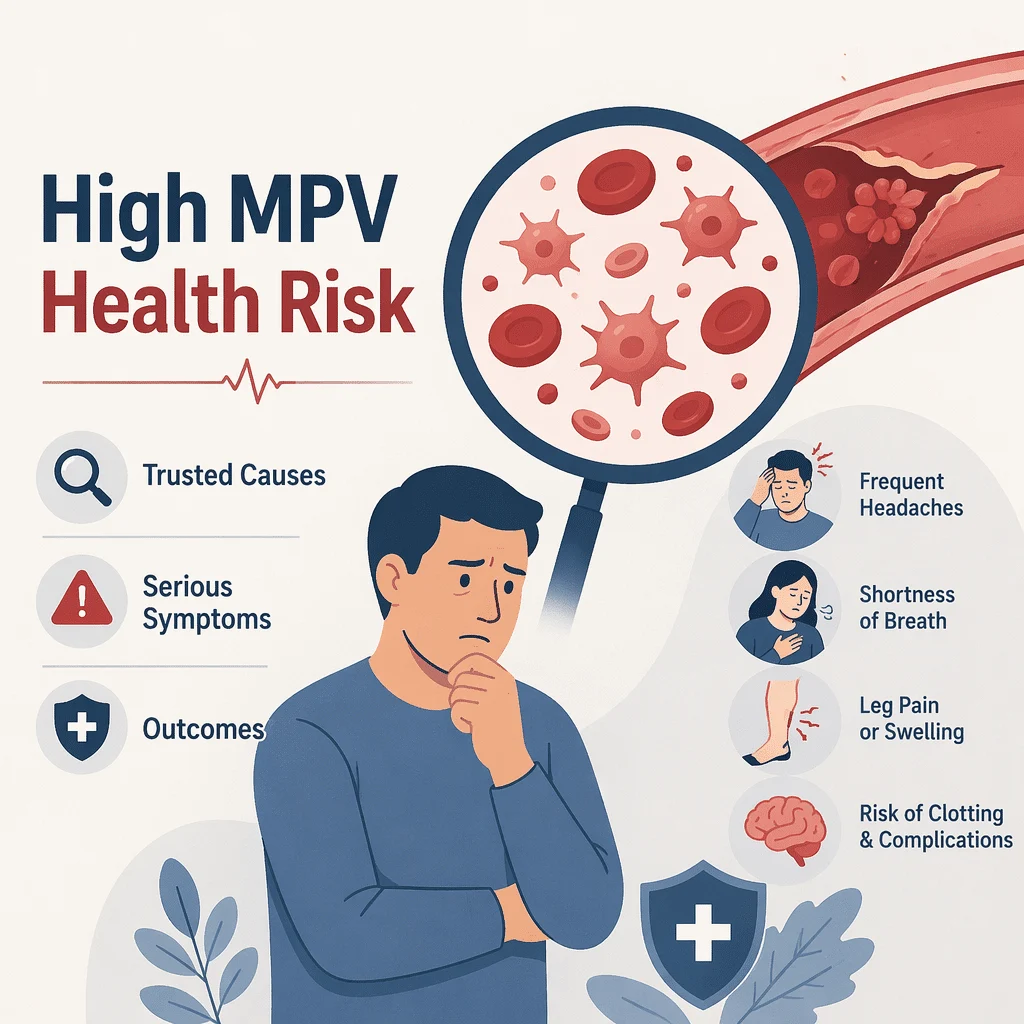
A high MPV on a blood test means your platelets are, on average, larger than most people’s. MPV stands for mean platelet volume, one of the smaller numbers a lab prints next to your platelet count on a complete blood count. On its own it is not a disease and not a diagnosis: it is a size measurement that becomes useful only when a clinician reads it alongside your platelet count, your symptoms and your history. In this article you’ll learn what MPV measures, what pushes it up, how the same value points in different directions depending on your platelet count, why the number drifts between labs and draws, and which situations genuinely deserve a follow-up.
What a high MPV actually measures
Platelets are not cells in the full sense. They are fragments shed by megakaryocytes, the large cells in your bone marrow. Those fragments differ in size, and MPV is the average size of the ones in your sample, reported in femtoliters (fL). Most laboratories place the usual adult range between roughly 7.5 and 11.5 fL, though the exact band on your report depends on your lab’s analyzer.
Why platelet size varies at all
Platelet size tracks platelet age. Freshly released platelets are bigger and more reactive; as they circulate over their eight-to-ten-day lifespan, the population averages out smaller. So when the marrow is pushing out replacements quickly, the average size in circulation rises. That is the idea behind almost every cause of a high MPV: a larger average platelet usually means a younger one. MPV is a window on platelet turnover — it reflects the pace of production and replacement, not the reason that pace changed.
What counts as a high MPV
There is no universal cutoff. A value of 12 fL is flagged as high by many labs and sits inside the reference range at others. Two things matter more than the raw figure: how far above your lab’s upper limit it sits, and what your platelet count is doing at the same time. Our team also explains how reference ranges are built and why one in twenty healthy people falls outside them.
Reading a high MPV against your platelet count
This is the part most explanations skip. MPV describes the average size of your platelets; the platelet count describes how many there are. Size and number are set by different processes, so the combination carries more information than either alone. The table below shows the three patterns a clinician recognizes immediately.
| What your report shows | What it commonly suggests | What a clinician looks at next |
|---|---|---|
| High MPV with a low platelet count | Platelets are being consumed or destroyed faster than usual, so the marrow releases young, large replacements. The pattern can also reflect a lifelong inherited condition in which platelets are simply born large. | A repeat count, a blood smear so a specialist can check platelet size by eye, questions about bruising or heavy periods, and — if the pattern goes back years — family history. |
| High MPV with a normal platelet count | Very often nothing that needs treating. Mild inflammation, an infection that has passed, smoking, a borderline reading or the way the sample was handled can all nudge MPV above the line while the count holds. | Usually a repeat test at the next routine check, with attention to an active infection, a recent illness or a new medication. An isolated finding rarely triggers further testing. |
| High MPV with a high platelet count | The marrow is making more platelets and larger ones at once. Reactive causes lead by a wide margin: inflammation, infection, iron deficiency, recent surgery or recovery from blood loss. A bone-marrow disorder is far rarer. | Iron studies, an inflammation marker, a review of recent illness or surgery, and — if a raised count persists unexplained — a hematology opinion. |
Why the pairing matters more than the number
The middle row, the reassuring one, is also the most common reason people look this up. A high MPV alongside an entirely normal platelet count is a frequent, usually unremarkable finding. The rows that prompt real investigation are the ones where the count has moved too. For the broader picture, we also explain how to read a complete blood count line by line.
What pushes MPV up
Faster platelet turnover
Anything that shortens platelet lifespan makes the marrow work harder, and the replacements it sends out are large. Recovery from bleeding or from a low platelet count, the rebound after chemotherapy and the healing phase after surgery all raise MPV for a while — a sign the system is responding, not failing.
Immune and consumptive causes
In immune thrombocytopenia, the immune system tags platelets for early removal. The count falls, the marrow compensates, and the platelets in circulation skew young and large — which is why a raised MPV with a low count is a recognized pattern here. Other consumptive states, including some infections and rarer clotting disorders, do the same for different reasons.
Inflammatory and metabolic conditions
Chronic inflammation appears to shift platelet production toward larger platelets, and studies report modestly higher average MPV in groups of people with inflammatory and metabolic conditions. The effect is real but small and overlaps heavily with normal, so it cannot be read backwards from your own result. If inflammation is the question your clinician is chasing, dedicated markers are far more informative, and we cover high CRP levels and what commonly raises them.
Inherited large-platelet conditions
A small group of people are born with platelets that are simply large. The umbrella term is macrothrombocytopenia: big platelets, low count, present for life. One hospital series found MPV clustering around 11 to 13.6 fL with platelet counts well below the usual range — alarming on paper, yet stable for those patients throughout. The pattern is easy to misread as acquired disease; the clues to an inherited cause are a long history of the same numbers, little serious bleeding despite a low count, and relatives with similar results.
Everyday factors and medications
Smoking, pregnancy, strenuous exercise shortly before a draw, and some medications can move MPV modestly. None of these turn a normal report into a worrying one, but mention them to your clinician: they change how a borderline value should be read. Never stop a prescribed medication because of an MPV result.
Why a high MPV drifts between labs and between draws
MPV is one of the least stable numbers on a complete blood count, for reasons that have nothing to do with your health. Knowing why removes a lot of unnecessary worry.
Time spent in the tube
Blood for a complete blood count is collected into a tube containing EDTA, an anticoagulant that stops it clotting. Platelets swell gradually while they sit in that tube, so the measured MPV creeps upward the longer the interval between the needle and the analyzer. The effect is recognized enough that researchers pooling MPV studies routinely separate samples analyzed within about two hours of the draw from those analyzed later.
The practical consequence: a borderline high MPV can partly reflect how long your sample waited, not what your marrow is doing. A tube couriered to a central laboratory may read slightly higher than one run on site within minutes. We describe what happens to your sample between the draw and the analyzer.
The analyzer matters when platelets are large
Different machines measure platelets in different ways, and the methods disagree most when platelets are big. Work comparing counting techniques found that once MPV reached about 13 fL, the older impedance method reported platelet counts meaningfully lower than a reference technique. A genuinely high MPV can therefore drag the platelet count on the same report downward as a measurement artifact — a reason not to panic at one startling result, and a reason laboratories re-run samples or add a blood smear when platelets look large.
What a high MPV does not mean
It is not a clot-risk test for you as an individual
Because larger platelets are more reactive, MPV has been studied extensively as a possible marker of cardiovascular and clotting risk, and population-level associations exist. That is not the same as a test predicting whether you personally will have a clot, and no major guideline uses MPV that way: the ranges of people who do and do not go on to have events overlap almost completely, findings are inconsistent between studies, and MPV is measured too variably to carry that weight. If cardiovascular risk is your concern, we also cover high triglyceride levels and how they are managed.
Symptoms come from the cause, not from the size
A high MPV produces no sensations of its own. When people with a raised MPV do have symptoms, those symptoms belong to whatever is driving it: easy bruising or pinpoint red dots if the platelet count has fallen, fever and fatigue if an infection is active, joint pain if an inflammatory condition is flaring.
It does not stand in for a diagnosis
MPV is a supporting detail. When platelets are low, a larger average size leans toward destruction or consumption rather than underproduction, and that leaning is genuinely useful to a hematologist deciding which tests to run next. But it is a nudge in a direction, not an answer. The same logic applies at the other end of the scale, which we cover separately in our guide to low MPV and what causes smaller platelets.
How a clinician works up a high MPV
The first step is almost always a repeat
Given how much MPV moves with sample handling and analyzer choice, a single high value with an otherwise clean blood count is usually rechecked rather than investigated. A repeat count a few weeks later at the same laboratory answers the important question: is this stable or a one-off? Direction of travel matters more than any single figure — a value that has climbed while the platelet count fell deserves attention even if neither number is dramatic. Our team also explains how to read a lab report and what the flags actually mean, and we cover high neutrophil counts and what they signal, another CBC value best read as a trend.
When a blood smear or a referral is added
A blood smear puts your platelets under a microscope so a specialist can see their size and shape directly rather than inferring it from a machine average. It is cheap and fast, and it is the natural next step when MPV is markedly high, when the platelet count is low, or when the analyzer flags the platelet histogram as unusual. What gets added beyond that depends on the pattern: iron studies when the count is high, immune and infection testing when it is low, and a hematology referral when the picture stays unexplained. The National Library of Medicine publishes a plain-language overview of platelet testing.
When to seek medical help
A high MPV by itself is not urgent. What deserves prompt attention is bleeding or a falling platelet count. Contact a clinician without delay if you notice:
- Unexplained bruising, or bruises appearing in unusual places such as your trunk or face
- A rash of tiny flat red or purple dots, most often on the lower legs, that does not fade under pressure
- Bleeding gums, frequent nosebleeds, or blood in urine or stool
- Periods that have become much heavier than your normal
- Cuts that keep bleeding longer than they used to
- A platelet count that has dropped substantially from your previous result
Seek same-day care for bleeding that will not stop, a severe headache alongside a known low platelet count, or bruising that appears after starting a new medication. Where anemia is also present, we explain anemia and the blood tests used to identify it.
Latest scientific advances
Research on MPV over the past three years has been less about new uses for it and more about defining honestly what it can and cannot do.
The cardiovascular story has become more careful, not less
A 2024 systematic review pooling 52 studies and roughly 47,000 people with coronary artery disease found that larger average platelet size measured on hospital admission tracked with worse survival — each one-unit rise in MPV went with roughly a third higher risk of dying in that group.
What this means for you: this finding concerns people already in hospital with established heart disease, where MPV was measured during acute illness. It says nothing about a healthy person whose routine blood count shows an MPV a little over the line. A 2026 meta-analysis of ten prospective studies in over 11,000 people with coronary heart disease found no significant link between a higher MPV and long-term death from any cause. Two large reviews reaching partly different conclusions is exactly why no guideline treats MPV as a risk test.
MPV as a clue when platelets are low
A 2023 systematic review combining 14 studies confirmed that average platelet size is meaningfully higher in immune thrombocytopenia — where platelets are destroyed — than in conditions where the marrow underproduces them. Used as a standalone test to tell the two apart, it was right roughly three times in four.
What this means for you: if your platelets are low, a high MPV helps your clinician decide which direction to investigate first, and may spare you a more invasive test. But three-in-four is a clue, not a verdict — expect it to guide the next test rather than replace it.
Inherited causes are being recognized far too late
A 2024 study of 41 people in a Japanese registry with a genetic condition causing large platelets and a low count found suggestive blood results appeared at a median age of nine, while the confirmed diagnosis came at twenty-five. Many had been treated for years as though they had immune thrombocytopenia.
What this means for you: if you have had a high MPV with a low platelet count for as long as you can remember, and you do not bleed the way the count would predict, say so explicitly. An inherited cause is not dangerous in the way an acquired one can be, and naming it can spare years of unnecessary treatment.
Group-level associations keep accumulating, and keep being modest
A 2024 review of 31 studies covering more than 3,600 people with obstructive sleep apnea — a condition in which breathing repeatedly pauses during sleep — found average MPV was higher than in comparison groups, more so in severe cases. A 2023 review of pre-eclampsia, a serious blood-pressure complication of pregnancy, reached a similar verdict.
What this means for you: these are averages across large groups with substantial overlap, so neither finding turns MPV into a screening test, and neither should be read backwards from your own number. Both sets of authors reached the same practical conclusion: MPV adds a little when combined with other information, and very little on its own.
Glossary
| Term | Definition |
|---|---|
| MPV (mean platelet volume) | The average size of the platelets in your blood sample, reported in femtoliters. It describes size only, never number. |
| Platelet | A small fragment of a bone-marrow cell that circulates in blood and clumps together to stop bleeding. Also called a thrombocyte. |
| Platelet count | How many platelets are present in a set volume of blood. Read together with MPV, it gives the interpretation most of the meaning. |
| Complete blood count (CBC) | The routine blood panel that counts red cells, white cells and platelets, and reports indices such as MPV alongside them. |
| Femtoliter (fL) | The unit MPV is measured in. One femtoliter is a quadrillionth of a liter, which is the scale a single platelet occupies. |
| Megakaryocyte | The large bone-marrow cell that sheds platelets into the bloodstream. How briskly it works helps set the average platelet size. |
| Platelet turnover | The pace at which platelets are used up and replaced. Faster turnover means younger, larger platelets in circulation. |
| Thrombocytopenia | A platelet count below the reference range. It can be caused by reduced production, faster destruction, or an inherited trait. |
| Blood smear | A drop of blood spread on a slide and examined under a microscope, so platelet size and shape can be checked directly. |
| Macrothrombocytopenia | A lifelong, usually inherited pattern of unusually large platelets present in reduced numbers, often with little or no bleeding. |
Frequently asked questions
Is a high MPV dangerous?
Not in itself. MPV is a size measurement, and a size measurement cannot harm you. What matters is whether something behind it needs attention, and the platelet count is the first place to look for that. A mildly high MPV with a normal platelet count and no symptoms is a common, generally unremarkable finding that is usually just rechecked at your next routine test. The reports that need investigating are the ones where MPV is markedly high, where the platelet count has moved, or where there is bleeding or bruising to explain. No guideline treats a raised MPV on its own as a reason for treatment.
Is an MPV of 14 high?
Yes, 14 fL sits above the upper limit at essentially every laboratory, so it is a genuinely high value rather than a borderline one. That said, a value at that level does not by itself tell you what is going on. Two questions decide what happens next: what your platelet count is, and whether the result repeats. A markedly high MPV also raises the possibility of a measurement effect, because some analyzers undercount platelets when platelets are large. For that reason a result like this is often confirmed with a repeat sample and a blood smear before anyone draws conclusions from it.
What does a slightly high MPV mean?
Usually very little, especially with a normal platelet count and no symptoms. Reference ranges are drawn so that roughly one in twenty healthy people falls outside them by chance, and MPV is additionally sensitive to how long the sample waited before analysis and which machine ran it. A recent infection, smoking, or simply a courier delay can push a borderline value over the line. The standard response is a repeat test rather than a work-up. If the same slightly high figure has appeared on every blood count you have ever had, that consistency is reassuring rather than concerning.
Can pregnancy raise MPV?
Yes. Platelet turnover changes during pregnancy and the platelet count commonly drifts down, particularly in the third trimester, so a modestly higher MPV is a normal-enough finding. Research has also looked at whether MPV could help flag pre-eclampsia, a serious blood-pressure complication, and concluded it has moderate value at best and works better alongside other markers than alone. In practice your maternity team monitors blood pressure, urine protein and the platelet count itself; MPV is not used to make decisions in pregnancy. Always raise a flagged result with your midwife or obstetrician rather than interpreting it yourself.
Can a high MPV be linked to an autoimmune condition?
It can appear in that setting, most clearly in immune thrombocytopenia, where the immune system removes platelets early and the marrow replies with large young ones. Some other autoimmune and inflammatory conditions are associated with modestly higher average MPV at group level. But the association runs one way only: these conditions can raise MPV, while a raised MPV cannot identify them. Autoimmune conditions are diagnosed from symptoms, examination and specific antibody or inflammatory testing. If you have joint pain, rashes, prolonged fatigue or unexplained fevers alongside an abnormal blood count, describe those symptoms to your clinician.
Does a high MPV cause symptoms you can feel?
No. Larger platelets produce no sensation of any kind, and there is no symptom that would let you guess your MPV. Any symptoms accompanying a high MPV come from the underlying situation. A low platelet count can cause easy bruising, pinpoint red spots, bleeding gums or heavier periods. An active infection brings fever and fatigue. An inflammatory flare brings its own pattern. This is worth knowing, because it means there is nothing to monitor at home if you feel well and your other counts are normal, and it means symptoms should be reported on their own merits rather than attributed to the MPV.
Sources
- MedlinePlus, National Library of Medicine — Platelet Tests — 2025 — medlineplus.gov
- Mayo Clinic — Complete blood count (CBC) — 2025 — mayoclinic.org
- American Society of Hematology — Blood Basics — 2025 — hematology.org
- Galimzhanov A, Tun HN, Sabitov Y, et al. — The prognostic value of mean platelet volume in patients with coronary artery disease: an updated systematic review with meta-analyses — European Journal of Clinical Investigation, 2024 — doi.org/10.1111/eci.14295
- Wang QC, Chen Y, Guan CL, Lu WK — Mean platelet volume and cardiovascular outcomes in patients with coronary heart disease: a meta-analysis of prospective studies — Medicine (Baltimore), 2026 — doi.org/10.1097/MD.0000000000041818
- Walle M, Arkew M, Asmerom H, Tesfaye A, Getu F — The diagnostic accuracy of mean platelet volume in differentiating immune thrombocytopenic purpura from hypo-productive thrombocytopenia: a systematic review and meta-analysis — PLOS ONE, 2023 — doi.org/10.1371/journal.pone.0295011
- Sakamoto A, Uchiyama T, Kaname T, et al. — Diagnostic delay of MYH9-related disorder in Japan — British Journal of Haematology, 2024 — doi.org/10.1111/bjh.19484
- Zeng J, He J, Chen M, Li J — Association between mean platelet volume and obstructive sleep apnea-hypopnea syndrome: a systematic review and meta-analysis — PLOS ONE, 2024 — doi.org/10.1371/journal.pone.0297815
- Ye D, Li S, Ding Y, Ma Z, He R — Clinical value of mean platelet volume in predicting and diagnosing pre-eclampsia: a systematic review and meta-analysis — Frontiers in Cardiovascular Medicine, 2023 — doi.org/10.3389/fcvm.2023.1251304
- Wang Z, Jin X, Wang S, You Q, Wang J, Xu D — Selection of automated platelet counting methods based on mean platelet volume — Clinical Laboratory, 2023 — doi.org/10.7754/Clin.Lab.2022.220807
- Milas GP, Karageorgiou V, Bellos I — Mean platelet volume and neonatal sepsis: a systematic review and meta-analysis of diagnostic accuracy — Journal of Maternal-Fetal and Neonatal Medicine, 2022 — doi.org/10.1080/14767058.2021.1879039
- Bhola A, Garg R, Sharma A, Gupta N, Kakkar N — Macrothrombocytopenia: role of automated platelet data in diagnosis — Indian Journal of Hematology and Blood Transfusion, 2023 — doi.org/10.1007/s12288-022-01590-6
Further reading
- CBC vs CMP: understanding the tests
- Abnormal blood test results and what to do next
- Low lymphocytes: causes, symptoms and risks
- Erythrocyte sedimentation rate (ESR) explained
- What a full blood panel includes
Understand your lab results with AI DiagMe
A high MPV is a good example of a number that means almost nothing alone and quite a lot in context. Seeing it next to your platelet count, your white cell counts and your inflammation markers is what turns a flagged line into something you can actually act on. AI DiagMe reads your complete blood count, platelet indices and related panels together and explains in plain language what each value contributes and which ones are worth raising with your doctor. It helps you understand your results and prepare better questions; it does not diagnose you and it does not replace your physician.
Get your results interpreted in minutes