




































High blood pressure rarely announces itself. You can feel perfectly well and still have readings that quietly strain your heart, brain, and kidneys. A large new analysis from the University of Oxford, published in September 2026, shows how often this goes unnoticed: among more than a million adults in England who had hypertension, most had never been told.
This article explains what the study found, why undiagnosed high blood pressure is so common, and how to find out where you stand. It also covers which blood and urine tests give useful context once a diagnosis is on the table. It adds a new angle to our pillar page, which already covers high blood pressure symptoms, numbers, and causes.
What the new Oxford study found
Researchers analyzed baseline blood pressure measurements from 1.4 million adults in England who joined the Our Future Health research program between 2022 and 2025. The results were published in BMJ Public Health on September 23, 2026. Hypertension was defined using the World Health Organization criteria: a systolic reading of 140 mm Hg or higher, a diastolic reading of 90 mm Hg or higher, or the use of blood pressure medication.
The key numbers
| 措施 | Finding in England, 2022 to 2025 |
|---|---|
| Adults with hypertension | 37.2% |
| Men versus women (age-standardized) | 41.9% versus 28.6% |
| From ages 18 to 39 up to age 80 and over | Men: 23% to 73%. Women: 10% to 69% |
| People with hypertension who were undetected | 58.8% |
| Treated people whose blood pressure was still not controlled | 50.2% |
In this study, a person counted as “detected” if they reported a prior diagnosis by a health professional or were taking blood pressure medication. So the 58.8% figure describes people who had high readings at enrollment but no known diagnosis and no treatment.
如何解读这些结果
Three cautions apply. First, this was a cross-sectional analysis, a snapshot taken at one point in time, so it cannot show how blood pressure changes in any one person. Second, the readings came from a single clinic visit, and a reading taken in a clinic can run higher than one taken at home. Third, the participants were volunteers in England, so the percentages may not match those in other countries or in the general population. The overall message still holds: high blood pressure is common, often missed, and often not well controlled even when it is treated.
Why high blood pressure goes unnoticed
The main reason is simple. High blood pressure usually causes no symptoms. The National Heart, Lung, and Blood Institute notes that symptoms do not usually appear until it has caused serious health problems. Headaches, dizziness, or a flushed face are not reliable signs, which is why waiting to “feel it” does not work.
The United States shows a similar pattern. The Centers for Disease Control and Prevention reports that 48.1% of US adults, about 119.9 million people, have high blood pressure under its definition of readings above 130/80 mm Hg or the use of medication. Only 22.5% of them have it under control, and about 1 in 6 adults with high blood pressure is unaware of it. These figures come from national survey data collected between 2017 and early 2020, so they are older than the English study.
How to find out if you have high blood pressure
The only way to know is to measure it. Blood tests cannot diagnose hypertension on their own, and neither can how you feel.
Get a reading in a clinic or pharmacy
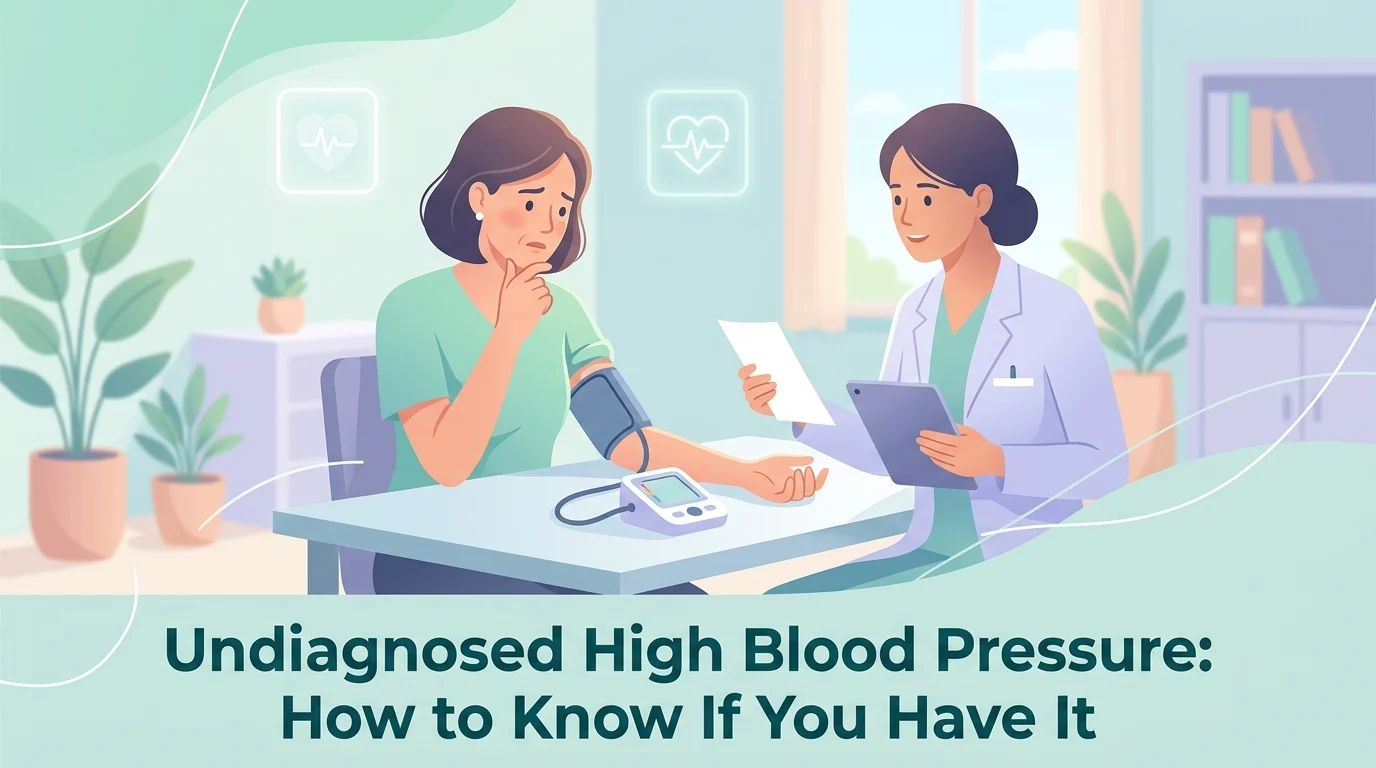
The NHLBI recommends having your blood pressure checked at least once a year. If a reading is high, a clinician will usually want repeated measurements on different days before confirming a diagnosis, because a single high reading can be a temporary spike.
Consider monitoring at home
A 2025 state-of-the-art review in the American Journal of Hypertension describes home monitoring as a validated way to measure blood pressure outside the office. It also notes that higher out-of-office readings are linked to cardiovascular risk independently of office readings, which is why home values can add information that a single clinic visit misses. If you buy a monitor, ask your pharmacist or clinician to help you choose a validated upper-arm model and to explain how often to measure. Bring your log to your appointment.
Which lab tests add context
Once high blood pressure is confirmed or suspected, doctors often order blood and urine tests. These tests do not replace the blood pressure reading. They help look for a cause, check whether the kidneys are affected, and estimate overall cardiovascular risk.
| 测试 | 它看起来是什么样的 | Why it matters with high blood pressure |
|---|---|---|
| Kidney function panel (creatinine, eGFR) | 肾脏过滤血液的能力 | Kidneys can be both a cause and a target of high blood pressure |
| Urine albumin or protein | Protein leaking into urine | An early sign of kidney strain |
| Cholesterol panel (LDL) | Fats that build up in artery walls | Feeds the overall cardiovascular risk estimate |
| 血糖 | Sugar regulation | Diabetes and high blood pressure often occur together |
Our recent news article explains the blood tests that decide whether you need medication. To read the first two rows of the table in detail, see our guide to the 肾功能检查 以及我们的解读文章: 尿蛋白. For the cholesterol row, our page on 低密度脂蛋白胆固醇水平与参考范围 covers the details.
最新科学进展
The Oxford analysis, published in BMJ Public Health in 2026, is among the largest looks at blood pressure detection in a single country. Its practical message for you: having no symptoms and no diagnosis does not mean your blood pressure is normal, and a measurement is the only way to find out. The authors also highlight that high blood pressure appears across nearly all groups, including younger adults, so waiting for middle age to get checked may leave a gap.
A 2025 expert review of home monitoring points the same way. Measuring outside the clinic can give a fuller picture than one office visit, and it can help people and clinicians adjust treatment over time. What this changes for you: a few weeks of careful home readings, shared with your doctor, can be more informative than a single number taken in a busy waiting room. These are population studies and expert reviews, so they inform screening habits but do not replace your own clinician’s judgment.
何时应该去看医生
Book an appointment if you have never had your blood pressure checked, if it has been more than a year, or if a home or pharmacy reading is higher than expected. Tell your doctor if high blood pressure runs in your family or if you have diabetes, kidney disease, or high cholesterol.
Seek emergency care right away if a very high reading comes with chest pain, trouble breathing, sudden weakness or numbness, confusion, trouble speaking, or a sudden severe headache.
词汇表
- 高血压: the medical term for persistently high blood pressure.
- 收缩压: the top number, the pressure in your arteries when the heart beats.
- 舒张压: the bottom number, the pressure between beats.
- 横断面研究: a study that measures many people at one moment in time.
- Home blood pressure monitoring: measuring your own blood pressure outside a medical office with a validated device.
- 肾小球滤过率 (eGFR): an estimate of how well your kidneys filter blood, calculated from a creatinine test.
常见问题解答
How do I know if I have high blood pressure?
You need to measure it. Symptoms are unreliable, so a clinic, pharmacy, or validated home monitor reading is the way to find out.
Can you have high blood pressure without symptoms?
Yes. It is usually silent until it has caused damage to organs such as the heart, brain, or kidneys.
Can a blood test show high blood pressure?
No. A blood test cannot diagnose hypertension. Blood and urine tests help look for causes, kidney effects, and overall cardiovascular risk once high readings are found.
我应该多久测量一次血压?
The NHLBI advises at least once a year. Your doctor may suggest more frequent or home checks if your readings are high or you have other risk factors.
Is a high reading at the doctor’s office always hypertension?
Not necessarily. Readings can rise in a clinic setting, and one measurement is rarely enough. Clinicians usually confirm with repeated or out-of-office measurements.
来源
- Liu W, et al. Hypertension prevalence, detection, treatment and control among 1.4 million adults in England. BMJ Public Health, 2026
- University of Oxford news release on undetected high blood pressure, September 2026
- Centers for Disease Control and Prevention: High Blood Pressure Facts
- National Heart, Lung, and Blood Institute: High Blood Pressure
- Liu J, et al. Home Blood Pressure Monitoring. American Journal of Hypertension, 2025
其他文章
借助AI DiagMe,读懂您自己的血液检测结果
Blood and urine results are easier to act on when you understand them. 利用 AI DiagMe 了解您的实验室结果 and bring clearer questions to your next appointment.