





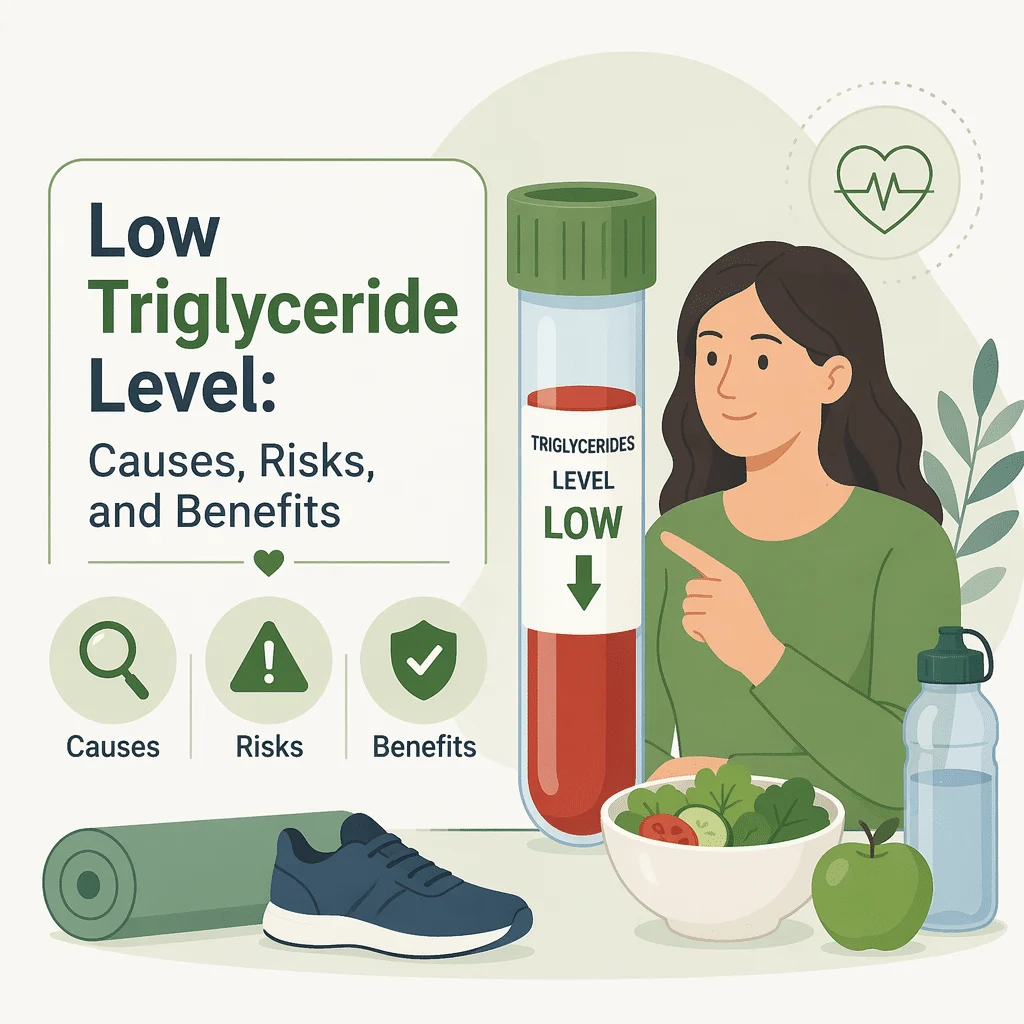
Een laag triglyceridengehalte op een lipidenonderzoek is doorgaans goed nieuws en geen reden tot bezorgdheid. Triglyceriden zijn het meest voorkomende type vet in uw bloed, en een lager gehalte wijst vaak op een gezond dieet, regelmatige lichaamsbeweging of simpelweg een efficiënte stofwisseling. Toch kan een zeer lage waarde soms duiden op iets dat de moeite waard is om te controleren, zoals een overactieve schildklier, slechte opname van voedingsstoffen of een erfelijk verschil in de manier waarop uw lichaam vet verwerkt. Deze gids legt uit wat triglyceriden zijn, waarom de test wordt gedaan, hoe een lage waarde wordt gedefinieerd en wat een laag resultaat voor u kan betekenen. In dit artikel leest u wanneer een lage waarde volkomen normaal is, wanneer nader onderzoek gewenst is en hoe artsen de uitslag in de juiste context beoordelen. De belangrijkste gedachte: één getal vertelt zelden het hele verhaal.
Wat triglyceriden zijn en wat “laag” betekent
Triglyceriden zijn vetmoleculen die uw lichaam gebruikt als energiebron. Wanneer u eet, worden calorieën die u niet direct nodig heeft omgezet in triglyceriden en opgeslagen in vetcellen. Tussen de maaltijden door geven hormonen deze vrij, zodat uw spieren en organen ze als brandstof kunnen verbranden. Ze worden via uw bloedbaan vervoerd in deeltjes die ook cholesterol bevatten, waardoor één enkele test meerdere vetten tegelijk kan meten.
Wat triglyceriden doen in het lichaam
Beschouw triglyceriden als de oplaadbare energiereserve van uw lichaam. Een bescheiden gehalte in het bloed is normaal en gezond. Gezondheidsproblemen worden veel vaker in verband gebracht met een hoog triglyceridengehalte, wat het risico op hart- en vaatziekten verhoogt. Een lage waarde betekent doorgaans het tegenovergestelde: uw lichaam verwerkt dit vet efficiënt.
Wanneer is een triglyceridenwaarde laag?
Er bestaat geen officiële medische grenswaarde voor “laag” zoals die er wel is voor hoog. De meeste laboratoria beschouwen waarden onder ongeveer 50 mg/dL (milligram per deciliter) als aan de lage kant, hoewel het exacte getal per laboratorium kan verschillen. Omdat triglyceriden normaal gesproken ruim onder de cholesterolwaarden op uw uitslag liggen, geeft een lage waarde op zichzelf zelden aanleiding tot bezorgdheid. Laboratoria vermelden deze waarde naast het cholesterol op een standaard lipidenpanel, en de uitslag is het best te begrijpen in samenhang met die andere resultaten.
Waarom het triglyceridenonderzoek wordt gedaan en hoe het wordt gemeten
Triglyceriden worden gemeten met een eenvoudige bloedafname, vrijwel altijd als onderdeel van een lipidenonderzoek dat wordt aangevraagd om het hartgezondheidsrisico te beoordelen. Artsen gebruiken de uitslag om het cardiovasculaire risico in te schatten, om aandoeningen zoals diabetes te volgen en om bij te houden hoe voeding, beweging of medicatie je vetwaarden in de loop van de tijd beïnvloeden. Een lage uitslag is doorgaans niet de reden waarom de test werd aangevraagd, maar verschijnt elke keer dat het lipidenonderzoek wordt uitgevoerd.
Waar triglyceriden verschijnen in een lipidenonderzoek
Een lipidenonderzoek rapporteert doorgaans het totale cholesterol, LDL-cholesterol, HDL-cholesterol en triglyceriden. Omdat deze waarden met elkaar samenhangen, lezen clinici ze samen. Een lage triglyceridewaarde in combinatie met een gezond HDL en een redelijk LDL is over het algemeen geruststellend. Om te zien waar jouw waarde staat, vergelijk je die met de gepubliceerde normale triglyceridenwaarden.
Waarom nuchter zijn belangrijk is
Triglyceriden stijgen sterk na een maaltijd, waardoor veel laboratoria je nog steeds vragen om de avond voor een bloedtest die triglyceriden omvat nuchter te blijven. Een nuchtere bloedafname geeft een betrouwbaarder beeld en verkleint de kans op een onterecht hoge waarde. Als je niet nuchter was, is een lage of normale waarde doorgaans nog steeds betekenisvol, maar je clinicus houdt het tijdstip in gedachten. Meer informatie vind je in deze gids over vasten voor een bloedtest.
Referentiewaarden voor triglyceriden
De onderstaande tabel toont de waarden die de meeste laboratoria in de Verenigde Staten hanteren voor nuchtere volwassenen, gebaseerd op richtlijnen van bronnen zoals Mayo Clinic en Cleveland Clinic. Een lage waarde valt onder de gezonde drempel en wordt over het algemeen als gunstig beschouwd. Referentiewaarden kunnen per laboratorium verschillen, dus vergelijk je uitslag altijd met de waarden op je eigen rapport.
| Categorie | Nuchtere triglyceriden (mg/dL) | Wat het over het algemeen aangeeft |
|---|---|---|
| Laag | Onder ongeveer 50 | Doorgaans gunstig; soms de moeite waard om nog eens naar te kijken |
| Normaal (optimaal) | Onder de 150 | Gezond bereik voor de meeste volwassenen |
| Grenswaarde hoog | 150 tot 199 | Lichte verhoging |
| Hoog | 200 tot 499 | Verhoogd; vaak aangepakt met leefstijlveranderingen of medicatie |
| Zeer hoog | 500 of hoger | Vereist snelle medische aandacht |
Er is geen officiële “te lage” grens in deze richtlijnen — één reden waarom een lage triglyceridewaarde zelden reden tot bezorgdheid is.
Wat een lage triglyceridewaarde kan betekenen
Voor de meeste mensen weerspiegelt een lage triglyceridewaarde gezonde gewoonten: een voeding met minder geraffineerde koolhydraten en vet, regelmatige beweging of een slank lichaamsgewicht. In die gevallen hoeft er niets te worden aangepakt. Soms is een zeer lage waarde een aanwijzing voor een onderliggende aandoening, vooral wanneer deze samen met andere afwijkende uitslagen of nieuwe klachten voorkomt. De onderstaande tabel geeft een overzicht van de meest voorkomende verklaringen en wat er doorgaans daarna gebeurt.
| Mogelijke oorzaak | Andere aanwijzingen om op te letten | Typische volgende stap |
|---|---|---|
| Zeer vetarm dieet of vasten | Recent dieet, plantaardig of vetarm eten, lang vasten voor de test | Meestal geen; herhaal de test als het patroon onduidelijk is |
| Triglyceriden verlagende medicatie | Gebruik van fibraten, hoge dosis visolie, statines of nieuwere lipidenverlagende middelen | Overleg met uw voorschrijver; vaak verwacht effect |
| Overactieve schildklier (hyperthyreoïdie) | Gewichtsverlies, snelle hartslag, angst, warmte-intolerantie | Schildkliertests zoals TSH en vrij T4 |
| Ondervoeding of malabsorptie | Onbedoeld gewichtsverlies, spijsverteringsproblemen, chronische ziekte | Voedingsonderzoek en aanvullende tests |
| Erfelijke aandoening met lage lipidenwaarden | Familiegeschiedenis, ook zeer laag cholesterol, soms leververvetting | Doorverwijzing naar een lipidenspecialist |
| Recente ziekte of ontsteking | Recente infectie, operatie of ziekenhuisopname | Opnieuw controleren na herstel |
Het interpreteren van het patroon is belangrijker dan het enkele getal. Lage triglyceriden in combinatie met een hoog LDL kunnen wijzen op een erfelijke cholesterolstofwisseling, terwijl lage triglyceriden met een laag HDL en laag LDL kunnen duiden op een verminderde vetproductie of -opname. Uw arts kan ook een laag HDL-cholesterolgehalte in hetzelfde panel bekijken om het totaalbeeld te completeren.
Veelvoorkomende oorzaken en risicofactoren voor lage triglyceriden
Lage triglyceriden hebben een breed scala aan verklaringen, waarvan de meeste onschuldig zijn. Door ze in te delen naar dieet, medicatie en medische aandoeningen zijn ze gemakkelijker te bespreken met uw arts.
Voeding en leefstijl
Minder calorieën eten, minder geraffineerde koolhydraten en alcohol gebruiken, een vetarm of plantaardig dieet volgen en regelmatig bewegen zorgen er allemaal voor dat triglyceriden dalen. Gewichtsverlies en langdurig vasten hebben hetzelfde effect. Dit zijn de meest voorkomende redenen voor een lage waarde, en ze wijzen doorgaans op een goede metabole gezondheid in plaats van op een probleem dat gecorrigeerd moet worden.
Medicijnen
Verschillende geneesmiddelen verlagen triglyceriden bewust. Fibraten en receptplichtige omega-3-vetzuren worden specifiek gebruikt om ze te verlagen, en statines verlagen ze licht naast het cholesterol. Als u een van deze middelen gebruikt, is een lage uitslag meestal het beoogde effect. Aan de andere kant hebben sommige mensen juist last van een hoog triglyceridegehalte, waarvoor diezelfde geneesmiddelen bedoeld zijn.
Medische aandoeningen
Wanneer dieet en medicatie een zeer lage waarde niet verklaren, overwegen artsen medische oorzaken. Een overactieve schildklier versnelt de stofwisseling en kan triglyceriden verlagen, zodat een lage waarde aanleiding kan zijn om uw schildklierhormoonwaardente controleren. Aandoeningen die de opname van voedingsstoffen belemmeren, zoals coeliakie of inflammatoire darmziekte, kunnen ze ook verlagen, vaak samen met een laag albuminegehalte. Zeldzame erfelijke aandoeningen kunnen iemand levenslang lage bloedvetten bezorgen.
Wanneer een laag triglyceridenresultaat de moeite waard is om te bespreken
Een laag triglyceridengehalte op zichzelf veroorzaakt bijna nooit klachten en heeft zelden behandeling nodig. Wat telt, is de bredere context. Als alles er verder goed uitziet, is er doorgaans geen actie nodig; als de waarde erg laag is of gepaard gaat met waarschuwingssignalen, is een gesprek zinvol.
Wanneer moet je een arts raadplegen?
Overweeg contact op te nemen met uw arts als een laag triglyceridenresultaat gepaard gaat met een van de volgende klachten:
- Onverklaard of onbedoeld gewichtsverlies
- Aanhoudende spijsverteringsproblemen zoals diarree, vettige ontlasting of een opgeblazen gevoel
- Tekenen van een overactieve schildklier, waaronder hartkloppingen, trillen of warmte-intolerantie
- Een familiegeschiedenis van zeer laag cholesterol of erfelijke vetstofwisselingsstoornissen
- Gevoelloosheid, tintelingen, veranderingen in het gezichtsvermogen of evenwichtsproblemen
- Zeer lage cholesterolwaarden op hetzelfde bloedonderzoek
Geen van deze punten betekent dat er iets mis is. Ze geven alleen aan dat het lage getal beter gelezen kan worden in samenhang met de rest van uw gezondheidssituatie. Leren hoe u Lees de resultaten van de bloedtest. in context kunt begrijpen, maakt deze gesprekken eenvoudiger.
Recente wetenschappelijke ontwikkelingen
Onderzoek van de afgelopen drie jaar heeft ons inzicht vergroot in waarom triglyceriden soms laag zijn. Dit is wat recente studies in begrijpelijke taal suggereren.
Een overactieve schildklier kan triglyceriden verlagen
Een vergelijkende studie uit 2025 bij mensen met schildklieraandoeningen toonde aan dat mensen met een overactieve schildklier significant lagere triglyceriden, totaalcholesterol en LDL hadden dan mensen met een normale schildklierfunctie. In gewone taal: wanneer de schildklier op hoge toeren draait, verbrandt het lichaam bloedvetten sneller. Wat dit voor u betekent: als uw triglyceriden onverwacht laag uitvallen, kan een eenvoudig schildklieronderzoek dit vaak verklaren. Hyperthyreoïdie betekent hier een overactieve schildklier die de stofwisseling versnelt.
Behandeling van de schildklier brengt triglyceriden vaak weer omhoog
Een afzonderlijke studie uit 2025 volgde mensen die behandeld werden voor de ziekte van Graves, een veelvoorkomende oorzaak van een overactieve schildklier. Triglyceridenwaarden die laag waren geweest, stegen weer richting normaal zodra de behandeling de schildklieractiviteit onder controle bracht. Wat dit voor u betekent: een laag triglyceridengehalte dat verband houdt met een overactieve schildklier herstelt zich vaak vanzelf nadat de schildklier is behandeld.
Sommige mensen hebben van nature lage bloedvetten
Onderzoekers die in 2023 zeldzame erfelijke vetstofwisselingsstoornissen bestudeerden, beschreven families die van nature zeer weinig vetdeeltjes in het bloed aanmaken — een aandoening die hypobetalipoproteinemie wordt genoemd. Deze mensen kunnen opvallend lage triglyceriden- en cholesterolwaarden hebben, en de meesten voelen zich volkomen gezond, hoewel een minderheid na verloop van tijd lever- of zenuwproblemen kan ontwikkelen. Wat dit voor u betekent: consequent zeer lage triglyceriden in combinatie met zeer laag cholesterol, zeker bij een familiegeschiedenis, kan een specialist ertoe brengen naar een erfelijke oorzaak te zoeken. Hypobetalipoproteinemie is een erfelijke aandoening waarbij het lichaam ongewoon weinig van bepaalde bloedvetten aanmaakt.
Wetenschappers brengen de 'remmers' van bloedvetten in kaart
Studies verduidelijken ook welke eiwitten bepalen hoe snel triglyceriden de bloedbaan verlaten. Een daarvan, ANGPTL3, werkt als een rem op lipoproteïnelipase, het enzym dat triglyceriden uit het bloed verwijdert; een analyse uit 2024 volgde deze eiwitten en hun verband met de gezondheid van het hart op lange termijn. Wat dit voor u betekent: mensen die van nature minder van deze remmende eiwitten aanmaken, hebben doorgaans lagere triglyceriden — een lage waarde kan dus uw genetische aanleg weerspiegelen en hoeft geen probleem te zijn. Dat verband is ook de reden waarom farmaceutische bedrijven deze eiwitten nu als behandeldoel onderzoeken.
Deze bevindingen worden nog bevestigd en mogen niet worden gebruikt voor zelfdiagnose. Ze bevestigen wel een praktisch punt: een lage triglyceridenwaarde is meestal onschuldig en heeft, wanneer dat niet het geval is, vaak een duidelijke en behandelbare verklaring.
Glossarium
| Termijn | Definitie |
|---|---|
| Triglyceriden | Het meest voorkomende type vet in het bloed, dat door het lichaam als energiebron wordt gebruikt. |
| Lipidenpanel | Een bloedtest die triglyceriden en cholesterol meet om de gezondheid van het hart te beoordelen. |
| Nuchtere bloedafname | Bloed afgenomen na niet eten, doorgaans 's nachts, voor een nauwkeurigere meting van de bloedvetten. |
| mg/dL | Milligram per deciliter, de eenheid die wordt gebruikt om triglyceriden- en cholesterolwaarden te rapporteren. |
| Hyperthyreoïdie | Een overactieve schildklier die de stofwisseling versnelt en de bloedvetwaarden kan verlagen. |
| Malabsorptie | Moeite met het opnemen van voedingsstoffen uit voedsel door een spijsverteringsstoornis. |
| Hypobetalipoproteinemie | Een erfelijke aandoening waarbij het lichaam ongewoon weinig van bepaalde bloedvetten aanmaakt. |
| Lipoproteïnelipase | Het enzym dat triglyceriden in de bloedbaan afbreekt en verwijdert. |
Veelgestelde vragen
Wat wordt beschouwd als een laag triglycerideniveau?
Er is geen officiële grenswaarde, maar de meeste laboratoria beschouwen nuchtere waarden onder ongeveer 50 mg/dL als aan de lage kant. Omdat een gezond triglyceridengehalte al onder de 150 mg/dL ligt, valt een lage waarde doorgaans comfortabel binnen het gunstige bereik. Vergelijk je waarde altijd met het referentiebereik op je eigen laboratoriumuitslag.
Wat betekent het als je triglyceriden laag zijn?
Meestal betekent het dat je lichaam vetten efficiënt verwerkt, vaak dankzij een vetarm dieet, regelmatige lichaamsbeweging of een gezond gewicht. Minder vaak weerspiegelt een zeer lage waarde een overactieve schildklier, slechte opname, een triglyceridenverlagend medicijn of een erfelijk verschil in vetmetabolisme. Het is het beste te beoordelen in combinatie met de rest van je lipidenwaarden.
Wat veroorzaakt lage triglyceriden?
Veelvoorkomende oorzaken zijn een vetarm of caloriearm dieet, gewichtsverlies, regelmatige lichaamsbeweging en langdurig vasten vóór de test. Geneesmiddelen zoals fibraten, medicinale visolie op recept en statines kunnen ze ook verlagen. Medische oorzaken zijn onder meer een overactieve schildklier, spijsverteringsproblemen die de opname belemmeren en zeldzame erfelijke aandoeningen.
Zijn lage triglyceriden goed of slecht?
In de meeste gevallen zijn ze een goed teken, gekoppeld aan een gezond metabolisme en een lager cardiovasculair risico dan hoge triglyceriden met zich meebrengen. Ze worden pas een punt van zorg wanneer ze zeer laag zijn en gepaard gaan met waarschuwingssignalen zoals onverklaarbaar gewichtsverlies, spijsverteringsproblemen of symptomen van een overactieve schildklier. Dan is de lage waarde een aanwijzing in plaats van het probleem zelf.
Wat betekent een hoog LDL met lage triglyceriden?
Deze combinatie komt vrij vaak voor en weerspiegelt vaak hoe je lichaam cholesterol verpakt, in plaats van een triglyceridenprobeem. Het kan worden beïnvloed door genetica, voeding en schildklierfunctie. Omdat een hoog LDL nog steeds van belang is voor de hartgezondheid, zal je arts zich richten op het LDL en je algehele risico, waarbij de lage triglyceridenwaarde als context wordt beschouwd en niet als een alarmsignaal.
Moet ik proberen mijn lage triglyceriden te verhogen?
Meestal niet. Een laag triglyceridengehalte is zelden schadelijk en hoeft op zichzelf niet verhoogd te worden. De juiste aanpak is het behandelen van een eventuele onderliggende oorzaak, zoals een overactieve schildklier of een probleem met de opname van voedingsstoffen, als die wordt gevonden. Als je lage waarde het gevolg is van voeding en beweging, is het simpelweg een teken van een goede gezondheid.
Bronnen
- MedlinePlus, National Library of Medicine. Triglycerides Test. medlineplus.gov
- Mayo Clinic. Triglycerides: Why do they matter? mayoclinic.org
- Cleveland Clinic. Triglycerides: Levels and Normal Range. my.clevelandclinic.org
- National Heart, Lung, and Blood Institute (NIH). High Blood Triglycerides. nhlbi.nih.gov
- Kebamo TE, et al. A comparative study on serum lipid levels in patients with thyroid dysfunction. BMC Endocrine Disorders, 2025. doi.org/10.1186/s12902-025-01851-1
- Nagamine T, et al. Impact of Graves’ hyperthyroidism treatment on lipid profiles and cholesterol dynamics. Therapeutic Advances in Endocrinology and Metabolism, 2025. doi.org/10.1177/20420188251372381
- Rare primary dyslipidaemias associated with low LDL and HDL cholesterol values in Portugal. Frontiers in Genetics, 2023. doi.org/10.3389/fgene.2022.1088040
- Silbernagel G, et al. Associations of circulating ANGPTL3, ANGPTL4, and ANGPTL3/8 and ANGPTL4/8 complexes with LPL activity, diabetes, inflammation, and cardiovascular mortality. Circulation, 2024. doi.org/10.1161/CIRCULATIONAHA.124.069272
Verder lezen
- Laag HDL-cholesterol begrijpen: oorzaken en risico's
- Normale LDL-waarden: een gids voor gezonde bereiken
- Hoge VLDL-waarden: oorzaken, symptomen en risico's
- De cholesterolratio uitgelegd: betekenis en risico's
- TSH: het hormoon dat je schildklier reguleert
Begrijp uw laboratoriumresultaten met AI DiagMe.
Een laag triglyceridengehalte krijgt pas echt betekenis in combinatie met de rest van uw lipidenpanel en, indien nodig, uw schildklier- en voedingsmarkers. AI DiagMe legt uit wat uw triglyceriden, cholesterol en gerelateerde waarden samen betekenen — in begrijpelijke taal en binnen enkele minuten. Het helpt u uw uitslagen te begrijpen en betere vragen voor te bereiden, maar stelt geen diagnose en vervangt uw arts niet.
Ontvang binnen enkele minuten een interpretatie van uw resultaten.