




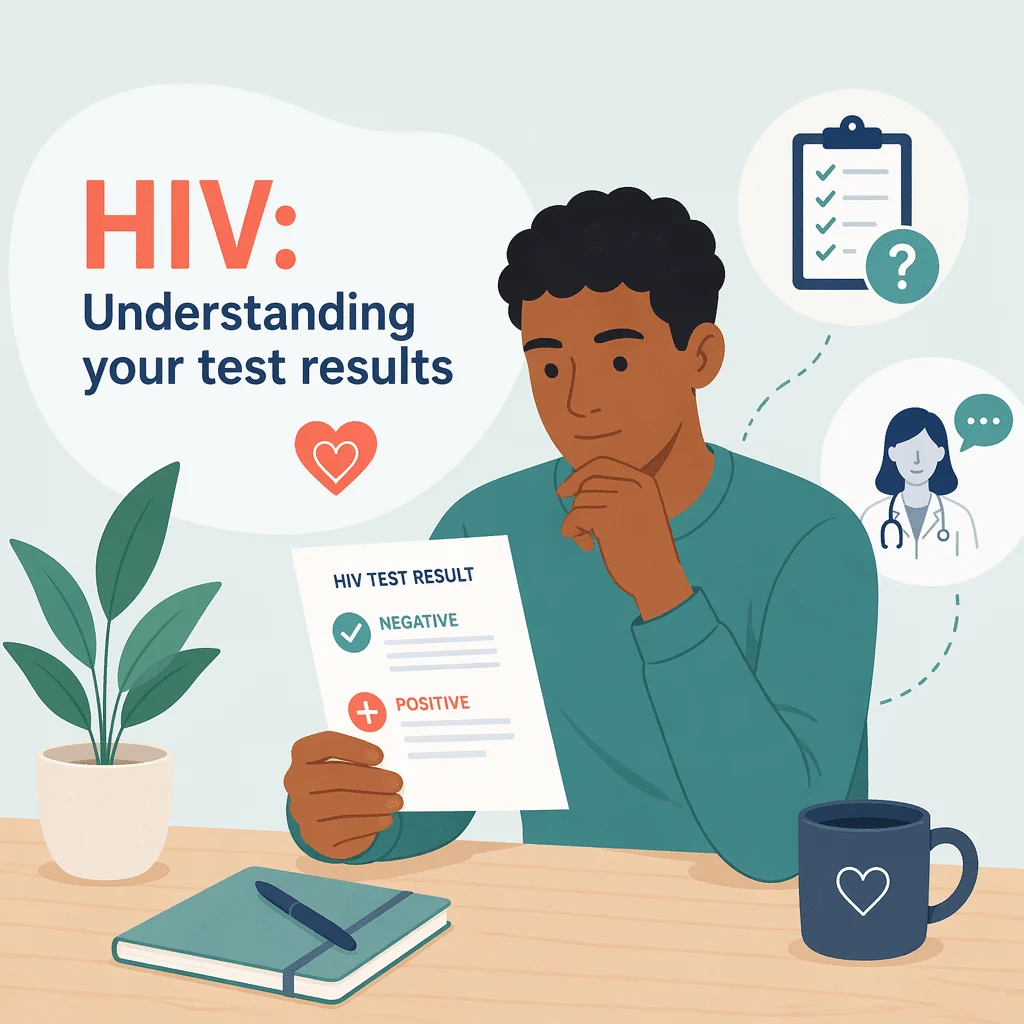
An HIV blood test looks for traces of the virus in a small blood sample, and the version used in most UK laboratories today finds them earlier than most people expect. If you are reading this with a result in front of you, or while counting days since a possible exposure, here is the most important thing first: a reactive screening result is not a diagnosis. Screening tests are built to miss as little as possible, so they sometimes react in people who do not have HIV. Confirmation is a normal, expected step. Testing itself is ordinary healthcare, recommended at least once for nearly every adult.
In this article you’ll learn what the test actually measures, how the window period works, what a negative result does and does not rule out, what happens after a reactive screen, and what a confirmed positive means today.
What an HIV blood test actually measures
HIV is not a substance your body makes, like cholesterol or iron. It is a virus. So an HIV blood test does not report a level that runs high or low. It looks for two specific traces of the virus and tells you whether it found them.
The p24 antigen
An antigen is a foreign substance that switches on your immune system. The p24 antigen is a protein from the inner core of HIV itself. If the virus is replicating, p24 appears in the blood within roughly two to three weeks, before the immune response is fully built. That makes it the earliest marker a routine laboratory test can pick up.
HIV-1 and HIV-2 antibodies
Antibodies are proteins your immune system makes when it meets something it treats as foreign. Anti-HIV antibodies take longer to appear than p24, but once they do, they stay. Standard tests look for antibodies to both HIV-1, the type behind most infections worldwide, and HIV-2, found mainly in West Africa, because the two are managed differently.
Why it is called a fourth-generation test
The test most UK laboratories now use is a fourth-generation antigen/antibody combination immunoassay. “Combination” means it looks for p24 and antibodies in a single run. “Fourth generation” simply describes how the technology evolved: earlier tests could only detect antibodies, so they were blind to the first weeks of infection. Adding p24 narrowed that gap considerably. CDC recommends antigen/antibody tests for laboratory testing, and they are the most common HIV test in the United States.
Your report may name it in several ways: “HIV Ag/Ab combo”, “HIV-1/2 antigen and antibody, fourth generation”, or simply “HIV screen”. They all describe the same test. The answer is usually reported as non-reactive or reactive rather than negative or positive, and that wording is deliberate. A screening test reacts; it does not diagnose. If the layout of your report is unfamiliar, you can also consult our guide to reading blood test results.
Why and when people get tested
Testing for HIV is routine healthcare. It is not an accusation, and it implies nothing about how anyone lives.
The CDC recommends that everyone aged 13 to 64 be tested for HIV at least once as part of routine health care. The US Preventive Services Task Force gives HIV screening in adolescents and adults aged 15 to 65 a grade A recommendation, its strongest category, reserved for services where there is high certainty of substantial benefit. The Task Force also gives a grade A to screening all pregnant people, including those whose HIV status is unknown when they arrive in labour.
This is why an HIV test often turns up on a panel you did not specifically ask for: a check-up, an insurance medical, a sexual health screen, an antenatal panel. The blood tests carried out during pregnancy routinely include it, because treatment in pregnancy is highly effective at preventing transmission to the baby.
The CDC also suggests testing at least once a year for people in certain circumstances, among them anyone who has had a new partner since their last test, anyone diagnosed with another sexually transmitted infection, hepatitis or tuberculosis, and anyone who has shared injection equipment. HIV is often checked alongside other bloodborne and sexually transmitted infections, so you may see it grouped into an STI serology panel, or sitting beside the hepatitis B surface antigen test, the hepatitis C antibody test and the RPR test for syphilis.
The reason to test is practical rather than moral: the only way to know your HIV status is to test. Knowing gives you useful options either way.
The window period: why timing changes what a test can find
No HIV test can detect the virus immediately after exposure. The gap between exposure and the point at which a test can reliably find HIV is called the window period, and it is the biggest single source of confusion, and of unnecessary worry.
During the window, the virus may be present while the marker the test looks for has not yet reached a detectable level. That is why a negative result taken too early does not rule out infection.
How long the window lasts depends on which test you took. The CDC gives the following ranges.
| Type of test | What it looks for | Window period (CDC) | Usual setting |
|---|---|---|---|
| Nucleic acid test (NAT) | The genetic material of the virus itself | 10 to 33 days | Blood from a vein; used after a known exposure or to resolve unclear results |
| Antigen/antibody lab test (fourth generation) | p24 antigen plus HIV-1 and HIV-2 antibodies | 18 to 45 days | Blood from a vein; the standard laboratory screen |
| Rapid antigen/antibody test | p24 antigen plus HIV-1 and HIV-2 antibodies | 18 to 90 days | Finger-prick blood; clinics and community testing |
| Antibody test (rapid or self-test) | HIV-1 and HIV-2 antibodies only | 23 to 90 days | Finger-prick blood or oral fluid; most self-tests |
Two things follow from that table. First, the sample matters: blood drawn from a vein detects HIV earlier than a finger-prick or an oral-fluid swab. Second, these are ranges, not deadlines. Immune systems respond at different speeds, so the same test may turn positive at day 18 in one person and day 44 in another.
If you tested inside the window, the answer is not to reason your way towards reassurance. It is to test again once the window for your test type has closed.
What a negative HIV blood test result means
A non-reactive, or negative, result means the test found no p24 antigen and no HIV antibodies in your sample.
What that tells you depends entirely on timing.
- If your last possible exposure was longer ago than the window period for the test you took, and nothing has happened since, a negative result means you do not have HIV. That is a real and trustworthy answer.
- If your last possible exposure was inside the window period, a negative result is incomplete information. It does not exclude infection. Test again once the window has closed.
It is worth being clear about this. A fourth-generation laboratory test 10 days after an exposure tells you very little. The same test at 45 days tells you a great deal.
One detail that often gets missed: a routine blood panel does not include HIV unless HIV was specifically requested. A complete blood count, for example, counts your blood cells and cannot detect the virus. If you want to know your status, the test has to be ordered by name.
If you think you may have been exposed within the last 72 hours, contact a healthcare provider or an emergency service straight away rather than waiting to test. There is an emergency preventive treatment, called PEP, that must begin within three days to work.
What a reactive result means, and the confirmation that follows
A reactive screening result means the test detected something. It does not mean you have HIV.
That is not a comfort blanket or a technicality. Screening immunoassays are deliberately tuned towards sensitivity: they are designed to miss as few true infections as possible, and the price of that design is that they occasionally react in people who do not have HIV. Other antibodies circulating in the blood, recent vaccination, pregnancy and some autoimmune conditions can all set off a reaction. This is precisely why no laboratory reports a diagnosis on a screening result alone, and why a reactive screen is always followed by further testing.
The CDC laboratory testing algorithm
When a laboratory screen is reactive, the lab usually runs the follow-up on the same blood sample, so a second visit is often unnecessary. The algorithm has three stages.
- Screen. The fourth-generation antigen/antibody test. If it is non-reactive, testing stops here. If it is reactive, the sample moves to step two.
- Differentiate. An HIV-1/HIV-2 antibody differentiation immunoassay. This does two jobs at once: it checks whether antibodies are genuinely present, and it identifies which virus. If it is reactive and agrees with the screen, the result is a confirmed positive.
- Resolve. If the differentiation assay is negative or indeterminate, meaning it disagrees with the screen, the laboratory runs an HIV-1 nucleic acid test (NAT) that looks for the genetic material of the virus directly. A positive NAT usually points to very early infection, caught before antibodies had developed. A negative NAT after a reactive screen indicates the screen was a false positive.
The older Western blot is no longer part of the recommended US algorithm. It was replaced because it was slower and less able to catch early infection.
| Your result | What it means | What happens next |
|---|---|---|
| Non-reactive, outside the window period | No HIV found; a reliable answer | Nothing further needed for this exposure; routine or yearly testing continues as advised |
| Non-reactive, inside the window period | Incomplete information; infection is not excluded | Retest once the window for your test type has passed |
| Reactive laboratory screen | Something was detected; not a diagnosis | The lab runs the antibody differentiation assay, usually on the same sample |
| Reactive screen with a discordant or indeterminate follow-up | The two tests disagree; unresolved | An HIV-1 NAT settles it, either confirming very early infection or showing a false positive |
| Reactive self-test or community rapid test | A preliminary signal only | See a healthcare provider for laboratory confirmation |
| Confirmed positive | You have HIV | Link to HIV care and start treatment; CD4 count and viral load follow |
About the waiting
Confirmation on the same sample is usually quick, but “quick” is relative when you are the one waiting. If a self-test or a community rapid test was reactive, you will need to see a healthcare provider for laboratory follow-up, and that will feel slower. It is entirely reasonable to ask the testing service when results are expected, and to ask for support in the meantime.
What a confirmed positive result means today
If confirmatory testing shows that you have HIV, what follows looks very different from the picture most people carry around, which is usually several decades out of date.
A treatable long-term condition
Treatment is antiretroviral therapy: often a single daily tablet, and in some cases a long-acting injection. It is started as soon as possible after diagnosis, no matter how well you feel. CDC notes that most people get HIV under control within six months of starting treatment. HIV and AIDS are not the same thing. AIDS is the most advanced stage of untreated HIV infection, and with effective treatment most people with HIV never reach it.
Undetectable = Untransmittable
Treatment can reduce the amount of virus in the blood so far that tests can no longer detect it, which is called an undetectable viral load. According to CDC, if you have an undetectable viral load, you will not transmit HIV through sex. This is known as Undetectable = Untransmittable, or U=U. Sustained viral suppression also prevents transmission through pregnancy, labour and delivery.
This is one of the better-established findings in modern medicine, and it has changed what a diagnosis means for relationships and for daily life.
The tests that come next
Two blood tests do the ongoing monitoring.
- The CD4 count measures a type of white blood cell that HIV targets, and reflects how your immune system is holding up. CDC notes that providers usually check it every 3 to 6 months.
- The viral load measures how much HIV is in your blood, and therefore how well treatment is working. It is typically checked every 4 to 6 months, and again around 2 to 8 weeks after starting or changing medicine.
CD4 cells are a subset of lymphocytes, so for background on what these cells do you can also read our guide to lymphocytes and their role in the immune system.
If your result is negative and you want to stay that way
PrEP, or pre-exposure prophylaxis, is medicine taken before a possible exposure that substantially reduces the chance of acquiring HIV. It is prescribed and monitored by a healthcare provider, and whether it suits you is a conversation to have with them.
Where to get tested and when to see a doctor
Where to get tested
HIV tests are widely available and frequently free. In the United Kingdom you can be tested at your GP's surgery, at sexual health clinics, at community health centres, and at home with a self-test kit. Many pharmacies and charities such as the Terrence Higgins Trust also offer testing. HIV tests are available on the NHS at no cost, and testing can be anonymous: you may be given a number to use instead of your name.
When to see a doctor
- Straight away, if you may have been exposed to HIV in the last 72 hours, because emergency preventive treatment (PEP) has to start within three days.
- Promptly, if a self-test or a rapid test was reactive, so that laboratory confirmation can be arranged.
- If you have any result you do not understand, including an indeterminate or discordant one.
- If you had a possible exposure, now have flu-like symptoms such as fever, sore throat, swollen glands, rash or night sweats, and an antibody test came back negative, since a NAT may be appropriate.
- If you tested negative inside the window period and are unsure when to retest.
- If waiting for a result is affecting your sleep, your mood or your ability to get through the day. That is a reasonable thing to bring to a doctor.
Latest scientific advances in HIV testing
Research over the past few years has been less about inventing new assays and more about answering the questions people actually have: what does a diagnosis mean for a life, and does testing outside a clinic really connect people to care?
A large collaborative analysis of European and North American cohorts, led by Adam Trickey and published in The Lancet HIV in 2023, followed more than 200,000 adults with HIV who had been on antiretroviral therapy for at least a year. A cohort study simply follows a defined group of people over time. For those whose immune systems were in good shape when follow-up began, remaining life expectancy at age 40 was only a few years short of the general population. For people whose immune systems were already badly depleted at the start, the outlook was substantially worse. What this means for you: with treatment, a normal or near-normal lifespan is a realistic expectation, and testing earlier rather than later is what protects that outcome.
The same group published a companion analysis in The Lancet HIV in 2024, tracking what people with HIV on treatment actually died of between 1996 and 2020. AIDS-related deaths fell from roughly half of all deaths in the late 1990s to a small minority by the late 2010s, and overall death rates dropped steadily. What this means for you: the risks that dominate modern HIV care are increasingly the ordinary risks of ageing, such as heart disease and cancer, which is why routine follow-up matters as much as the HIV medicine itself.
A systematic review and meta-analysis led by Ying Zhang, published in the Journal of the International AIDS Society in 2024, pooled 173 studies on what happens after someone uses an HIV self-test. A systematic review gathers all the studies on a question and analyses them together. Among people whose self-test was reactive, the large majority went on to have confirmatory testing, and most of those newly diagnosed started treatment. What this means for you: a self-test is a legitimate starting point and most people do follow through, but it is a first step and not an answer. A reactive self-test needs laboratory confirmation.
A global systematic review led by Sanele Ngcobo, published in the Journal of the International AIDS Society in 2025, mapped 47 studies using machine learning across HIV care. Software reading photographs of rapid and self-test strips interpreted them more consistently than people did, and chatbots increased how many people took up self-testing at all. What this means for you: these tools are still research rather than routine practice, and none replaces the laboratory algorithm.
Read together, these studies say something worth holding on to: the value of an HIV blood test lies almost entirely in what happens afterwards, and what happens afterwards is now good.
Glossary
| Term | Definition |
|---|---|
| Antigen | A foreign substance that triggers a response from your immune system. In HIV testing, the antigen looked for is a piece of the virus. |
| Antibody | A protein your immune system makes in response to something it treats as foreign. Anti-HIV antibodies take weeks to appear but then persist. |
| p24 antigen | A protein from the core of HIV. It appears in the blood before antibodies, which is what lets modern tests detect infection earlier. |
| Fourth-generation test | A laboratory immunoassay that looks for the p24 antigen and HIV-1 and HIV-2 antibodies in a single run. The standard screen in the United Kingdom. |
| Reactive | The wording laboratories use when a screening test detects something. It signals that confirmatory testing is needed, not that a diagnosis has been made. |
| Window period | The time between exposure and the point at which a given test can reliably detect HIV. A negative result inside this period does not exclude infection. |
| Nucleic acid test (NAT) | A test that looks for the genetic material of HIV directly. It detects infection earliest and is used to resolve unclear results or measure viral load. |
| Antibody differentiation assay | The second step after a reactive screen. It confirms whether HIV antibodies are truly present and distinguishes HIV-1 from HIV-2. |
| CD4 count | A measure of the white blood cells HIV targets. It shows how well the immune system is functioning and is monitored after diagnosis. |
| Viral load | The amount of HIV in the blood. Effective treatment lowers it until tests can no longer detect it, which is called an undetectable viral load. |
Frequently asked questions
Can I trust a negative HIV blood test at four weeks?
Four weeks is 28 days, which sits inside the 18 to 45 day window the CDC gives for a fourth-generation laboratory test. So a negative at that point is encouraging but not conclusive: many people would already test positive by then, and some would not. The straightforward answer is to retest once 45 days have passed since the exposure you are thinking about. If you took a rapid or self-test rather than a laboratory test, the window is longer still, up to 90 days. Waiting is uncomfortable, but a second test is the only thing that converts a maybe into an answer.
How long do HIV blood test results take?
It depends on the test. A rapid antibody test or a rapid antigen/antibody test, including self-tests used at home, gives a result in 30 minutes or less. A laboratory antigen/antibody test or a NAT requires the sample to be sent away, and results typically take several days. If a laboratory screen comes back reactive, the confirmatory testing is usually run on the same blood sample, so it does not normally require another draw or another wait of the same length. Your testing service can tell you what to expect.
Are HIV self-tests reliable?
Self-tests are a genuinely useful way to find out your status privately, and they are approved for that purpose. Two limits are worth knowing. The FDA-approved self-test is an antibody test, so its window period runs up to 90 days, considerably longer than a laboratory test. And a reactive self-test is a preliminary result that always needs laboratory confirmation. Follow the manufacturer’s instructions exactly, and if the test comes out invalid, it simply did not work and you will need another one or a test at a clinic.
What can cause a false positive HIV test?
Screening tests are deliberately built to catch as many true infections as possible, and that design means they sometimes react when HIV is not present. Other antibodies in the blood, recent vaccination, pregnancy and certain autoimmune conditions have all been described as causes. This is not a flaw in your sample or a mistake by the laboratory. It is the reason the confirmation algorithm exists, and it is why a reactive screen alone is never reported as a diagnosis. The differentiation assay and, if needed, a NAT are what sort this out.
Does a routine blood test check for HIV?
No. HIV is only tested for when it has been specifically requested. A general panel measures other things entirely: cell counts, kidney and liver markers, cholesterol and so on. None of them can detect HIV. Similarly, HIV cannot be inferred from a low lymphocyte count or any other indirect finding, whatever the internet suggests. If you want to know your HIV status, the test has to be ordered by name, and you can ask for it directly.
If treatment works, will my HIV test become negative again?
No, and this catches people out. Antiretroviral therapy does not remove the antibodies your immune system made, so an antibody test stays positive for life. What treatment changes is the viral load: the amount of virus in the blood can fall below what tests can detect. Undetectable viral load and negative HIV test are different things. Someone with a sustained undetectable viral load still has HIV, still takes treatment, and, according to the CDC, will not transmit HIV through sex.
Sources
- Centers for Disease Control and Prevention — Getting Tested for HIV
- MedlinePlus, US National Library of Medicine — HIV Screening Test
- US Preventive Services Task Force — Human Immunodeficiency Virus (HIV) Infection: Screening
- Centers for Disease Control and Prevention — Treating HIV
- Trickey A, Sabin CA, Burkholder G, et al. — Life expectancy after 2015 of adults with HIV on long-term antiretroviral therapy in Europe and North America: a collaborative analysis of cohort studies — The Lancet HIV, 2023 — https://doi.org/10.1016/S2352-3018(23)00028-0
- Trickey A, McGinnis K, Gill MJ, et al. — Longitudinal trends in causes of death among adults with HIV on antiretroviral therapy in Europe and North America from 1996 to 2020: a collaboration of cohort studies — The Lancet HIV, 2024 — https://doi.org/10.1016/S2352-3018(23)00272-2
- Zhang Y, Goh SM, Tapa J, et al. — Linkage to care and prevention after HIV self-testing: a systematic review and meta-analysis — Journal of the International AIDS Society, 2024 — https://doi.org/10.1002/jia2.26388
- Ngcobo S, Mntla EM, Shock J, et al. — Artificial intelligence for HIV care: a global systematic review of current studies and emerging trends — Journal of the International AIDS Society, 2025 — https://doi.org/10.1002/jia2.70045
Further reading
- Abnormal blood test results: what they mean
- Low lymphocytes: causes, symptoms and risks
- CRP blood test: reading your inflammation results
- Toxoplasmosis IgG and IgM: deciphering your blood test results
- Blood markers glossary: key terms explained
Understand your lab results with AI DiagMe
Reports that mention an HIV antigen/antibody test, a CD4 count, a viral load or a full blood count are written for clinicians, not for the person holding them. AI DiagMe turns that wording into plain language, so you arrive at your appointment knowing what was measured and what to ask. It helps you understand your results; it does not diagnose you, exclude any condition, or replace your doctor.
Get your results interpreted in minutes