




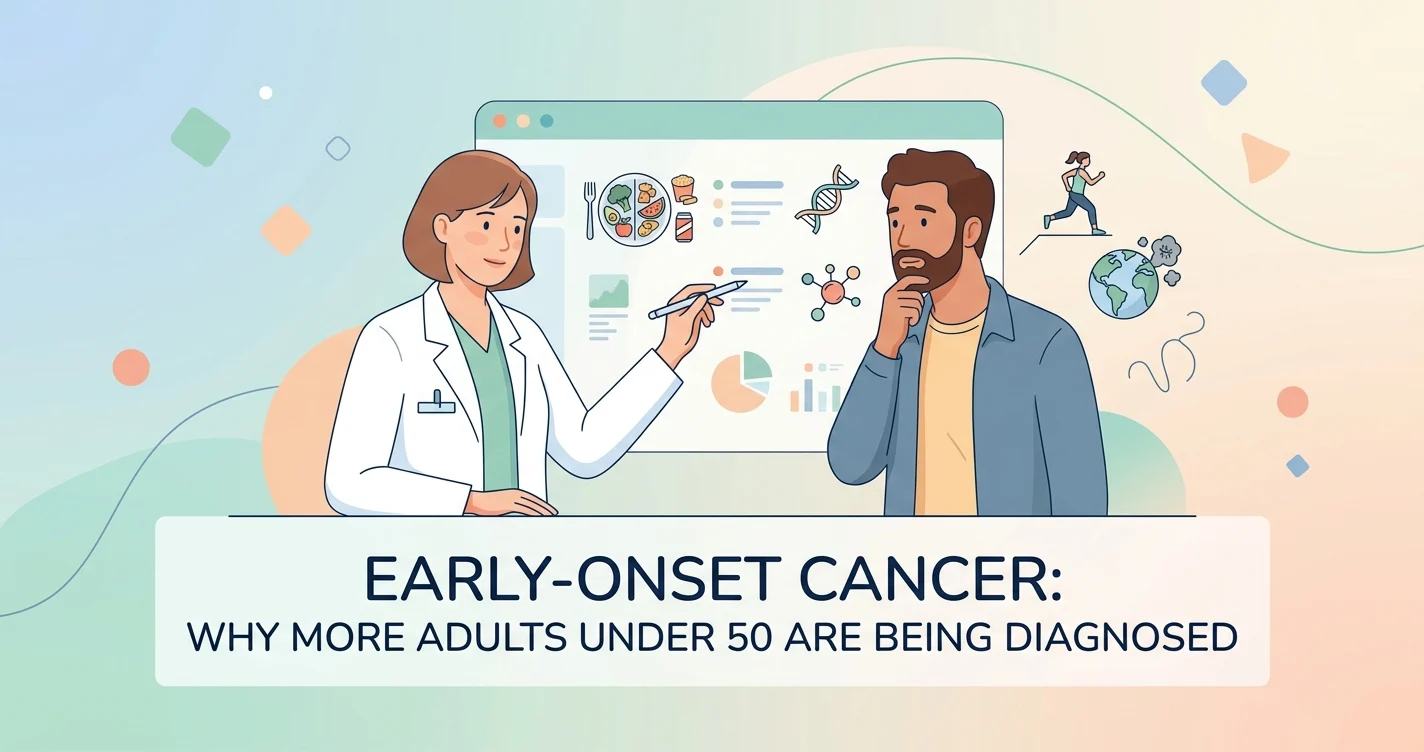
On October 6, 2026, the World Cancer Research Fund (WCRF) published a new analysis of cancers diagnosed before age 50 in England, the United States and the Netherlands. The headline is easy to misread, so it helps to look at what the data actually say: several cancers are being diagnosed more often in younger adults, but cancer is still far more common after 60. This article explains the findings, what researchers think may be behind them, which symptoms deserve attention, and what a blood test can and cannot tell you.
What the new WCRF analysis found
The WCRF looked at 12 site-specific cancers in adults under 50, using national data from 2000 to 2023 in the United States and the Netherlands and from 2001 to 2023 in England. It then tested whether the number of cases was rising in a statistically significant way. The table below summarizes the cancers that showed a significant increase, as listed on the WCRF website.
| Country | النساء دون سن 50 | الرجال دون سن 50 |
|---|---|---|
| England | Breast, colorectal, cervical, uterine, kidney, liver, pancreatic, stomach | Colorectal, kidney, liver, pancreatic, prostate |
| الولايات المتحدة | Breast, colorectal, uterine, kidney, liver, pancreatic, stomach | Colorectal, kidney, pancreatic, stomach |
| هولندا | Cervical, colorectal, kidney, liver | Colorectal, kidney, liver |
Press coverage of the analysis gave a few examples of the size of the change in England between 2001 and 2023. Bowel cancer in adults under 50 rose from about 3.9 to 8.4 cases per 100,000 people, prostate cancer from about 1 to 3.6, and breast cancer from about 42 to 47.5. In the United States, kidney cancer in this age group rose from about 2.5 to 5.3 per 100,000 between 2000 and 2023. Lung cancer in under-50s fell in all three countries, which researchers link to declining smoking.
These figures come from news reports of the WCRF work rather than from a peer-reviewed paper, so they are best read as a signal of direction, not as exact estimates.
Is cancer suddenly common in young people?
No. The WCRF itself stresses that age remains the biggest risk factor for cancer and that the median age at diagnosis in high-income countries is above 60. A rising rate starting from a low base still means that most adults under 50 will not develop these cancers. What matters is the trend: when a cancer becomes more frequent in successive generations, something about exposures, detection or both has probably changed.
Why might early-onset cancers be rising?
Nobody has a single answer yet, and researchers are careful to say so. The National Cancer Institute notes that there is no definitive explanation, and the WCRF says the causes are not fully understood. Several lines of evidence are being explored:
- Overweight and obesity, low physical activity, and diets high in red and processed meat, fast food and sugary drinks, with low fiber intake.
- Alcohol and smoking, which still contribute even though smoking rates have fallen.
- Environmental exposures such as air and water pollution, chemicals and plastics, none of which has been proven to be the cause.
- Changes in the gut microbiome, which may influence inflammation and immunity.
- Earlier or more frequent diagnosis, through greater awareness and more imaging. The WCRF says this can explain part of the rise but not all of it, especially where deaths are also increasing.
The WCRF estimates that about 40% of cancers are linked to modifiable factors, which is why prevention advice focuses on weight, diet, activity and alcohol.
Symptoms worth taking seriously at any age
Doctors have long assumed that cancer is unlikely in a young patient, and that assumption can delay diagnosis. The NCI reports that diagnosis of early-onset colorectal cancer is often delayed by six months or more after the first symptoms. The warning signs most often cited are:
- Blood in the stool or rectal bleeding.
- Persistent abdominal pain.
- A lasting change in bowel habits, including diarrhea.
- Unexplained weight loss or constant fatigue.
- Iron deficiency anemia with no obvious cause.
Most of the time these symptoms have benign explanations. They still deserve a medical review when they last more than a few weeks. If you notice blood, our article explains how blood tests for colon cancer are being studied, and a stool-based approach is covered in our report on stool tests and colon cancer deaths.
What a blood test can and cannot tell you
A routine blood test does not detect most cancers. It can, however, reveal clues that lead your doctor to look further. A low hemoglobin or low iron stores can point to slow bleeding in the digestive tract, which is why unexplained anemia is taken seriously. You can learn how a complete blood count is read, see what a ferritin result says about your iron reserves, and understand the common causes of anemia. None of these results can confirm or exclude cancer on its own.
Screening is a separate question. In the United States, the CDC advises most people to begin colorectal cancer screening at age 45, and earlier if there is a family history. People with symptoms need diagnostic tests rather than screening. For a broader view, read our colorectal cancer guide و our explainer on multi-cancer early detection tests.
أحدث التطورات العلمية
According to PubMed, several recent reviews and analyses add context to the WCRF findings, and they are best read together rather than one by one.
A 2026 analysis in the Journal of Gastrointestinal Oncology looked at early-onset colorectal cancer in the United States over three decades. It found a steady upward trend and suggested that diet, especially processed meat, and body weight are leading modifiable contributors. What this means for you: the habits that protect the heart and metabolism are also the ones most often linked to this cancer, and they are worth acting on early in life.
A 2026 review in the European Journal of Cancer examined early-onset colorectal cancer across Europe. It describes uneven trends between countries, screening programs that mostly start at 50, and frequent diagnostic delays because doctors do not expect cancer in younger adults. What this means for you: do not wait for an age threshold if you have persistent symptoms.
A 2026 scoping review in EClinicalMedicine gathered evidence from Latin America. It reports rising early-onset cancers in parts of the region but also fragmented registries and uneven data quality. What this means for you: the trend is not limited to wealthy countries, although the evidence is still incomplete in many places.
These studies describe patterns in populations. They cannot tell any individual whether they will develop cancer, and they do not replace advice from your own doctor.
متى يجب عليك التحدث إلى طبيبك؟
Book an appointment if you notice blood in your stool, abdominal pain or a change in bowel habits that lasts more than two to three weeks, unexplained weight loss, or anemia that your doctor has not explained. Tell your doctor about any close relative who had colorectal or other cancers at a young age, since family history can change when testing should start. Seek urgent care for heavy bleeding, severe pain or fainting.
مسرد المصطلحات
- Early-onset cancer: a cancer diagnosed before the age of 50.
- Incidence: the number of new cases diagnosed in a given population over a given period.
- سرطان القولون والمستقيم: cancer of the colon or the rectum, also called bowel cancer.
- فقر الدم الناتج عن نقص الحديد: a low red blood cell level caused by too little iron, sometimes due to slow blood loss.
- الفحص الوقائي: testing people who have no symptoms in order to find disease early.
- الميكروبيوم: the community of bacteria and other microbes living in the gut.
الأسئلة الشائعة
Does this mean cancer is now common in people in their 20s and 30s?
No. Cancer remains uncommon in young adults, and the typical age at diagnosis is above 60. The concern is that some cancers are becoming more frequent over time.
Is better screening the only reason for the rise?
Probably not. Greater awareness and more imaging explain part of it, but the WCRF notes that this does not account for the whole trend, particularly where mortality is also increasing.
Can a blood test detect early-onset cancer?
A standard blood test cannot diagnose most cancers. It can show anemia, low iron or inflammation, which may prompt further tests.
At what age should I start colorectal cancer screening?
The CDC advises most people to start at 45. Ask your doctor about starting earlier if a close relative had colorectal cancer or polyps.
What can I do to lower my risk?
Maintaining a healthy weight, staying active, limiting alcohol and processed meat, not smoking and eating more fiber are the measures most consistently recommended.
مصادر
- World Cancer Research Fund, “Are more young people getting cancer?” (October 6, 2026): wcrf.org
- National Cancer Institute, “Why Is Early-Onset Cancer On the Rise?” (2025): cancer.gov
- Centers for Disease Control and Prevention, colorectal cancer screening: cdc.gov
- ITV News, “Cancer cases rising in younger people” (October 6, 2026): itv.com
- Irish Examiner, “Cancer rates rising more quickly among younger people”: irishexaminer.com
- Youssef MY et al., Journal of Gastrointestinal Oncology, 2026: DOI 10.21037/jgo-2026-0314
- Wankhede D et al., European Journal of Cancer, 2026: DOI 10.1016/j.ejca.2026.116908
- Lopes-Junior LC et al., EClinicalMedicine, 2026: DOI 10.1016/j.eclinm.2026.104107
مقالات أخرى
- Colorectal cancer: symptoms, tests and treatment
- Colon cancer blood test: what the research shows
- Breast cancer screening guidelines in 2026
- Pancreatic cancer: understanding, diagnosing, treating
- Kidney cancer: symptoms and diagnosis
افهم نتائج تحاليل دمك بنفسك مع AI DiagMe
Upload your lab report and get a clear, plain-language explanation of every value, reviewed by a committee of doctors. افهم نتائج مختبرك باستخدام AI DiagMe.