










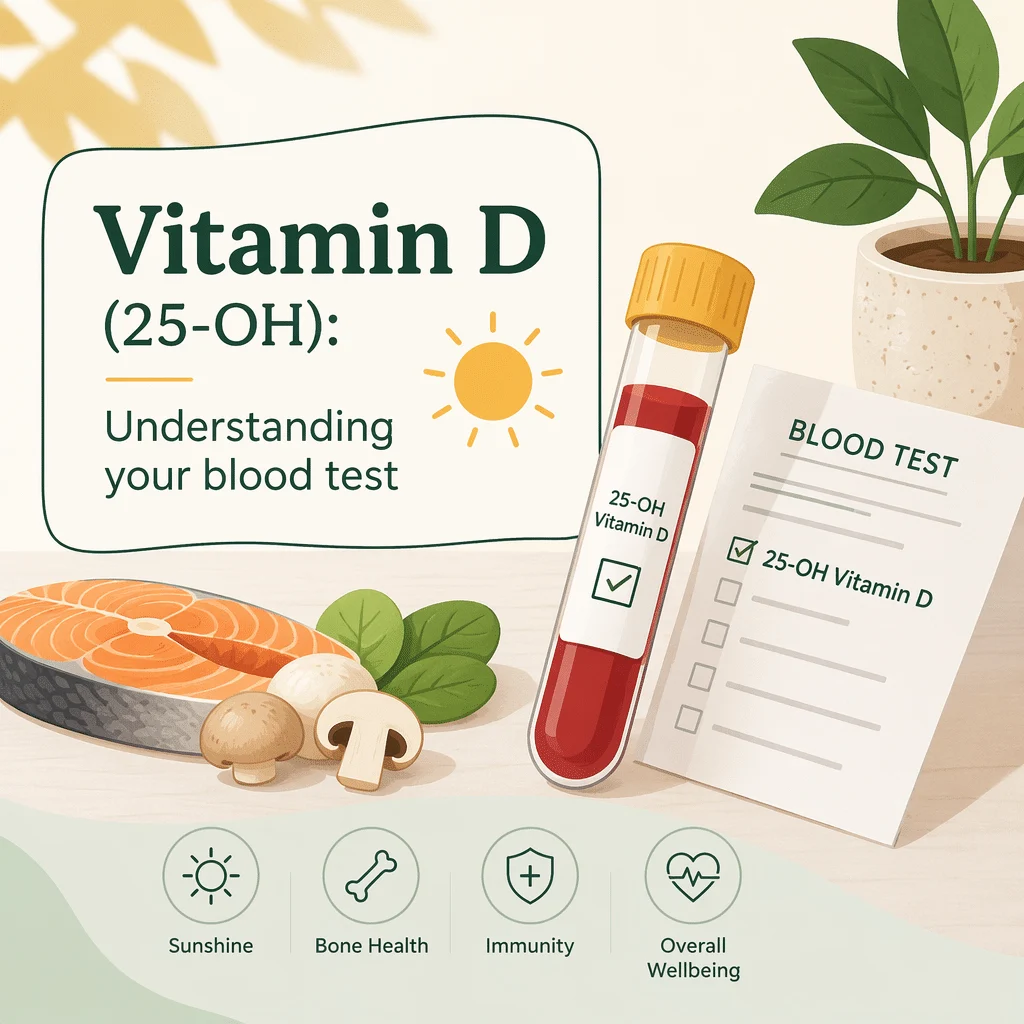
The vitamin D blood test, printed on your report as 25-OH vitamin D or 25-hydroxyvitamin D, measures how much vitamin D your body has in reserve. It is the single measurement doctors rely on to judge vitamin D status, and it has become one of the most frequently ordered tests in the world.
A number outside the printed reference range is common, and it is rarely an emergency. It is a starting point for a conversation with your doctor rather than a diagnosis on its own.
In this article you’ll learn what the 25-OH form represents, why doctors order this test and who genuinely benefits from it, how to read your result against thresholds set by different expert bodies, what raises or lowers your level, and where those bodies openly disagree.
維生素D血液檢測的測量內容
Vitamin D travels through your body in several forms. The vitamin D blood test measures 25-hydroxyvitamin D, shortened to 25-OH vitamin D or 25(OH)D. This is the circulating storage form: the version your body holds between the moment vitamin D is made or eaten and the moment it is put to work.
The journey has three stops. Your skin makes vitamin D when ultraviolet B (UVB) rays reach it, and food and supplements add a smaller amount. What your body collects travels to the liver, which converts it into 25-hydroxyvitamin D. Your kidneys then convert part of that reserve into the active hormone, 1,25-dihydroxyvitamin D, which does the actual work.
為何實驗室測量25-OH形式
The active form sounds more useful to measure, but it is not. It circulates in tiny amounts, disappears within hours, and your body keeps it steady even when reserves run low, so it can look reassuring while stores are quietly depleted. The 25-OH form lasts for weeks and tracks your actual supply. That stability made it the standard measure.
醫師為何及何時會開立維生素D血液檢測
Doctors order this test either to explain something or to monitor something. Testing to explain applies when someone has bone pain, muscle weakness, repeated fractures, osteoporosis, a condition affecting fat absorption, or a calcium result that does not add up. Testing to monitor applies to people already known to be at risk or already being treated.
專家機構認為真正需要檢測的族群
Here the guidance has shifted. In its 2024 clinical practice guideline, the Endocrine Society suggests against routine 25-OH vitamin D testing in generally healthy people with no established medical reason for it, having found no clinical trial evidence that screening healthy adults improves their health.
The US Preventive Services Task Force reaches a related conclusion differently, stating that current evidence is insufficient to weigh the benefits and harms of screening adults without symptoms. “Insufficient evidence” does not mean screening is useless; it means the studies needed to settle the question have not been done.
Both positions concern healthy people without risk factors. Neither applies when your doctor has a specific clinical reason to test, and neither is a reason to skip a test your doctor recommended.
Reading your vitamin D result: the thresholds and who sets them
A typical line reads: VITAMIN D (25-OH), Serum ……. 28 ng/mL ……. (Ref: 30 – 100). The name identifies the marker, 28 is your result, and the unit is usually nanograms per millilitre (ng/mL) in the United States or nanomoles per litre (nmol/L) elsewhere; roughly, 1 ng/mL equals 2.5 nmol/L. The bracketed range is what your laboratory considers expected, and a star or colour flags anything outside it.
The harder truth is that this reference range is a choice, not a law of nature, and organisations have made different choices. For a broader view of how laboratories build ranges, you can consult our guide to normal blood test ranges.
| Organisation | Position on 25-OH vitamin D thresholds |
|---|---|
| Institute of Medicine / National Academies (2011) | Below 12 ng/mL (30 nmol/L): linked to deficiency and bone disease. 12–20 ng/mL (30–50 nmol/L): generally inadequate for bone health. At or above 20 ng/mL (50 nmol/L): generally adequate for healthy people. Above 50 ng/mL (125 nmol/L): linked to possible adverse effects. |
| Endocrine Society (2011 guideline) | Defined sufficiency as at least 30 ng/mL (75 nmol/L), insufficiency as 20–30 ng/mL, deficiency as below 20 ng/mL. Many laboratory ranges still reflect this framework. |
| Endocrine Society (2024 update) | No longer endorses its own earlier definitions, concluding that trial evidence does not allow a threshold that reliably predicts who benefits from treatment. |
| US Preventive Services Task Force | Concludes evidence is insufficient to assess benefits and harms of screening adults without symptoms, and issues no threshold of its own. |
This is why two people with the same number hear different things. A result of 25 ng/mL sits in the adequate zone under the Institute of Medicine framework and in the insufficient zone under the older Endocrine Society definitions many laboratories still print. The blood has not changed; the yardstick has. Your doctor reads your number alongside your symptoms, your history, and the season.
Low vitamin D: causes, symptoms and effects on bone
A low result is by far the most common abnormal finding, and in most people it reflects lifestyle and geography rather than disease.
會使您的數值降低的因素
- Limited sun exposure, the leading cause: indoor work, covering clothing, consistent sunscreen use, and northern latitudes.
- Darker skin tone, because melanin absorbs UVB and slows production in the skin.
- 冬季及初春時節,許多緯度地區的UVB強度過弱,根本無法合成維生素D。
- A higher body mass index, since vitamin D is fat-soluble and distributes into body fat.
- Older age, as skin becomes less efficient at producing it.
- Conditions impairing fat absorption, including coeliac disease, Crohn’s disease, and bariatric surgery.
- Liver or kidney disease, which can disrupt the conversion steps.
- Some medications, notably long-term corticosteroids and certain anti-epileptic drugs.
- A diet low in vitamin D, a genuine but secondary factor, since few foods contain much naturally.
How low vitamin D affects bone
Vitamin D’s best-established job is helping your intestine absorb calcium. When it runs low, less calcium gets in, and your body compensates by raising parathyroid hormone, which pulls calcium from your bones to keep blood calcium steady. Blood calcium stays normal; bone quietly pays for it.
Sustained over years, this weakens the skeleton. Severe, prolonged deficiency causes osteomalacia in adults, meaning bone that is soft because it is inadequately mineralised, and rickets in children. Symptoms are often quiet: fatigue, aching bones, weakness climbing stairs or rising from a chair. Many people with low readings feel entirely well, which is why the number alone never tells the whole story.
High vitamin D: rare, and almost always from supplements
A high result is uncommon. Sunshine will not cause it, because your skin self-regulates and stops producing vitamin D once it has made enough. Food will not cause it either.
Toxicity comes almost exclusively from large supplement doses taken over a long period, usually well beyond what was advised. The problem is not the vitamin D but the calcium it lets in: excess absorption leads to hypercalcemia, meaning too much calcium in the blood. That can cause nausea, intense thirst, frequent urination, constipation, confusion and, if it persists, kidney damage. A genuinely high result deserves a prompt medical review.
How vitamin D fits with calcium, PTH and the rest of your panel
Vitamin D is rarely interpreted alone, because it is one player in a system managing calcium.
當結果偏低或令人困惑時,您的醫師通常會進一步開立 血鈣檢測, since calcium is what vitamin D protects. Because much of your calcium binds to the protein albumin, laboratories can also calculate a corrected calcium value that reflects the situation more accurately.
您的醫師可能會進一步要求 parathyroid hormone test, because raised PTH alongside low vitamin D signals the body compensating at the skeleton’s expense. The workup often includes a 血磷檢測, and clinicians frequently review an alkaline phosphatase test, an enzyme that rises when bone is actively remodelled.
Since PTH cannot work without magnesium, your doctor may check a 血液鎂檢測. And because the liver and kidneys perform the conversion steps, your doctor may review your 肝功能檢查 and check your 肌酸酐血液檢查. Broader check-ups sometimes bundle these into a 維生素D血液檢測.
Latest scientific advances in vitamin D testing
Vitamin D is one of the most actively debated topics in medicine, and recent years changed the conversation more than the previous decade did.
The Endocrine Society withdrew its own thresholds
In a 2024 guideline communication, McCartney and colleagues explained that the Endocrine Society no longer endorses the definitions of “sufficiency” (at least 30 ng/mL) and “insufficiency” (20 to 30 ng/mL) it proposed in 2011. Those numbers came largely from observational studies, which watch what happens without intervening and can only show associations. When large randomised trials arrived, where chance decides who gets treatment or placebo, the panel found they did not support any threshold that reliably identifies who benefits.
這對您的意義:若您的報告將25 ng/mL標記為偏低,可能是沿用了某機構已修訂的定義。這並不代表該標記毫無意義,但這也解釋了為何您的醫師可能不像星號所暗示的那樣感到擔憂。
Routine testing of healthy people has never actually been tested
The systematic review by Shah and colleagues underpinning that guideline searched for trials measuring the benefits and harms of screening healthy people with a 25-OH test. It found none. A systematic review is a structured search gathering every study meeting set quality criteria, so this is a meaningful absence rather than an oversight.
這對您的意義:對於沒有危險因子的健康人進行檢測是否有益,目前確實尚無定論,既未獲證實,也未被推翻。正因如此,內分泌學會與美國預防服務工作小組均不建議進行常規篩檢。
可能受益的族群與應接受檢測的族群是兩個不同的問題
The 2024 guideline led by Demay and colleagues drew a distinction that is easy to miss. The panel suggests vitamin D for certain groups, including children and adolescents, adults over 75, people who are pregnant, and people with high-risk prediabetes. Yet it still suggests against routine 25-OH testing, including in people with obesity or darker skin.
這對您的意義:「可能從維生素D中獲益」與「應接受維生素D檢測」是兩個不同的問題,回答其中一個並不能解決另一個。您是否屬於這些族群,應與您的醫師討論。
More is not automatically better
A 2024 meta-analysis by de Souza and colleagues, which statistically combines results across randomised trials, examined healthy adults aged 60 and over without osteoporosis. Supplementation did not reduce overall fracture rates in this group, and the pooled trials showed a signal of more hip fractures among women taking it. The authors treat this as a caution about high intermittent doses given without knowing someone’s vitamin D level or calcium intake, not as a settled finding.
這對您的意義:維生素D並非多多益善,針對沒有骨骼疾病的健康人所得出的研究結果,未必適用於有明確缺乏症的人。關於補充劑的決定應由您的醫師來做,因為他了解您的數值、骨骼狀況及其他用藥情形。
The honest summary: experts agree severe deficiency is real and worth correcting, and disagree about almost everything above that line. That disagreement reflects a field where the definitive trials have not been run, and reputable bodies are being candid about the limits of what is known.
何時應就醫
Book an appointment to discuss your result if any of these apply:
- 您的25-OH維生素D結果非常低,尤其是低於12 ng/mL(30 nmol/L)。
- 您的結果偏高,特別是在您有服用維生素D補充劑的情況下。
- 您有持續性骨骼疼痛、肌肉無力,或從椅子上站起來有困難。
- 您曾因輕微跌倒而骨折,或已被診斷為骨質疏鬆症。
- 您的鈣或副甲狀腺素檢測結果也超出正常範圍。
- 您有影響吸收的疾病,或曾接受減重手術。
- 您長期服用類固醇或抗癲癇藥物。
Seek prompt advice if you have nausea, intense thirst, frequent urination or confusion while taking vitamin D supplements, as these can point to excess calcium in the blood.
詞彙表
| 術語 | 定義 |
|---|---|
| 25-hydroxyvitamin D (25-OH) | The storage form made by the liver. It lasts weeks in the blood, which is why it is the standard measure of vitamin D status. |
| 1,25-dihydroxyvitamin D | The active hormone form, produced by the kidneys. Short-lived and tightly controlled, so measured only in specific situations. |
| Vitamin D3 (cholecalciferol) | The form your skin makes from sunlight, also found in animal foods and most supplements. |
| Vitamin D2 (ergocalciferol) | A plant- and fungus-derived form used in some prescriptions and fortified foods. The test counts D2 and D3 together. |
| ng/mL and nmol/L | The two reporting units. Roughly, 1 ng/mL equals 2.5 nmol/L, so 20 ng/mL is about 50 nmol/L. |
| 副甲狀腺素(PTH) | A hormone that keeps blood calcium steady, partly by releasing calcium from bone. It commonly rises when vitamin D is low. |
| 高血鈣症 | Too much calcium in the blood. It is the mechanism through which vitamin D excess becomes harmful. |
| Osteomalacia | Softening of adult bone from inadequate mineralisation, linked to severe prolonged deficiency. In children it is called rickets. |
| 脂溶性 | Dissolving in fat rather than water. Fat-soluble vitamins can be stored in the body, so excess intake can accumulate. |
常見問題
維生素D血液檢測的名稱是什麼?
On most reports it appears as 25-OH vitamin D, 25-hydroxyvitamin D, 25(OH)D, or vitamin D 25-hydroxy. Some laboratories label it calcifediol or calcidiol, other names for the same molecule. All refer to the same standard test measuring your reserves. If you see 1,25-dihydroxyvitamin D instead, that is a different and much less common test measuring the active hormone, usually ordered for specific kidney or calcium problems. Your laboratory can confirm which one you had.
Do you have to fast for a vitamin D blood test?
No. Vitamin D is measured in its storage form, which does not change meaningfully after a meal, so fasting is not required. You may still be asked to fast if the test is drawn alongside markers that do require it, such as fasting glucose or a lipid panel, so follow the instruction your laboratory gives for the full set. It is worth mentioning any vitamin D or biotin supplements you take, since biotin can interfere with some laboratory methods.
25-羥基維生素D結果偏低代表什麼意思?
Most often it means your supply has not kept up with your body’s use, usually because of limited sun exposure rather than disease. How much it matters depends on how low it is. A markedly low result, particularly below 12 ng/mL, is taken seriously by every expert body because that is the range linked to bone disease. A mildly low result sits in the contested zone where organisations disagree about whether it needs action at all. Your doctor weighs the number against your symptoms, the season and your other results.
Does the season affect my vitamin D blood test result?
是的,影響相當顯著。在許多緯度地區,冬季陽光中的UVB強度不足,皮膚無法合成足夠的維生素D,因此體內濃度會在整個冬季持續下降,於冬末或初春降至最低點,之後逐漸回升,在夏末達到高峰。同一個人在二月和九月的檢測結果可能差異很大,但這並不代表有任何問題。這也是醫師在判讀結果時,會將採樣時間納入考量的原因之一,有時也會建議在不同季節重複檢測。
維生素D2和維生素D3有什麼差別?
Vitamin D3, or cholecalciferol, is what your skin produces from sunlight and what you get from animal foods and most supplements. Vitamin D2, or ergocalciferol, comes from plants and fungi and appears in some prescriptions and fortified foods. Research generally suggests D3 raises and maintains 25-OH levels somewhat more effectively than D2, though both work. This rarely affects how you read your result, because the standard test reports total 25-OH vitamin D, adding both forms into one number.
參考資料
- MedlinePlus, National Library of Medicine — Vitamin D Test — https://medlineplus.gov/lab-tests/vitamin-d-test/
- US Preventive Services Task Force — Vitamin D Deficiency in Adults: Screening — https://www.uspreventiveservicestaskforce.org/uspstf/recommendation/vitamin-d-deficiency-screening
- National Institute of Arthritis and Musculoskeletal and Skin Diseases (NIH) — Calcium and Vitamin D: Important for Bone Health — https://www.niams.nih.gov/health-topics/calcium-and-vitamin-d-important-bone-health
- Demay MB, Pittas AG, Bikle DD, et al. — Vitamin D for the Prevention of Disease: An Endocrine Society Clinical Practice Guideline — The Journal of Clinical Endocrinology and Metabolism, 2024 — https://doi.org/10.1210/clinem/dgae290
- Shah VP, Nayfeh T, Alsawaf Y, et al. — A Systematic Review Supporting the Endocrine Society Clinical Practice Guidelines on Vitamin D — The Journal of Clinical Endocrinology and Metabolism, 2024 — https://doi.org/10.1210/clinem/dgae312
- McCartney CR, McDonnell ME, Corrigan MD, Lash RW — Vitamin D Insufficiency and Epistemic Humility: An Endocrine Society Guideline Communication — The Journal of Clinical Endocrinology and Metabolism, 2024 — https://doi.org/10.1210/clinem/dgae322
- de Souza MD, et al. — Vitamin D Supplementation and the Incidence of Fractures in the Elderly Healthy Population: A Meta-analysis of Randomized Controlled Trials — Journal of General Internal Medicine, 2024 — https://consensus.app/papers/details/5ccc566fd9785f0a9e21b1e31aa4f05a/
延伸閱讀
- Understand another fat-soluble marker by reading our vitamin A blood test guide.
- Explore a second fat-soluble vitamin with our vitamin E blood test guide.
- Learn about a marker often checked alongside vitamin D in our vitamin B12 blood test guide.
- Decode your report from top to bottom with our simple guide to reading blood test results.
- Put a flagged value in context by reading our guide to 血液檢查結果異常.
用 AI DiagMe 讀懂您的檢驗報告
Vitamin D rarely tells its story alone. Reading 25-OH vitamin D next to calcium, parathyroid hormone and phosphate is what turns separate numbers into one coherent picture. AI DiagMe translates those lines into plain language in minutes, so you arrive at your appointment with better questions. It helps you understand your results; it does not diagnose you, and it does not replace your doctor.