









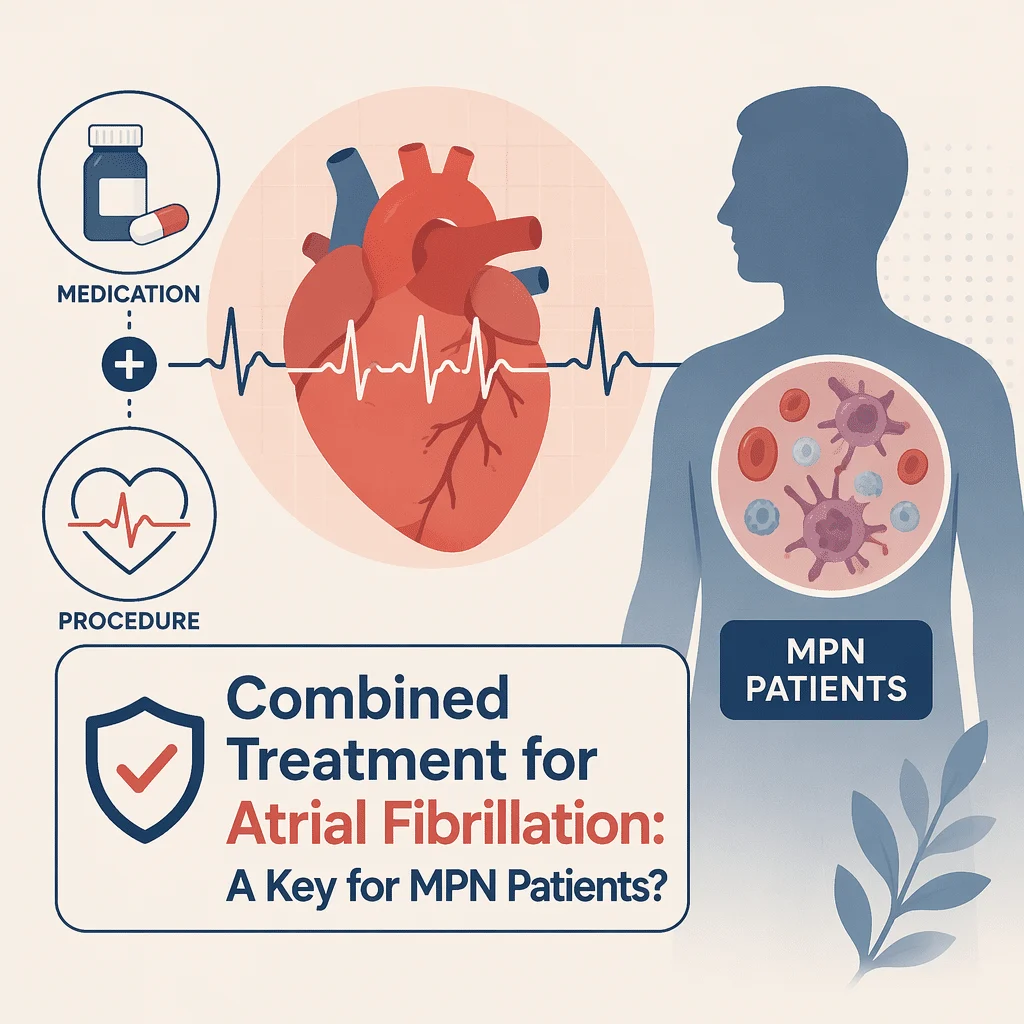
Leven met zowel atriumfibrilleren als een MPN vraagt van uw behandelteam een zorgvuldige afweging. Atriumfibrilleren (AFib) is een onregelmatig hartritme waarbij bloed in het hart kan ophopen en stolsels kan vormen, waardoor bloedverdunners doorgaans noodzakelijk zijn. Een myeloproliferatieve neoplasie (MPN) — een groep bloedkankers waaronder polycythemia vera, essentiële trombocytemie en myelofibrose — maakt het bloed al gevoeliger voor stolselvorming, en soms ook gevoeliger voor bloedingen. Omdat de behandeling van de ene aandoening de risico's van de andere beïnvloedt, moet het behandelplan op u als geheel persoon zijn afgestemd, niet op twee afzonderlijke diagnoses. In dit artikel leest u hoe artsen stolselpreventie voor het hartritme combineren met een behandeling die een overactief beenmerg tot rust brengt, welke bloedtests daarbij als leidraad dienen, en wat recent onderzoek suggereert over de veiligste aanpak.
Wat atriumfibrilleren en MPN betekenen wanneer ze samen voorkomen
Atriumfibrilleren is de meest voorkomende aanhoudende hartritmestoornis. In plaats van regelmatig te kloppen, trillen de bovenste hartkamers, waardoor bloed kan stagneren en stolsels kan vormen. Als een stolsel naar de hersenen reist, kan het een beroerteveroorzaken, en daarom staan ritmecontrole en stolselpreventie centraal in de behandeling van AFib.
Een MPN is anders: het begint in het beenmerg, het sponsachtige weefsel dat bloedcellen aanmaakt. Bij een MPN maakt het beenmerg te veel rode bloedcellen (polycythemia vera), te veel bloedplaatjes (essentiële trombocytemie), of vult het geleidelijk op met littekenweefsel (myelofibrose). Dikker bloed en hogere bloedplaatjesaantallen vergroten de kans op stolsels, en dezelfde ziekte kan de normale bloedstolling zodanig verstoren dat er bloedingen ontstaan.
Wanneer deze twee aandoeningen samengaan, moet de gebruikelijke aanpak bij atriumfibrilleren worden bijgesteld. Een bloedverdunner die bij iemand met alleen atriumfibrilleren vanzelfsprekend zou zijn, moet worden afgewogen tegen een MPN die het bloed enerzijds al naar stolling drijft en anderzijds soms juist naar bloeding. Artsen omschrijven dit als balanceren op een koord tussen te veel stolling en te veel bloeding.
Waarom een MPN de balans naar trombose verschuift — en soms naar bloeding
De meeste MPN's worden veroorzaakt door een verandering in een gen genaamd JAK2 (de JAK2 V617F-mutatie is de meest voorkomende), of in verwante genen zoals CALR of MPL. Door deze verandering gedraagt het beenmerg zich alsof het voortdurend de opdracht krijgt om te groeien, waardoor het te veel bloedcellen aanmaakt. Extra rode bloedcellen maken het bloed dikker; extra bloedplaatjes — de celfragmenten die stolsels vormen — maken het nog kleveriger.
Wat uw bloedwaarden onthullen
Daarom houdt uw hematoloog uw waarden zo nauwlettend in de gaten. Bij elk bezoek bekijkt uw behandelteam een volledig bloedbeeld om te zien of rode bloedcellen, witte bloedcellen en bloedplaatjes binnen de streefwaarden vallen. Witte bloedcellen zijn ook belangrijk: onderzoekers hebben een verhoogd aantal witte bloedcellen in verband gebracht met een hogere kans op zowel trombose als bloedingen, dus uw arts kan ook een hoog neutrofielenaantalbijhouden. Grote, pas aangemaakte bloedplaatjes kunnen de bloedstolling beïnvloeden — een patroon dat wordt weergegeven door het gemiddeld bloedplaatjesvolume; onze gids legt uit wat een hoog MPV-resultaat.
Waarom bloeding ook een aandachtspunt is
Het lijkt tegenstrijdig dat een ziekte waarbij er te veel bloedcellen zijn ook bloedingen kan veroorzaken, maar een zeer hoog aantal bloedplaatjes kan een stollingseiwit genaamd von Willebrand-factor opslokken, waardoor er minder van overblijft om normaal te stollen. Dat is één reden waarom artsen bij een MPN niet zomaar bloedverdunners opstapelen. Het doel is voldoende tromboseprofylaxe om de hersenen en het hart te beschermen, zonder u in gevaarlijke bloedingen te laten belanden.
Hoe artsen trombose bij atriumfibrilleren voorkomen
Bij atriumfibrilleren (AFib) is het belangrijkste doel van de behandeling het voorkomen van stolsels in het hart. Artsen schatten uw beroerterisico in met eenvoudige scoringstools die factoren meewegen zoals leeftijd, diabetes en eerder doorgemaakte trombose. Veel mensen met AFib moeten ook hoge bloeddrukonder controle houden, omdat dit zowel het risico op een beroerte als op bloedingen vergroot.
Eén nuance is hier van belang. De beroerterisicoscores die artsen gebruiken voor AFib zijn ontwikkeld voor de algemene bevolking, niet voor mensen bij wie het bloed al geneigd is tot stolling. Een MPN kan een extra risico toevoegen dat deze tools niet volledig in kaart brengen, waardoor specialisten de score vaak afwegen tegen uw type MPN, uw voorgeschiedenis van trombose en uw huidige bloedwaarden. Het doel is een beslissing die uw volledige risicoprofiel weerspiegelt, en niet slechts één getal.
Anticoagulantia: bloedverdunners voor het hart
De geneesmiddelen die beroertes door AFib voorkomen, zijn anticoagulantia, en er worden twee groepen gebruikt. Vitamine K-antagonisten, voornamelijk warfarine, verlagen verschillende stollingsfactoren die de lever aanmaakt met behulp van vitamine K; ze werken goed, maar vereisen regelmatige bloedtests om binnen een veilig bereik te blijven. Om warfarine te bewaken, herhalen klinieken een test die de protrombinetijd en INR rapporteert, en veel patiënten willen hun uitslagen vitamine K bloedtest. De nieuwere familie, directe orale anticoagulantia (DOAC's), blokkeert één enkel stollingseiwit — de meeste blokkeren factor Xa — en vereist doorgaans geen routinematige INR-controles.
Welke rol aspirine speelt
Aspirine is een trombocytenaggregatieremmer, geen anticoagulans: het maakt bloedplaatjes minder kleverig in plaats van stollingsproteïnen te blokkeren. Bij veel MPN's is lage-dosis aspirine een hoeksteen die het risico op bloedstolsels in kleine bloedvaten verlaagt. Bij boezemfibrilleren is aspirine alleen echter niet voldoende om de grotere stolsels te voorkomen die beroertes veroorzaken. De beslissing of aspirine, een anticoagulans of beide gebruikt moet worden — en in welke dosering — is een van de moeilijkste afwegingen bij gecombineerde behandeling, en nooit iets om zelf te beslissen.
Tegelijkertijd de MPN behandelen
Het voorkomen van hartgerelateerde bloedstolsels is slechts de helft van het plan. De andere helft is het kalmeren van de MPN zelf, zodat het beenmerg minder cellen aanmaakt die het bloed verdikken. Artsen noemen dit cytoreductie.
Het gebruikelijke eerstelijns cytoreductieve middel is hydroxycarbamide (hydroxyurea), dat het beenmerg vertraagt door een enzym te blokkeren dat cellen nodig hebben om hun DNA te kopiëren. Interferon is een andere optie, vaak gekozen voor jongere patiënten, en een JAK-remmer zoals ruxolitinib kan helpen wanneer het groeisignaal aangestuurd door JAK2 moet worden teruggedraaid, met name bij myelofibrose of moeilijk te beheersen polycythaemia vera.
Bij polycythaemia vera gebruiken artsen ook flebotomie — het afnemen van een eenheid bloed, vergelijkbaar met een bloeddonatie — om de hematocriet te verlagen. Aangetoond is dat het houden van de hematocriet onder de 45 procent de kans op stolsels verlaagt. Herhaalde flebotomie verlaagt geleidelijk het ijzergehalte, dus uw arts kan een ijzerstatus-panel in de gaten houden.
Het gecombineerde behandelplan opstellen
Alles samengenomen bestaat een plan voor boezemfibrilleren en MPN doorgaans uit drie onderdelen: hartgerelateerde bloedstolsels voorkomen, het beenmerg kalmeren en nauwlettend letten op bloedingen. De exacte combinatie hangt af van uw MPN-type, uw beroerterisico, uw bloedplaatjesaantal en uw nier- en leverfunctie. De onderstaande tabel laat in begrijpelijke termen zien wat elk onderdeel van het plan doet.
| Behandeling | Wat het in gewone taal doet | Veelvoorkomende voorbeelden | Wat uw behandelteam in de gaten houdt |
|---|---|---|---|
| Lage-dosis aspirine (trombocytenaggregatieremmer) | Maakt bloedplaatjes minder kleverig zodat ze minder samenklonteren | Aspirine 81 mg | Tekenen van bloeding, maagklachten |
| Direct oraal anticoagulans (DOAC) | Blokkeert één enkel stollingseiwit (factor Xa) om de stolling te vertragen | Apixaban, rivaroxaban, edoxaban | Nierfunctie, bloeding; geen routinematige INR |
| Warfarine (vitamine K-antagonist) | Verlaagt meerdere vitamine K-afhankelijke stollingsfactoren | Warfarine | Regelmatige protrombinetijd- en INR-bepalingen |
| Cytoreductie | Vertraagt een overactief beenmerg zodat het minder bloedcellen aanmaakt | Hydroxycarbamide, interferon, ruxolitinib | Volledig bloedbeeld, bijwerkingen |
| Flebotomie (voornamelijk bij polycythaemia vera) | Verwijdert bloed om de hematocriet te verlagen | Streefhematocriet onder 45% | Hematocriet, ijzerwaarden |
Geen twee behandelplannen zien er precies hetzelfde uit. Iemand met essentiële trombocytemie en een laag beroertescore kan goed reageren op cytoreductie in combinatie met laaggedoseerd aspirine, terwijl iemand met polycytemie vera en een eerdere beroerte mogelijk een volledige antistolling nodig heeft naast aderlating en hydroxycarbamide. De combinatie wordt gezamenlijk gekozen, bij voorkeur door een hematoloog en een cardioloog die samen werken.
Uw plan is ook niet voor het leven vastgelegd. Bloedplaatjes- en bloedtellingen veranderen naarmate de MPN op de behandeling reageert, de nierfunctie kan met de leeftijd veranderen, en een nieuwe trombose of bloedingsincident kan aanleiding geven tot heroverweging. Verwacht dat uw behandelteam het evenwicht bij regelmatige controles opnieuw bekijkt, waarbij doses worden aangepast of medicijnen worden gewisseld naarmate uw waarden en klachten veranderen. Een actuele lijst van uw medicijnen meenemen naar elk consult maakt die aanpassingen veiliger.
Bloedonderzoeken die uw gecombineerde behandeling sturen
Omdat het plan een evenwichtsoefening is, wordt er sterk geleund op laboratoriumuitslagen. Een aantal onderzoeken komt steeds opnieuw aan bod.
- Volledig bloedbeeld: volgt de rode bloedcellen, het hematocriet, de witte bloedcellen en de bloedplaatjes, zodat uw behandelteam kan beoordelen of de MPN onder controle is.
- Bloedplaatjesaantal en gemiddeld bloedplaatjesvolume: zeer hoge of zeer actieve bloedplaatjes verhogen zowel het risico op trombose als op bloedingen.
- JAK2 V617F-test: bevestigt de meest voorkomende oorzaak van MPN en helpt uw tromboserisico te verklaren.
- Protrombinetijd en INR: houden warfarine binnen een veilig bereik en signaleren bloedingsneiging.
- Nier- en leverpanels: sturen de dosering van DOAC's, omdat deze organen de medicijnen afbreken.
Om te zien hoe de stollingstesten samenhangen, legt onze gids uit een stollingsonderzoek. Als klachten op de borst zorgen baren over het hart, kunnen clinici ook een hartmarkerspanelaanvragen. En omdat een MPN een bloedkanker is, kunnen dezelfde waarden die het bewaken ook andere beenmergproblemen signaleren; ons team legt uit hoe artsen een bloedtest voor leukemie.
Wanneer u dringend medische hulp moet zoeken
Gecombineerde behandeling verschuift uw risico tegelijkertijd in twee richtingen, dus het is nuttig om de waarschuwingssignalen te kennen die snel handelen vereisen. Bel onmiddellijk de hulpdiensten als u tekenen van een beroerte of ernstige bloeding opmerkt.
- Tekenen van een beroerte (onthoud FAST): hangende mondhoek, zwakte in de arm, moeite met spreken — tijd om hulp te bellen.
- Plotselinge hevige hoofdpijn, verwardheid of plotseling verlies van gezichtsvermogen.
- Bloeding die niet stopt, zwarte of bloederige ontlasting, bloed braken of bloed ophoesten.
- Ongewone, uitgebreide blauwe plekken of kleine rode stipjes op de huid.
- Nieuwe kortademigheid, pijn op de borst, of een warme, gezwollen, pijnlijke been, wat kan wijzen op een trombose.
Houd tussen de afspraken door alle bloedonderzoekafspraken na, neem medicijnen precies in zoals voorgeschreven, en begin of stop nooit met aspirine of een bloedverdunner zonder eerst met uw behandelteam te overleggen.
Recente wetenschappelijke ontwikkelingen
Het onderzoek naar atriumfibrilleren en MPN gaat snel vooruit, al is het meeste nog gebaseerd op het terugkijken in patiëntendossiers in plaats van grote vergelijkende studies. Dit is wat recente onderzoeken in begrijpelijke taal suggereren.
Atriumfibrilleren lijkt de uitkomsten bij MPN te verslechteren
Een groot onderzoek uit de praktijk, gepubliceerd in 2026, analyseerde meer dan 2.600 mensen met een MPN. Degenen die ook boezemfibrilleren hadden, kregen vaker trombose — met name in de slagaders — en hadden een kortere overleving dan mensen zonder boezemfibrilleren. Opvallend genoeg gebruikte meer dan een derde van deze patiënten geen enkele bloedplaatjesremmer zoals aspirine. Wat dit voor jou betekent: als je beide aandoeningen hebt, is het de moeite waard om je behandelteam te vragen of je trombosepreventiepan volledig is, want het trombosepatroon bij MPN kan afwijken van gewoon boezemfibrilleren.
Uw genen en ontsteking kunnen het risico op atriumfibrilleren verhogen
Een ander onderzoek, uit 2025, ontdekte dat bepaalde verworven genveranderingen in het bloed — met name een verandering die TET2 wordt genoemd — samenhingen met een ongeveer drievoudig hogere kans op het ontwikkelen van boezemfibrilleren, en dat boezemfibrilleren op zijn beurt het risico op een beroerte verhoogde. Ontsteking, gesignaleerd door een boodschapperstof genaamd IL-1β (een eiwit dat ontsteking aanwakkert), leek onderdeel te zijn van dit verband. Wat dit voor jou betekent: je MPN zelf kan je hart in de richting van boezemfibrilleren duwen, dus het onder controle houden van de ziekte en de bijbehorende ontsteking is ook een manier om je hart te beschermen.
Nieuwere pillen versus oudere
Een systematische review die meerdere onderzoeken samenvoegde, stelde vast dat directe orale anticoagulantia steeds vaker worden gebruikt bij MPN in plaats van warfarine, voornamelijk omdat ze gemakkelijker in te nemen zijn. Ze lijken te werken, maar het beeld is genuanceerd. Eén analyse op basis van praktijkgegevens toonde aan dat bloedingen iets vaker voorkwamen dan verwacht, en een andere liet zien dat het combineren van een DOAC op volledige dosis met aspirine het bloedingsrisico verhoogde, terwijl een lage dosis het bloedingsrisico verlaagde maar meer slagadertrombose toeliet. Wat dit voor jou betekent: de juiste bloedverdunner en dosering worden afgestemd op jouw situatie, en het toevoegen van aspirine is een medische beslissing, geen doe-het-zelf-keuze.
Klinische studies onderzoeken de beste aanpak
Artsen voeren momenteel klinische onderzoeken uit om deze vragen goed te beantwoorden. Een grote fase 3-studie genaamd AVAJAK vergelijkt directe orale anticoagulantia met laaggedoseerde aspirine voor de preventie van trombose bij mensen met JAK2-positieve MPN, en een eerder pilotstudie testte apixaban versus aspirine in dezelfde groep. Wat dit voor jou betekent: er komt duidelijkere richtlijnen aan, en als je geïnteresseerd bent, kun je je hematoloog vragen of deelname aan een studie een optie is.
Glossarium
| Termijn | Definitie |
|---|---|
| Boezemfibrilleren (atriumfibrilleren) | Een onregelmatig, vaak snel hartritme waarbij bloed kan ophopen en stolsels kan vormen. |
| Myeloproliferatieve neoplasie (MPN) | Een groep bloedkankers waarbij het beenmerg te veel bloedcellen aanmaakt. |
| Polycythemia vera | Een MPN die wordt gekenmerkt door te veel rode bloedcellen en een hoge hematocriet. |
| Essentiële trombocytemie | Een MPN die wordt gekenmerkt door te veel bloedplaatjes. |
| Myelofibrose | Een MPN waarbij littekenweefsel geleidelijk ophoopt in het beenmerg. |
| JAK2 V617F | De meest voorkomende genverandering die MPNs veroorzaakt, vastgesteld via een bloedtest. |
| Antistollingsmiddel | Een bloedverdunner die stollingsproteïnen blokkeert, zoals warfarine of een DOAC. |
| Trombocytenaggregatieremmer | Een geneesmiddel zoals aspirine dat bloedplaatjes minder kleverig maakt. |
| Cytoreductie | Behandeling die overgeproduceerde bloedcellen verlaagt, zoals hydroxyureum. |
| Hematocriet | Het aandeel van het bloed dat bestaat uit rode bloedcellen; bij polycythemia vera gehouden onder 45%. |
Veelgestelde vragen
Is het veilig om bloedverdunners te nemen als ik een MPN heb?
Over het algemeen wel, wanneer een arts oordeelt dat het risico op trombose zwaarder weegt dan het bloedingsrisico, maar de keuze wordt per persoon bepaald. Mensen met een MPN kunnen meer bloeden dan gemiddeld, dus het type en de dosis bloedverdunner worden zorgvuldig gekozen en regelmatig herzien. Begin, stop of wijzig nooit zelf een bloedverdunner.
Welk bloedverdunningsmiddel is het beste bij atriumfibrilleren met een MPN?
Er is nog geen eenduidige beste optie. Warfarine heeft de langste staat van dienst; directe orale anticoagulantia zijn gemakkelijker in te nemen en worden steeds vaker gebruikt, hoewel het bewijs bij MPN nog groeiende is. Uw hematoloog en cardioloog maken een keuze op basis van uw MPN-type, nier- en leverfunctie, andere geneesmiddelen en bloedingsrisico.
Kan ik aspirine en een anticoagulans tegelijk nemen?
Soms wel, maar alleen onder nauw toezicht. Aspirine in combinatie met een volledige dosis anticoagulans verhoogt het bloedingsrisico, dus artsen reserveren deze combinatie voor mensen die beide echt nodig hebben, en passen de dosis vaak aan. Dit is een beslissing voor uw behandelteam, niet iets dat u zelf kunt toevoegen.
Verlaagt de behandeling van mijn MPN het risico op atriumfibrilleren?
Het onder controle houden van de MPN — met cytoreductie en, bij polycythemia vera, aderlating — verlaagt het algehele tromboserisico en vermindert de ontsteking die kan bijdragen aan hartproblemen. Het geneest atriumfibrilleren niet, maar een goed gecontroleerde MPN maakt het totaalplaatje veiliger.
Welke bloedonderzoeken heb ik nodig?
Verwacht een regelmatig volledig bloedbeeld om uw beenmerg te volgen, een bloedplaatjestelling en vaak een JAK2-test bij diagnose. Als u warfarine gebruikt, zijn controles van de protrombinetijd en INR nodig. Nier- en levertests helpen bij het bepalen van de dosis van een direct oraal anticoagulans.
Moet ik meer dan één specialist raadplegen?
Meestal wel. Gecombineerde zorg werkt het beste wanneer een hematoloog voor de MPN en een cardioloog voor het hartritme en de beroertepreventie samenwerken. Uw huisarts helpt het plan vaak samen te brengen en volgt u dagelijks op.
Bronnen
- National Heart, Lung, and Blood Institute — Atrial Fibrillation — nhlbi.nih.gov
- National Cancer Institute — Myeloproliferative Neoplasms Treatment (PDQ), Patient Version — cancer.gov
- Cleveland Clinic — Polycythemia Vera — clevelandclinic.org
- Demska O, et al. — Impact of Atrial Fibrillation on Thrombotic Complications in Myeloproliferative Neoplasms: Real-World Analysis — Thrombosis and Haemostasis, 2026 — doi.org/10.1055/a-2869-7105
- Teng G, et al. — TET2-mutaties bij myeloproliferatieve neoplasmata: bemiddeling van atriumfibrilleren door interleukine-1β en impact op het beroerterisico — Journal of Thrombosis and Haemostasis, 2025 — doi.org/10.1016/j.jtha.2025.09.015
- Baysal M, et al. — Huidig bewijs over het gebruik van directe orale anticoagulantia bij patiënten met een myeloproliferatief neoplasma: een systematische review — Expert Review of Hematology, 2023 — doi.org/10.1080/17474086.2023.2174515
- Herbreteau L, et al. — Voordelen en valkuilen van directe orale anticoagulantia bij zeer hoogrisico myeloproliferatieve neoplasmata — Thrombosis Research, 2022 — doi.org/10.1016/j.thromres.2022.05.015
- How J, et al. — Praktijkpatronen en uitkomsten van het gebruik van directe orale anticoagulantia bij patiënten met een myeloproliferatief neoplasma — Blood Cancer Journal, 2021 — doi.org/10.1038/s41408-021-00566-5
- Tefferi A, Barbui T. — Polycythemia vera en essentiële trombocytemie: update 2021 over diagnose, risicostratificatie en behandeling — American Journal of Hematology, 2020 — doi.org/10.1002/ajh.26008
- ClinicalTrials.gov — AVAJAK: Directe orale anticoagulantia versus aspirine voor primaire preventie bij JAK2 V617F-positieve myeloproliferatieve neoplasmata (NCT05198960) — clinicaltrials.gov/study/NCT05198960
- ClinicalTrials.gov — Tromboprofylaxe met apixaban bij JAK2-positieve patiënten met een myeloproliferatief neoplasma (NCT04243122) — clinicaltrials.gov/study/NCT04243122
Verder lezen
- Volledig bloedbeeld (CBC): Hoe lees je je resultaten?
- Stollingsonderzoek uitgelegd: PT, PTT, INR en D-dimeer
- Beroerte (cerebrovasculair accident): Inzicht en handelen
- Bloedtest voor leukemie: symptomen, diagnose en het laatste onderzoek.
- Hartmarkerspanel: Troponine, BNP en CK uitgelegd
Begrijp uw laboratoriumresultaten met AI DiagMe.
Als u naast een myeloproliferatief neoplasma ook atriumfibrilleren heeft, kunnen uw uitslagen aanvoelen als een muur van cijfers. AI DiagMe helpt u grip te krijgen op veelvoorkomende onderzoeken zoals uw volledig bloedbeeld, hematocriet, trombocytenaantal en INR, en legt elke waarde uit in begrijpelijke taal. Het is bedoeld om u te helpen uw uitslagen te begrijpen en betere vragen voor te bereiden voor uw hematoloog en cardioloog — het stelt geen diagnose en vervangt uw arts niet.
Ontvang binnen enkele minuten een interpretatie van uw resultaten.