





















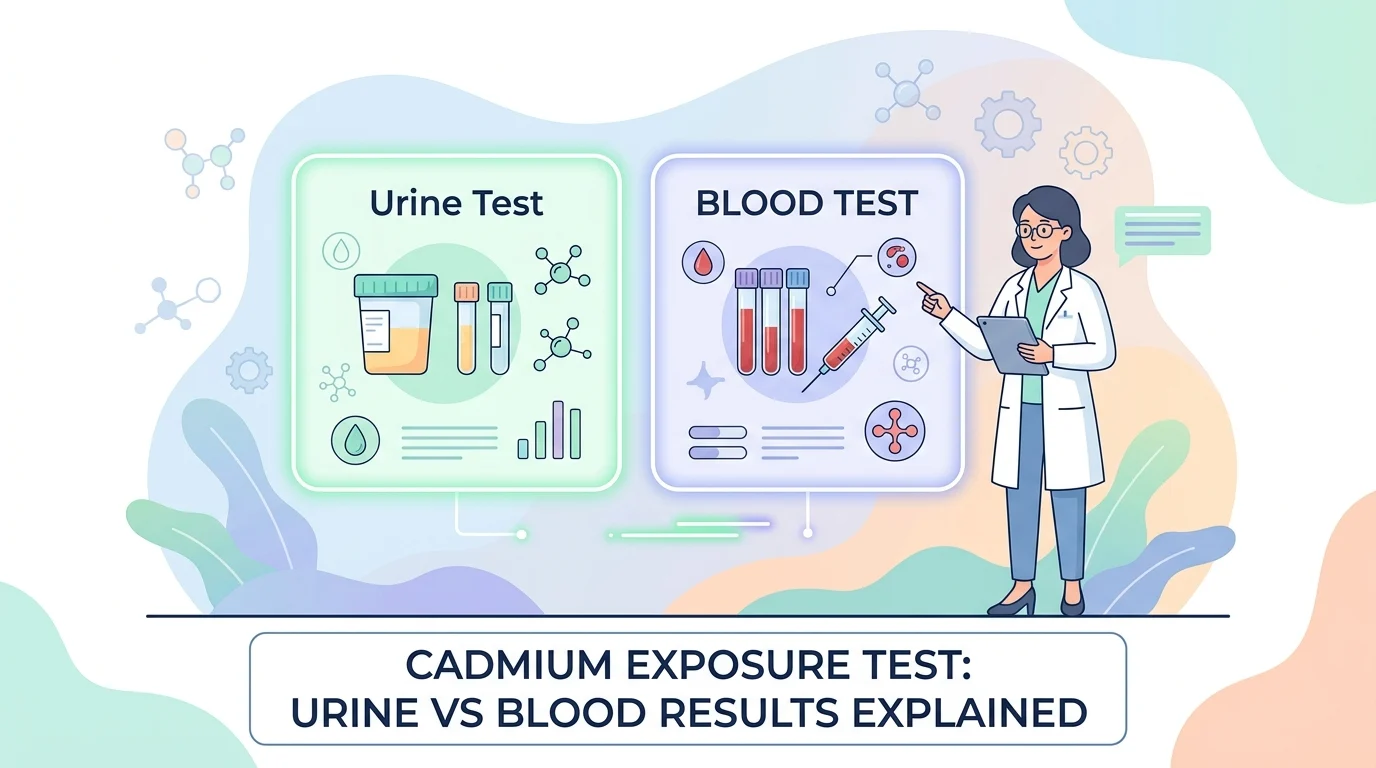
A cadmium exposure test measures how much of this toxic metal is in your urine or blood. It is in the news because France began reimbursing cadmium screening on June 16, 2026, for certain people living on polluted land. In the United States, doctors do not routinely offer the test, so many readers wonder whether they would ever need one.
This article explains who might be tested, how urine and blood results differ, what the newest research says about the kidneys, and when to talk to a doctor. A single cadmium number never tells the whole story, so it is always read alongside your history, smoking status, and kidney function.
What a cadmium exposure test measures
Cadmium is a metal found in the earth’s crust. People meet it through food, cigarette smoke, polluted air or soil, and some jobs. According to the federal ATSDR, nonsmokers are mostly exposed through food such as leafy greens, potatoes, grains, shellfish, and organ meats. Smokers and people who live with smokers take in more, because tobacco smoke contains cadmium.
The body clears cadmium very slowly. France’s public health portal Santé.fr states that it takes 10 to 30 years for half of it to leave the body. That slow clearance is why long-term exposure, even at low levels, can matter for the kidneys and bones.
Urine or blood: which cadmium test is used?
Urine cadmium shows long-term buildup
The ATSDR says urine cadmium is the best estimate of the total amount of cadmium in your body. Labs usually correct the result for urine creatinine, which accounts for how dilute your urine is. If you want to see how that correction works, it helps to read a guide to urine creatinine.
Blood cadmium shows recent exposure
Blood cadmium reflects more recent exposure, so a doctor may add it when a recent source is suspected. Feces can also be tested, but that reflects only recent oral intake. The ATSDR notes that none of these tests can predict whether you will develop health problems.
| 샘플 | 반영하는 내용 | 주요 활용 목적 |
|---|---|---|
| 소변 | Long-term buildup in the body | First-line test |
| 혈액 | More recent exposure | Add-on when a recent source is suspected |
| Feces | Recent oral intake | Rarely used |
Who may need a cadmium exposure test?
Testing is not a routine screen for everyone. A doctor may consider it for people who work around cadmium, who live near facilities that make or use it, or who have a long smoking history. In France, the reimbursed pathway is limited to people potentially overexposed because of where they live (on land recognized as polluted) and to people followed for chronic cadmium poisoning, with a prescription. Without a prescription, the urine test can still be done there but is not reimbursed.
Reading a urine cadmium result
Labs compare your number with their own reference values, and your doctor interprets it. For context, the French food-safety agency Anses uses a critical value of 0.5 micrograms of cadmium per gram of creatinine in urine. In the French Esteban survey of 2014 to 2016, 47 percent of adults and 18 percent of children were above it, according to Santé.fr. That value is a French public health benchmark, not a diagnosis.
When a result is high, French guidance reported by the lab group Biogroup is to repeat the urine test a few months later before going further with a kidney workup. Kidney follow-up usually relies on creatinine and urine albumin, so you may also want to review the urine albumin-to-creatinine ratio test.
최신 과학적 발전
Based on articles retrieved from PubMed, two recent systematic reviews help explain the kidney link.
A 2023 review in Science of the Total Environment pooled 31 studies and about 195,000 people. It found that higher cadmium exposure goes with lower kidney filtration, and that the link was clearer for blood cadmium than for urine cadmium. Most studies were observational, so they show an association, not proof of cause, and the authors call for better prospective studies (DOI).
A 2025 review in Chemical Research in Toxicology analyzed 30 studies of exposed workers, about 1,980 people, compared with roughly 1,290 unexposed workers. Early markers of damage to the kidney’s filtering tubes, such as beta-2 microglobulin and retinol-binding protein in urine, changed even when creatinine and urine albumin looked acceptable. Results differed a lot between studies (DOI).
What this means for you: a normal creatinine does not always rule out early kidney strain after long exposure. If you are in a higher-risk situation, discuss it with your doctor instead of relying on one number. For the general population, these findings are still preliminary.
의사와 상담해야 할 때
Bring it up if you work with cadmium, live close to an industrial site, have smoked for many years, or have unexplained bone fractures or changes in kidney tests. Seek urgent care for sudden breathing trouble after breathing metal fumes. For poisoning questions in the United States, the Poison Control Center number listed by the National Library of Medicine’s ToxTown is 1-800-222-1222. To put kidney numbers in context, a reference such as a chart of normal blood test ranges 가이드를 참고하시면 도움이 됩니다.
용어 설명
- Cadmium: a heavy metal found in soil, tobacco smoke, and some foods.
- Urine cadmium: the amount of cadmium measured in a urine sample.
- Blood cadmium: the amount of cadmium measured in blood.
- Creatinine correction: adjusting a urine result for how concentrated the urine is.
- eGFR (추정 사구체여과율): 신장이 혈액을 얼마나 잘 걸러내는지를 추정하는 수치입니다.
자주 묻는 질문
Is cadmium dangerous?
Long-term exposure can build up in the kidneys and is linked to fragile bones. The National Toxicology Program lists cadmium as a known human carcinogen, mainly through inhalation.
How do people get exposed to cadmium?
Mainly through food, cigarette smoke, and some workplaces or polluted areas.
Can I get a cadmium test without a prescription?
Availability varies by country and lab. In the United States, the ATSDR notes that doctors’ offices do not routinely offer it, so start with a conversation with your clinician.
Can the test tell me if I will get sick?
No. The ATSDR states that cadmium tests cannot predict whether health problems will develop.
How can I lower my exposure?
Quitting smoking and avoiding secondhand smoke are the steps highlighted by NLM’s ToxTown. Santé.fr also advises varying foods and limiting organ meats.
출처
- ATSDR (CDC), ToxFAQs: Cadmium
- National Library of Medicine, ToxTown: Cadmium
- National Toxicology Program, Report on Carcinogens: Cadmium and Cadmium Compounds
- Santé.fr, Cadmium et alimentation (updated September 10, 2026)
- Biogroup, Dépistage du cadmium (October 13, 2026)
- PubMed에 따르면: Doccioli et al., Science of the Total Environment, 2023
- PubMed에 따르면: Kalahasthi et al., Chemical Research in Toxicology, 2025
관련 글 더 보기
AI DiagMe로 내 혈액 검사 결과 직접 이해하기
AI DiagMe로 내 검사 결과 이해하기: upload your report and get a clear explanation reviewed by a committee of physicians.