




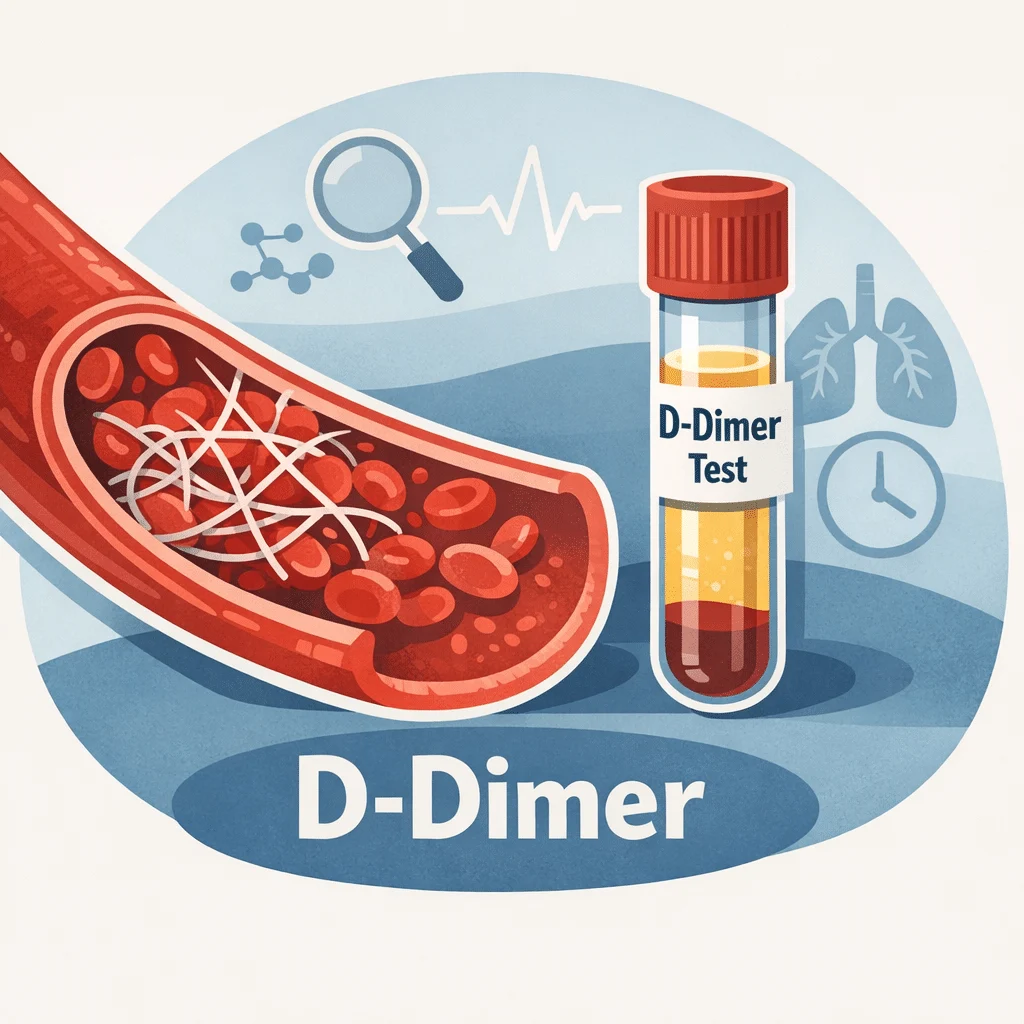
D-dimeeri-testi mittaa pientä proteiinikatkelmaa, joka ilmestyy vereesi, kun hyytymä hajoaa. Lääkärit määräävät sen useimmiten sulkeakseen pois vaarallisen hyytymän – kuten syvän laskimotukoksen (DVT) tai keuhkoembolian (PE) – yhdistettynä kliiniseen riskiarvioon. Tässä oppaassa selitetään, mitä testi mittaa, miten lukea oma arvosi viitearvoon nähden, miksi ikäkorjatut raja-arvot ovat tärkeitä ja mitkä muut tilat voivat nostaa tätä merkkiainetta ilman hyytymää. Löydät myös selkokielisen yhteenvedon uusimmasta tutkimustiedosta, sanaston sekä selkeän ohjeen siitä, milloin tulos vaatii nopeaa lääkärikäyntiä.
Mikä on D-dimeeri-testi?
D-dimeeri on jäännöskappale, joka syntyy, kun elimistösi hajottaa veritulpan. Terveessä veressä sitä ei esiinny merkittäviä määriä, ellei kehossasi jossain tapahdu aktiivisesti hyytymistä ja hyytymän hajoamista. Kun hyytymä muodostuu, proteiini fibriini rakentaa verkon, joka pitää sen koossa. Kun vamma paranee, plasmiini-niminen entsyymi liuottaa tämän verkon, ja jäänteisiin kuuluu D-dimeeri-kappaleita, jotka kiertävät veressä, kunnes munuaiset ja maksa poistavat ne.
D-dimeeri-testi havaitsee nämä kappaleet tavallisesta verinäytteestä. Koska kappale ilmestyy vain silloin, kun hyytymää muodostuu ja hajotetaan, kohonnut arvo kertoo lääkärille, että hyytymistoimintaa tapahtuu jossakin. Se ei kerro missä eikä miksi – näihin vastauksiin tarvitaan lisätutkimuksia.
Miksi testi on tärkeä käytännön lääketieteessä
Tämän merkkiaineen tärkein vahvuus on se, mitä normaali tulos sulkee pois – ei se, mitä korkea tulos vahvistaa. Kun lääkäri arvioi oireidesi ja esitietojesi perusteella, että hyytymä on epätodennäköinen, normaali D-dimeeri-arvo auttaa poissulkemaan DVT:n tai PE:n ilman kuvantamistutkimuksia. Tämä yhdistelmä – kliininen arvio ja verikoe – tekee D-dimeeristä niin hyödyllisen päivystys- ja avohoidossa, sillä se säästää monet ihmiset tarpeettomalta TT-kuvaukselta tai ultraäänitutkimukselta.
D-dimeerin testitulosten lukeminen
Laboratorioraporttisi sisältää luvun, yksikön ja viitevälin. Tyypillinen tulos näyttää tältä: D-dimeeri 320 ng/mL FEU (viiteväli: alle 500 ng/mL FEU). FEU tarkoittaa fibrinogeenivastaavia yksiköitä (fibrinogen equivalent units) – yksi kahdesta yleisestä tavasta, joilla laboratoriot ilmoittavat tämän testin tuloksen. Jotkut laboratoriot käyttävät sen sijaan D-dimeeriyksiköitä (DDU), joilla on eri numeerinen raja-arvo. Jos vertaat tulostasi muualta löytämääsi tietoon, tarkista aina, mitä yksikköä oma laboratoriosi on käyttänyt.
Useimmat aikuisten laboratoriot käyttävät vakiorajana noin 500 ng/mL FEU. Tätä raja-arvoa alempaa tulosta kutsutaan yleensä negatiiviseksi, mikä tarkoittaa, että hyytymäaktiivisuutta ei havaittu merkittävällä tasolla. Raja-arvolla tai sen yläpuolella olevaa tulosta kutsutaan positiiviseksi, jolloin lääkärisi tutkii asiaa tarkemmin sen sijaan, että diagnosoisi hyytymän suoraan.
Miksi ikä muuttaa tilannetta
D-dimeeri nousee luonnollisesti iän myötä, jopa täysin terveillä ihmisillä. Saman kiinteän raja-arvon käyttäminen sekä 30-vuotiaalle että 80-vuotiaalle tarkoittaa, että vanhemmat aikuiset merkitään "positiivisiksi" paljon useammin ilman, että heillä todella on hyytymä. Tämän korjaamiseksi monet laboratoriot ja päivystysosastot käyttävät nykyään ikäkorjattua raja-arvoa yli 50-vuotiaille potilaille: kerro ikäsi vuosina kymmenellä saadaksesi henkilökohtaisen raja-arvosi yksikössä ng/mL FEU. Esimerkiksi 70-vuotiaalla raja-arvo olisi noin 700 ng/mL tavanomaisen 500:n sijaan.
Tätä korjausta on tutkittu suurissa potilasryhmissä, ja useat ammattijärjestöt tukevat sitä nykyään, vaikka FDA ei ole virallisesti hyväksynyt sitä merkintämuutoksena. Sen tarkoitus on kapea ja tarkka: se parantaa sitä, kuinka luotettavasti normaali tulos sulkee pois hyytymän vanhemmilla aikuisilla, ilman että todelliset hyytymät jäisivät merkittävässä määrin havaitsematta. Se ei ole yleinen "normaali viitealue iälläsi" -taulukko – se koskee ainoastaan tuloksen tulkintaa silloin, kun sitä käytetään mahdollisen syvälaskimotukoksen tai keuhkoembolian tutkimiseen.
Yksinkertainen päätöspolku tuloksesi lukemiseen
Käytä tätä järjestystä lähtökohtana, ei lääketieteellisen neuvon korvikkeena.
| Vaihe | Mitä tarkistaa |
|---|---|
| 1. Tarkista yksikkö | Varmista, ilmoittaako laboratoriosi tuloksen yksikössä ng/mL FEU vai DDU – se on merkitty tuloksesi viereen |
| 2. Vertaa ilmoitettuun viitealueeseen | Käytä oman laboratorioraporttisi viitealuetta, älä muualta peräisin olevaa lukua |
| 3. Tarkista ikäsi | Jos olet yli 50-vuotias, kysy, sovelletaanko ikäkorjattua raja-arvoa (ikä x 10 ng/mL) |
| 4. Huomioi viimeaikainen tilanne | Äskettäinen leikkaus, raskaus, infektio tai pitkä sairaus voi nostaa tulosta itsessään |
| 5. Keskustele lääkärisi kanssa | Vain lääkäri voi yhdistää tämän tuloksen oireisiisi ja riskitekijöihisi |
Miksi D-dimeeri on herkkä mutta ei spesifinen
Testi on herkkä, kun se havaitsee tilan luotettavasti sen ollessa läsnä, ja spesifinen, kun se pysyy luotettavasti normaalina tilan puuttuessa. D-dimeeri on oppikirjaesimerkki erittäin herkästä mutta heikosti spesifisestä merkistä: se nousee lähes aina, kun merkittävä hyytymä muodostuu tai liukenee, mutta monet muutkin tilanteet nostavat sitä, joten positiivinen tulos yksinään todistaa vähän.
Tilanteet ja olosuhteet, jotka voivat nostaa D-dimeerin ilman vaarallista verihyytymää, ovat muun muassa raskaus, äskettäinen leikkaus tai vamma, aktiivinen infektio tai sepsis, syöpä, maksasairaus sekä yksinkertaisesti ikääntyminen. Myös voimakas fyysinen rasitus, kuten maratonin juokseminen, voi aiheuttaa tilapäisen nousun, joka tasaantuu päivän tai kahden kuluessa. Juuri tästä syystä lääkärit yhdistävät testin strukturoituun riskiarvioon – kuten Wells-pisteytyksen, jossa otetaan huomioon esimerkiksi äskettäinen liikkumattomuus, aiemmat hyytymät ja tietyt oireet – sen sijaan että toimittaisiin pelkän lukuarvon perusteella.
D-dimeerin kohoamiseen liittyvät tilanteet
Kohonnut D-dimeeri on merkki jatkotutkimusten tarpeesta, ei diagnoosi. Alla käsitellään tilanteita, joita lääkärit harkitsevat useimmiten.
Syvä laskimotukos (DVT)
Syvä laskimotukos (DVT) on hyytymä, joka muodostuu syvään laskimoon, useimmiten pohkeeseen tai reiteen. Kun elimistö yrittää hajottaa hyytymää, D-dimeerin hajoamistuotteet pääsevät verenkiertoon ja nostavat testitulosta. Tyypillisiä oireita ovat turvotus, kipu, lämpö tai punoitus toisessa jalassa. Jalkojen ultraäänitutkimus on vakiintunut tapa vahvistaa tai sulkea pois DVT, kun epäily on herännyt.
Keuhkoembolia (PE)
Keuhkoembolia syntyy, kun hyytymä – yleensä DVT:nä alkanut – irtoaa ja juuttuu keuhkovaltimon haaraan. Äkillinen hengenahdistus, terävä rintakipu joka pahenee hengittäessä ja nopea sydämen syke ovat tavallisia varoitusmerkkejä. Koska keuhkoembolia voi olla hengenvaarallinen, lääkärit siirtyvät usein nopeasti positiivisesta D-dimeeri-tuloksesta keuhkojen TT-angiografiaan. Yksityiskohtainen oppaamme aiheesta keuhkoembolian oireet ja hoito käsittelee koko diagnostiikan ja hoidon kulun.
Disseminoitunut intravaskulaarinen koagulaatio (DIC)
DIC on harvinainen ja vakava tila, jossa hyytymisjärjestelmä aktivoituu koko kehossa yhtä aikaa muodostaen lukuisia pieniä hyytymää, jotka kuluttavat hyytymistekijöitä nopeammin kuin elimistö pystyy niitä korvaamaan. Tämä lisää paradoksaalisesti sekä hyytymisen että verenvuodon riskiä samanaikaisesti. D-dimeerin arvot ovat DIC:ssä yleensä hyvin korkeat, ja testiä käytetään yhdessä verihiutalemäärän ja muiden hyytymisarvojen kanssa diagnoosin vahvistamiseen ja hoitovasteen seurantaan.
Infektio, tulehdus ja syöpä
Mikä tahansa prosessi, joka aktivoi tulehdusreaktiota, nostaa yleensä myös hyytymisaktiivisuutta – siksi vakavat infektiot, krooniset tulehdukselliset tilat ja jotkin syövät voivat kaikki aiheuttaa kohonneen D-dimeerin ilman, että vaarallinen hyytymä on muodostunut. Näissä tilanteissa lääkäri tarkastelee D-dimeeriä yleensä yhdessä muiden tulehdusmerkkiaineiden kanssa ja tarkistaa C-reaktiivisen proteiinin (CRP) arvot erottamaan tavallinen tulehdus todellisesta hyytymisongelmasta.
Mitä normaali D-dimeeri tarkoittaa
Normaali D-dimeeri on aidosti rauhoittava löydös, kun lääkäri arvioi veritulpan riskin jo valmiiksi matalaksi tai kohtalaiseksi. Tässä tilanteessa testillä on erittäin korkea negatiivinen ennustearvo – se on erinomainen vahvistamaan, että syvä laskimotukos tai keuhkoembolia on epätodennäköinen, ja säästää usein sinut TT-kuvaukselta tai ultraäänitutkimukselta. Tämä on testin ylivoimaisesti tärkein käyttötarkoitus jokapäiväisessä lääketieteessä.
Muutama asia on hyvä tietää. Testi voi toisinaan antaa normaalin tuloksen hyvin varhain tukoksen alussa, ennen kuin hajoamistuotteita on kertynyt riittävästi tason nostamiseksi. Se ei myöskään sulje pois kaikkia verisuoniongelmia, ja jos lääkärillä on vahva kliininen epäily normaalista tuloksesta huolimatta, lisätutkimuksia voidaan silti tehdä. Ennen testiä otetut verenohennuslääkkeet voivat myös antaa virheellisesti normaalin tuloksen, joten on tärkeää kertoa hoitotiimillesi kaikesta antikoagulanttien käytöstä.
Hyytymistutkimuspaneeli: D-dimeerin rooli
D-dimeeri esiintyy harvoin yksinään laboratoriovastauksessa. Se on yleensä osa laajempaa hyytymistutkimuspaneelia, johon kuuluvat myös PT, PTT ja INR, joista kukin mittaa eri osaa hyytymisprosessista. Alla oleva taulukko näyttää, miten D-dimeeri vertautuu muihin yleisiin hyytymistesteihin.
| Testata | Mitä se mittaa | Tavallinen käyttötarkoitus |
|---|---|---|
| D-dimeeri | Hyytymän hajoamisesta jäävä fragmentti | Auttaa sulkemaan pois syvän laskimotukoksen tai keuhkoembolian, kun riski on matala |
| PT / INR | Ulkoisen hyytymisreitin nopeus | Varfariinihoidon seuranta, maksan toiminnan arviointi |
| PTT / aPTT | Sisäisen hyytymisreitin nopeus | Hepariinihoidon seuranta, verenvuotohäiriöiden tutkiminen |
| Fibrinogeeni | Proteiini, joka muodostaa hyytymän fibriiniverkon | Arvioidaan yhdessä D-dimeerin kanssa DIC:ssä |
Kaksi luonnollista antikoagulanttia, jotka pitävät hyytymisen kurissa, mitataan erikseen, kun epäillään perinnöllistä hyytymishäiriötä: Proteiini C ja Proteiini S. Lääkärit tarkastelevat myös aPTT-tuloksia tarkemmin kun verenvuoto- tai hyytymistendenssi vaatii lähempää tarkastelua, ja selittämättömät tukokset johtavat joskus antitrombiini III:n puutoksen testaamiseen.
Erityistilanteet, jotka nostavat D-dimeeriä
Raskaus
Raskaus lisää luonnostaan hyytymisaktiviteettia valmistaen kehoa synnytykseen, joten D-dimeerin taso nousee tasaisesti joka raskauskolmanneksella ja on tyypillisesti selvästi yli tavallisen aikuisviiterajan kolmannella kolmanneksella. Tämän vuoksi lääkärit eivät käytä yleistä viitearvoa arvioidessaan raskaana olevan potilaan tulosta; epäiltyä tukosta raskauden aikana tutkitaan yleensä kuvantamisella eikä pelkällä D-dimeeriarvolla. Jos haluat laajemman kuvan raskaudenaikaisista laboratoriotutkimuksista, oppaamme kattaa koko joukon verikokeet raskauden aikana, mukaan lukien mitkä merkkiaineet muuttuvat ja miksi.
Äskettäinen leikkaus tai sairaalahoito
Jokainen leikkaus käynnistää kudosten korjautumisen ja hyytymistoiminnan, joten D-dimeerin kohoaminen yhdestä useaan viikkoon leikkauksen jälkeen on tavallista ja odotettavissa. Kirurgiset tiimit ottavat tämän odotetun muutoksen huomioon jo tulkitessaan leikkausta edeltäviä verikokeita, joten kohonnut tulos pian leikkauksen jälkeen ei yksinään yleensä aiheuta huolta.
Korkea ikä
Kuten edellä todettiin, pelkkä ikääntyminen nostaa D-dimeerin perusarvoa – juuri siksi yli 50-vuotiaille on olemassa ikään suhteutettu viiteraja.
Milloin mennä lääkäriin
Useimmat poikkeavat D-dimeerin tulokset käydään rauhallisesti läpi oman lääkärin kanssa, eikä kyse ole hätätilanteesta. Tietyt oirekombinaatiot vaativat kuitenkin nopeaa huomiota laboratorioarvosta riippumatta.
Hakeudu kiireelliseen hoitoon tai päivystykseen, jos sinulla on:
- Äkillinen hengenahdistus, rintakipu joka pahenee hengittäessä tai veren yskiminen.
- Turvotus, kipu, lämpö tai punoitus toisessa jalassa tai käsivarressa, joka ilmaantuu äkillisesti.
- Nopea sydämen syke yhdistettynä huimaukseen tai pyörtymiseen jonkin edellä mainitun oireen kanssa.
Ota yhteyttä lääkäriisi tuloksen läpikäymiseksi ilman päivystyskäyntiä, jos sinulla on:
- Lievästi kohonnut D-dimeeri ilman oireita ja tunnettu äskettäinen syy, kuten leikkaus tai raskaus.
- Kohtalaisesti kohonnut tulos, jota lääkärisi haluaa seurata uusintakokeella muutaman viikon kuluttua.
- Kysymyksiä siitä, miten jokin lääke tai ravintolisä saattaa vaikuttaa tulokseesi.
Uusimmat tieteelliset edistysaskeleet
D-dimeerin tulkintaa koskeva tutkimus on edennyt nopeasti viime vuosina – pääasiassa tarkentamalla, miten lääkärit käyttävät mukautettuja viiterajoja, eikä niinkään muuttamalla itse testin mittaamaa asiaa. Vuoden 2023 systemaattinen katsaus ja meta-analyysi, jossa yhdistettiin 68 tutkimusta ja yli 140 000 potilaan tiedot, vertaili useita tapoja mukauttaa D-dimeerin viiterajaa – iän, ennakkotodennäköisyyden ja YEARS-nimisen yhdistelmäalgoritmin perusteella. Kaikki mukautusstrategiat säilyttivät testin kyvyn tunnistaa todelliset hyytymät käytännössä muuttumattomana, mutta paransivat merkittävästi normaalin tuloksen kykyä sulkea pois hyytymä – tosin strategioiden suorituskyky vaihteli eri potilasryhmissä. Mitä tämä tarkoittaa sinulle: ikään ja todennäköisyyteen suhteutetut viiterajat vaikuttavat turvallisilta, eivätkä ne ole pelkkä teoreettinen ajatus – niiden taustalla on erittäin laaja yhdistetty potilasaineisto (Gerber et al., Journal of Internal Medicine, 2023; DOI-koodi).
Vuonna 2024 julkaistu narratiivinen katsaus vertaili erityisesti ikäkorjattua raja-arvoa ja kliiniseen todennäköisyyteen perustuvaa raja-arvoa – kahta yleisimmin käytettyä tarkennusmenetelmää. Katsauksen mukaan ikäkorjattu lähestymistapa on näistä kahdesta varovaisempi: se jättää hyvin harvoin todellisia veritulppia havaitsematta, mutta sulkee hieman harvemmat potilaat pois veritulpan mahdollisuudesta. Kliiniseen todennäköisyyteen perustuva lähestymistapa puolestaan sulkee useammat potilaat pois, mutta siihen liittyy hieman suurempi riski jättää jokin tapaus havaitsematta. Mitä tämä tarkoittaa sinulle: kumpikaan menetelmä ei ole yksiselitteisesti "parempi" – päivystyspoliklinikkasi valitsema raja-arvo heijastaa harkittua tasapainoa turvallisuuden ja tarpeettomien kuvantamistutkimusten välttämisen välillä, eikä se ole mielivaltainen oikotie (Righini et al., Journal of Clinical Medicine, 2024).
Vuonna 2025 julkaistu merkittävän ADJUST-PE-tutkimuksen toissijainen analyysi selvitti, toimiiko ikäkorjattu raja-arvo yhdenmukaisesti eri D-dimeeri-laboratorioanalyyseillä, sillä sairaalat eivät kaikki käytä samaa testauslaitteistoa. Kun alkuperäinen testi toistettiin säilytetyillä näytteillä useilla vaihtoehtoisilla analyyseillä, havaittiin, että neljästä vaihtoehtoisesta analyysistä kaksi toimi yhtä turvallisesti kuin alkuperäinen menetelmä, kun taas kaksi muuta luokitteli enemmän potilaita matalan riskin ryhmään tavalla, joka olisi jättänyt pienen määrän todellisia veritulppia havaitsematta. Mitä tämä tarkoittaa sinulle: laboratoriosi käyttämällä analyysimenetelmällä on merkitystä. Tämä on vielä vahvistettavana oleva alustava löydös, joka selittää, miksi sairaalat validoivat oman laitteistonsa ennen ikäkorjatun raja-arvon käyttöönottoa sen sijaan, että oletettaisiin kaikkien D-dimeeri-testien toimivan identtisesti (Robert-Ebadi et al., Journal of Thrombosis and Haemostasis, 2025).
Raja-arvojen tarkentamisen lisäksi vuonna 2024 Haematologica-lehdessä julkaistu katsaus tarkasteli, miten hematologien tulisi lähestyä muuten terveitä avopotilaita, joilla on todettu selittämättömän korkea D-dimeeri ilman merkkejä veritulpasta – yhä yleisempi tilanne, kun testiä määrätään entistä laajemmin. Katsauksessa korostettiin, että yksittäinen korkea D-dimeeri oireettomalla henkilöllä harvoin vaatii aggressiivista tutkimista, ja sen tulisi johtaa jäsenneltyyn mutta harkittuun selvittelyyn hälyttämisen sijaan – ottaen huomioon ikä, lääkitys sekä mahdolliset hienovaraiset riskitekijät syövän tai taustalla olevan hyytymishäiriön suhteen. Mitä tämä tarkoittaa sinulle: jos sinulle kerrotaan, että D-dimerisi on "hieman koholla" ilman muita löydöksiä, nykyinen asiantuntijasuositus kallistuu rauhallisen, vaiheittaisen seurannan puolelle välittömän invasiivisen tutkimuksen sijaan (Franchini et al., Haematologica, 2024).
Sanasto
| Termi | Määritelmä |
|---|---|
| Ikäkorjattu raja-arvo | Henkilökohtainen D-dimeerin viitearvo yli 50-vuotiaille, joka lasketaan kertomalla ikä luvulla 10 ng/ml |
| D-dimeeri | Proteiinifragmentti, joka vapautuu vereen, kun verihyytymä hajoaa |
| Syvä laskimotukos (DVT) | Syvään laskimoon muodostunut verihyytymä, useimmiten jalassa |
| Disseminoitunut intravaskulaarinen koagulaatio (DIC) | Vakava tila, jossa hyytymistä ja verenvuotoa tapahtuu samanaikaisesti kaikkialla elimistössä |
| Fibriini | Proteiini, joka muodostaa verihyytymän verkkomaisen rakenteen |
| FEU (fibrinogeenivastaavat yksiköt) | Yksi kahdesta yleisestä D-dimeerin tulosten ilmoitusyksiköstä |
| Negatiivinen ennustearvo | Kuinka luotettavasti normaali testitulos sulkee pois tutkittavan tilan |
| Keuhkoembolia (PE) | Verihyytymä, joka tukkii keuhkovaltimon, yleensä kuljettuaan sinne jalkalaskimosta |
| Herkkyys ja tarkkuus | Kuinka luotettavasti testi havaitsee tilan sen ollessa läsnä (herkkyys) ja antaa normaalin tuloksen sen puuttuessa (tarkkuus) |
| Wellsin pisteytysjärjestelmä | Kliininen pisteytysmenetelmä, jolla arvioidaan syvän laskimotukoksen tai keuhkoembolian todennäköisyyttä ennen testejä |
Usein kysyttyjä kysymyksiä D-dimeeritestistä
Voivatko stressi tai raskas liikunta nostaa D-dimeerin tasoa?
Tavallinen psyykkinen stressi ei yleensä nosta D-dimeeriä merkittävästi. Erittäin raskas fyysinen suoritus – kuten maratonin juokseminen tai muu kestävyysurheilutapahtuma – voi aiheuttaa tilapäisen nousun, koska lihasten hyytymis- ja hajoamistoiminta lisääntyy. Tämä vaikutus palautuu yleensä lähtötasolle 24–48 tunnin kuluessa, joten kannattaa mainita lääkärille, jos olet treenannut kovaa juuri ennen testiä.
Vaikuttaako hormonaalinen ehkäisy D-dimeeritasoihin?
Kyllä. Sekä estrogeenia että progestiinia sisältävät yhdistelmähormonaaliset ehkäisymenetelmät voivat nostaa D-dimeeriarvoa hieman, koska estrogeeni vaikuttaa veren hyytymiseen. Vaikutus on yleensä lievä eikä kovin merkittävä. Pelkkää progestiinia sisältävillä menetelmillä on yleensä vain vähäinen tai olematon vaikutus mitattavaan arvoon. Jos käytät hormonaalista ehkäisyä, mainitse siitä lääkärille tai muulle terveydenhuollon ammattilaiselle, joka määrää tai tulkitsee testiäsi.
Mitkä lääkkeet voivat vaikuttaa D-dimeerin testituloksiin?
Antikoagulanttilääkkeitä, joita kutsutaan yleisesti verenohennuslääkkeiksi, määrätään usein juuri korkean D-dimeerin vuoksi – mutta ne voivat myös aiheuttaa virheellisesti normaalin tuloksen, jos testi toistetaan hoidon jo alettua. Fibrinolyyttiset lääkkeet, jotka liuottavat aktiivisesti hyytymää hätätilanteissa, aiheuttavat tilapäisen jyrkän nousun toimiessaan. Kerro aina hoitotiimillesi kaikista lääkkeistäsi ja ravintolisistäsi ennen tätä testiä.
Miksi lääkäri voi määrätä D-dimeeri-testin rintakivun yhteydessä?
Keuhkoembolian oireet – kuten äkillinen hengenahdistus ja rintakipu – voivat muistuttaa läheisesti sydänongelmaa. Tilaamalla D-dimeeri-testin sydänmerkkiaineiden rinnalle lääkäri voi nopeasti erottaa nämä kaksi mahdollisuutta toisistaan. Normaali tulos yhdistettynä matalaan kliiniseen todennäköisyyteen tekee keuhkoemboliasta epätodennäköisemmän ja ohjaa tutkimukset tehokkaammin muihin rintakivun syihin.
Voiko keuhkoemboliaa saada, jos D-dimeeri on normaali?
Tämä on harvinaista mutta mahdollista, erityisesti hyvin pienen tai pitkäaikaisen (kroonisen) hyytymän kohdalla, joka ei aktiivisesti hajoa testaushetkellä. Näin voi käydä myös, jos käytät jo antikoagulanttia, joka vaimentaa tulosta. Juuri siksi lääkärin kliininen arvio kulkee aina luvun rinnalla – jos epäily pysyy korkeana normaalista testituloksesta huolimatta, kuvantamistutkimus järjestetään tyypillisesti silti.
Voivatko D-dimeerin tulokset vaihdella eri laboratorioiden välillä?
Kyllä, merkittävästikin. Eri laboratoriot käyttävät erilaisia testausmenetelmiä ja voivat ilmoittaa tulokset eri yksiköissä, minkä vuoksi sekä luku että raportissasi näkyvä viiteväli voivat vaihdella laboratoriosta toiseen. Tulkitse tuloksesi aina sen laboratorion ilmoittaman viitevälin perusteella, joka teki testin. Jos tuloksiasi verrataan eri käyntikerroilta eri paikoissa, mainitse käytetty menetelmä tai yksikkö.
Lähteet
- D-dimeeri-testi — MedlinePlus, U.S. National Library of Medicine
- D-dimeeri-testi: mitä se on, mihin sitä käytetään, riskit ja tulokset — Cleveland Clinic
- Syvä laskimotukos (DVT): diagnoosi ja hoito, mukaan lukien D-dimeerin verikoe — Mayo Clinic
- Gerber ym., Utility and limitations of patient-adjusted D-dimer cut-off levels for diagnosis of venous thromboembolism — a systematic review and meta-analysis, Journal of Internal Medicine, 2023 (PubMed PMID 37143392) — DOI-koodi
- Righini, Robert-Ebadi ja Le Gal, Age-Adjusted and Clinical Probability Adapted D-Dimer Cutoffs to Rule Out Pulmonary Embolism: A Narrative Review of Clinical Trials, Journal of Clinical Medicine, 2024 (PubMed PMID 38929970) — DOI-koodi
- Robert-Ebadi ym., Different D-dimer assays with age-adjusted cutoffs to exclude pulmonary embolism: secondary analysis of ADJUST-PE study, Journal of Thrombosis and Haemostasis, 2025 (PubMed PMID 40252844) — DOI-koodi
- Franchini, Focosi, Pezzo ja Mannucci, How we manage a high D-dimer, Haematologica, 2024 (PubMed PMID 37881856) — DOI-koodi
Lisälukemista
- Hyytymistutkimukset: PT, PTT, INR ja D-dimeeri selitettyinä
- Keuhkoembolia: oireet, diagnoosi ja hoito
- aPTT-verikoe: tasojesi tulkinta
- Verikokeen tulosten lukeminen
- Verimerkkiaineet: kattava sanasto
Hyytymistulokset kertovat harvoin koko tarinan yksinään, ja D-dimeerin on helpoin ymmärtää muun laboratorioraporttisi yhteydessä. AI DiagMe auttaa sinua hahmottamaan liittyvät arvot – kuten verihiutalemäärän, fibrinogeenin ja PT/INR:n – selkokielellä ja näyttää, miten ne liittyvät D-dimeerin tulokseesi. Se on suunniteltu auttamaan sinua ymmärtämään laboratoriotuloksesi – ei diagnosoimaan sinua tai korvaamaan lääkäriäsi.
Ymmärrä laboratoriotuloksiasi tekoälyn DiagMen avulla
Tulkitse tuloksesi muutamassa minuutissa