

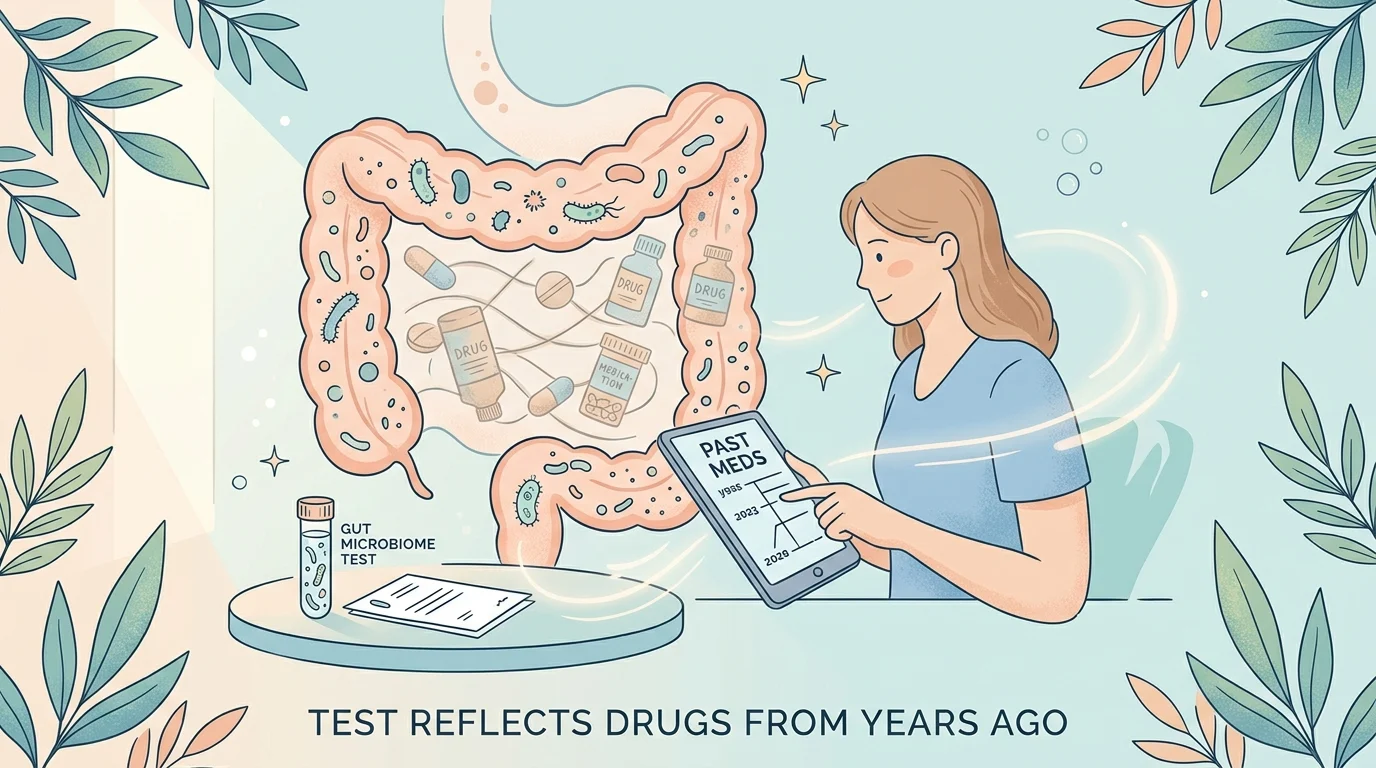
A gut microbiome test reads the bacteria living in your intestine from a single stool sample, and new research suggests that reading is shaped by prescriptions you filled years ago. On 24 August 2026, a team at the University of Tartu Institute of Genomics reported that antibiotics, antidepressants, beta-blockers, acid-reducing drugs and anti-anxiety medicines all leave detectable traces in gut bacteria long after the last dose. In this article you will learn what the study actually showed, which drug families leave the longest mark, and why your medication history changes how any stool or microbiome result should be read. We also cover what laboratory stool tests do measure reliably, and when results deserve a medical opinion.
A separate article explains what strain-level research changes for a gut bacteria test.
What the researchers actually found
The team analysed stool samples and prescription records from more than 2,500 adults enrolled in the Estonian Biobank. Instead of noting only what participants were taking on the day of sampling, they went back through electronic health records covering the previous five years.
Most of the 186 medicines examined were linked to differences in gut bacteria. For close to half of them, those differences were still visible years after people had stopped treatment. The researchers describe this as a carryover effect: the prescription ends, the microbial signature does not.
They also observed an additive pattern. The more courses a person had taken, the stronger the association. And in a smaller subgroup who provided a second stool sample later on, starting or stopping a medicine was followed by matching shifts in gut bacteria, which suggests the drugs themselves explain part of the change rather than the illness behind them.
Which medicines leave the longest mark
Antibiotics were expected. The surprise was how many non-antibiotic drugs behaved in a similar way, including medicines millions of people take for years at a time.
| Drug family | Usually prescribed for | What the study observed |
|---|---|---|
| Broad-spectrum antibiotics | Bacterial infections | The strongest and longest-lasting changes, still detectable years later |
| Benzodiazepines | Anxiety, sleep problems | Associations comparable to broad-spectrum antibiotics |
| Proton pump inhibitors | Acid reflux, stomach protection | Persistent changes, confirmed in repeat samples |
| Antidepressants (SSRIs) | Depression, anxiety | Microbial differences still visible after treatment ended |
| Beta-blockers | High blood pressure, heart conditions | A distinct microbial signature years after use |
One detail matters for how this research is usually done. Two medicines from the same class did not always behave the same way: diazepam and alprazolam, both benzodiazepines, differed in how strongly they were linked to microbial change. Grouping drugs by class, as most studies do, may hide real differences between individual molecules.
What this changes when you read a gut microbiome test
Consumer microbiome reports usually compare your bacterial profile with a reference population, then label your diversity as excellent, average or poor. This study adds a large asterisk. If a course of antibiotics taken in 2021, or two years of an acid blocker, still shapes the sample, then a single snapshot describes your prescription history as much as your diet or your lifestyle.
There is a second, older problem. No agreed threshold defines a healthy or unhealthy gut microbiome, and profiles vary enormously between people who are perfectly well. Independent work has shown that the same stool sample sent to several companies can come back rated excellent by one laboratory and unfavourable by another.
The practical takeaway is simple. If you take such a test, write down every antibiotic course, acid blocker, antidepressant, sedative and beta-blocker you have used over the past five years, and hand that list to whoever interprets the result. Never stop or change a prescription to improve a microbiome score.
What a laboratory stool test does measure reliably
Direct-to-consumer microbiome profiling and clinical stool testing are not the same exercise. Laboratory stool tests answer narrow, validated questions, and their reference ranges have been established in real patients.
- To separate inflammatory bowel disease from irritable bowel syndrome, clinicians order a faecal calprotectin test.
- When diarrhoea persists, laboratories run a stool culture test.
- To look for intestinal parasites, technicians examine an ova and parasites stool test.
- Before any laboratory work, nurses describe normal and abnormal stool consistency.
Symptoms during or after treatment also have their own explanations. Many people report constipation during a course of antibiotics, and long-lasting symptoms deserve the stool tests recommended for persistent diarrhoea rather than a commercial microbiome panel.
Latest scientific advances
Three recent publications frame this question. Here is what each one adds, in plain language.
The Estonian study led by Oliver Aasmets and Elin Org, published in the journal mSystems, is the first to combine detailed prescription histories from medical records with stool sequencing in the same cohort, meaning a group of people followed over time. What this means for you: a microbiome result is not a photograph of your current habits alone, it also carries your treatment history.
A commentary published in the same journal by Pamela Ferretti, titled The gut remembers, underlines the consequence for research itself. If past medication is ignored, a difference in gut bacteria between healthy people and people with a disease may simply reflect the treatments one group received. What this means for you: be cautious with headlines linking a single bacterium to a disease, because the drug may be the missing explanation.
A separate Swedish study published in Nature Medicine in 2026 followed nearly 15,000 adults and cross-referenced eight years of antibiotic prescriptions with stool sequencing. Recent antibiotic use reduced bacterial diversity the most, but courses taken four to eight years earlier were still associated with measurable differences, with clindamycin, fluoroquinolones and flucloxacillin standing out. What this means for you: not all antibiotics behave alike, and narrower-spectrum options such as phenoxymethylpenicillin were linked to far fewer changes.
All three findings are observational, meaning they show associations rather than proof of cause, and none of them justifies avoiding a treatment your doctor considers necessary.
When to talk to a doctor
A microbiome score is not a reason to consult. Symptoms are. Book an appointment if diarrhoea lasts more than a few days or keeps coming back, if you notice blood, mucus or pus in the toilet, if stools turn black and tarry, if you lose weight without trying, or if abdominal pain wakes you at night. Persistent digestive symptoms after several courses of antibiotics also deserve a proper assessment rather than self-medication with supplements.
Glossary
| Term | Definition |
|---|---|
| Gut microbiome | The community of bacteria and other micro-organisms living in the digestive tract, mostly in the colon. |
| Metagenomics | A laboratory method that sequences all the genetic material in a sample to identify which micro-organisms are present. |
| Carryover effect | A change that remains measurable after the exposure, here a medicine, has stopped. |
| Dysbiosis | A loosely defined imbalance of the gut microbial community, with no agreed numerical threshold. |
| Bacterial diversity | The number and variety of different bacterial species found in a sample. |
| Broad-spectrum antibiotic | An antibiotic active against many types of bacteria, including beneficial ones. |
| Proton pump inhibitor (PPI) | A medicine that lowers stomach acid, prescribed for reflux and stomach protection. |
| Benzodiazepine | A sedative medicine used for anxiety or sleep problems, such as diazepam or alprazolam. |
| Cohort | A defined group of people studied together, often followed over several years. |
| Observational study | Research that records what happens without assigning treatments, so it shows links rather than causes. |
Frequently asked questions
How long can antibiotics affect gut bacteria?
Longer than most people assume. The Estonian cohort found differences years after a course ended, and the Swedish study found associations for antibiotics taken four to eight years earlier. That does not mean the gut never recovers. Bacterial diversity usually rebounds within weeks to months, but some species may not return to their previous levels, especially after repeated courses.
Should I order an at-home gut microbiome test?
It can be interesting, but it is not a medical test. There is no validated threshold for a healthy microbiome, results differ between laboratories, and the same profile may be normal in one person and unusual in another. If you have digestive symptoms, a targeted stool test requested by a doctor will answer a clearer question.
Do probiotics repair the gut after antibiotics?
Not reliably. Research has shown that responses vary widely from person to person, and that in some cases a probiotic mixture slowed rather than accelerated the natural return of gut bacteria. Fibre-rich food, fermented foods and time remain the best-supported approach.
Does a gut microbiome test diagnose disease?
No. Some commercial reports mention risks of cancer, neurodegenerative disease or depression based on the presence of certain bacteria. Current scientific evidence does not support that kind of individual conclusion, and no regulator has approved such tests for diagnosis.
Should I stop a medicine to protect my gut bacteria?
No. Antibiotics, acid blockers, antidepressants and beta-blockers are prescribed for reasons that outweigh a change in microbial profile. Stopping them without advice can be dangerous. Discuss the duration and the need with your prescriber instead.
What should I tell the person interpreting my result?
List every medicine taken over the past five years, with approximate dates and the number of courses. Also mention recent travel, gastrointestinal infections and any major diet change, as all of them influence the sample.
Sources
- MedlinePlus, National Library of Medicine (NIH) — Calprotectin Stool Test — medlineplus.gov
- Centers for Disease Control and Prevention — Side Effects of Antibiotics, 2026 — cdc.gov
- Johns Hopkins Medicine — Your Digestive System: 5 Ways to Support Gut Health — hopkinsmedicine.org
- Aasmets O, Taba N, Krigul KL, Andreson R, Org E — A hidden confounder for microbiome studies: medications used years before sample collection — mSystems, 2025 — doi.org/10.1128/msystems.00541-25
- Ferretti P — The gut remembers: the long-lasting effect of medication use on the gut microbiome — mSystems, 2025 — doi.org/10.1128/msystems.01076-25
- Baldanzi G, Larsson A, Sayols-Baixeras S, et al. — Antibiotic use and gut microbiome composition links from individual-level prescription data of 14,979 individuals — Nature Medicine, 2026 — doi.org/10.1038/s41591-026-04284-y
Further reading
- Faecal lactoferrin: what a positive result means
- Fatty stool: causes, tests and what steatorrhoea means
- Cyclospora stool test: why routine exams miss it
- At-home stool test cuts colon cancer deaths by 43%
- Black specks in stool: causes and when to worry
Understand your lab results with AI DiagMe
A microbiome score rarely answers the question people actually have, which is what their symptoms and their routine laboratory results mean together. AI DiagMe reads the tests that do have validated reference ranges, from blood counts and inflammation markers to urine and stool analyses such as faecal calprotectin, and explains each value in plain language. It helps you understand your results and prepare your next consultation. It does not diagnose, and it does not replace your doctor.
Get your results interpreted in minutes