



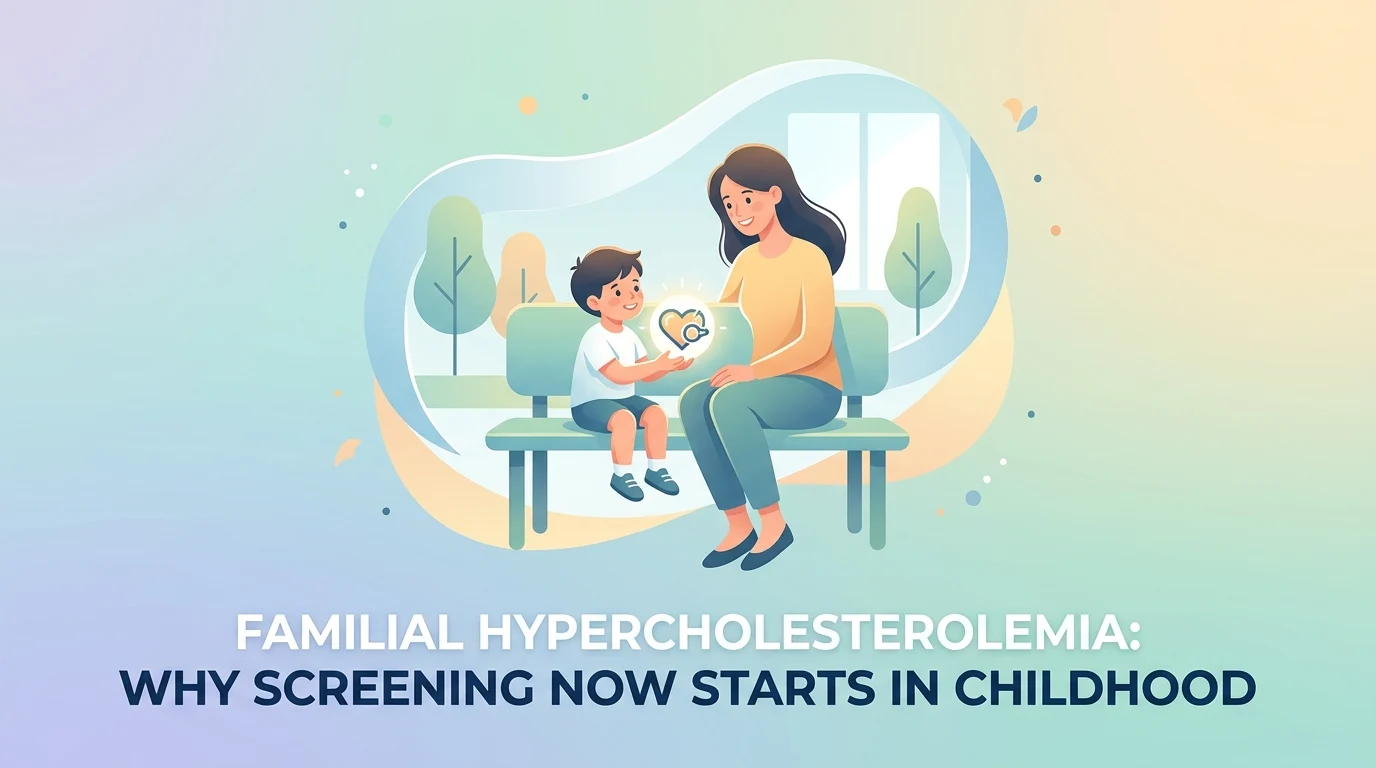
Familial hypercholesterolaemia is the reason a cholesterol test now belongs on the checklist for healthy children, not just for adults with a worrying lab report. The 2026 multisociety dyslipidaemia guideline gives its strongest class of recommendation to universal lipid screening between ages 9 and 11, and France has just gone further: a law passed on 27 July 2026 makes early screening for this condition part of every child’s medical record in the year after their sixth birthday. In this article you’ll learn why a genetic cholesterol disorder is screened for in childhood, what the blood test actually measures, what an elevated result sets in motion for the whole family, and what recent research says about the right age to test.
Why a childhood cholesterol test at all
Familial hypercholesterolaemia is an inherited condition in which the body cannot clear LDL cholesterol from the blood properly. Most people who have it carry a variant in one of a handful of genes, usually LDLR, APOB or PCSK9. The consequence is mechanical: LDL builds up from birth and starts depositing in the artery wall decades before anything hurts.
The CDC puts the frequency at roughly 1 in 250 people, and international estimates converge around 1 in 311. That makes it one of the most common serious genetic conditions in the general population, and one of the most consistently missed. Most people who have it do not know.
The stakes explain the urgency. Left untreated, heart attacks occur in about half of men with the condition by age 50 and about a third of women by age 60. Treated early, the outlook changes almost completely: cholesterol-lowering treatment cuts cardiovascular risk by more than half, and life expectancy approaches normal. That gap between untreated and treated is exactly what a screening programme is trying to close.
What the guidelines say about screening age
US recommendations are layered. The American Heart Association considers it reasonable to test children at increased risk starting at age 2, when a parent, sibling or grandparent has had an early heart attack or a known cholesterol disorder. All other children should have their cholesterol checked between ages 9 and 11, and again at age 19.
The 2026 multisociety dyslipidaemia guideline raised universal screening at ages 9 to 11 to a Class 1 recommendation, framing it as a life-course prevention measure rather than a one-off test. The reasoning is that identifying an affected child before atherogenic exposure accumulates buys decades of protection.
France’s new law sits earlier on that timeline. Its screening appointment falls in the year after a child turns 6, with the doctor recording on the health record either that screening was done or that a parent declined it. Different age, same logic: find the condition while it is still silent.
What the blood test actually measures
Screening uses an ordinary blood draw. The laboratory reports total cholesterol, LDL, HDL and triglycerides — the same panel adults get. A separate guide explains the standard lipid panel and what each value means. In children, the LDL number carries most of the diagnostic weight.
One technical detail matters when comparing results. LDL is often not measured directly but calculated from the other values, and laboratories recently revised the LDL calculation used on lab reports. Repeat testing in the same laboratory therefore gives the most comparable picture. Our reference article covers normal LDL levels and why one healthy range does not exist.
| Who is tested | LDL level that raises suspicion | What happens next |
|---|---|---|
| Child, no treatment | 160 mg/dL or higher | Repeat draw to confirm, then clinical review |
| Adult, no treatment | 190 mg/dL or higher | Work-up for an inherited cause, family testing |
| Homozygous form (rare) | often above 400 mg/dL | Prompt referral to specialist lipid care |
These figures are orientation points, not a diagnosis. A clinician reads them alongside family history, physical examination and, when useful, genetic testing.
One high result, a whole family screened
This is the part most people have never heard of. When a child turns out to have a very high LDL, that child often becomes the index case for the family — the person through whom a parent, siblings and sometimes grandparents discover they carry the same condition. Testing outward from that first diagnosis is called cascade screening, and it is currently the most productive way to find people with an inherited cholesterol disorder.
In adults, the work-up frequently extends beyond the basic panel. Two markers add precision to cardiovascular risk assessment: our article explains the ApoB blood test, and a separate piece covers lipoprotein(a) screening for adults. Both are genetically influenced, and both change how aggressively a clinician treats.
When to raise it with a clinician
- A parent, sibling or grandparent had a heart attack or stroke before age 55 in men or 65 in women — screening a child can reasonably start at age 2.
- A first-degree relative already carries a confirmed diagnosis — children and siblings should be tested without waiting for a scheduled appointment.
- A child’s LDL sits at or above 160 mg/dL on two separate draws.
- Visible cholesterol deposits appear — thickened Achilles tendons, yellowish patches around the eyelids, a pale ring at the edge of the cornea. These are late signs and warrant prompt review.
- An adult’s cholesterol stays very high despite genuine diet and exercise changes — this pattern points towards an inherited cause rather than lifestyle. Our overview covers high cholesterol, its causes and its treatment.
Latest scientific advances
Several recent studies sharpen the picture, and each comes with a caveat worth keeping.
At what age does cholesterol reliably separate affected children from unaffected ones? A Norwegian team compared LDL levels in children with a genetically confirmed diagnosis against children who tested negative, drawing on a national family screening programme. Cord blood at birth turned out to be a poor filter: the two groups overlap so much that a newborn screen would miss close to half of affected babies. From age 1 through 12, by contrast, LDL separates the groups well and catches the large majority. What this means for you: a school-age blood draw sits inside the window where the test genuinely works, which supports both the American 9-to-11 window and the new French age of 6.
Does universal screening actually reach the children it targets? An analysis of nearly 400,000 adolescent records in a large US health system found that only a minority were screened at all, and that the great majority of expected cases were neither identified nor treated. One correctable habit drove much of the shortfall: clinicians tended to order the test for children with obesity, even though this inherited condition has no relationship with body weight. What this means for you: a slim child can absolutely be affected, and screening only helps if it is applied to everyone.
Should results be read the same way in girls and boys? A study built on the Slovenian universal screening programme found that prepubertal girls carry slightly higher total and LDL cholesterol than boys — a gap that disappears in children who carry the variant. What this means for you: childhood reference values may one day account for sex, which would spare some families a false alarm. Until then, a borderline result is always confirmed on a second draw.
Is a national programme worth the money? A US simulation published in early 2026 modelled universal lipid testing at age 10 or 18 followed by genetic testing when LDL was elevated. It projected that cardiovascular events would be prevented, but at a cost per year of healthy life gained above the thresholds usually considered cost-effective in the United States. This is a model rather than a trial, and its assumptions reflect current treatment practice, which is itself incomplete. What this means for you: the debate concerns how a country organises a programme, not whether an individual family benefits from knowing — for a family carrying this condition, the value of an early diagnosis is not in question.
Alongside these, the National Lipid Association published an updated expert consensus in 2026 that reaffirms two principles: systematic paediatric screening, and organised family testing around every case found.
Glossary
| Term | Definition |
|---|---|
| Familial hypercholesterolaemia | An inherited condition that raises LDL cholesterol from birth and speeds up fatty deposits in the arteries. |
| LDL cholesterol | The cholesterol fraction carried towards body tissues. In excess it accumulates in artery walls, which is why it is called the bad cholesterol. |
| Lipid panel | The blood test that reports total cholesterol, LDL, HDL and triglycerides. |
| Index case | The first person in a family in whom a condition is identified, and the starting point for testing relatives. |
| Cascade screening | Testing the parents, siblings and children of a diagnosed person, then continuing outward through the family. |
| Autosomal dominant | A pattern of inheritance in which one affected parent is enough to pass a condition on, with a one-in-two chance per pregnancy. |
| Heterozygous vs homozygous | Heterozygous means the variant came from one parent; homozygous means it came from both, which is rare and much more severe. |
| Atherosclerosis | The gradual buildup of fats and inflammatory cells in artery walls, the process behind heart attacks and strokes. |
| Statin | A medication that lowers LDL cholesterol by reducing how much the liver produces. |
| Lipoprotein(a) | A cholesterol-carrying particle whose level is largely set by genetics and which independently raises cardiovascular risk. |
Frequently asked questions
Does this condition cause symptoms in children?
Almost never, and that is precisely why a blood test is used. The child looks well, grows normally, and a physical examination shows nothing. The visible signs — cholesterol deposits in tendons or around the eyes — appear much later in life and only in some people. A lipid panel is the only way to catch the problem at an age when it has not yet caused damage to the arteries.
Does my child need to fast before the test?
A lipid panel is traditionally taken after a fast of about 12 hours, water permitted. Some clinicians accept a non-fasting sample for initial screening because LDL varies little with meals, though triglycerides do. Follow the instruction written on the request form: the prescribing clinician sets the conditions, and a sample taken under the wrong conditions can make triglycerides difficult to interpret.
Does a high result mean treatment starts immediately?
No. A first elevated value leads to a repeat test, then a consultation. The clinician weighs the family history, examines the child and decides what follows. In children, management begins with diet and physical activity; medication is considered only in specific situations, from a certain age, and after specialist assessment. Nothing is decided on a single number.
If my child is screened, should I check my own cholesterol?
Yes, and this is the point most families miss. Because the condition passes from parent to child, an elevated result in a child means one of the parents is very probably affected and often unaware. Cascade screening exists for exactly this reason: offering a lipid panel to the parents, siblings and children of the person diagnosed is the most efficient way to find the undiagnosed relatives.
Can diet alone fix an inherited cholesterol disorder?
Diet and exercise remain part of care and still matter, but they rarely normalise the level on their own, because the underlying problem is a genetic one rather than a dietary one. That is the key difference from lifestyle-related high cholesterol. LDL level, age and overall cardiovascular risk determine whether medication is needed, and that decision belongs to a clinician.
Is genetic testing necessary to confirm the diagnosis?
Not always. A diagnosis can be made clinically from LDL levels, personal and family history, and physical findings. Genetic testing adds certainty, identifies the specific variant, and makes family testing far more straightforward, because relatives can then be tested for one known variant instead of relying on cholesterol levels alone. Availability and coverage vary, so this is worth discussing with the clinician managing the case.
Sources
- American Heart Association — What Is Familial Hypercholesterolaemia?, reviewed 2026. Read the AHA page
- Centers for Disease Control and Prevention — Family Health History and Heart Disease. Read the CDC page
- Cleveland Clinic — Familial Hypercholesterolaemia: diagnosis, treatment and outlook, updated 2026. Read the Cleveland Clinic page
- Ahmad Z, Agarwala A, Cuchel M, et al. — Update on familial hypercholesterolaemia: an expert clinical consensus from the National Lipid Association — Journal of Clinical Lipidology, 2026. DOI 10.1016/j.jacl.2026.01.011
- Bogsrud MP, Stava TT, Berge KE, et al. — LDL-cholesterol in newborns and children with genetically verified familial hypercholesterolaemia: implications for cholesterol-based screening — European Heart Journal, 2025. DOI 10.1093/eurheartj/ehaf815
- Kafol J, Becker M, Cugalj Kern B, et al. — Sex differences in cholesterol levels among prepubertal children — Atherosclerosis, 2025. DOI 10.1016/j.atherosclerosis.2025.120484
- Cortez AB, et al. — Universal lipid screening in adolescents to identify familial hypercholesterolaemia in a large healthcare system — Journal of Clinical Lipidology, 2023. Read the study
- Lentz M, et al. — Cascade screening for familial hypercholesterolaemia from paediatric index cases diagnosed through universal screening — Journal of Clinical Lipidology, 2024. Read the study
- Bellows BK, Zhang Y, Ruiz-Negrón N, et al. — Familial hypercholesterolaemia screening in childhood and early adulthood: a cost-effectiveness study — JAMA, 2026. Read the study
Further reading
- Advanced Lipid Panel: What It Tests and Who Needs It
- Cholesterol Ratio: What It Really Tells You
- Low HDL Cholesterol: Causes, Risks, and What to Check Next
- Prediabetes A1c: What the Grey Zone Really Means for Your Heart
- Full-Fat Dairy and Cholesterol: What a New 12-Week Trial Found
Understand your lab results with AI DiagMe
A lipid panel for a child or an adult fits on a few lines, yet what those numbers mean depends on age, family history and the rest of the results. AI DiagMe turns laboratory reports into plain language — total cholesterol, LDL, HDL and triglycerides, but also blood sugar or kidney function — with the context you need before a consultation. The tool helps you understand your results; it does not diagnose, and it does not replace your clinician.
Get your results interpreted in minutes