





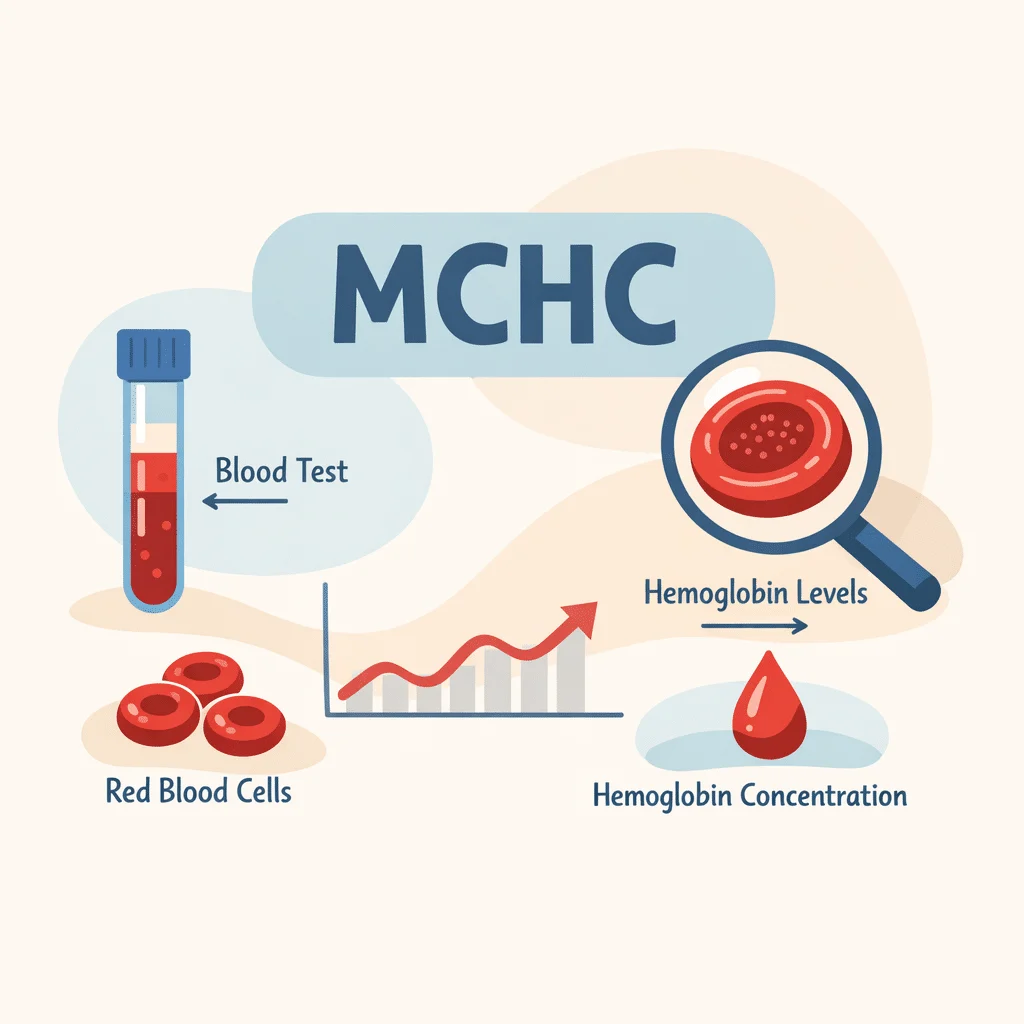
The MCHC blood test measures the average concentration of haemoglobin inside your red blood cells, one of the standard values reported on a full blood count (FBC). Haemoglobin is the iron-rich protein that carries oxygen from your lungs to the rest of your body, and MCHC tells you how densely it is packed inside each cell rather than how many cells you have. In this article you’ll learn what MCHC measures, what counts as a normal range, what low and high results can mean, and when a result is worth discussing with your doctor.
What does the MCHC blood test measure?
MCHC stands for mean corpuscular haemoglobin concentration. It is calculated from two other FBC values, haemoglobin and haematocrit (the percentage of blood volume made up of red cells), rather than measured directly. The result reflects the density of haemoglobin inside an average red blood cell, not the total amount of haemoglobin in your bloodstream.
A simple way to picture it: if red blood cells are delivery lorries carrying oxygen, haemoglobin is the cargo. MCHC tells you how fully loaded each lorry is on average. A low MCHC means the cells are underloaded relative to their size, while a high MCHC means they are unusually concentrated. Both patterns can point towards different underlying causes, which is why doctors rarely look at MCHC in isolation.
Laboratories report MCHC because it helps classify the type of anaemia (a shortage of healthy red blood cells or haemoglobin) a person may have. Combined with MCV (the average size of red cells) and MCH (the average amount of haemoglobin per cell), MCHC helps narrow down whether an anaemia is linked to iron, genetics, chronic inflammation, or another cause.
Normal MCHC range and how to read your result
The standard reference range for the MCHC blood test is typically 32 to 36 grams per decilitre (g/dL), sometimes written as 320 to 360 grams per litre (g/L). Ranges can vary slightly between laboratories depending on the analyser and methods used, so always compare your result to the range printed on your own report.
Here is a sample CBC report showing where MCHC sits alongside related red blood cell values.
| Parameter | Result | Normal range | Unit |
|---|---|---|---|
| Red blood cells | 4.8 | 4.2-5.6 | 10¹²/L |
| Haemoglobin | 14.5 | 12.0-16.0 | g/dL |
| Haematocrit | 42 | 37-47 | % |
| MCV | 87.5 | 80-100 | fL |
| MCH | 30.2 | 27-32 | pg |
| MCHC | 34.5 | 32-36 | g/dL |
In this example, the MCHC of 34.5 g/dL falls comfortably within range. Labs often flag out-of-range values with colour, an asterisk, or an arrow. Reference ranges come from statistical studies of large, healthy populations, so they can shift slightly depending on the equipment used and the demographic makeup of that reference group. A complete blood count puts MCHC in context alongside your other red blood cell results, and our guide to reading a complete blood count report walks through every value on that panel.
What a low MCHC can mean
A low MCHC value, called hypochromia, means red blood cells contain less haemoglobin than expected relative to their size. The most common cause by far is iron-deficiency anaemia. Without enough iron, the bone marrow cannot make normal amounts of haemoglobin, so it produces red blood cells that are both smaller (microcytic) and paler (hypochromic) than usual. Typical symptoms include fatigue, pale skin, and shortness of breath, though mild cases may cause no noticeable symptoms at all.
Thalassaemias, a group of inherited disorders that disrupt production of the globin chains that make up haemoglobin, are another recognised cause of low MCHC. Chronic blood loss, some chronic diseases, and rarely certain toxic exposures can also lower this value. Because low MCHC on its own does not explain why it happened, doctors typically follow up with additional testing. This site’s dedicated guide to low MCHC causes, symptoms, and treatment options covers that follow-up path, including iron studies and treatment approaches, in much greater depth than this overview can.
What a high MCHC can mean
A high MCHC value, or hyperchromia, means the haemoglobin concentration inside red blood cells is higher than normal. This pattern is less common than a low result and tends to point towards a narrower set of causes.
Hereditary spherocytosis, a genetic condition in which red blood cells are shaped like spheres rather than the usual flattened disc, is a classic cause: the abnormal shape packs haemoglobin into a smaller cell volume, raising MCHC. Significant dehydration can also raise MCHC temporarily, because a smaller plasma volume concentrates everything in the blood, including haemoglobin inside red cells; this usually corrects once fluid intake returns to normal. Autoimmune haemolytic anaemia, in which the immune system destroys red blood cells prematurely, can sometimes produce a falsely elevated MCHC reading on automated lab analysers rather than a true increase, which is one reason unusual results are sometimes rechecked before being acted on.
Low versus high MCHC at a glance
Because the two directions point towards very different explanations, it helps to compare them side by side before deciding what to ask your doctor.
| Feature | Low MCHC (hypochromia) | High MCHC (hyperchromia) |
|---|---|---|
| Typical range | Below about 32 g/dL | Above about 36 g/dL |
| Most common cause | Iron-deficiency anaemia | Dehydration or hereditary spherocytosis |
| Other possible causes | Thalassaemia, chronic blood loss, some chronic diseases | Autoimmune haemolytic anaemia, lab interference |
| Related red cell size (MCV) | Often small (microcytic) | Often normal or small |
| Typical next step | Iron studies, reticulocyte count | Hydration review, blood smear, repeat testing |
What influences MCHC and how doctors interpret it
MCHC rarely stands alone in clinical decision-making. Doctors read it together with MCV, MCH, haemoglobin, and haematocrit because the same MCHC number can mean different things depending on what the other values show. For example, a low MCHC paired with a low MCV strongly suggests iron deficiency or thalassaemia, while a low MCHC with a normal or high MCV points towards a different mechanism. Our guides to low MCV causes and treatment and high MCV levels and their causes explain how cell size adds to the picture MCHC alone cannot provide.
The concentration of haemoglobin in red blood cells also connects to how well tissues receive oxygen. When that concentration drops, the body can trigger metabolic adjustments that affect the heart, lungs, and brain over time. Since the 1930s, when MCHC was first defined, its role has shifted from a secondary calculation to a central piece of anaemia classification, particularly for distinguishing iron-related anaemias from other types.
A practical example: someone with a persistently high MCHC consults their doctor and learns the cause is chronic mild dehydration. After adopting better hydration habits, their MCHC normalises within a few weeks. This illustrates why an abnormal MCHC deserves a conversation with a healthcare professional rather than self-diagnosis, since the same number can reflect something as simple as fluid intake or something that needs further investigation.
When to see a doctor about your MCHC result
Most single, mildly abnormal MCHC values are not emergencies and are often rechecked before any action is taken. Still, some situations call for prompt medical attention rather than waiting.
- Your MCHC is below roughly 30 g/dL or above roughly 38 g/dL, which most labs consider a more significant deviation.
- You notice a rapid change between two consecutive tests rather than a stable, mild variation.
- Abnormal MCHC appears alongside symptoms such as persistent fatigue, pale skin, shortness of breath, dizziness, or a rapid heartbeat.
- You have a family history of an inherited blood disorder such as thalassaemia or hereditary spherocytosis and your result is unexplained.
- Your doctor has specifically flagged the result or asked you to schedule a follow-up appointment.
By contrast, a result only slightly outside the range, with no symptoms and no concerning trend, is often simply monitored with a repeat test in a few months. The table below summarises general follow-up guidance based on the size of the deviation; your own clinician’s advice always takes priority.
| MCHC level | Suggested follow-up |
|---|---|
| Normal (32-36 g/dL) | Discuss as part of a routine annual check-up |
| Slightly low (30-31.9 g/dL) | Monitor; consider a follow-up test in 3-6 months |
| Severely low (below 30 g/dL) | Prompt medical consultation to investigate the cause |
| Slightly high (36.1-38 g/dL) | Monitor; consider a follow-up test in 3-6 months |
| Significantly high (above 38 g/dL) | Prompt medical consultation to investigate the cause |
Lifestyle and dietary habits that support a healthy MCHC
Depending on which direction your MCHC tends to move, a few everyday habits can support healthier results alongside any care your doctor recommends.
For levels that trend low, increasing intake of iron-rich foods such as lean meats, poultry, fish, lentils, and spinach can help. Pairing plant-based iron sources with vitamin C, found in citrus fruits and peppers, improves how well that iron is absorbed. Adequate vitamin B12 and folate from dairy products, eggs, and leafy greens also support healthy red blood cell production, since both nutrients play a role in the maturation process. Our guide to interpreting a broader iron studies panel explains how ferritin, serum iron, and related markers work together when iron deficiency is suspected, and the article on low ferritin causes and treatment covers the iron-storage side of that picture in detail.
For levels that trend high, staying properly hydrated by drinking sufficient water throughout the day is the most direct lever, since dehydration is a common and reversible driver of elevated MCHC. Limiting alcohol consumption, which can affect red blood cell health, and maintaining a balanced diet with regular, moderate physical activity round out a sensible approach. None of these steps replace medical evaluation when a result is significantly abnormal or persistent.
Latest scientific advances
Research on MCHC continues to refine how laboratories use it alongside newer testing technology. A 2024 review in the International Journal of Laboratory Hematology examined how hereditary spherocytosis is diagnosed and found that MCHC, together with MCV and red cell distribution width (RDW, a measure of how much red cell size varies), was amongst the first erythrocyte parameters used to flag this inherited condition. What this means for you: if your MCHC is high and hereditary spherocytosis is suspected, your doctor may also draw on newer analyser-generated values that were not available when MCHC was first introduced, giving a more complete picture than MCHC alone ever could. This is a review of existing diagnostic methods rather than a controlled trial, so it describes current best practice rather than a single definitive study, but it reflects a broad expert consensus on how these tests are combined in practice.
Separately, a 2024 case report in the journal Clinical Laboratory described two patients whose MCHC readings appeared abnormally high due to interference from cold agglutination (a temperature-related clumping of red cells) and lipid content in the blood sample, rather than a true increase in haemoglobin concentration. After correcting for the interference in the laboratory, both patients’ MCHC values returned to normal and matched their actual clinical picture. What this means for you: an unexpectedly high MCHC result, especially one that doesn’t fit your symptoms, may sometimes reflect a technical lab artefact rather than a real change in your blood, which is exactly why doctors often repeat an unusual result before drawing conclusions. This finding comes from a small case series rather than a large study, so it illustrates a known but uncommon pitfall rather than how most results should be interpreted.
An MCHC result is easier to make sense of when it’s read alongside related values such as haemoglobin, MCV, and iron studies, and when you understand what a normal range on your own report actually represents. Tools that walk through a full complete blood count, a haemoglobin result, or an iron panel side by side can help you prepare better questions before your next appointment, understand what’s driving an abnormal number, and know when a finding like low or high MCHC deserves prompt medical attention rather than routine monitoring. None of these resources diagnose a condition or replace your doctor’s judgement, but they can make the conversation with your clinician more productive.
Understand your lab results with AI DiagMe
Get your results interpreted in minutes
Glossary
| Term | Definition |
|---|---|
| MCHC (mean corpuscular haemoglobin concentration) | The average concentration of haemoglobin inside a red blood cell, calculated from haemoglobin and haematocrit. |
| Haemoglobin | The iron-rich protein in red blood cells that carries oxygen from the lungs to the rest of the body. |
| Haematocrit | The percentage of blood volume made up of red blood cells. |
| MCV (mean corpuscular volume) | The average size of a red blood cell, often used together with MCHC to classify anaemia. |
| Hypochromia | A term for red blood cells with lower-than-normal haemoglobin concentration, corresponding to a low MCHC. |
| Hyperchromia | A term for red blood cells with higher-than-normal haemoglobin concentration, corresponding to a high MCHC. |
| Thalassaemia | A group of inherited disorders that reduce normal production of haemoglobin’s globin chains. |
| Hereditary spherocytosis | A genetic condition where red blood cells are sphere-shaped instead of disc-shaped, often raising MCHC. |
| Complete blood count (CBC) | A routine blood test that measures red cells, white cells, platelets, and related values including MCHC. |
| Reference range | The span of values considered typical for a healthy population, set by each laboratory. |
Frequently asked questions
What does it mean if my MCHC blood test result is low?
A low MCHC blood test result usually means your red blood cells contain less haemoglobin than expected for their size, a pattern called hypochromia. The most frequent cause is iron-deficiency anaemia, since insufficient iron limits how much haemoglobin the bone marrow can pack into each cell. Other possible causes include thalassaemia and chronic blood loss. A single low result is often followed by iron studies to pinpoint the exact cause, so it’s worth discussing the finding with your doctor rather than assuming the worst.
What if MCHC is high in a blood test?
A high MCHC blood test result means red blood cells are carrying more haemoglobin per unit of volume than typical, a pattern known as hyperchromia. Common explanations include dehydration, which temporarily concentrates blood components, and hereditary spherocytosis, a genetic condition affecting red cell shape. Occasionally, lab interference can produce a falsely elevated reading. Because the causes range from simple to more involved, an unexpected high result is usually rechecked or investigated further rather than acted on immediately.
What level of MCHC is considered dangerously high or low?
Most labs consider an MCHC below about 30 g/dL or above about 38 g/dL to be a more significant deviation that warrants prompt medical attention, compared with milder deviations that are simply monitored. These thresholds are general guidance rather than fixed cutoffs, since what counts as concerning also depends on your symptoms, other CBC values, and how quickly the number has changed. Your own lab’s reference range and your doctor’s interpretation of your full picture matter more than any single number in isolation.
Can MCHC be high with a low MCV at the same time?
Yes, this combination can occur, most classically in hereditary spherocytosis, where red blood cells are smaller than average (low MCV) but densely packed with haemoglobin relative to their size (high MCHC), because the spherical shape reduces cell volume more than it reduces haemoglobin content. This pairing is a useful diagnostic clue precisely because it differs from the more common pattern of low MCHC with low MCV seen in iron deficiency. If your report shows this combination, your doctor will likely look closely at your blood smear and consider additional targeted testing.
How is MCHC different from MCH and MCV?
All three are red blood cell indices reported on a CBC, but they measure different things. MCV is the average size of a red blood cell. MCH is the average amount of haemoglobin in a single red blood cell, expressed as a weight. MCHC is the concentration of that haemoglobin relative to the cell’s volume, expressed as haemoglobin per unit of cell size. Because MCHC combines information from both haemoglobin and haematocrit, it can sometimes highlight patterns that MCV or MCH alone would miss, which is why doctors typically review all three together rather than relying on just one.
Does MCHC change during pregnancy?
MCHC can shift somewhat during pregnancy, largely because blood volume increases substantially whilst red blood cell production increases more modestly, which can influence related values. Iron needs also rise during pregnancy, making iron-deficiency-related low MCHC a relatively common finding that clinicians watch for at routine antenatal visits. Because pregnancy affects several CBC values simultaneously, an obstetric care provider typically interprets MCHC alongside haemoglobin, MCV, and iron studies rather than in isolation.
Sources
- Complete Blood Count (CBC) — MedlinePlus, National Library of Medicine (NIH) — https://medlineplus.gov/lab-tests/complete-blood-count-cbc/
- Anaemia — MedlinePlus, National Library of Medicine (NIH) — https://medlineplus.gov/anemia.html
- Anemia: Symptoms and Causes — Mayo Clinic — https://www.mayoclinic.org/diseases-conditions/anemia/symptoms-causes/syc-20351360
- Polizzi A, Dicembre LP, Failla C, et al. — Overview on Hereditary Spherocytosis Diagnosis — International Journal of Laboratory Haematology, 2024 — https://doi.org/10.1111/ijlh.14376
- Li G, Lu M, Wang Q, Lu T — Two Cases of False Elevation of MCHC — Clinical Laboratory, 2024 — https://doi.org/10.7754/Clin.Lab.2024.240212