




Pancreatic cancer is a serious disease that often develops quietly, which is one reason it is frequently found at a later stage than many other cancers. The reassuring part is that understanding how it behaves, who is most at risk, and which warning signs deserve attention can help you act sooner and ask sharper questions. In this article you will learn what pancreatic cancer is, what raises the risk, the symptoms to watch for, and how doctors use imaging, biopsy, and blood work to reach a diagnosis. You will also find a clear look at current treatments, the latest research, and where a simple lab test fits into the bigger picture. The aim is not to alarm you, but to give you accurate, calm information you can use in a real conversation with your doctor.
What is pancreatic cancer?
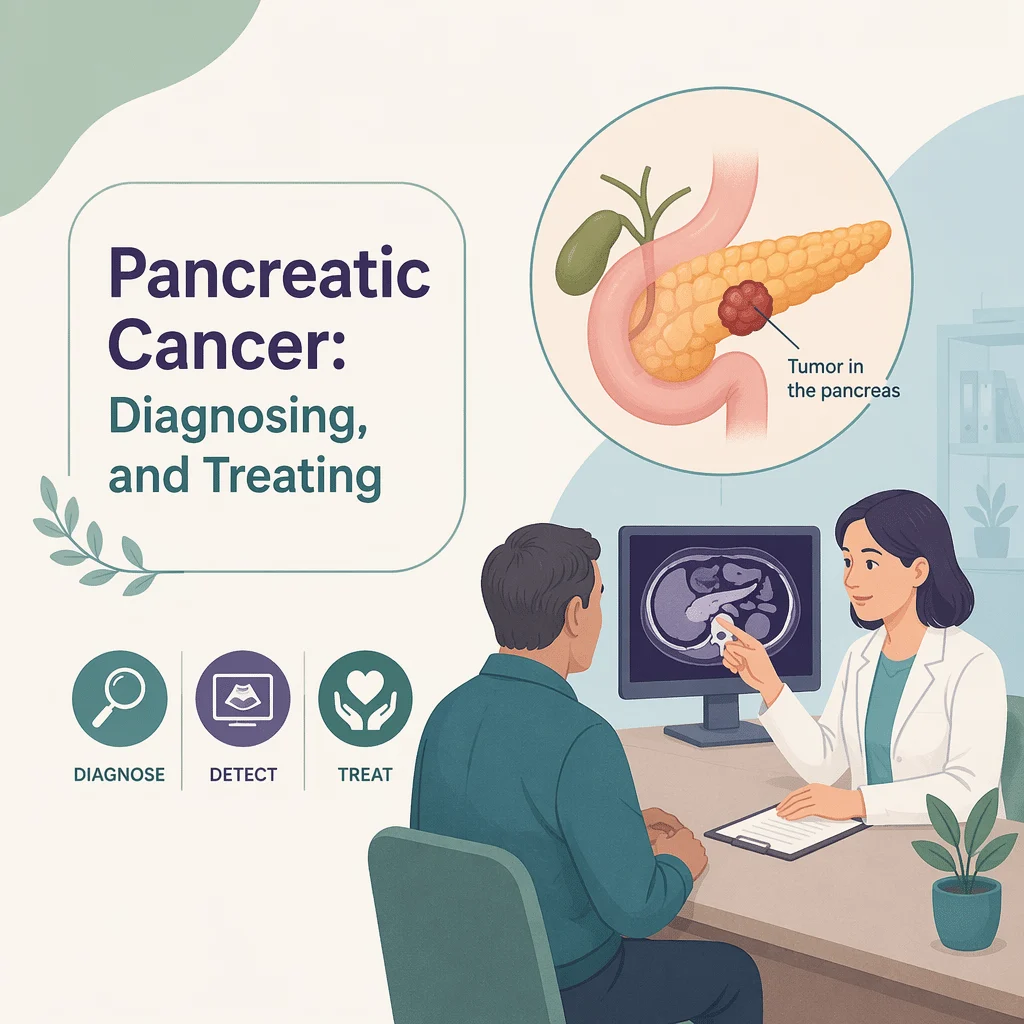
The pancreas is a small, fish-shaped organ tucked behind the stomach. It has two main jobs: it makes digestive juices that help break down food, and it produces hormones such as insulin that control blood sugar. Pancreatic cancer begins when cells in the pancreas grow out of control and form a tumour. Because the pancreas sits deep inside the abdomen, a growing tumour can go unnoticed for a long time before it causes clear symptoms.
Exocrine tumours
According to the American Cancer Society, most pancreatic cancers start in the exocrine cells, the ones that make digestive enzymes. The most common type is called pancreatic ductal adenocarcinoma, which forms in the tubes that carry those enzymes. This is the aggressive form most people mean when they talk about pancreatic cancer.
Neuroendocrine tumours
A smaller share of tumours, known as pancreatic neuroendocrine tumours, grow in the hormone-making cells. These tend to grow more slowly and often carry a better outlook than adenocarcinoma. They can sometimes release extra hormones, which produces symptoms very different from the more common form of the disease.
What causes pancreatic cancer and who is at risk?
In most cases, doctors cannot point to a single cause. Instead, several factors add up over time and raise the odds. Knowing them helps you understand your own situation, but having a risk factor does not mean you will develop the disease, and many people diagnosed have no obvious risk factor at all.
Risk factors you may be able to influence
Smoking is one of the strongest and most preventable risk factors, roughly doubling the risk. Excess body weight, heavy alcohol use over many years, and a diet high in processed and red meat also appear to contribute. Long-standing inflammation is also a recognised risk factor, and repeated attacks can scar the organ and cause chronic pancreatitis. Type 2 diabetes has a two-way link with the disease that we return to below.
Risk factors you cannot change
Age matters, because most cases are diagnosed after 60. A family history of pancreatic cancer, and certain inherited gene changes such as BRCA2, Lynch syndrome, and familial pancreatitis, can raise the risk. People with several affected relatives may qualify for specialist monitoring, so it is worth sharing your family history with your doctor.
Symptoms and warning signs of pancreatic cancer
Early pancreatic cancer rarely announces itself. Symptoms usually appear once a tumour grows large enough to press on nearby structures or block the bile duct. None of the signs below prove cancer on their own, since each has far more common and harmless explanations. What matters is a new, persistent, or unexplained pattern, especially when several signs appear together.
Common symptoms
- Yellowing of the skin and the whites of the eyes, known as jaundice, often with dark urine and pale stools
- Pain in the upper abdomen that may spread to the back
- Unexplained weight loss and a fading appetite
- Greasy, pale, hard-to-flush bowel movements, a sign of poor fat digestion
- New-onset diabetes, or diabetes that suddenly becomes hard to control, in an adult
- Ongoing tiredness, nausea, or itchy skin
When to see a doctor
Use this short checklist as a guide for seeking prompt medical advice. Booking an appointment does not mean something is seriously wrong, but these patterns deserve a professional look:
- Your skin or eyes turn yellow, or your urine becomes dark for no clear reason
- You lose weight without trying, or your appetite drops for more than a couple of weeks
- You develop new upper-abdominal or mid-back pain that will not settle
- You are diagnosed with diabetes as an adult without the usual risk factors, or your blood sugar suddenly becomes hard to manage
- Your stools become persistently greasy, pale, and difficult to flush
How pancreatic cancer is diagnosed
No single test diagnoses pancreatic cancer. Doctors combine a physical examination, imaging, tissue sampling, and blood tests to build a complete picture. The order of tests depends on your symptoms and what an earlier scan or result suggests.
Imaging tests
Imaging is the backbone of diagnosis. A specialised CT scan of the pancreas is often the first detailed look, and MRI or a scan of the bile and pancreatic ducts called MRCP can add information. An endoscopic ultrasound, in which a thin camera is passed into the stomach, gives a close-up view and lets doctors sample tissue at the same time.
Biopsy
A firm diagnosis usually needs a biopsy, in which a small tissue sample is examined under a microscope. This is frequently taken during the endoscopic ultrasound. The biopsy confirms whether cancer is present, identifies the exact type, and guides treatment planning.
Where blood tests fit
Blood tests support the process but do not diagnose pancreatic cancer by themselves. To follow the disease and its response to treatment, doctors often order a CA 19-9 tumour marker test. In some cases they add a second marker called CEA. When jaundice appears, the care team also runs liver function tests to see whether the bile duct is blocked, and may measure the pancreatic enzymes amylase and lipase. Because the pancreas controls blood sugar, doctors also check your blood glucose levels, and a sudden change may prompt a fuller diabetes blood test. The table below shows what each result can hint at, and its limits.
| Blood test | What an abnormal result can suggest | Important limitation |
|---|---|---|
| CA 19-9 | Can rise with pancreatic cancer and is useful for tracking how a known tumour responds to treatment | Often normal in early cancer and raised by harmless conditions, so it cannot confirm a diagnosis |
| Bilirubin and liver enzymes | May climb when a tumour blocks the bile duct, which produces jaundice | Many liver and gallbladder problems raise the same values |
| Blood glucose | New or suddenly unstable diabetes in an adult can occasionally be an early clue | Diabetes is very common and is only rarely linked to cancer |
| Amylase and lipase | Can shift when the pancreas is inflamed or a duct is blocked | Mainly point to pancreatitis rather than cancer |
The key message is simple: an abnormal blood result is a reason to look further, not a diagnosis. Only imaging and a biopsy can confirm pancreatic cancer.
Staging: how far the cancer has spread
Once cancer is confirmed, doctors assign a stage that describes the size of the tumour and how far it has spread. Staging shapes every treatment decision. In practical terms, teams often sort tumours into groups: resectable, meaning surgery can remove it; borderline resectable; locally advanced, where the tumour involves nearby blood vessels; and metastatic, where the cancer has reached distant organs such as the liver. Blood work can support this picture. Advanced disease and poor nutrition may show up as low albumin, which helps the team judge overall condition and readiness for treatment.
Treatment options for pancreatic cancer
Treatment depends on the type of tumour, its stage, and your general health. Care is usually delivered by a team that may include surgeons, medical oncologists, radiation specialists, and dietitians. The plan often combines several approaches.
Surgery
When a tumour can be fully removed, surgery offers the best chance of long-term control. The best-known operation is the Whipple procedure, which removes the head of the pancreas along with parts of the small intestine, bile duct, and sometimes the stomach. It is a major operation best performed at experienced, high-volume centres.
Chemotherapy and radiation
Chemotherapy uses drugs to slow or shrink cancer. It may be given before surgery to make a tumour easier to remove, after surgery to lower the chance of return, or as the main treatment when surgery is not possible. Radiation therapy, which uses targeted energy beams, is sometimes added to control the tumour or ease symptoms.
Targeted therapy and immunotherapy
For a minority of patients whose tumours carry specific gene changes, targeted drugs or immunotherapy may be an option, and tumour gene testing helps identify who might benefit. These approaches are advancing quickly, as the next section explains.
Latest scientific advances in pancreatic cancer
Research is moving faster than the disease’s difficult reputation suggests. Here is what recent studies mean in plain terms, along with what each finding could mean for you. These are research updates, not personal medical advice, and much of this work is still being tested.
Stronger first-line chemotherapy combinations
A large international trial published in 2023 tested a four-drug combination called NALIRIFOX against an older standard for cancer that had already spread, and people on the newer combination lived modestly longer on average. A 2024 analysis that pooled several trials found that NALIRIFOX and the well-established FOLFIRINOX regimen give broadly similar results, each stronger than the older gemcitabine pairing, though they differ in side effects. What this means for you: there is now more than one solid first-line option, and the best choice depends on your fitness and which side effects you can most comfortably manage.
Targeting the KRAS “engine” of the tumour
About nine in ten pancreatic cancers are driven by a change in a gene called KRAS, which acts like a stuck accelerator inside the cell. For decades KRAS was considered impossible to target. A 2024 review in a leading journal described how new drugs have finally begun to block it, and researchers note that most pancreatic tumours carry a version called G12D that newer medicines are designed to hit. Several of these drugs are now in clinical trials, including a large phase 3 study testing a KRAS G12D blocker added to chemotherapy, and an early-stage vaccine that trains the immune system to recognise mutated KRAS. What this means for you: these treatments are still experimental, but if you carry a KRAS change, it is reasonable to ask your oncologist whether a clinical trial is an option.
Blood tests that aim to catch cancer earlier
Because pancreatic cancer is so often found late, scientists are testing blood tests that read tiny fragments of tumour DNA. A 2023 study showed a test reading DNA chemical tags could flag several cancer types, including pancreatic, from a single blood draw. A 2025 study went further and detected tumour DNA in stored blood samples more than three years before people were diagnosed, and another 2025 report described a test tuned to digestive cancers that spotted most pancreatic cases, including early ones. What this means for you: these tools are promising but not yet ready to replace standard care, so no one should rely on them for reassurance today. They do, however, point towards a future where a simple blood draw plays a bigger role.
Where immunotherapy stands
Immunotherapy, which unleashes the immune system against cancer, has transformed several other tumours but has so far helped only a small subset of pancreatic cancer patients. A 2024 review explained that pancreatic tumours build a dense, protective shield that keeps immune cells out, which is why vaccines and combination strategies are being tested to break through it. What this means for you: standard immunotherapy is not yet a routine pancreatic cancer treatment, but it is one of the most active areas of research.
Living with pancreatic cancer
A diagnosis affects daily life well beyond the tumour itself. Because the pancreas helps with digestion, many people benefit from prescription enzyme supplements taken with meals, which help maintain weight and reduce fatty stool. A dietitian can tailor eating plans, and managing blood sugar becomes important when the pancreas is affected. Pain, fatigue, and low mood are common and treatable, so it is worth raising them early. Palliative care, which focuses on comfort and quality of life, can be offered alongside active treatment at any stage, not only at the end. Support from family, patient groups, and your care team makes a real difference.
Glossary
| Term | Definition |
|---|---|
| Adenocarcinoma | The most common type of pancreatic cancer, which starts in the cells that line the ducts carrying digestive juices. |
| Neuroendocrine tumour | A less common pancreatic tumour that grows in hormone-making cells and often grows more slowly. |
| CA 19-9 | A protein measured in blood that doctors use mainly to track a known pancreatic tumour over time. |
| Jaundice | Yellowing of the skin and eyes caused by a build-up of bilirubin, often when the bile duct is blocked. |
| Whipple procedure | A major operation that removes the head of the pancreas and nearby structures to take out a tumour. |
| Endoscopic ultrasound | A test using a camera passed into the stomach to view the pancreas closely and sample tissue. |
| Biopsy | Removing a small sample of tissue to examine under a microscope and confirm whether cancer is present. |
| Neoadjuvant therapy | Treatment such as chemotherapy given before surgery to shrink a tumour and improve the chance of removal. |
| KRAS | A gene that is altered in most pancreatic cancers and acts like a stuck accelerator driving tumour growth. |
| Steatorrhoea | Greasy, pale, hard-to-flush stools that signal the body is not digesting fat properly. |
Frequently asked questions
What are the early signs of pancreatic cancer?
Early pancreatic cancer usually causes no symptoms, which is part of what makes it hard to catch. When signs do appear, they often include unexplained weight loss, upper-abdominal or back pain, jaundice, greasy stools, or new-onset diabetes in an adult. Each of these has common, harmless causes, so they are not proof of cancer. The point to remember is that a new pattern that persists for more than a couple of weeks is worth discussing with a doctor rather than waiting.
What causes pancreatic cancer?
In most people there is no single cause. Risk builds from a mix of factors, including smoking, older age, excess weight, long-term heavy alcohol use, chronic inflammation of the pancreas, and certain inherited gene changes. Type 2 diabetes is also linked. Having one or more of these does not mean you will develop the disease, and many people diagnosed have no clear risk factor at all. Avoiding tobacco and keeping a healthy weight are the most useful steps within your control.
Is pancreatic cancer hereditary?
Most cases are not inherited, but roughly one in ten is linked to genes passed down in families. Inherited conditions such as BRCA2 mutations, Lynch syndrome, and familial pancreatitis can raise the risk, especially when several close relatives have been affected. If pancreatic cancer runs in your family, tell your doctor. You may be offered genetic counselling and, in higher-risk situations, a monitoring programme that watches the pancreas more closely over time.
What is the survival rate for pancreatic cancer?
Survival has historically been lower than for many cancers, largely because the disease is often found after it has spread. Outcomes vary widely, though, and depend heavily on whether the tumour can be removed with surgery and how it responds to treatment. People diagnosed at an earlier, operable stage do considerably better than average. Statistics describe groups, not individuals, so your own outlook is best discussed with the specialist who knows your full situation.
Can pancreatic cancer be cured?
When a tumour is found early and can be completely removed with surgery, often followed by chemotherapy, long-term remission is possible. Unfortunately, many cancers are found too late for surgery, and in those cases treatment focuses on controlling the disease, extending life, and maintaining quality of life rather than curing it. Research into earlier detection and new drugs is steadily improving what is achievable, but no treatment can guarantee a cure.
Can a blood test detect pancreatic cancer?
No routine blood test can currently detect or rule out pancreatic cancer on its own. Markers such as CA 19-9 are mainly used to monitor a tumour that has already been diagnosed, and they can be normal in early disease. Promising experimental blood tests that read tumour DNA are being studied, but they are not yet part of standard screening. For now, diagnosis still relies on imaging and a biopsy, with blood tests playing a supporting role.
Sources
- National Cancer Institute — Pancreatic Cancer, Patient Version — cancer.gov
- American Cancer Society — Pancreatic Cancer — cancer.org
- Mayo Clinic — Pancreatic cancer, symptoms and causes — mayoclinic.org
- Wainberg ZA, et al. — NALIRIFOX versus nab-paclitaxel and gemcitabine in metastatic pancreatic cancer (NAPOLI 3) — The Lancet, 2023 — doi.org/10.1016/S0140-6736(23)01366-1
- NALIRIFOX, FOLFIRINOX, and gemcitabine with nab-paclitaxel as first-line chemotherapy for metastatic pancreatic cancer — JAMA Network Open, 2024 — doi.org/10.1001/jamanetworkopen.2023.50756
- Targeting KRAS in cancer — Nature Medicine, 2024 — doi.org/10.1038/s41591-024-02903-0
- Targeting KRAS in pancreatic cancer — Oncology Research, 2024 — doi.org/10.32604/or.2024.045356
- Multi-cancer early detection by circulating cell-free DNA methylation (THUNDER) — Annals of Oncology, 2023 — doi.org/10.1016/j.annonc.2023.02.010
- Detection of cancers three years prior to diagnosis using plasma cell-free DNA — Cancer Discovery, 2025 — doi.org/10.1158/2159-8290.CD-25-0375
- Blood-based early detection of gastrointestinal cancers (GutSeer) — Molecular Cancer, 2025 — doi.org/10.1186/s12943-025-02367-x
- Current and future immunotherapeutic approaches in pancreatic cancer — Journal of Hematology & Oncology, 2024 — doi.org/10.1186/s13045-024-01561-6
- DAWN-303: chemotherapy with or without a KRAS G12D inhibitor in metastatic pancreatic cancer (Phase 3) — ClinicalTrials.gov — NCT07522073
- Mutant KRAS-targeted peptide vaccine with immunotherapy for pancreatic and colorectal cancer (Phase 1) — ClinicalTrials.gov — NCT06411691
Further reading
- Bladder cancer symptoms and warning signs
- Ovarian cancer symptoms and testing
- Leukaemia blood test and diagnosis
- Multiple myeloma causes and diagnosis
- Brain tumour symptoms and red flags
Understand your lab results with AI DiagMe
Blood tests do not diagnose pancreatic cancer, but markers like CA 19-9, liver function tests, and blood glucose play a real role in supporting diagnosis and monitoring treatment. Making sense of these numbers on your own can be confusing and stressful. AI DiagMe helps you understand what your results mean in plain language, with interpretation validated by a committee of doctors. It is designed to help you understand your results and prepare better questions, not to diagnose you or replace your doctor.
Get your results interpreted in minutes