







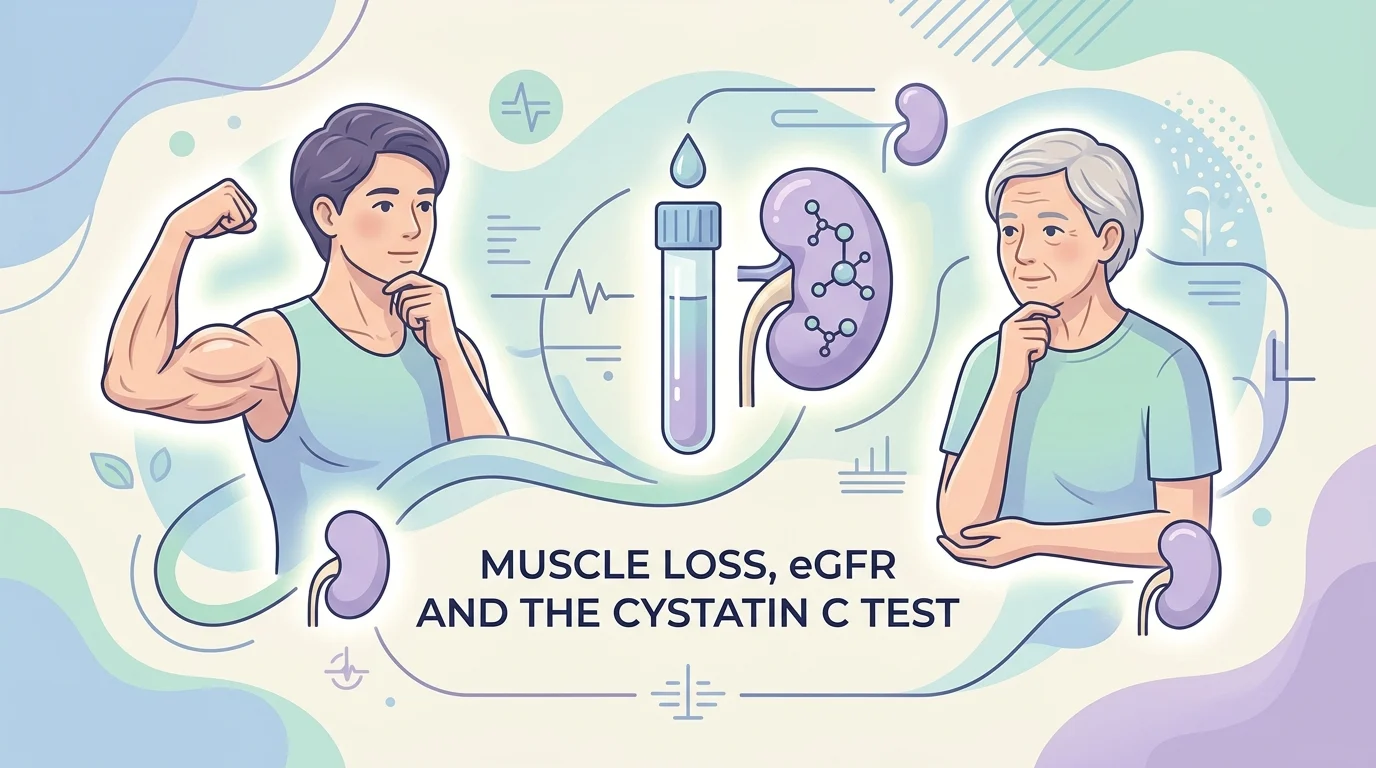
A wave of weight-loss news in July 2026 has quietly put an unexpected question back on the table: can losing muscle change what your kidney blood test says? On July 23, 2026, researchers reported that people whose weight keeps going up and down lose far more thigh muscle than those who stay stable, a finding that matters as millions start and stop GLP-1 weight-loss drugs. Muscle happens to be exactly what feeds the most common kidney marker, creatinine. This article explains what a kidney blood test really measures, why muscle loss can make an eGFR look better than it is, and where a second marker called cystatin C fits in.
What a kidney blood test actually measures
Most kidney checks start with creatinine, a waste product your muscles release into the blood at a fairly steady rate. Labs feed that number, along with your age and sex, into a formula that estimates how well your kidneys filter: the estimated glomerular filtration rate, or eGFR. A higher eGFR suggests better filtering. Creatinine and eGFR usually appear together on a kidney function panel, often beside urea and electrolytes as part of a comprehensive metabolic panel, so many people first meet these numbers on a routine blood draw.
The key word is estimated. eGFR is a calculation, not a direct measurement, and it leans on one assumption: that your muscle mass is about average for your age and sex. When that holds, creatinine tracks kidney function well. When it does not, the estimate can drift, which is why it helps to know how to read your blood test results as a pattern rather than a single line.
Why muscle loss can make eGFR look better than it is
Here is the part that surprises people. Because creatinine comes from muscle, having less muscle means less creatinine in the blood, even when your kidneys are doing exactly the same work. A lower creatinine feeds the formula and pushes the eGFR up, so the test can look reassuring while true filtration has not changed at all. In plain terms, muscle loss can flatter your kidney number.
That is why the July 2026 weight-cycling study reaches beyond muscles and joints. Rapid or repeated weight loss, including the muscle loss that can accompany GLP-1 medicines when protein and strength training are neglected, lowers creatinine for reasons that have nothing to do with the kidney. The same trap appears in older adults, in people with serious illness, and in anyone with naturally low muscle mass. A single mildly off value rarely tells the whole story, so a result that lands outside the reference range is best read in context.
Where cystatin C comes in
Cystatin C is a second way to estimate kidney function. It is a small protein made by nearly all cells and cleared by the kidneys, and crucially it is barely affected by muscle mass. That makes it a valuable cross-check when creatinine might mislead. When clinicians combine creatinine and cystatin C in a single equation, the estimate is more accurate than either marker alone, because each one’s blind spots partly cancel out. International kidney guidance (KDIGO) now suggests adding cystatin C when a creatinine-only eGFR is guiding an important decision, or when body build, muscle mass, or rapid weight change make creatinine unreliable. It is a simple add-on blood test, not a new procedure.
What the newest science shows
Cystatin C was long treated as a niche test. That is changing fast. A very large international analysis published in late 2025 pooled data from more than eight hundred thousand adults and asked a simple question: what happens when your two kidney estimates disagree? When cystatin C pointed to worse kidney function than creatinine did, those people went on to face higher risks of heart disease, kidney failure, and early death, a warning that a comfortable creatinine number can hide. A separate study in a very large United Kingdom population reached the same conclusion. What this changes for you is practical: a normal creatinine-based eGFR is not always the clean bill of health it looks like, especially if you have lost muscle. Measuring cystatin C can reveal the fuller picture and, when the two markers disagree, flag the people who deserve a closer look.
Reading a kidney result without panic
A kidney number is a prompt to look closer, not a verdict. The table below offers a calm way to think it through.
| What you see | What it can mean | A reasonable step |
|---|---|---|
| A normal eGFR after major weight loss | Creatinine may be low from lost muscle, so filtering could be worse than it looks | Ask whether a cystatin C check is worthwhile |
| An eGFR that keeps rising as you lose weight | May reflect shrinking muscle rather than improving kidneys | Track the trend and mention the weight change |
| Creatinine and cystatin C that disagree | A signal worth understanding, not ignoring | Bring both results to a clinician |
| A single mildly low eGFR | Common and often harmless on its own | Repeat with context before worrying |
When cystatin C is worth asking about
Cystatin C is most useful when creatinine is likely to mislead. That includes people losing weight quickly on GLP-1 medicines, anyone with much more or much less muscle than average (from strength athletes to frail older adults), people with serious illness or a very high body mass index, and anyone whose kidney result will guide an important choice such as drug dosing. If your eGFR sits near a threshold that would change your care, or your weight has shifted a lot, it is reasonable to ask your doctor whether adding cystatin C would sharpen the picture, alongside a look at urea and creatinine together and any urine creatinine and albumin testing. Because weight and metabolism travel together, kidney checks often sit beside HbA1c and other diabetes blood tests.
Glossary
- Creatinine: a muscle waste product cleared by the kidneys and used to estimate filtration; it depends partly on muscle mass.
- eGFR: estimated glomerular filtration rate, a calculated score of how well the kidneys filter, based on a blood marker plus age and sex.
- Cystatin C: a blood marker of kidney function that is largely independent of muscle mass, used to cross-check creatinine.
- eGFR discordance: a meaningful gap between the creatinine-based and cystatin C-based estimates in the same person.
- Non-GFR determinants: things other than kidney filtering, such as muscle mass, that move a marker up or down.
- KDIGO: the international body that publishes kidney disease guidelines.
Frequently asked questions
Can losing muscle really change my kidney test?
Yes. Creatinine comes from muscle, so less muscle usually means less creatinine, which pushes the estimated eGFR upward even when filtering is unchanged. After large or repeated weight loss, a reassuring creatinine-based eGFR can overstate how well the kidneys are working, which is why context matters.
What is cystatin C and how is it measured?
Cystatin C is a small protein cleared by the kidneys and made by most cells, so it barely depends on muscle. It is measured from the same kind of blood sample as creatinine, needs no special preparation, and is often reported with its own eGFR or combined with creatinine for a more accurate estimate.
Should I ask for cystatin C if I take a GLP-1 weight-loss drug?
It can be reasonable, especially if you have lost a lot of weight or muscle, or if a kidney number will guide dosing or a treatment choice. Cystatin C is less affected by muscle change, so it can confirm or correct a creatinine-based result. Your doctor can decide whether it adds value in your case.
Is a normal eGFR always reassuring?
Not always. A creatinine-based eGFR assumes average muscle mass, so it can look normal in someone who has lost muscle even if filtering has declined. When results will guide important decisions, a cystatin C cross-check gives a fuller picture than creatinine alone.
Do I need to fast for a kidney blood test?
Creatinine and cystatin C do not usually require fasting, though they are often taken alongside glucose or cholesterol tests, which may. A very high-protein meal or intense exercise just before the test can nudge creatinine, so follow the instructions on your request form and ask the lab if unsure.
Sources
- Marth AA, et al. Association of Weight Cycling with MRI-based Thigh Muscle Quality and Knee-adjacent Obesity: Osteoarthritis Initiative Data. Radiology, 2026. doi.org/10.1148/radiol.253988
- Estrella MM, Shlipak MG, et al. Discordance in Creatinine- and Cystatin C-Based eGFR and Clinical Outcomes: A Meta-Analysis. JAMA, 2025. doi.org/10.1001/jama.2025.17578
- Liu Q, Mark PB, Welsh P, et al. Discordance between Cystatin C-Based and Creatinine-Based eGFR and Mortality in the General Population. Clinical Chemistry, 2025. doi.org/10.1093/clinchem/hvaf063
- Stehlé T, Delanaye P. Which is the best glomerular filtration marker: creatinine, cystatin C or both? European Journal of Clinical Investigation, 2024. doi.org/10.1111/eci.14278
- Kidney Disease: Improving Global Outcomes (KDIGO). 2024 Clinical Practice Guideline for the Evaluation and Management of CKD. kdigo.org
- National Kidney Foundation. Cystatin C. kidney.org
Further reading
- Kidney function panel: what it checks
- High BUN and creatinine levels explained
- Read blood test results: a simple guide
- What abnormal blood test results mean
- Comprehensive blood panels: more numbers, more clarity?
Understand your lab results with AI DiagMe
A kidney result is easier to face when each value is explained in plain language. AI DiagMe helps you see what markers such as creatinine, eGFR and cystatin C mean together, so you read your results as a coherent picture rather than a single highlighted line, and know which questions to raise. It helps you understand your results and prepare for your appointment; it does not diagnose and does not replace your doctor. Get a clear interpretation in minutes.